
Edward T. Hall (1914–2009)
Author of The Hidden Dimension
About the Author
Image credit: Photo courtesy of Kathryn Sorrells
Works by Edward T. Hall
Handbook for proxemic research 3 copies
LA DIMENSIÓN OCULTA 1 copy
The Spanish Main 1 copy
Associated Works
Tagged
Common Knowledge
- Canonical name
- Hall, Edward T.
- Legal name
- Hall, Edward Twitchell, Jr.
- Birthdate
- 1914-05-06
- Date of death
- 2009-07-20
- Gender
- male
- Education
- Columbia University (PhD|1942)
University of Arizona (MA|1938)
University of Denver (BA|1936) - Occupations
- anthropologist
professor - Organizations
- University of Denver
Bennington College
Foreign Service Institute
Washington School of Psychiatry
Northwestern University
Army Corps of Engineers (WWII) - Nationality
- USA
- Birthplace
- Webster Groves, Missouri, USA
- Places of residence
- Sante Fe, New Mexico, USA
- Place of death
- Santa Fe, New Mexico, USA
- Associated Place (for map)
- New Mexico, USA
Members
Reviews

The Hidden Dimension is, among other things, cutting-edge theory of multiculturalism ... for 1969. Author Edward T. Hall was, as well as an anthropologist with an expressed interest in city planning, also an adroit neologist. His coinages in this volume include: proxemics for the study of interpersonal distances and personal space, infraculture for the unconscious perceptual conventions on which culture is erected, and the self-explanatory term pair sociopetal / sociofugal to characterize show more the dynamics of spatial factors and arrangements.
I was interested in this preliminary overview of nascent proxemic science for my own purposes as a performing liturgist (i.e. designer and executor of ceremonial ritual). The core chapters of the book (IV-X out of XIV total) do in fact have useful information and ideas toward that end: in particular, the correlation of different sensory qualities and capacities with different distances. Chapters XI and XII provide cross-cultural comparisons and contrasts that substantiate the idea of benchmarking ceremonies to national standards--even in an international organization dedicated to the principle of universal brotherhood.
The concerns of the author, however, revolve around quotidian life and labor. While some of his remarks about "the American Negro" and the "Spanish American" populations are painfully dated with respect to their language and assumptions, this book participated in the process that led to new perspectives on cultural minorities in American life. Hall is especially concerned with the condition of cities: perceiving the hazards of both decline in which capital flees the central urban areas, and also of "urban renewal" with its gentrification and new housing designed for appearance and profitability rather than livability--when the latter depends on infracultural variables that have never been consciously assessed.
He also offers indictments of the whole of American mass culture. Even though he avoids value-judgments when comparing cultures, he does repeatedly emphasize how American culture facilitates a sensorily-poor environment. He has some sage warnings (still unheeded half-a-century later, alas!) about the impacts of the automobile and the telephone on socio-spatial perception. Hall cautions his readers that the hyper-urbanization transpiring worldwide is creating dynamics "more lethal than the hydrogen bomb" (165) -- a warning which is tempting to dismiss as hyperbole. And yet the combined evidence of both history and ethology is on his side in making this claim.
Considering how outmoded some of the presentation in this book is, I was surprised to see that it had been reprinted in the 1990s. It would be a shame if no one has followed up in this topic so as to obsolete this ground-breaking text. If such further work has been done, I would be very interested to read it. show less
I was interested in this preliminary overview of nascent proxemic science for my own purposes as a performing liturgist (i.e. designer and executor of ceremonial ritual). The core chapters of the book (IV-X out of XIV total) do in fact have useful information and ideas toward that end: in particular, the correlation of different sensory qualities and capacities with different distances. Chapters XI and XII provide cross-cultural comparisons and contrasts that substantiate the idea of benchmarking ceremonies to national standards--even in an international organization dedicated to the principle of universal brotherhood.
The concerns of the author, however, revolve around quotidian life and labor. While some of his remarks about "the American Negro" and the "Spanish American" populations are painfully dated with respect to their language and assumptions, this book participated in the process that led to new perspectives on cultural minorities in American life. Hall is especially concerned with the condition of cities: perceiving the hazards of both decline in which capital flees the central urban areas, and also of "urban renewal" with its gentrification and new housing designed for appearance and profitability rather than livability--when the latter depends on infracultural variables that have never been consciously assessed.
He also offers indictments of the whole of American mass culture. Even though he avoids value-judgments when comparing cultures, he does repeatedly emphasize how American culture facilitates a sensorily-poor environment. He has some sage warnings (still unheeded half-a-century later, alas!) about the impacts of the automobile and the telephone on socio-spatial perception. Hall cautions his readers that the hyper-urbanization transpiring worldwide is creating dynamics "more lethal than the hydrogen bomb" (165) -- a warning which is tempting to dismiss as hyperbole. And yet the combined evidence of both history and ethology is on his side in making this claim.
Considering how outmoded some of the presentation in this book is, I was surprised to see that it had been reprinted in the 1990s. It would be a shame if no one has followed up in this topic so as to obsolete this ground-breaking text. If such further work has been done, I would be very interested to read it. show less
Notes
"Brilliant book. Thoroughly enjoyed it and want more. This is the one who created the theory of 'high context' vx 'low context' cultures.
Hall was one of the sources my Cross-Cultural Communications professor at AGSIM drew on, and I've always wanted to read him. In this book, Hall discusses the concept of context as an human behavioral influence. A high-context situation is one in which much of the communication is non-verbal or understood because of the shared context. He characterizes show more societies as being typically low-context, which are typical of northern Europe, and high-context, most dramatically represented by Japan. Context even affects language, and human speech patterns will change, depending upon who they are speaking to and the context of the communication. I liked the idea of ‘action chains,’ which is a sequence of events in which two or more individuals participate. Shaking hands is a simple chain, becoming engaged is a more complex one. Again, different cultures vary in their emphasis on completing action chains. An American may be very casual about dropping an ongoing chain, which may be very negatively received in other cultures.
His chapter “Culture as an Irrational Force” is full of good common-sense advice on getting along with other people. Hall has provided advice to diplomats and corporate executives, and his book is very practical. While it delves into theory, it always has a concrete application.
He has some very strong political opinions on human institutions and the state of academia. “Bureaucracies have no soul, no memory, and no conscience.”" show less
"Brilliant book. Thoroughly enjoyed it and want more. This is the one who created the theory of 'high context' vx 'low context' cultures.
Hall was one of the sources my Cross-Cultural Communications professor at AGSIM drew on, and I've always wanted to read him. In this book, Hall discusses the concept of context as an human behavioral influence. A high-context situation is one in which much of the communication is non-verbal or understood because of the shared context. He characterizes show more societies as being typically low-context, which are typical of northern Europe, and high-context, most dramatically represented by Japan. Context even affects language, and human speech patterns will change, depending upon who they are speaking to and the context of the communication. I liked the idea of ‘action chains,’ which is a sequence of events in which two or more individuals participate. Shaking hands is a simple chain, becoming engaged is a more complex one. Again, different cultures vary in their emphasis on completing action chains. An American may be very casual about dropping an ongoing chain, which may be very negatively received in other cultures.
His chapter “Culture as an Irrational Force” is full of good common-sense advice on getting along with other people. Hall has provided advice to diplomats and corporate executives, and his book is very practical. While it delves into theory, it always has a concrete application.
He has some very strong political opinions on human institutions and the state of academia. “Bureaucracies have no soul, no memory, and no conscience.”" show less

A very dry read with a strong message. A message I wish I had learned back in high school.
Recently I found a quote that emphasizes a part of The Silent Language message.
"We don't see things as they are. We see things as we are"
This book explains why languages can never be 100% translated. One has to grow up in the culture to understand the nuances of words and body language.
Recently I found a quote that emphasizes a part of The Silent Language message.
"We don't see things as they are. We see things as we are"
This book explains why languages can never be 100% translated. One has to grow up in the culture to understand the nuances of words and body language.
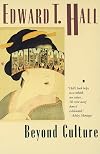
"A fascinating book that no one should do 'himself' the disservice of failing to read. Beyond Culture not only will increase the reader's knowledge, but also will enlarge 'his' mind. Opening up new dimensions of understanding and equipping the reader with new capacities for perception, the book is an eye-opening experience that will reward the reader with high dividends...Hall's book helps us to rethink our values in these and so many other matters constructively. We come away from it show more exhilirated."
-Ashley Montagu
Chicago Daily News show less
-Ashley Montagu
Chicago Daily News show less
Lists
Awards


You May Also Like


Associated Authors
Statistics
- Works
- 19
- Also by
- 2
- Members
- 2,892
- Popularity
- #8,861
- Rating
- 3.9
- Reviews
- 23
- ISBNs
- 59
- Languages
- 8
- Favorited
- 9