
Deborah Tannen
Author of You Just Don't Understand: Women and Men in Conversation
About the Author
Deborah Tannen is the bestselling author of "The Argument Culture", "Talking from 9 to 5", "That's Not What I Meant", & "You Just Don't Understand", which was on "The New York Times" bestseller list for nearly four years, including eight months as number one. She is a professor at Georgetown show more University, in Washington D.C. "I Only Say This Because I Love You" is her seventeenth book. Her latest book is entitled, "You Were Always Mom's Favorite: Sisters in Conversation Throughout Their Lives." (Publisher Provided) show less
Image credit: Susanne van der Kleij
Works by Deborah Tannen
You're Wearing That?: Understanding Mothers and Daughters in Conversation (2006) 532 copies, 10 reviews
I Only Say This Because I Love You: How the Way We Talk Can Make or Break Family Relationships Throughout Our Lives (2001) 283 copies, 3 reviews
You Were Always Mom's Favorite!: Sisters in Conversation Throughout Their Lives (2009) 128 copies, 6 reviews
You're the Only One I Can Tell: Inside the Language of Women's Friendships (2006) 70 copies, 1 review
Talking Voices: Repetition, Dialogue, and Imagery in Conversational Discourse (Studies in Interactional Sociolinguistics) (1989) 50 copies
"Communication Matters - He Said/She Said: Women, Men and Language" (The Modern Scholar, Course One) (2003) 21 copies, 1 review
Finding My Father: His Century-Long Journey from World War I Warsaw and My Quest to Follow (2020) 16 copies, 1 review
Spoken and Written Language: Exploring Orality and Literacy (Advances in Discourse Processes) (1982) 12 copies
Coherence in Spoken and Written Discourse (Advances in Discourse Processes, Vol. 12) (1984) 11 copies, 1 review
Linguistics in context : connecting observation and understanding : lectures from the 1985 LSA/TESOL and NEH institutes (1988) 2 copies
Deborah Tannen Boxed Set: Give The Gift Of Understanding / You Just Don't Understand / That's Not What I Meant! (1994) 2 copies
Warum sagen Sie nicht, was Sie meinen?: Jobtalk - wie Sie lernen, am Arbeitsplatz miteinander zu reden (2002) 2 copies
Ma guarda come ti vesti! 1 copy
What!? 1 copy
Ordinary thunderstorms 1 copy
You Just Don't Understand 1 copy
Associated Works
Me, My Hair, and I: Twenty-seven Women Untangle an Obsession (2015) — Contributor — 151 copies, 35 reviews
Tagged
Common Knowledge
- Canonical name
- Tannen, Deborah
- Legal name
- Tannen, Deborah Frances
- Birthdate
- 1945-06-07
- Gender
- female
- Education
- Harpur College (BA | 1966)
Wayne State University (MA | 1970)
University of California, Berkeley (MA | 1976 | PhD | 1979 | Linguistics) - Occupations
- professor of linguistics
linguist
behavioral scientist
author
editor - Organizations
- Georgetown University
PEN/Faulkner Foundation (Board of Directors) - Awards and honors
- Fellow, Linguistics Society of America (2013)
- Relationships
- Macovski, Michael (husband)
- Short biography
- Deborah Tannen is one of a small number in Georgetown University's College of Arts and Sciences who hold the distinguished rank of University Professor; she is also Professor of Linguistics. The author of many books and articles about how the language of everyday conversation affects relationships, Prof. Tannen is best known for "You Just Don't Understand: Women and Men in Conversation," which was on the New York Times best seller list for nearly four years, including eight months as No. 1, and has been translated into 31 languages. She has been McGraw Distinguished Lecturer at Princeton University and was a fellow at the Center for Advanced Study in the Behavioral Sciences in Stanford, California, following a term in residence at the Institute for Advanced Study in Princeton, NJ. In addition to her writing for general audiences, Prof. Tannen is author or editor of many books and over 100 hundred articles for scholarly audiences. She has also published poems, short stories, personal essays, and plays.
- Nationality
- USA
- Birthplace
- Brooklyn, New York, USA
- Places of residence
- Washington, D.C., USA
- Associated Place (for map)
- USA
Members
Reviews
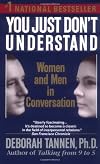
Have you ever had a conversation with someone of the opposite sex that seemed like you were operating on different wavelengths, or that the conversation you thought you were having was interpreted completely differently by the other party? Dr. Tannen argues that it's not in your head: women and men in conversation is much closer to cross-cultural communication than we might imagine. She then goes on to enumerate the many ways that miscommunication arises based on the different ways we tend show more to speak and interpret conversations: through the lens of status (men) or connection (women).
Dr. Tannen's research, including transcripts of conversations from studies of boys, girls, men, and women of various ages and anecdotal evidence from real conversations persuasively makes the case for the status and connection at work in every conversation. I appreciated that the author never makes a moral judgment about the way one or the other interprets the conversation. She merely explains what's going on from each point of view, giving each party the language to express what they're trying to do or say. I recognized many conversations as ones I have had with my brother, my father, and male friends. Some of the topics she touches on, such as high-involvement/high-considerate and direct/indirect ways of speaking are beneficial even in conversations with people of the same sex (for example, as a "high-involvement speaker" I can now explain to my family that I really do end a sentence with "and" waiting for someone to overlap my speech). Because she ties everything back to the original ideas of status and connection, her comments on conversations do become a bit repetitive after awhile. But her conversational style and clear presentation of a persuasive argument make this book worth reading. show less
Dr. Tannen's research, including transcripts of conversations from studies of boys, girls, men, and women of various ages and anecdotal evidence from real conversations persuasively makes the case for the status and connection at work in every conversation. I appreciated that the author never makes a moral judgment about the way one or the other interprets the conversation. She merely explains what's going on from each point of view, giving each party the language to express what they're trying to do or say. I recognized many conversations as ones I have had with my brother, my father, and male friends. Some of the topics she touches on, such as high-involvement/high-considerate and direct/indirect ways of speaking are beneficial even in conversations with people of the same sex (for example, as a "high-involvement speaker" I can now explain to my family that I really do end a sentence with "and" waiting for someone to overlap my speech). Because she ties everything back to the original ideas of status and connection, her comments on conversations do become a bit repetitive after awhile. But her conversational style and clear presentation of a persuasive argument make this book worth reading. show less
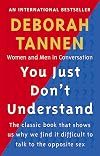
Here we are again, another book on the different ways of communicating between men and women! Here we are again, another book milking the juicy debates Martians vs Venusians! Here we are again, but...
We are dealing here with proper sociolinguistics, a perfectly respectable field in which Deborah Tannen is not only an eminent researcher, but, also, was Robin Lakoff's student, the author of the 'Language and women's place'' the book that started it all when it comes to studying the connection show more (if any) between gender and language. You could be excused, then, to expect a rigorous essay, academic, on such a fascinating topic despite its dubious use by some other shabby authors... Well…
It's not her points that bother me, but how she puts them forwards.
The idea that men and women are being socialised differently (she deals with children quite extensively...) thus affecting our way of perceiving social relationships and, so, to communicate, this itself leading not only to misunderstandings and prejudices towards the opposite sex, but, also, isn't without consequence when it comes to the position of women in society, is interesting. If anything, it gives her the opportunity to delve into two approaches regarding speech: talk to establish connections, and talk to transmit informations ('rapport talk' vs 'report talk'). But, the thing is, the way the topic is dealt with is frankly quite embarrassing. To multiply examples is great; but to mainly use anecdotical evidence, most coming either from we-don't-know-where or literature (fiction to illustrate facts?! Come on!) doesn't seem serious at all. Was that in order to be accessible? She can rely on serious academic works and researches, but otherwise there's a sure lack of credibility in many passages! She should have focused on the science only. As it is, here's more Dr Phil than, well, Robin Lakoff!
Her points are interesting, but are they serious or just pop doolali? I still can't tell! show less
We are dealing here with proper sociolinguistics, a perfectly respectable field in which Deborah Tannen is not only an eminent researcher, but, also, was Robin Lakoff's student, the author of the 'Language and women's place'' the book that started it all when it comes to studying the connection show more (if any) between gender and language. You could be excused, then, to expect a rigorous essay, academic, on such a fascinating topic despite its dubious use by some other shabby authors... Well…
It's not her points that bother me, but how she puts them forwards.
The idea that men and women are being socialised differently (she deals with children quite extensively...) thus affecting our way of perceiving social relationships and, so, to communicate, this itself leading not only to misunderstandings and prejudices towards the opposite sex, but, also, isn't without consequence when it comes to the position of women in society, is interesting. If anything, it gives her the opportunity to delve into two approaches regarding speech: talk to establish connections, and talk to transmit informations ('rapport talk' vs 'report talk'). But, the thing is, the way the topic is dealt with is frankly quite embarrassing. To multiply examples is great; but to mainly use anecdotical evidence, most coming either from we-don't-know-where or literature (fiction to illustrate facts?! Come on!) doesn't seem serious at all. Was that in order to be accessible? She can rely on serious academic works and researches, but otherwise there's a sure lack of credibility in many passages! She should have focused on the science only. As it is, here's more Dr Phil than, well, Robin Lakoff!
Her points are interesting, but are they serious or just pop doolali? I still can't tell! show less
Finding My Father: His Century-Long Journey from World War I Warsaw and My Quest to Follow by Deborah Tannen

This is quite a story, but the title really doesn't do it justice. The story about her father is also the story about her father's family and how it was intertwined with the events of the 20th Century - WW I, WW II, European history, Jewish history, immigrant history, Albert Einstein, the Communist government in Poland (the FBI makes a cameo appearance) and so much more. Really fascinating in its depiction of those lives and intersections. and all that happened in Europe and the US in that show more time. I dropped a star because (in my opinion) she does spend a bit too much time (okay, only a chapter) on analyzing her father's motivations for marrying her mother, reading from his journals and personal letters (which he gave her to read with full permission) but I think she tries too hard to understand what amounts to the fluid train of thought that he engages in. Important for her, understandably, but not for the rest of us. I really think this is unknowable to anyone other than her father, despite his detailed written brooding on the subject. Nonetheless, it is well written and engaging, and recommended, and I would definitely read it again. show less
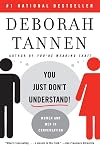
Tannen's work is often cited as foundational to notions of gender and language, but it's hard to see that 27 years after its publication. This book subtly uses language that favors or excuses male behavior and calls on women to be more assertive, even while admitting that women who do are less likely to be respected by men.
Another thing that bothered me was the way Tannen conflated gender with personality. Some people are more taciturn than others, but gender is not the indicator, per se.
Another thing that bothered me was the way Tannen conflated gender with personality. Some people are more taciturn than others, but gender is not the indicator, per se.
Lists
Awards


You May Also Like


Associated Authors
Statistics
- Works
- 36
- Also by
- 6
- Members
- 6,200
- Popularity
- #3,960
- Rating
- 3.7
- Reviews
- 78
- ISBNs
- 246
- Languages
- 13
- Favorited
- 7
