
Peter L. Berger (1929–2017)
Author of The Social Construction of Reality: A Treatise in the Sociology of Knowledge
About the Author
Peter Ludwig Berger was born in Vienna, Austria on March 17, 1929. He immigrated to the United States when he was 17 years old. He received a bachelor's degree from Wagner College in 1949 and did his doctoral work at the New School in Manhattan. He was a theologian who was known for his work in the show more sociology of knowledge, understanding how humans experience everyday reality. He taught at several universities including Boston University, the New School for Social Research, Brooklyn College, Rutgers University, and Boston College. He wrote many books during his lifetime including The Social Construction of Reality: A Treatise in the Sociology of Knowledge, A Rumor of Angels: Modern Society and the Rediscovery of the Supernatural, The Noise of Solemn Assemblies: Christian Commitment, The Religious Establishment in America, The Heretical Imperative: Contemporary Possibilities of Religious Affirmation, and A Far Glory: The Quest for Faith in an Age of Credulity. He died from heart failure on June 27, 2017 at the age of 88. (Bowker Author Biography) show less
Series
Works by Peter L. Berger
The Social Construction of Reality: A Treatise in the Sociology of Knowledge (1966) 1,907 copies, 13 reviews
A Rumor of Angels: Modern Society and the Rediscovery of the Supernatural (1970) 466 copies, 4 reviews
Heretical Imperative: Contemporary Possibilities of Religious Affirmation (1979) 172 copies, 1 review
The Desecularization of the World: Resurgent Religion and World Politics (1999) — Editor — 162 copies
The noise of solemn assemblies; Christian commitment and the religious establishment in America (1961) 111 copies
The Capitalist Revolution: Fifty Propositions About Prosperity, Equality, and Liberty (1970) 87 copies, 2 reviews
The Many Altars of Modernity: Toward a Paradigm for Religion in a Pluralist Age (2014) 42 copies, 1 review
Adventures of an Accidental Sociologist: How to Explain the World Without Becoming a Bore (2011) 34 copies, 1 review
Between Relativism and Fundamentalism: Religious Resources for a Middle Position (2009) — Editor — 33 copies
The precarious vision; a sociologist looks at social fictions and Christian faith (1976) 28 copies, 1 review
Against the World for the World: The Hartford Appeal and the Future of American Religion (1976) 24 copies
The Limits of Social Cohesion: Conflict and Mediation in Pluralist Societies, 1998 | Online Research Library: Questia (1997) 22 copies
Christian Social Ethics in a Global Era (Abingdon Press Studies in Christian Ethics and Economic Life, Vol 1) (1995) 19 copies, 1 review
The Hidden Form of Capital: Spiritual Influences in Societal Progress (Anthem Studies in Development and Globalization) (2010) 16 copies
Aspiring to freedom: Commentaries on John Paul II's encyclical The Social concerns of the Church (1988) — Contributor — 15 copies, 1 review
El dosel sagrado. 2 copies
Hilfe - was hab' ich für Schwestern 2 copies
Religion in a Revolutionary Society (Distinguished lecture series on the Bicentennial) (1974) 2 copies
comprendre la sociologie 2 copies
Speaking to the Third World: Essays on Democracy and Development (Studies in Religion, Philosophy, & Public Policy) (1985) 2 copies
Friedrich Ehrlich und die Macht der Computer. Ein ungleicher Kampf gegen Elektronen- Gehirne. 1 copy
Modernleşme ve Bilinç 1 copy
Il brusio degli angeli 1 copy
Associated Works
Tagged
Common Knowledge
- Canonical name
- Berger, Peter L.
- Legal name
- Berger, Peter Ludwig
- Birthdate
- 1929-03-17
- Date of death
- 2017-06-27
- Gender
- male
- Education
- Wagner College (BA|1949)
The New School (MA|1950)
The New School (PhD|1954) - Occupations
- sociologist
theologian
professor - Organizations
- Boston University
Institute on Culture, Religion and World Affairs
Hartford Seminary
The New School
Rutgers University
Boston College (show all 10)
Evangelische Akademie
Universidad de Carolina del Norte
American Sociological Association
Eastern Sociological Society - Awards and honors
- Mannes Sperber Prize ( [1992])
Honorary Doctorate (Loyola University)
Honorary Doctorate (Wagner College)
Honorary Doctorate (University of Notre Dame)
Honorary Doctorate (University of Geneva)
Honorary Doctorate (University of Munich) - Relationships
- Berger, Brigitte (wife)
Berger, Thomas U. (son) - Cause of death
- heart failure
- Nationality
- Austria (birth)
USA (naturalized) - Birthplace
- Vienna, Austria
- Places of residence
- New York, New York, USA
Bad Boll, Germany
Boston, Massachusetts, USA
Hartford, Connecticut, USA - Place of death
- Brookline, Massachusetts, USA
- Associated Place (for map)
- USA
Members
Reviews

Here is an older book I should have read a couple of decades ago (when it was not new), in order to apply its insights in my academic work. First published in 1967, Berger's The Sacred Canopy is subtitled "elements of a sociological theory of religion." Despite his insistence on sociology as an empirical discipline, the book is not oriented to primary studies of the sociological features of contemporary religious operation. Most of the book is trained on very large-scale phenomena over long show more periods, using lenses inherited and adapted from theorists such as Weber, Durkheim, and Mead.
Berger hardly touches the term "belief," but makes extensive use of the closely related concept of "plausibility," advancing the creation and maintenance of "plausibility structures" as inherent operations undertaken by society in the religious mode. There are useful distinctions between the methods used to maintain plausibility in religions that dominate entire cultures and the different strategies that are necessarily adopted by "cognitive minorities" He also highlights theodicy, taken in a sense generalized beyond the usual theological problem to any religious explanation of the anomic challenges of death, suffering, and evil.
The later parts of the book are preoccupied with the phenomena of secularization and their relationship to parallel and dialectically related developments in economic and scientific development. Throughout the book, Berger uses examples from a wide diversity of religions, but in these sections he pays special and deserved attention to Christianity generally, and Protestantism in particular. "If the drama of the modern era is the decline of religion, then Protestantism can aptly be described as its dress rehearsal" (157).
Perhaps the high point of the whole volume for me was "Appendix II: Sociological and Theological Perspectives," in which Berger points out some methodological distinctions, withdraws and revises positions made in a previous book (The Precarious Vision, 1961), and proposes possibilities for constructive dialogue between sociology and theology. He is clear that such possibilities may not be realized, because of the demands for "openness" that they make on both sides. show less
Berger hardly touches the term "belief," but makes extensive use of the closely related concept of "plausibility," advancing the creation and maintenance of "plausibility structures" as inherent operations undertaken by society in the religious mode. There are useful distinctions between the methods used to maintain plausibility in religions that dominate entire cultures and the different strategies that are necessarily adopted by "cognitive minorities" He also highlights theodicy, taken in a sense generalized beyond the usual theological problem to any religious explanation of the anomic challenges of death, suffering, and evil.
The later parts of the book are preoccupied with the phenomena of secularization and their relationship to parallel and dialectically related developments in economic and scientific development. Throughout the book, Berger uses examples from a wide diversity of religions, but in these sections he pays special and deserved attention to Christianity generally, and Protestantism in particular. "If the drama of the modern era is the decline of religion, then Protestantism can aptly be described as its dress rehearsal" (157).
Perhaps the high point of the whole volume for me was "Appendix II: Sociological and Theological Perspectives," in which Berger points out some methodological distinctions, withdraws and revises positions made in a previous book (The Precarious Vision, 1961), and proposes possibilities for constructive dialogue between sociology and theology. He is clear that such possibilities may not be realized, because of the demands for "openness" that they make on both sides. show less

I made it about halfway before my eyeballs were twitching so badly I couldn't continue. I can summarize it best by saying it's the dated, obtuse ramblings of a couple of German post WWII academics on the primacy of society - I would characterize this more as Social Existentialism rather than sociology. A weird mash of Nietzsche and Camus with an overcoat of religion. Really it's the old nature/nurture debate, and in this instance nurture is everything, nature is nothing. Which is about half show more right...
Read it only if your eyeballs need the exercise. show less
Read it only if your eyeballs need the exercise. show less
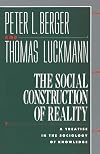
The purpose of this book is nothing short of attempting to explain how human thought and representation become material reality and how that material reality becomes the basis for individual consciousness and social identification. The argument moves astonishingly fast for the grandness of its scope.
The authors argue, convincingly, about how individual consciousness begins with one's own thoughts and awareness of surroundings. We then come to realize ways of sharing what is internal through show more objectivation. What becomes externalized as objects becomes incorporated into typified actions and interactions around which we (and others) develop roles. Multiply these relations and the result is institutions and beliefs that exist "in reality" apart from, but very much a product of our shared consciousness. As institutions take hold and persist across generations they take on independent legitimacy that is further supported through the development of tradition, mythology, ideology, religion, etc. These institutions and their associated roles are then internalized by future generations, becoming part of their identities and outlook on the world.
The argument is laid out quickly and at times in broad strokes. There are examples that help to envision the logic of the argument, but many of the details in the process of externalization and internalization are fuzzy and implied. Pairing this book with work from someone like John Searle makes for a satisfyingly rich view of the social construction of reality and the central function of language and discursive interaction in that process. show less
The authors argue, convincingly, about how individual consciousness begins with one's own thoughts and awareness of surroundings. We then come to realize ways of sharing what is internal through show more objectivation. What becomes externalized as objects becomes incorporated into typified actions and interactions around which we (and others) develop roles. Multiply these relations and the result is institutions and beliefs that exist "in reality" apart from, but very much a product of our shared consciousness. As institutions take hold and persist across generations they take on independent legitimacy that is further supported through the development of tradition, mythology, ideology, religion, etc. These institutions and their associated roles are then internalized by future generations, becoming part of their identities and outlook on the world.
The argument is laid out quickly and at times in broad strokes. There are examples that help to envision the logic of the argument, but many of the details in the process of externalization and internalization are fuzzy and implied. Pairing this book with work from someone like John Searle makes for a satisfyingly rich view of the social construction of reality and the central function of language and discursive interaction in that process. show less

Peter Berger, sociologist, churchman, and a prolific commentator on the contemporary scene, is a voluntarist who believes that the choices of policy-makers affect the course of history; he is also a social scientist who believes that the ethical questions attendant on modernization should be confronted head-on. His book, Pyramids of Sacrifice, submits the two dominant schemes for national development—capitalism and Communism—to human cost-accounting. Berger thereby takes a long step show more toward uniting “two attitudes that are usually separate—the attitudes of ‘hard nosed’ analysis and of utopian imagination.”
Pyramids of Sacrifice is an essay on the human dimensions of development. It views development not from the perspective of world history or of ideological combat, but through its impact on the individuals whose lives are transformed by social, economic, and political change. This perspective makes Berger sensitive to human problems which are too frequently ignored in the calculations of philosophers of history, revolutionaries, and reformist social engineers. Viewing history from below, Berger reflects on the moral imperatives of policy-making for the Third World. Foremost among such imperatives, for him, are that those affected by a policy have the opportunity to participate in the making of decisions; that policymakers carefully calculate the likely human costs of alternative policies in order to avoid those that come too dear; and that no development strategy be adopted which would require the sacrifice of a generation to the achievement of long-range goals.
by Jeane J. Kirkpatrick show less
Pyramids of Sacrifice is an essay on the human dimensions of development. It views development not from the perspective of world history or of ideological combat, but through its impact on the individuals whose lives are transformed by social, economic, and political change. This perspective makes Berger sensitive to human problems which are too frequently ignored in the calculations of philosophers of history, revolutionaries, and reformist social engineers. Viewing history from below, Berger reflects on the moral imperatives of policy-making for the Third World. Foremost among such imperatives, for him, are that those affected by a policy have the opportunity to participate in the making of decisions; that policymakers carefully calculate the likely human costs of alternative policies in order to avoid those that come too dear; and that no development strategy be adopted which would require the sacrifice of a generation to the achievement of long-range goals.
by Jeane J. Kirkpatrick show less
Lists
Awards


You May Also Like


Associated Authors
Statistics
- Works
- 75
- Also by
- 3
- Members
- 6,248
- Popularity
- #3,922
- Rating
- 3.9
- Reviews
- 38
- ISBNs
- 273
- Languages
- 21
- Favorited
- 10
