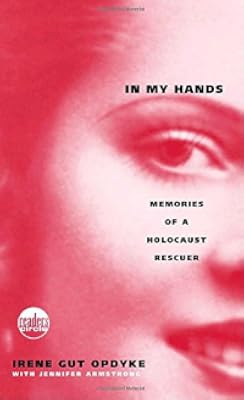
In My Hands: Memories of a Holocaust Rescuer
by Irene Gut Opdyke
On This Page
Description
Recounts the experiences of the author who, as a young Polish girl, hid and saved Jews during the Holocaust.Tags
Recommendations






Member Reviews
The author of this memoir was a teenager when war broke out in Europe in the 1930s. Although Germany and the Soviet Union both wanted control of Poland, neither country nor their armies had any regard for the Polish people. Irene found herself separated from her family, and she had to grow up too quickly, first at the hands of the Russian army, then at the hands of the German. Irene was working in a hotel that housed German officers when she became aware of its proximity to the Jewish ghetto. She was appalled by what she could see and hear from the hotel. She didn't have the ability to help the Jews on a large scale, but the small acts of kindness in her power would make a difference to a few people. She started by leaving food under a show more hole in the fence. When she realized that the penalty was the same for leaving bits of food as for more daring acts, she did more and more to help as many Jews as she could. She was able to provide employment for several, and then found a place for them to hide when she learned of plans to kill all of the remaining Jews.
I have read quite a few Holocaust memoirs. Suffering is common to all of them, but each story of survival and escape is unique. Opdyke's story is a reminder that life is precious and that family and friends are to be cherished. The audio production is excellent, and it includes introductory comments by the author herself. Opdyke's voice adds an intimacy to the experience, and it serves as a reminder that she was a real person and not a character in a novel. Highly recommended. show less
I have read quite a few Holocaust memoirs. Suffering is common to all of them, but each story of survival and escape is unique. Opdyke's story is a reminder that life is precious and that family and friends are to be cherished. The audio production is excellent, and it includes introductory comments by the author herself. Opdyke's voice adds an intimacy to the experience, and it serves as a reminder that she was a real person and not a character in a novel. Highly recommended. show less
I'm glad that our library puts Young Adult audio books in with the Adult ones or I might have not seen this one. It's awesome and eye opening. I've read other novels and true stories about the Holocaust mostly from the viewpoint of a Jewish person. I think other than "The Hiding Place," this is the only book I've read of someone who hid them and this takes place at the other end of Europe. Very moving and exciting at times. I could hardly wait to drive some time and ended up finishing it in my room.
In My Hands: Memories of a Holocaust Rescuer, by Irene Gut Opdyke
"In My Hands" starts with the author writing to the reader that if she tried to tell you what really happened during the war, told you everything at once, you wouldn't understand it. She includes an image that you won't comprehend until later in the book, the image of a bird falling, a bird that is not a bird. And as you come to understand what the bird really is, your heart will break, and you will know just what Irene means.
Born in 1922, in Poland, Irene had a happy childhood and a normal life. As a young child, she is saved from death by the family dog, and many in her village are convinced this means she has a great and promising life ahead of her. But for a girl in show more the 1920s, there weren't many adventures available, and drawn to helping people, Irene decided to go to nursing school.
On September 1, 1939, Germany invaded Poland. Irene's school was on the border, and she was immediately thrust into the war as a student nurse, then as a member of the Polish resistance. Living in the woods, part of an army without a country, Irene was selected to go on a mission into a nearby town and was captured by a Russian patrol who raped her and left her for dead. That experience alone would be enough to break almost anybody, but not Irene. The rape is merely the first of an indescribable number of hardships she endured during World War II; I often had tears in my eyes while reading this book. Irene lived through several lifetimes during the war, and while I am around the same age as her, I couldn't imagine surviving anything that she went through.
Irene's story is so many things - it is one of hope, one of courage, one of resistance, one of overcoming the odds, one of doing the right thing. A prisoner herself, while working in a German hotel, Irene did all she could to help those around her, including smuggling out food, warnings, and even hiding 12 Jews in a German officer's home.
Once I started "In My Hands," I couldn't put it down. Irene's story captivated me from beginning to end, and as I came to understand the metaphor of the bird that she starts her story with, I agreed with her. There is no way I could have understood all that she wanted to tell me if I didn't know the whole story, if I didn't know everything she endured and fought for. I found myself wanting to tell everyone I could about her story, and it led to a great talk between my father and myself (we're both history nerds).
While "In My Hands" is marketed as a young adult book, I believe it's beneficial for anyone, of any age, to read it and absorb it. Irene was moved to write her story after hearing that some groups claimed the Holocaust was a hoax, and she spoke for 30 years, imbuing a message of hope and tolerance to children across the country. Hands down, this is the best book I've read all year, and I wish I could thank the author.
5/5. show less
"In My Hands" starts with the author writing to the reader that if she tried to tell you what really happened during the war, told you everything at once, you wouldn't understand it. She includes an image that you won't comprehend until later in the book, the image of a bird falling, a bird that is not a bird. And as you come to understand what the bird really is, your heart will break, and you will know just what Irene means.
Born in 1922, in Poland, Irene had a happy childhood and a normal life. As a young child, she is saved from death by the family dog, and many in her village are convinced this means she has a great and promising life ahead of her. But for a girl in show more the 1920s, there weren't many adventures available, and drawn to helping people, Irene decided to go to nursing school.
On September 1, 1939, Germany invaded Poland. Irene's school was on the border, and she was immediately thrust into the war as a student nurse, then as a member of the Polish resistance. Living in the woods, part of an army without a country, Irene was selected to go on a mission into a nearby town and was captured by a Russian patrol who raped her and left her for dead. That experience alone would be enough to break almost anybody, but not Irene. The rape is merely the first of an indescribable number of hardships she endured during World War II; I often had tears in my eyes while reading this book. Irene lived through several lifetimes during the war, and while I am around the same age as her, I couldn't imagine surviving anything that she went through.
Irene's story is so many things - it is one of hope, one of courage, one of resistance, one of overcoming the odds, one of doing the right thing. A prisoner herself, while working in a German hotel, Irene did all she could to help those around her, including smuggling out food, warnings, and even hiding 12 Jews in a German officer's home.
Once I started "In My Hands," I couldn't put it down. Irene's story captivated me from beginning to end, and as I came to understand the metaphor of the bird that she starts her story with, I agreed with her. There is no way I could have understood all that she wanted to tell me if I didn't know the whole story, if I didn't know everything she endured and fought for. I found myself wanting to tell everyone I could about her story, and it led to a great talk between my father and myself (we're both history nerds).
While "In My Hands" is marketed as a young adult book, I believe it's beneficial for anyone, of any age, to read it and absorb it. Irene was moved to write her story after hearing that some groups claimed the Holocaust was a hoax, and she spoke for 30 years, imbuing a message of hope and tolerance to children across the country. Hands down, this is the best book I've read all year, and I wish I could thank the author.
5/5. show less
When World War II began, Irene Gutowna was a 17-year-old Polish nursing student. Six years later, she writes in this inspiring memoir, "I felt a million years old." In the intervening time she was separated from her family, raped by Russian soldiers, and forced to work in a hotel serving German officers. Sickened by the suffering inflicted on the local Jews, Irene began leaving food under the walls of the ghetto. Soon she was scheming to protect the Jewish workers she supervised at the hotel, and then hiding them in the lavish villa where she served as housekeeper to a German major. When he discovered them in the house, Gutowna became his mistress to protect her friends--later escaping him to join the Polish partisans during the show more Germans' retreat. The author presents her extraordinary heroism as the inevitable result of small steps taken over time, but her readers will not agree as they consume this thrilling adventure story, which also happens to be a drama of moral choice and courage. Although adults will find Irene's tale moving, it is appropriately published as a young adult book. Her experiences while still in her teens remind adolescents everywhere that their actions count, that the power to make a difference is in their hands. --Wendy Smith --This text refers to the Hardcover edition. show less
I listened to this audio, which was excellent, and the story is fascinating. I also listened to it thinking it was a YA book, which isn't accurate I guess. I think I'll bring it to our schools anyway, because Irene is a teenager for a good part of the story, and it's so compelling I think they'll find it interesting. It does touch on very dark things as well as very hopeful things, but it didn't feel too graphic for our middle school students.
It also has stark parallels to several current situations, and I found her very first acts to help Jewish people in the ghettos encouraging for when you're overwhelmed by a situation. That moment of "I can't fix this, but I can offer a small act," is such a good reminder that small things count show more even if you sometimes feel like nothing you can do will matter. show less
It also has stark parallels to several current situations, and I found her very first acts to help Jewish people in the ghettos encouraging for when you're overwhelmed by a situation. That moment of "I can't fix this, but I can offer a small act," is such a good reminder that small things count show more even if you sometimes feel like nothing you can do will matter. show less
This book was pretty good but not amazing. I read it two years before writing this review, and I would have liked the story well enough - and perhaps given it 3 stars - if not for the content. It's a true story, so it really happened, but it made me uncomfortable to read about certain things.
Some of the major things that bothered me most weresleazy and creepy Nazi soldiers preying on women, the author's rape by Russian solders (a real threat to so many women in Europe during the war), and her willingly becoming a mistress to a Nazi officer in order to save her Jewish friends. The rape was not described at all and happened off-screen, and none of the book was explicit, but there were details about the other things and how it took show more place, and the mistress part was especially uncomfortable for me. I know it really happened to the author and other women, which I don't mind knowing, but it made me feel icky to read a dramatized account of it. It's just a matter of personal preference and my comfort zone.
There were also descriptions of other atrocities of war that got very gruesome at times, includingthe brutal killing of babies in horrible, inhuman ways. That was not my preference to read about, either, even though I'm okay with some violence.
Another thing that I didn't like about the book - that was merely annoying to me - was that it was written in a bit of a melodramatic fashion, as if the author and co-author were trying to sound like a beautiful novel. I don't prefer to read fiction that is overly descriptive or "novel-like" in its writing, and I definitely don't prefer it in an autobiography. I love autobiographies, and the good ones are just as gripping as a novel, but they're gripping enough when the writing is tight and quality and plain - they don't need to try so hard to be good.
This is an amazing story, and I was very inspired by the author's immense courage and the way she saved Jews with unflinching determination - despite being, as someone told her condescendingly, "just a girl." But the content issues took away from my enjoyment of the book, and I don't recommend it. I give it 1.5 or 2 stars. I love World War II autobiographies, but I prefer to stick with the ones that are comfortable for me. show less
Some of the major things that bothered me most were
There were also descriptions of other atrocities of war that got very gruesome at times, including
Another thing that I didn't like about the book - that was merely annoying to me - was that it was written in a bit of a melodramatic fashion, as if the author and co-author were trying to sound like a beautiful novel. I don't prefer to read fiction that is overly descriptive or "novel-like" in its writing, and I definitely don't prefer it in an autobiography. I love autobiographies, and the good ones are just as gripping as a novel, but they're gripping enough when the writing is tight and quality and plain - they don't need to try so hard to be good.
This is an amazing story, and I was very inspired by the author's immense courage and the way she saved Jews with unflinching determination - despite being, as someone told her condescendingly, "just a girl." But the content issues took away from my enjoyment of the book, and I don't recommend it. I give it 1.5 or 2 stars. I love World War II autobiographies, but I prefer to stick with the ones that are comfortable for me. show less
** mild spoilers below **
This was an amazing story of how a Polish woman helped save the lives of over a dozen Jews during the Holocaust (she hid twelve of them in a Nazi officer's house, and she helped others living in the forest). It's even more powerful since Irene suffered so much during the war herself - she was raped by Russian soldiers, forced to be a Nazi's mistress to help protect her Jewish friends, lost her first love (a Polish partisan) during a raid, lost her father (who was murdered by the Nazis), and never saw her mother again (she died after Irene fled Poland for the United States). It's an amazing story of courage and survival.
This was an amazing story of how a Polish woman helped save the lives of over a dozen Jews during the Holocaust (she hid twelve of them in a Nazi officer's house, and she helped others living in the forest). It's even more powerful since Irene suffered so much during the war herself - she was raped by Russian soldiers, forced to be a Nazi's mistress to help protect her Jewish friends, lost her first love (a Polish partisan) during a raid, lost her father (who was murdered by the Nazis), and never saw her mother again (she died after Irene fled Poland for the United States). It's an amazing story of courage and survival.
Members
- Recently Added By
Lists

Books About World War II
102 works; 29 members
Best War Stories
87 works; 16 members

Holocaust
100 works; 11 members

Non-Fiction Worth Reading
1,025 works; 256 members

Holocaust Narratives
159 works; 3 members
Talk Discussions
Past Discussions
Holocaust Fiction? - Gentile Rescuer in Name that Book (October 2010)
Author Information

4 Works 1,227 Members
Irene Gut Opdyke lives in Yorba Linda, California. (Bowker Author Biography)
All Editions
Awards and Honors
Awards
Distinctions
Common Knowledge
- Original publication date
- 1999
- People/Characters
- Irene Gutowna; William Opdyke; Pani Ridela
- Important places
- Poland; Kozienice, Masovia, Poland; Germany; Hessich-Lichtenau, Hesse, Germany
- Important events
- World War II (1939 | 1945); Holocaust
- Dedication
- To my daughter, Janina.
And for the young people, who can accomplish the impossible and can achieve greatness by finding the strength in God and in the goodness of the human spirit. I dedicate my life story to encourag... (show all)e them to find hope and strength within themselves. Courage is a whisper from above: when you listen with your heart, you will know what to do and how and when. With all my life.
Irene Gut Opdyke
I dedicate this book with love and respect to Irene.
Jennifer Armstrong - First words
- Kozienice is a small village in eastern Poland.
Classifications
- Genres
- Nonfiction, Biography & Memoir, Teen
- DDC/MDS
- 940.531809438 — History & geography History of Europe History of Europe 1918- World War II, 1939-1945 Social, political, economic history; Holocaust Holocaust Standard subdivisions History, geographic treatment, biography Europe Germany & Central Europe Poland
- LCC
- D804.66 .O73 — History of Europe, Asia, Africa and Oceania History (General) World War II (1939-1945)
- BISAC
Statistics
- Members
- 1,194
- Popularity
- 20,983
- Reviews
- 22
- Rating
- (4.28)
- Languages
- 6 — Dutch, English, French, German, Hungarian, Swedish
- Media
- Paper, Audiobook, Ebook
- ISBNs
- 25
- ASINs
- 7