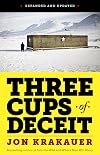
Three Cups of Deceit: How Greg Mortenson, Humanitarian Hero, Lost His Way
by Jon Krakauer
On This Page
Description
Greg Mortenson has built a global reputation as a selfless humanitarian and children's crusader, and he's been nominated for the Nobel Peace Prize. He is also not what he appears to be. As acclaimed author Jon Krakauer discovered, Mortenson has not only fabricated substantial parts of his bestselling books Three Cups of Tea and Stones into Schools, but has also misused millions of dollars donated by unsuspecting admirers like Krakauer himself. This is the tragic tale of good intentions gone show more very wrong. 100% of Jon Krakauer's proceeds from the sale of Three Cups of Deceit will be donated to the "Stop Girl Trafficking" project at the American Himalayan Foundation (www.himalayan-foundation.org/live/project/stopgirltrafficking). Photograph © Matthieu Paley/www.paleyphoto.com show lessTags
Recommendations















































Member Recommendations

Stones into Schools: Promoting Peace with Books, Not Bombs, in Afghanistan and Pakistan by Greg Mortenson
BookWallah And now for the rest of the story... warning this is not pretty.
21

BookWallah Are you willing to hear the other side of this story... warning this is not pretty.
TooBusyReading I think it is important to read both sides of the story.
21
Member Reviews
I have been curious to learn more about Greg Mortenson ever since I heard that Three Cups of Tea (which I was definitely taken in by) didn't quite represent the truth as well as one might hope. This book had been sitting on my shelves for quite some time before I decided it would be a good book for Dewey's readathon.
Krakauer is an emotional, talented writer. His story drew me forward, kept me turning pages to try to discover just what was reality and what was distortion. It was a little embarrassing to have pointed out all of the aspects of Mortenson's story that should have raised flags as "probably too good to be true," but which I (and many, many others) didn't examine because they felt so good. This story is sad one, ultimately, show more because Mortenson clearly had a passion to help, and if only had accepted more input, made himself more accountable, instead of falling in love with his white savior narrative, he could have done so much more good.
Of course, with a little distance (and a little research) from both books, they start to mirror each other in more interesting ways. Tea over-romanticizes and fictionalizes in service to its mission: which is to raise more money and understanding for what it believes to be a desperately important cause. Unfortunately, it seems that Deceit also glosses over and blows out of proportion in service to its mission: which sadly seems to be just to savage Mortenson. Could Mortenson have done a better job? Absolutely. Were he and his organization still adding up to a net good in the world? I think so. With distance, Krakauer's rage on behalf of all the "bilked" schoolchildren (who were moved by Mortenson's visions and held fundraisers and donated their own little collections of pennies) seem a little out of proportion? Also, yes.
This was an interesting book, but I wish it had been a different book. I wish it had been a book about how people sometimes get wrapped up in good intentions and are swept away by their own stories. I wish it had been a story about the ways we do and do not effectively build empathy between cultures. I wish it had been a story about how we demand unrealistic levels of perfection from non-profits, and are eager to burn them to the ground when they don't live up to our expectations, but shrug our shoulders at the sins of corporations, or the military-industrial complex, or sensationalist media hyping war.
Who will write that book? show less
Krakauer is an emotional, talented writer. His story drew me forward, kept me turning pages to try to discover just what was reality and what was distortion. It was a little embarrassing to have pointed out all of the aspects of Mortenson's story that should have raised flags as "probably too good to be true," but which I (and many, many others) didn't examine because they felt so good. This story is sad one, ultimately, show more because Mortenson clearly had a passion to help, and if only had accepted more input, made himself more accountable, instead of falling in love with his white savior narrative, he could have done so much more good.
Of course, with a little distance (and a little research) from both books, they start to mirror each other in more interesting ways. Tea over-romanticizes and fictionalizes in service to its mission: which is to raise more money and understanding for what it believes to be a desperately important cause. Unfortunately, it seems that Deceit also glosses over and blows out of proportion in service to its mission: which sadly seems to be just to savage Mortenson. Could Mortenson have done a better job? Absolutely. Were he and his organization still adding up to a net good in the world? I think so. With distance, Krakauer's rage on behalf of all the "bilked" schoolchildren (who were moved by Mortenson's visions and held fundraisers and donated their own little collections of pennies) seem a little out of proportion? Also, yes.
This was an interesting book, but I wish it had been a different book. I wish it had been a book about how people sometimes get wrapped up in good intentions and are swept away by their own stories. I wish it had been a story about the ways we do and do not effectively build empathy between cultures. I wish it had been a story about how we demand unrealistic levels of perfection from non-profits, and are eager to burn them to the ground when they don't live up to our expectations, but shrug our shoulders at the sins of corporations, or the military-industrial complex, or sensationalist media hyping war.
Who will write that book? show less
"I wish I understood the pathology that has compelled the unending need to embellish the truth so flagrantly. With one hand Greg has created something potentially beautiful and caring (regardless of his motives). With the other he has murdered his creation by his duplicity." - Tom Hornbein, American physician and mountaineer, CAI chairman 2001-2
This quote pretty much sums up the argument of the book. I remember Three Cups of Tea soaring into the bestseller lists and garnering rave reviews. I didn't buy it - and now I'm glad I didn't. Because the truth behind the schmaltz was rather different. Krakauer was one of the generous millions who donated a significant sum of money to Greg Mortenson's school project, and now he is the man show more exposing the lies that conned him into doing so.
This is a short book, but if you've been swept away by Mortenson's two offerings, you shouldn't hesitate to read it. Krakauer lives up to his reputation by unpicking truth from lie in Mortenson's narrative - and there are a lot of lies. Encounters and stirring promises that never happened. A 'kidnapping' that was actually a generous welcome into a community which has now been disgraced by Mortenson's dramatic retelling. Schools that are already lying empty thanks to poor building decisions and a lack of resources and support.
Although CAI itself - that's the Central Asia Institute - comes across as a worthy and inspirational organisation, it is clear that its founder is out of control. The high and rapid turnover of the more capable staff suggests that people arrive with great aspirations and leave disillusioned almost immediately.
Mortenson comes across as a man consumed by vanity and greed, driven by book sales and rapturous welcomes wherever he goes, yet failing to be accountable to anyone and siphoning off CAI funds - funds donated by individuals as well as by schools and other organisations - at a rate of millions. His pay is astronomical, he flies by private jet, none of his royalties benefit CAI, he uses CAI money to fund his expenses, and he seems to be a keen practitioner of creative accounting. In short, he is a disgrace.
I can categorically say that as of this moment, I will not be selling his books via my shop. And anyone who asks for Three Cups of Tea or Stones into Schools (as someone did yesterday after her friend mentioned how 'inspiring' it was) will be receiving a hearty recommendation to pick up this book instead. Read it and weep.
P.S. The book is currently available to read online for free at: http://images.bimedia.net/documents/Three_Cups_of_Deceit_Jon_Krakauer.pdf show less
This quote pretty much sums up the argument of the book. I remember Three Cups of Tea soaring into the bestseller lists and garnering rave reviews. I didn't buy it - and now I'm glad I didn't. Because the truth behind the schmaltz was rather different. Krakauer was one of the generous millions who donated a significant sum of money to Greg Mortenson's school project, and now he is the man show more exposing the lies that conned him into doing so.
This is a short book, but if you've been swept away by Mortenson's two offerings, you shouldn't hesitate to read it. Krakauer lives up to his reputation by unpicking truth from lie in Mortenson's narrative - and there are a lot of lies. Encounters and stirring promises that never happened. A 'kidnapping' that was actually a generous welcome into a community which has now been disgraced by Mortenson's dramatic retelling. Schools that are already lying empty thanks to poor building decisions and a lack of resources and support.
Although CAI itself - that's the Central Asia Institute - comes across as a worthy and inspirational organisation, it is clear that its founder is out of control. The high and rapid turnover of the more capable staff suggests that people arrive with great aspirations and leave disillusioned almost immediately.
Mortenson comes across as a man consumed by vanity and greed, driven by book sales and rapturous welcomes wherever he goes, yet failing to be accountable to anyone and siphoning off CAI funds - funds donated by individuals as well as by schools and other organisations - at a rate of millions. His pay is astronomical, he flies by private jet, none of his royalties benefit CAI, he uses CAI money to fund his expenses, and he seems to be a keen practitioner of creative accounting. In short, he is a disgrace.
I can categorically say that as of this moment, I will not be selling his books via my shop. And anyone who asks for Three Cups of Tea or Stones into Schools (as someone did yesterday after her friend mentioned how 'inspiring' it was) will be receiving a hearty recommendation to pick up this book instead. Read it and weep.
P.S. The book is currently available to read online for free at: http://images.bimedia.net/documents/Three_Cups_of_Deceit_Jon_Krakauer.pdf show less
I will admit upfront that I've not read Three Cups of Tea—in part because I was turned off by the overwhelming media saturation; in part because I anticipated that there would be some aggrandisement of Greg Mortenson in its pages and I was not in the humour for another What These Folks Need is a White Man narrative. However, I never imagined that the book contained as much dishonesty and fabrication as Krakauer documents here. While, as Krakauer admits, some of the allegations boil down to 'he said, she said', there is such an overwhelming amount of evidence on the financial side of things to raise some serious questions about Mortenson's honesty. A former staffer of the Central Asia Institute (CAI), the non-profit which Mortenson show more founded to build schools in the region, claims that Mortenson regarded the organisation as his own personal ATM, and that is certainly the impression one gets from Krakauer's account. Beyond that, though, what was most dismaying was seeing how Mortenson had manipulated Western stereotypes of Muslims and of Afghanis in order to add more drama to his writing (and to increase his revenues). A pretty damning indictment. show less
Jon Krakauer is a man on a mission. He says it himself: news of Greg Mortenson's behavior felt like a "personal betrayal." And you do not want to betray Jon Krakauer. His response was to tear Mortenson apart with an exhaustive investigation, using personal emails and quotes from disgruntled ex-employees to sweeten his revenge.
If you are not familiar with Greg Mortenson - and I wasn't before reading this book - he is the founder of a charity that builds schools (or, rather, claims to build schools) in rural Afghanistan. I have had Mortenson's book [b:Three Cups of Tea: One Man's Mission to Promote Peace ... One School at a Time|49436|Three Cups of Tea One Man's Mission to Promote Peace ... One School at a Time|Greg show more Mortenson|http://images.gr-assets.com/books/1395407074s/49436.jpg|251800] on my "to-read" list for a while, but thanks to Krakauer I don't have to read it or its sequel because of his extensive quoting and summarizing of the texts.
The conclusion here is that Greg Mortenson is a despicable human being who lies about everything and uses his charity as a personal bank account. Krakauer is disgruntled because he believed Mortenson's lies and donated over $75,000 to Mortenson's charity before learning that he wasn't funding schools for poor Afghan children, but stuffing Mortenson's pockets. Adding to Krakauer's rage is that an angry letter he wrote to the charity's Board was not taken as advice and seemingly ignored.
Three Cups of Deceit is an interesting expose by one of my favorite writers, but it is apparent that Krakauer has a personal vendetta against Mortenson. Maybe I would be more interested in the story if I had a personal vendetta against him, too. show less
If you are not familiar with Greg Mortenson - and I wasn't before reading this book - he is the founder of a charity that builds schools (or, rather, claims to build schools) in rural Afghanistan. I have had Mortenson's book [b:Three Cups of Tea: One Man's Mission to Promote Peace ... One School at a Time|49436|Three Cups of Tea One Man's Mission to Promote Peace ... One School at a Time|Greg show more Mortenson|http://images.gr-assets.com/books/1395407074s/49436.jpg|251800] on my "to-read" list for a while, but thanks to Krakauer I don't have to read it or its sequel because of his extensive quoting and summarizing of the texts.
The conclusion here is that Greg Mortenson is a despicable human being who lies about everything and uses his charity as a personal bank account. Krakauer is disgruntled because he believed Mortenson's lies and donated over $75,000 to Mortenson's charity before learning that he wasn't funding schools for poor Afghan children, but stuffing Mortenson's pockets. Adding to Krakauer's rage is that an angry letter he wrote to the charity's Board was not taken as advice and seemingly ignored.
Three Cups of Deceit is an interesting expose by one of my favorite writers, but it is apparent that Krakauer has a personal vendetta against Mortenson. Maybe I would be more interested in the story if I had a personal vendetta against him, too. show less
wow okay so mortenson embezzled a bunch of money, used money inappropriately, and made up a bunch of his story (in a way that harmed others), and didn't listen to the advice of the people he was supposedly there to help. his point was still true, that education is so important, important enough to save lives, but what a disappointment. (he still did a lot of good work but could have done *so* much more.)
read half the sky by kristoff instead of three cups of tea if you want to learn how to help and why.
read half the sky by kristoff instead of three cups of tea if you want to learn how to help and why.
I didn't read Three Cups of Tea, and I hadn't even heard of it or Greg Mortenson. I like John Krakauer and scooped this up at the library.
I don't plan on reading Mortenson's books now, though I doubt I would have anyway. It's possible that I have biased view of the situation, but I'm pretty sure John got the important bits right and that Mortenson exaggerated or fabricated parts of his story and that he then played fast and lose with money donated to help poor children.
How do guys like Mortenson achieve such success? I would like to meet him. Krakauer doesn't dwell on it, but I get the impression that Mortenson has a powerful personality and can captivate an audience.
The CAI seems to be up and running today. Wikipedia says they were show more audited and had a probation imposed by Montana and the IRS, but that ended in 2014. Mortenson is still running the charity and people are still giving. He was made to pay back $1M the charity had paid him for speaking fees and travel, though in deceit Krakauer says CAI paid a lot more than that over the years. Mortenson isn't the darling he was and the awards aren't rolling in, but if he is still running a charity that gets good marks from charity navigator and the like, what good are charity ratings?
I am a charity skeptic. How many more Mortensons are out there in the non-profit world? I think America is too easy on non-profits and if I ever got to shape US policy I would crack down on organizations that don't pay tax. Many charities seem not so different from CAI. They are an administrative apparatus to raise $1M in donations in order to spend $200K on good works.
I do give to charity, but for the last few years I have only given to charities whose good works I have personally witnessed. show less
I don't plan on reading Mortenson's books now, though I doubt I would have anyway. It's possible that I have biased view of the situation, but I'm pretty sure John got the important bits right and that Mortenson exaggerated or fabricated parts of his story and that he then played fast and lose with money donated to help poor children.
How do guys like Mortenson achieve such success? I would like to meet him. Krakauer doesn't dwell on it, but I get the impression that Mortenson has a powerful personality and can captivate an audience.
The CAI seems to be up and running today. Wikipedia says they were show more audited and had a probation imposed by Montana and the IRS, but that ended in 2014. Mortenson is still running the charity and people are still giving. He was made to pay back $1M the charity had paid him for speaking fees and travel, though in deceit Krakauer says CAI paid a lot more than that over the years. Mortenson isn't the darling he was and the awards aren't rolling in, but if he is still running a charity that gets good marks from charity navigator and the like, what good are charity ratings?
I am a charity skeptic. How many more Mortensons are out there in the non-profit world? I think America is too easy on non-profits and if I ever got to shape US policy I would crack down on organizations that don't pay tax. Many charities seem not so different from CAI. They are an administrative apparatus to raise $1M in donations in order to spend $200K on good works.
I do give to charity, but for the last few years I have only given to charities whose good works I have personally witnessed. show less
Reading this very short 75-page book is like being told as a child that Santa doesn't exist – all the arguments are logical but you still don't quite want to believe them. When I first heard of Three Cups of Deceit, I assumed (because I wanted to) that it was written by some disgruntled hack who just wanted to share the spotlight by defaming Mortenson. When I learned it was written by Jon Krakauer, an author I respect, I thought it was worth a second look.
Mr. Krakauer, once an ardent supporter of CAI, the nonprofit organization that Mortenson is affiliated with, became disillusioned with Mortenson and decided to dig into the story for himself. He seems to have done his research well. His allegations of Mortenson's portraying as truth show more that which is fiction, and misuse of CAI funds, seems well founded.
I still believe that Mortenson has done some good, has helped some of the people that he claimed to have helped. It saddens me to see that he apparently has lost his way, or at any rate, is not choosing the most honorable path. What saddens me more is that people want to believe, people want to help to the best of their abilities, and this causes us to lose faith. When someone donates, especially in these times when fewer people can donate or must donate less, the donor wants to know that his money is being used wisely, is being stretched as far as it can for the purpose intended. The controversy over Mortenson's work and actions hurts all nonprofits. Donors are at a loss, not knowing who and what they can trust. And that hurts everyone.
Some quotes that were especially meaningful to me:
“What's disturbing is not the amount Mortenson was paid, but that he lied about it – and that dozens of such falsehoods are strewn thought the book.”
“In all fairness, Greg Mortenson has done much that is admirable since he began working in Baltistan sixteen and a half years ago. He's been a tireless advocate for girls' education. He's established dozens of schools in Afghanistan and Pakistan....”
This one seems especially relevant:
“With one hand Greg has created something potentially beautiful and caring (regardless of his motives). With the other he has murdered his creation by his duplicity.”
And I really, really wanted to believe in Santa Claus. show less
Mr. Krakauer, once an ardent supporter of CAI, the nonprofit organization that Mortenson is affiliated with, became disillusioned with Mortenson and decided to dig into the story for himself. He seems to have done his research well. His allegations of Mortenson's portraying as truth show more that which is fiction, and misuse of CAI funds, seems well founded.
I still believe that Mortenson has done some good, has helped some of the people that he claimed to have helped. It saddens me to see that he apparently has lost his way, or at any rate, is not choosing the most honorable path. What saddens me more is that people want to believe, people want to help to the best of their abilities, and this causes us to lose faith. When someone donates, especially in these times when fewer people can donate or must donate less, the donor wants to know that his money is being used wisely, is being stretched as far as it can for the purpose intended. The controversy over Mortenson's work and actions hurts all nonprofits. Donors are at a loss, not knowing who and what they can trust. And that hurts everyone.
Some quotes that were especially meaningful to me:
“What's disturbing is not the amount Mortenson was paid, but that he lied about it – and that dozens of such falsehoods are strewn thought the book.”
“In all fairness, Greg Mortenson has done much that is admirable since he began working in Baltistan sixteen and a half years ago. He's been a tireless advocate for girls' education. He's established dozens of schools in Afghanistan and Pakistan....”
This one seems especially relevant:
“With one hand Greg has created something potentially beautiful and caring (regardless of his motives). With the other he has murdered his creation by his duplicity.”
And I really, really wanted to believe in Santa Claus. show less
Members
- Recently Added By
Author Information

29+ Works 52,295 Members
Jon Krakauer was born in Brookline, Massachusetts on April 12, 1954. He received a degree in environmental studies from Hampshire College in Massachusetts in 1976. He worked as a carpenter, fisherman, and writer. He articles on mountain climbing appeared in several publications including GQ, National Geographic, Architectural Digest, Playboy, The show more New Yorker, and Rolling Stone. In 1996, he climbed Mt. Everest, but a storm took the lives of four of the five teammates who reached the summit with him. An analysis of the calamity he wrote for Outside magazine received a National Magazine Award. An article he wrote for Smithsonian about volcanology received the 1997 Walter Sullivan Award for Excellence in Science Journalism. He is the author of several books including Into Thin Air: A Personal Account of the Mt. Everest Disaster; Under the Banner of Heaven: A Story of Violent Faith; Where Men Win Glory: The Odyssey of Pat Tillman; Three Cups of Deceit: How Greg Mortenson, Humanitarian Hero, Lost His Way; and Missoula: Rape and the Justice System in a College Town. His book, Into the Wild, was made into a movie in 2007. He is also the editor of the Modern Library Exploration series. (Bowker Author Biography) show less
Some Editions
Work Relationships
Common Knowledge
- Canonical title
- Three Cups of Deceit: How Greg Mortenson, Humanitarian Hero, Lost His Way
- Original publication date
- 2011
- Important places
- Afghanistan; Pakistan
- First words
- Greg Mortenson doesn't hide his light under a bushel.
- Last words
- (Click to show. Warning: May contain spoilers.)With the other he has murdered his creation by his duplicity.
Classifications
- Genres
- Nonfiction, General Nonfiction, Biography & Memoir
- DDC/MDS
- 361.7 — Society, government, & culture Social problems and social services Social problems and services Private Charity & Philanthropy
- LCC
- LC2330 .M67 .K7 — Education Special aspects of education Special aspects of education Education of special classes of persons Women
- BISAC
Statistics
- Members
- 508
- Popularity
- 59,154
- Reviews
- 35
- Rating
- (3.81)
- Languages
- English
- Media
- Paper, Audiobook, Ebook
- ISBNs
- 6
- ASINs
- 7