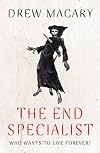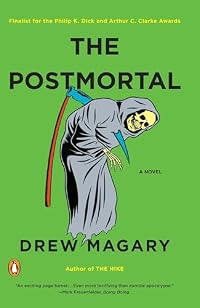
The Postmortal
by Drew Magary
On This Page
Description
John Farrell is about to get "The Cure." Old age can never kill him now. The only problem is, everything else still can . . .Imagine a near future where a cure for aging is discovered and-after much political and moral debate-made available to people worldwide. Immortality, however, comes with its own unique problems-including evil green people, government euthanasia programs, a disturbing new religious cult, and other horrors. Witty, eerie, and full of humanity, The Postmortal is an show more unforgettable thriller that envisions a pre-apocalyptic world so real that it is completely terrifying. show lessTags
Recommendations







Member Recommendations

Member Reviews
The Postmortal is a powerful book. Magary takes an honest look at society's reaction to not aging - constant partying, marriages fall apart, the earth's resources are dwindling. We see John Farrell, a wise-cracking lawyer, who's life changes markedly throughout the book as he gets older without aging. His optimism turns to skepticism, even on to hopelessness. The storyline is very dark in this book, but Magary manages to add humor and lighten the mood in just the right places.
It's an interesting novel, showing how society slowly disintegrates just as it is granted one of its biggest wishes. The government begins to take total control of everyone's life...and death. This story really makes you think, even as you're being entertained.
It's an interesting novel, showing how society slowly disintegrates just as it is granted one of its biggest wishes. The government begins to take total control of everyone's life...and death. This story really makes you think, even as you're being entertained.
A dystopian view of civilization collapsing after a cure for aging is discovered. I enjoyed it, especially the exploration of all the social implications. That was the core of the book. It had the flaw of a lot of sci fi, though. The author was better at exploring the ideas than at creating believable characters. I never related to any of the characters and the romance at the end felt vaguely creepy to me.
Here's a complaint about this and lots of other science fiction: in a future in which people's lives are lengthened, authors often assume that women's reproductive years are automatically lengthened as well. But women aren't like men, who keep making new sperm. Women are born with a finite number of eggs. Once those are gone, no more show more babies. If you have 80 year old women getting pregnant, you need to explain how that is possible. show less
Here's a complaint about this and lots of other science fiction: in a future in which people's lives are lengthened, authors often assume that women's reproductive years are automatically lengthened as well. But women aren't like men, who keep making new sperm. Women are born with a finite number of eggs. Once those are gone, no more show more babies. If you have 80 year old women getting pregnant, you need to explain how that is possible. show less
Working as a SI (supplemental instructor/sort of a TA 'lite') for my university's Freshman English Composition class, we were, along with many other classes, assigned this book to read. At first I thought it would be a 'tap water' read. Quick, palatable, and not being able to leave much in the way of an impression. How wrong I was, and how glad I am.
Much like Max Brooks' "World War Z" this book's readability belies its complexity. This surprising amount of depth is evident in author Drew Magary's commendable ability to tease out the central concept of his book in such a way that it feels like most every conceivable issue that need be addressed is addressed. And considering that this book's central concept is the finding of a medical show more cure for aging, and that Magary manages to touch on religion, war, politics, economics, love, morality, family and a few other key human 'endeavors' and all in under 400 pages, that's a hell of a feat.
But in doing this (and this is where I dock Magary a few points) the writer unfortunately sacrifices pacing (most notably towards the end of the novel) and dialogue (it all feels very workmanlike and exposition based, even when the intent is humor or pathos). These aren't major issues and as I commented over the course of my reading I was constantly and consistently surprised by this book's treating of not only its central conceit but also of its readers as an audience willing to deal with the limitations of their own moral and ethical, as well as cultural, horizons. We need more books like this in the US of A, please. show less
Much like Max Brooks' "World War Z" this book's readability belies its complexity. This surprising amount of depth is evident in author Drew Magary's commendable ability to tease out the central concept of his book in such a way that it feels like most every conceivable issue that need be addressed is addressed. And considering that this book's central concept is the finding of a medical show more cure for aging, and that Magary manages to touch on religion, war, politics, economics, love, morality, family and a few other key human 'endeavors' and all in under 400 pages, that's a hell of a feat.
But in doing this (and this is where I dock Magary a few points) the writer unfortunately sacrifices pacing (most notably towards the end of the novel) and dialogue (it all feels very workmanlike and exposition based, even when the intent is humor or pathos). These aren't major issues and as I commented over the course of my reading I was constantly and consistently surprised by this book's treating of not only its central conceit but also of its readers as an audience willing to deal with the limitations of their own moral and ethical, as well as cultural, horizons. We need more books like this in the US of A, please. show less
The Postmortal is pitched as a darkly comic satire about a world where a cure for aging is invented and becomes widely available. However, if it is a satire, it is of a character most similar to Jonathan Swift's infamous essay advocating the cannibalization of Irish babies as a solution to poverty. If you happen to smile while reading The Postmortal, I imagine it will be a mirthless rictus intermingled with horror rather than anything signifying amusement. For my part, I don't think I laughed a single time reading the book in a mad rush over the past two days, but I don't count that as a mark against it. In fact, I found it both gripping and chilling in equal parts.
When the cure for aging, commonly known as "The Cure", is first show more invented, doctors are quick to point out that it isn't actually a cure for death, either by cancer or a more violent end, but that and the fact that it is initially banned by the government don't stop the main character, John Farrell, from spending seven thousand dollars at a black market clinic to get cured at the age of twenty nine. The narrative follows John over the next 60 years of his life, as he learns what it truly means to have eternal youth from both a personal and a global perspective.
An early scene where John takes his roommate back to the same clinic to get the cure sets the tone for the rest of the story, as unexpected tragedy decisively intrudes. John's life is forever changed in an instant, both by the looming spectres of death and destruction that seem to lurk just around the next corner for the rest of his life, and by the fleeting glimpse outside the clinic of a beautiful blonde woman he feels certain he will meet again some day. Magary does an excellent job of setting up a palpable sense of dread very early on in the book; we quickly learn to expect that nothing good will ever come to John without some greater evil following quickly behind.
The book alternates between John's journals/life recordings and excerpts of articles, interviews, and news headlines. We soon get a fuller picture of the way that the cure for aging affects the world around John in new and terrifying ways. One particularly chilling article recounts the story of a woman who gives the cure to her child so that the girl will stay a lovable, innocent baby forever. Magary also spends a good amount of time establishing the particularly catastrophic results of the cure in already over-populated China, and you get the sense that an entire novel could be set in that particular corner of the apocalypse.
The book jumps forward in time over the decades of John's artificially extended life, and we watch as his personal tragedies and disappointments all add together to transform him from a hopeful young lawyer to a cynical, hardened "End Specialist", a sort of bounty hunter who ekes out both euthanasia and questionable justice as forms of legalized population control. My only real criticism of the book is that John still felt like a bit of a cypher by the end of the story; Magary does a great job of portraying the personal hardships that he experiences over his long life, and we get little snapshots of emotion and grief, but John feels more like a window into the world rather than a fully lived-in protagonist.
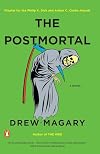
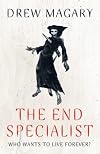
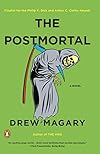
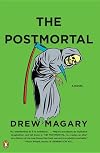
The Postmortal is a brisk read even at just under 400 pages in print, and if I hadn't started reading it so late at night, I might have finished the entire thing in one sitting. The scenes of action peppered throughout the book are written in a clear, compelling style, and Magary has a knack for grabbing the reader just in time to show them how bad things can get. The brightly-colored cover and the author's history as a comedy writer are a bit misleading considering the searing bleakness of his debut, but if you can stomach it, The Postmortal is a incredibly thrilling piece of dystopian gallows humor, and I highly recommend it. show less
When the cure for aging, commonly known as "The Cure", is first show more invented, doctors are quick to point out that it isn't actually a cure for death, either by cancer or a more violent end, but that and the fact that it is initially banned by the government don't stop the main character, John Farrell, from spending seven thousand dollars at a black market clinic to get cured at the age of twenty nine. The narrative follows John over the next 60 years of his life, as he learns what it truly means to have eternal youth from both a personal and a global perspective.
An early scene where John takes his roommate back to the same clinic to get the cure sets the tone for the rest of the story, as unexpected tragedy decisively intrudes. John's life is forever changed in an instant, both by the looming spectres of death and destruction that seem to lurk just around the next corner for the rest of his life, and by the fleeting glimpse outside the clinic of a beautiful blonde woman he feels certain he will meet again some day. Magary does an excellent job of setting up a palpable sense of dread very early on in the book; we quickly learn to expect that nothing good will ever come to John without some greater evil following quickly behind.
The book alternates between John's journals/life recordings and excerpts of articles, interviews, and news headlines. We soon get a fuller picture of the way that the cure for aging affects the world around John in new and terrifying ways. One particularly chilling article recounts the story of a woman who gives the cure to her child so that the girl will stay a lovable, innocent baby forever. Magary also spends a good amount of time establishing the particularly catastrophic results of the cure in already over-populated China, and you get the sense that an entire novel could be set in that particular corner of the apocalypse.
The book jumps forward in time over the decades of John's artificially extended life, and we watch as his personal tragedies and disappointments all add together to transform him from a hopeful young lawyer to a cynical, hardened "End Specialist", a sort of bounty hunter who ekes out both euthanasia and questionable justice as forms of legalized population control. My only real criticism of the book is that John still felt like a bit of a cypher by the end of the story; Magary does a great job of portraying the personal hardships that he experiences over his long life, and we get little snapshots of emotion and grief, but John feels more like a window into the world rather than a fully lived-in protagonist.
The Postmortal is a brisk read even at just under 400 pages in print, and if I hadn't started reading it so late at night, I might have finished the entire thing in one sitting. The scenes of action peppered throughout the book are written in a clear, compelling style, and Magary has a knack for grabbing the reader just in time to show them how bad things can get. The brightly-colored cover and the author's history as a comedy writer are a bit misleading considering the searing bleakness of his debut, but if you can stomach it, The Postmortal is a incredibly thrilling piece of dystopian gallows humor, and I highly recommend it. show less
A really interesting premise, but poorly executed. The story is based on a cure for ageing, which effectively freezes an individual at the age he/she receives the cure. This becomes conflated to become an elixir that will give eternal life, but this is patently untrue given that people can still have cancer and heart disease. Thus the story was flawed. The writing style was clunky and lacked depth and I felt that there was more than a slight whiff of misogyny .
I really loved the first half of this novel. It was disturbing and absolutely divine the way it explored the whole issue of what happens after we cure old age:
A whole world full of fledgling immortals and those people ideologically opposed to it, gradually realizing that the s**t is about to hit the fan when resources run out and we're all stuck with each other. :)
It was delightful and often RATHER disturbing what we all got up to.
And then our MC had his change. He became the End Specialist.
I didn't hate this part, but it wasn't easy to read. I didn't like seeing his soul erode. I liked him for so long. It was like seeing cancer take over a loved one.
But it felt real as hell. This is a novel to read when you want a serious "be careful show more what you wish for". Make sure no one else gets their wishes. Otherwise, well, it's a Chinese curse. (Apocryphal or not.)
Either way, it's a great novel. Painful and funny and glorious. :) The end is very bittersweet and perfectly in line with the main theme. :) show less
A whole world full of fledgling immortals and those people ideologically opposed to it, gradually realizing that the s**t is about to hit the fan when resources run out and we're all stuck with each other. :)
It was delightful and often RATHER disturbing what we all got up to.
And then our MC had his change. He became the End Specialist.
I didn't hate this part, but it wasn't easy to read. I didn't like seeing his soul erode. I liked him for so long. It was like seeing cancer take over a loved one.
But it felt real as hell. This is a novel to read when you want a serious "be careful show more what you wish for". Make sure no one else gets their wishes. Otherwise, well, it's a Chinese curse. (Apocryphal or not.)
Either way, it's a great novel. Painful and funny and glorious. :) The end is very bittersweet and perfectly in line with the main theme. :) show less
I'm out of book reviewing shape (among other kinds of shape), and it's hard to get back into the swing of things (if there ever was a swing). I always have a number of false starts when trying to write reviews. I usually start off with an idea for a review only to grow frustrated and switch into adjectival blabber.
So after three false starts let's see if I can get this thing reviewed.
What would happen to our world when the cure for aging, and thus dying of old age, is commonly available?
Would you take the cure like I'd expect most people would, or would you oppose the cure at all costs?
Luckily for us, we don't have to seriously make decisions like this yet. We are also lucky because the world Magary paints is alarmingly similar to show more how I'd imagine things would play out. Within this disturbing, violent and doomed world we see that the story is a ultimately a search for meaning and morality. How can you go wrong with that?
It's hard to say whether I'd take the cure. Part of me is interested in seeing firsthand how we destroy ourselves and it would give me the opportunity to read all of the books I know I'll never get around to with my currently limited life span. However another part of me is afraid of what I'd become if presented with the chance for immortality. show less
So after three false starts let's see if I can get this thing reviewed.
What would happen to our world when the cure for aging, and thus dying of old age, is commonly available?
Would you take the cure like I'd expect most people would, or would you oppose the cure at all costs?
Luckily for us, we don't have to seriously make decisions like this yet. We are also lucky because the world Magary paints is alarmingly similar to show more how I'd imagine things would play out. Within this disturbing, violent and doomed world we see that the story is a ultimately a search for meaning and morality. How can you go wrong with that?
It's hard to say whether I'd take the cure. Part of me is interested in seeing firsthand how we destroy ourselves and it would give me the opportunity to read all of the books I know I'll never get around to with my currently limited life span. However another part of me is afraid of what I'd become if presented with the chance for immortality. show less
Members
- Recently Added By
Lists

Books I've Read
40 works; 2 members

Arthur C. Clarke Award Winners and Shortlisted Books
219 works; 14 members
Author Information

10+ Works 2,329 Members
Some Editions
Awards and Honors
Awards
Common Knowledge
- Alternate titles
- The End Specialist
- Original publication date
- 2011
- Dedication
- To my wife and children
- First words
- In March 2090, a worker for the Department of Containment named Anton Vyrin was conducting a routine sweep of an abandoned collectivist compound in rural Virginia when he stumbled upon an eighth-generation wireless-enabled pr... (show all)ojected-screening device (WEPS.8) that was still functional after charging. Stored inside the device's hard drive was a digital library containing sixty years' worth of text files written by a man who went by the screen name John Farrell.
- Last words
- (Click to show. Warning: May contain spoilers.)My split second of immortality is over. All that's left now is the end, which is all any of us ever has. The WEPS battery is dying. I have a shot of SoFlo at the ready. There is no dread. There is only certainty.
Classifications
Statistics
- Members
- 954
- Popularity
- 27,569
- Reviews
- 65
- Rating
- (3.51)
- Languages
- English, German, Polish, Spanish
- Media
- Paper, Audiobook, Ebook
- ISBNs
- 11
- ASINs
- 8