On This Page
Description
This study explores the importance of the Bible in different communities and cultures and attempts to explain why it has such a variety of uses and interpretations.Tags
Recommendations




Member Reviews
The problem with this VSI series is quite plain. Few people are likely to pick up the VSI to the Bible without already having some interest in the topic, but the series is premised on the idea that each book will hook you into a particular topic. That means that the truly fascinating stuff is squeezed into only half of this book (the writing of the biblical texts, the way jews and early christians decided which books would be part of 'scripture') and the rest of it is about how the bible has been used to uphold/bring down unjust political systems (really? no! surely not!) and on the bare fact that the bible influences much art and culture (shock!). Certainly liberation theology is interesting, as is Atwood's use of biblical allusion in show more The Handmaid's Tale. But I imagine that most people who read this want to hear more about canonization and less about Desmond Tutu's letters to supports of apartheid.
Two less important problems: the writing is a little condescending, and there are spaces between paragraphs. Odd design choice, that; it makes the whole thing seem much more discontinuous than it is. The first few chapters are quite good, and considering that there's no obvious 'topic' for the author to focus on, he's done a reasonable job. show less
Two less important problems: the writing is a little condescending, and there are spaces between paragraphs. Odd design choice, that; it makes the whole thing seem much more discontinuous than it is. The first few chapters are quite good, and considering that there's no obvious 'topic' for the author to focus on, he's done a reasonable job. show less
This book starts of very well and then becomes less interesting. The first four chapters deal with the different ways of reading the Bible (as a classic or a sacred text), with how and when the different parts of the Bible were written, with the process of the canonization of the different texts and with different translation and productions. All of this was fascinating to me!
After that, the author ventures to many other areas, such as the Bible's influence on art, different readings of the texts or how it was and is used in politics. He provides examples regarding each of the areas, and these are often very particular. I would have preferred more of an overview compared to learning so much about the details of the specific examples.
After that, the author ventures to many other areas, such as the Bible's influence on art, different readings of the texts or how it was and is used in politics. He provides examples regarding each of the areas, and these are often very particular. I would have preferred more of an overview compared to learning so much about the details of the specific examples.
This book starts with a couple of chapters on the origins of the Biblical books and the formation of the Jewish and Christian canons, and then looks at how the Bible has been used to uphold and subvert the status quo in various times and places. The story of Abraham and Isaac and Jewish and Christian responses to it are used as an example. The author then looks at the cultural influence of the Bible in literature and art. After a quick look at how the Bible is referred to in late 20th century political arguments, a conclusion wraps things up.
Some interesting nuggets, but overall it didn't really grab my attention.
Some interesting nuggets, but overall it didn't really grab my attention.
A good survey of the origins and significance of the Bible. Well illustrated.
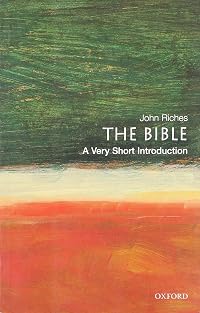
About the author: quoting from the book's cover, "John Riches is Professor of Divinity and Biblical Criticism at the University of Glasgow. His published work includes 'The World of Jesus: First Century Judaism in Crisis' and 'A Century of New Testament Study.' About the book: Joel Marcus of Boston University said of this work, "Short in length, but not in substance, nor in interest. A fascinating introduction both to the way in which the Bible came to be what it is, and what it means and has meant for believers. The examples are well-chosen and involving, and the discussion is erudite and original." This book includes chapter notes, an index of Biblical references and a general index in its 160 pages.
Ratings
Members
- Recently Added By
Author Information
21+ Works 710 Members
John Riches is Emeritus Professor of Divinity and Biblical Criticism at Glasgow University.
Series

Common Knowledge
- Canonical title
- The Bible: A Very Short Introduction
- Original publication date
- 2000
- People/Characters
- Jesus Christ; Moses; Abraham; Isaac, son of Abraham and Sarah; Paul, the Apostle; Desmond Tutu (show all 7); Martin Luther
- Important events
- Reformation; Paul wrote letter to Galatians; Apartheid; Colonization of the Americas
- First words
- It is sometimes said that there are more unread copies of the Bible than of any other book in the world.
- Last words
- (Click to show. Warning: May contain spoilers.)What are required are discriminating readers, alert to its life-giving potential, on their guard against its darker tones.
- Original language
- English
Classifications
Statistics
- Members
- 380
- Popularity
- 82,208
- Reviews
- 5
- Rating
- (3.26)
- Languages
- Chinese, English, Spanish
- Media
- Paper, Audiobook, Ebook
- ISBNs
- 12
- ASINs
- 5