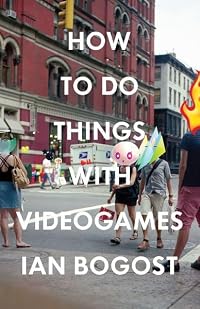
How to Do Things with Videogames (Electronic Mediations)
by Ian Bogost
On This Page
Description
"In recent years, computer games have moved from the margins of popular culture to its center. Reviews of new games and profiles of game designers now regularly appear in the New York Times and the New Yorker, and sales figures for games are reported alongside those of books, music, and movies. They are increasingly used for purposes other than entertainment, yet debates about videogames still fork along one of two paths: accusations of debasement through violence and isolation or defensive show more paeans to their potential as serious cultural works. In How to Do Things with Videogames, Ian Bogost contends that such generalizations obscure the limitless possibilities offered by the medium's ability to create complex simulated realities. Bogost, a leading scholar of videogames and an award-winning game designer, explores the many ways computer games are used today: documenting important historical and cultural events; educating both children and adults; promoting commercial products; and serving as platforms for art, pornography, exercise, relaxation, pranks, and politics. Examining these applications in a series of short, inviting, and provocative essays, he argues that together they make the medium broader, richer, and more relevant to a wider audience. Bogost concludes that as videogames become ever more enmeshed with contemporary life, the idea of gamers as social identities will become obsolete, giving rise to gaming by the masses. But until games are understood to have valid applications across the cultural spectrum, their true potential will remain unrealized. How to Do Things with Videogames offers a fresh starting point to more fully consider games' progress today and promise for the future"--Provided by publisher. show lessTags
Recommendations






Member Reviews
While this is not my favorite book about video games, this is one I finished reading, closed the book and said "finally, a book about games written by a person who actually KNOWS of games". This is not the kind of book I would recommend for gamers. Instead, this is the kind of book I would recommend for people who still think that video games are for children. It is well known that this is far from true since a long time ago, so it's refreshing to see that there are people who actually take games seriously. Bogost goes further than just questioning whether video games incite to violence. He actually did a lot of research and put a lot of effort in explaining why video games are more than "toys": they are another form of media. They have show more their own implications and meanings, their own form of art. In this book you can find not only references to relatively recent games, but also about well-known movies, advertisements and other kinds of media. Additionally, you can see how they relate to games, and why they are so important nowadays.
If you are still skeptical regarding the subject "video games" as something more than "just another tech junk my nephew plays", you should definitely read this book. show less
If you are still skeptical regarding the subject "video games" as something more than "just another tech junk my nephew plays", you should definitely read this book. show less
This short and easy book hits on a number of interesting ideas relating to what videogames can do for their players. Good to read for inspiration, it is sadly lacking in depth. I will check out Bogost's other work, but this book disappointed me somewhat with its lightness.
Main thing is that I'm not the audience of this book. Video game people are. So stripped-down chapters, simplified categories, and sometimes outrageous bits (the 'designing games for Illinois Republicans' is kind of...ick), the TED-esque nonengagement with capitalism as a problem: well, that's fine, so long as I remember that I'm not who the book is for.
I'll take it as a companion volume to parts of Alien Phenomenology.
And the discussion of ET as a game about powerlessness: recommended.
Here's a relevant discussion: https://twitter.com/samplereality/status/341271358778507265
I'll take it as a companion volume to parts of Alien Phenomenology.
And the discussion of ET as a game about powerlessness: recommended.
Here's a relevant discussion: https://twitter.com/samplereality/status/341271358778507265
With every essay in this book, I gained a new insight into videogames. That's as much as one ought to expect from it.
Ratings
Members
- Recently Added By
Lists

Books Read in 2014
2,342 works; 89 members

Read in 2014
334 works; 11 members
Author Information

15+ Works 1,296 Members
Ian Bogost is Ivan Allen College Distinguished Chair in Media Studies and professor of interactive computing at the Georgia Institute of Technology. He is author of many books, including How to Do Things with Videogames and Alien Phenomenology, or What It's Like to Be a Thing (both from the University of Minnesota Press). He is the award-winning show more game designer of A Slow Year, Cow Clicker, and more. show less
Series
Belongs to Publisher Series
Common Knowledge
- Original publication date
- 2011
Classifications
- Genres
- Nonfiction, General Nonfiction, Technology
- DDC/MDS
- 793.93 — Arts & recreation Recreation, sports, and performing arts Games, Puzzles Other indoor diversions Adventure games
- LCC
- GV1469.34 .S52 .B63 — Geography, Anthropology and Recreation Recreation. Leisure Recreation. Leisure Games and amusements Indoor games and amusements Computer games. Video games. Fantasy games
- BISAC
Statistics
- Members
- 142
- Popularity
- 229,697
- Reviews
- 4
- Rating
- (3.74)
- Languages
- English
- Media
- Paper, Ebook
- ISBNs
- 6
- ASINs
- 1