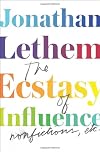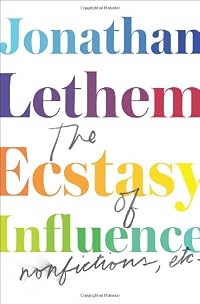
The Ecstasy of Influence: Nonfictions, Etc.
by Jonathan Lethem
On This Page
Description
A career-spanning anthology of writings incorporates several new essays and includes numerous celebrity portraits as well as the author's musings on topics ranging from sex in cinema and drugs to cyberculture and graffiti.Tags
Recommendations








Member Reviews
What’s a novelist supposed to do with contemporary culture? And what’s contemporary culture supposed to do with novelists? In The Ecstasy of Influence, Jonathan Lethem, tangling with what he calls the “white elephant” role of the writer as public intellectual, arrives at an astonishing range of answers.
A constellation of previously published pieces and new essays as provocative and idiosyncratic as any he’s written, this volume sheds light on an array of topics from sex in cinema to drugs, graffiti, Bob Dylan, cyberculture, 9/11, book touring, and Marlon Brando, as well as on a shelf’s worth of his literary models and contemporaries: Norman Mailer, Paula Fox, Bret Easton Ellis, James Wood, and others. And, writing about show more Brooklyn, his father, and his sojourn through two decades of writing, Lethem sheds an equally strong light on himself. show less
A constellation of previously published pieces and new essays as provocative and idiosyncratic as any he’s written, this volume sheds light on an array of topics from sex in cinema to drugs, graffiti, Bob Dylan, cyberculture, 9/11, book touring, and Marlon Brando, as well as on a shelf’s worth of his literary models and contemporaries: Norman Mailer, Paula Fox, Bret Easton Ellis, James Wood, and others. And, writing about show more Brooklyn, his father, and his sojourn through two decades of writing, Lethem sheds an equally strong light on himself. show less
Picked this up just to keep the high going after PKD's Exegesis but he had me with the first line of the first essay, "I came from dropping out; the only thing I knew at the start was to quit before they could fire me."
He's not afraid to leave the slapdash bad ones in here and address that, yes, sometimes there are bad ones and (even better) sometimes you have to leave them in there to fulfill a contractual agreement you signed before you knew better. Yes, sometimes we don't know better. It's brave and unpretentious.
His relationship to SF fandom is fascinating and it informs his appreciation of his fans now. I love it because he and I seem to be walking back and forth across this same bridge everyday.
He comes off as far more show more interesting here than in interviews.
Chronic City is the best novel written about the internet. show less
He's not afraid to leave the slapdash bad ones in here and address that, yes, sometimes there are bad ones and (even better) sometimes you have to leave them in there to fulfill a contractual agreement you signed before you knew better. Yes, sometimes we don't know better. It's brave and unpretentious.
His relationship to SF fandom is fascinating and it informs his appreciation of his fans now. I love it because he and I seem to be walking back and forth across this same bridge everyday.
He comes off as far more show more interesting here than in interviews.
Chronic City is the best novel written about the internet. show less
Jonathan Lethem has read more books than you ever will. This is not surprising, given that the only jobs he held before becoming a successful author, with the exception of a couple of typical teenage food service jobs, were at used book stores. He has also probably listened to more music than you have. Certainly he has more opinions about just about anything than you do. And many of them are in this book!
This is not to say that he is a disagreeable companion. Some of his many passions are of interest: J.G. Ballard, Bob Dylan, Shirley Jackson, James Brown, science fiction in general, Philip K. Dick in particular, Jorge Luis Borges—you get the idea. On 9/11, however, which he witnessed from across the river in Brooklyn, his writing show more during the aftermath is strangely inadequate, but perhaps that isn’t too surprising given the extreme circumstances. He does tell the poignant story of New Yorkers being asked to delete all their voice mail to prevent the final messages from victims trapped in the World Trade Centers from being erased due to system overcapacity, which I had not heard before.
Much of the book amounts to an autobiography, told through accounts of his various interests. I don’t share his fascination with literary movements and critical theory, so his lengthy discussions of the nature of postmodernism and a few other topics was largely meaningless. If the book has any center at all, it is Lethem's assault on modern copyright law, which he contends is designed to benefit corporations rather than serve the public good as copyright was originally intended to. To make his point, his influential essay in the Atlantic, “The Ecstasy of Influence”, was largely compiled from the work of others! The book also includes a work of fiction pulled together in the same way.
Scattered throughout, there are also a few other pieces of fiction, which while not great are still pretty good. Overall, the book would benefit if he had left a little out, but there is still a lot here to enjoy. Lethem recognizes the privilege he has as a popular author of publishing these odds and ends and takes full advantage of it. In so doing, he occasionally takes advantage of his readers as well. show less
This is not to say that he is a disagreeable companion. Some of his many passions are of interest: J.G. Ballard, Bob Dylan, Shirley Jackson, James Brown, science fiction in general, Philip K. Dick in particular, Jorge Luis Borges—you get the idea. On 9/11, however, which he witnessed from across the river in Brooklyn, his writing show more during the aftermath is strangely inadequate, but perhaps that isn’t too surprising given the extreme circumstances. He does tell the poignant story of New Yorkers being asked to delete all their voice mail to prevent the final messages from victims trapped in the World Trade Centers from being erased due to system overcapacity, which I had not heard before.
Much of the book amounts to an autobiography, told through accounts of his various interests. I don’t share his fascination with literary movements and critical theory, so his lengthy discussions of the nature of postmodernism and a few other topics was largely meaningless. If the book has any center at all, it is Lethem's assault on modern copyright law, which he contends is designed to benefit corporations rather than serve the public good as copyright was originally intended to. To make his point, his influential essay in the Atlantic, “The Ecstasy of Influence”, was largely compiled from the work of others! The book also includes a work of fiction pulled together in the same way.
Scattered throughout, there are also a few other pieces of fiction, which while not great are still pretty good. Overall, the book would benefit if he had left a little out, but there is still a lot here to enjoy. Lethem recognizes the privilege he has as a popular author of publishing these odds and ends and takes full advantage of it. In so doing, he occasionally takes advantage of his readers as well. show less
Lethem states in the beginning that often readers get irritated by the self awareness of modern writing. The endless MFA analysing and theorizing about literature is why I didn't major in English lit. While a little navel gazing isn't out of place when reading, the whole "postmodernism" - analysis of analysis of analysis of uber self awareness - the insertion of the author's narcissistic tendencies into the book, if you will - makes me want to spork myself in the eye. Anyway, a couple of good things in here, pop culture riff, the used bookshop, the bit on plaigarism. As much as I like Lethem, this made me go, "Quit rambling and get *on with it". Lethem even mentions the king of observing self referential minutia - Klosterman. Except? show more Klosterman still makes it interesting, Lethem not so much. I know. I'm a philistine. Eh bien. Minor reference to my alma mater. Memo to Lethem: The Fluttering Duck isn't a "coffeehouse". It's a bar. show less
As should probably be expected from a 450-ish page collection of mostly pretty short essays, the quality in this book varied. The title essay, "The Ecstasy of Influence" (it's available online) is a fantastic exploration of plagiarism/influence and hypocrisy, and I found almost all of Lethem's essays on books enjoyable. The stuff about his time as a bookstore clerk confirmed my long-held fear that bookstore clerks really are as judgmental as they seem. The sci-fi and postmodernism stuff was interesting, too. A lot of the music and film stuff didn't quite manage to hold my interest (notable exception: "The Drew Barrymore stories", a short piece, which was delightful).
So, reading this: worthwhile, but skip over the stuff that doesn't show more interest you, and be aware that if you start finding Lethem annoyingly self-serving, you probably tried to read too much at once. show less
So, reading this: worthwhile, but skip over the stuff that doesn't show more interest you, and be aware that if you start finding Lethem annoyingly self-serving, you probably tried to read too much at once. show less
I like books like this, the sort you might term 'lapidarium', or collected essays. However, I thought Lethem's to be a touch to hit-or-miss; some of his writing, especially on his early career as a clerk in a used books shop, is excellent - enthralling, even - but for somebody who has little interest in music journalism, a lot was skippable.
"Our language has no choice but to be self-conscious if it is to be conscious in the first place."
Hit and miss. Keen glances at paradoxes of art, artist, and audience, and at memory-nostalgia. Skimmed the last few sections as the voice and I grew weary, lacking focus or relevance to each other.
Hit and miss. Keen glances at paradoxes of art, artist, and audience, and at memory-nostalgia. Skimmed the last few sections as the voice and I grew weary, lacking focus or relevance to each other.
Members
- Recently Added By
Lists

Creativity and the Creative Process
20 works; 4 members
Author Information

100+ Works 24,603 Members
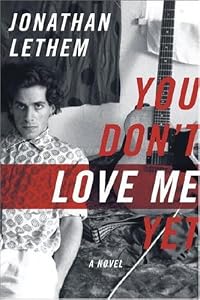
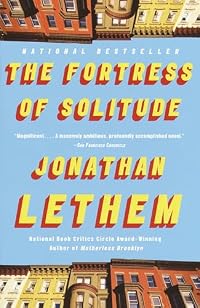
Jonathan Lethem was born in Brooklyn, New York on February 19, 1964. His first novel, Gun, with Occasional Music was published in 1994. His other works include As She Climbed across the Table (1997), Amnesia Moon (1995), The Fortress of Solitude (2003), You Don't Love Me Yet (2007), Chronic City (2009), and Dissident Gardens (2013). He won the show more National Book Critics Circle Award for Motherless Brooklyn (1999). He also writes short stories, comics and essays. His work has appeared in The New Yorker, Harper's, Rolling Stone, Esquire, The New York Times, The Paris Review, McSweeney's and other periodicals and anthologies. (Bowker Author Biography) show less
Some Editions
Awards and Honors
Common Knowledge
- Original publication date
- 2011
Classifications
Statistics
- Members
- 374
- Popularity
- 83,479
- Reviews
- 12
- Rating
- (3.49)
- Languages
- English, German, Italian, Spanish
- Media
- Paper, Audiobook, Ebook
- ISBNs
- 12
- ASINs
- 4