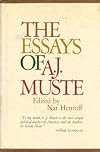
The Essays of A. J. Muste
by A. J. Muste, Nat Hentoff (Editor)
On This Page
Tags
Recommendations


























Member Reviews
Essential essays by an extraordinary yet little-known (to most people) American: A.J. Muste, radical pacifist, political organizer, Dutch Reformed minister, and pragmatic philosopher.
Muste did not espouse a pallid, weak pacifism. His pacifism was fiery and impassioned, one that was solidly built on the recognition that peace is not possible without social justice. A Gandhi of America, he deserves to be read and remembered. This reissue makes it possible.
"The problem after a war is the victor. He thinks he has just proved that war and violence will pay. Who will now teach him a lesson?" (A.J. Muste, 1941)
Muste did not espouse a pallid, weak pacifism. His pacifism was fiery and impassioned, one that was solidly built on the recognition that peace is not possible without social justice. A Gandhi of America, he deserves to be read and remembered. This reissue makes it possible.
"The problem after a war is the victor. He thinks he has just proved that war and violence will pay. Who will now teach him a lesson?" (A.J. Muste, 1941)
A collection of essays compiled and edited by Nat Hentoff, ranging across the career of one of the most respected conscientious pacifists in the United States in the 20th century, sometimes referred to as the "American Gandhi."
Ratings
Members
- Recently Added By
Author Information
21+ Works 297 Members

Nathan Irving Hentoff was born in Boston, Massachusetts on June 10, 1925. He graduated from Northeastern University in 1946. After several years with a Boston radio station, he moved to New York in 1953 and covered jazz for Down Beat until 1957. In 1958, he was a founding editor of The Jazz Review that lasted until 1961. He wrote for The New show more Yorker from 1960 to 1986, for The Washington Post from 1984 to 2000, and for The Village Voice from 1958 to 2009. During his freelance career, his work appeared in Esquire, Harper's, Commonweal, The Reporter, Playboy, The New York Herald Tribune, Jewish World Review, The Wall Street Journal, and The Washington Times. In 1995, he received the National Press Foundation's award for lifetime achievement in contributions to journalism. He wrote more than 35 books during his lifetime. His nonfiction works included The Jazz Life, Peace Agitator: The Story of A. J. Muste, The New Equality, Living the Bill of Rights, and Free Speech for Me - but Not for Thee: How the American Left and Right Relentlessly Censor Each Other. He wrote several memoirs including Boston Boy and Speaking Freely. In 1955, he co-edited with Nat Shapiro Hear Me Talkin' to Ya: The Story of Jazz as Told by the Men Who Made It. His young adult novels included Jazz Country, This School Is Driving Me Crazy, Does This School Have Capital Punishment?, and The Day They Came to Arrest the Book. He died on January 7, 2017 at the age of 91. (Bowker Author Biography) show less
Common Knowledge
- Canonical title
- The Essays of A. J. Muste
Classifications
- Genres
- Nonfiction, General Nonfiction, Politics and Government, Philosophy
- DDC/MDS
- 341.1 — Society, government, & culture Law International Law - United Nations, EU Sources of law of nations
- LCC
- JX1963 .M8455 — Political Science International law, see JZ and KZ (obsolete) International law, see JZ and KZ International arbitration, organization, etc.
Statistics
- Members
- 62
- Popularity
- 500,901
- Reviews
- 2
- Rating
- (4.50)
- Languages
- English
- Media
- Paper
- ISBNs
- 2
- ASINs
- 6