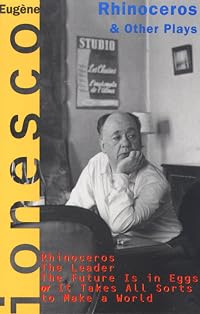
Rhinoceros and Other Plays
by Eugène Ionesco
On This Page
Description
In Rhinoceros, as in his other plays, Eugene Ionesco startles audiences with a world that invariably erupts in explosive laughter and nightmare anxiety. A rhinoceros suddenly appears in a small town, tramping through its peaceful streets. Soon there are two, then three, until the "movement" is universal. This is not an invasion of wild animals, but a transformation of average citizens into beasts, as they learn to move with the times. As the curtain comes down, only one desperate man show more remains. Rhinoceros is a commentary on the absurdity of the human condition made tolerable only by self-delusion. It shows us the struggle of the individual to maintain integrity and identity in a world where all others have succumbed to the "beauty" of brute force and mindlessness. show lessTags
Recommendations


















Member Recommendations
CGlanovsky People are strangely accepting of extremely absurd situations.
Member Reviews
When the master of the absurd writes, it is worth reading. The best work of the three is, of course, Rhinoceros, because it would be hard to top that piece, about people turning into rhinoceroses. The other two are short pieces, and the story and characters are not as well developed, but the title piece is a master stroke that shows the loneliness of individuality, the way that people fall in line behind the latest thing, and generates a lot of wonderful images that allow us to question our own desire to hold onto reality. In the end, with the threatened extinction of the white rhinoceros, one has to ask: would it be all that terrible if people started turning into rhinoceroses?
Lately I've been contemplating the meaning of "Magic Realism." I've seen it put that magic realism is "a polite way of saying you write fantasy." That's not quite so. All fiction requires invention of people, places and events that do not strictly exist. So all fiction requires a bit of fantasy. It's a matter of degree, and I believe "Magic Realism" is a necessary term for a middle ground. I'd say it's when the setting is meant to look very much like the world in which we all live and in which people act very much the way we all would, except that truly bizarre things take place and while the characters don't quite think it's normal their reaction falls far short of that which we would expect. It's when strangeness and absurdity is show more treated as though it were merely curious, inconvenient, or even mundane. Thus far I think "Rhinoceros" fits the mold.
Another critical definition of the genre that carries a bit more weight is that Magic Realism is "fantasy written in Spanish". I do associate the genre very strongly with Latin America, it's true, but I think it's time that that association became more like my association of tragedy with Greece. Having been developed and defined by that place it has clearly burst those bonds and spread throughout the world (see Murakami, Rushdie, Grass, Saramago) and we should embrace that.
Finally, however, perhaps I'm missing something very important: "Rhinoceros" is a play. A lack of knowledge of theater history may mean I fail to see the lineage of the play within a uniquely dramatic context. I could buy that: that the play does not require description according to novelistic terminology because it already has it's own more accurate and meaningful terminology. So let me just say that for the uninitiated reader of dramatic texts who, like me, enjoys a story incorporating the strange and surreal into an otherwise banal environment, this play offers precisely that. Funny, original, vaguely disturbing, evocative of potentially meaningful associations, Ionesco's play is worth a detour away from the novel form. show less
Another critical definition of the genre that carries a bit more weight is that Magic Realism is "fantasy written in Spanish". I do associate the genre very strongly with Latin America, it's true, but I think it's time that that association became more like my association of tragedy with Greece. Having been developed and defined by that place it has clearly burst those bonds and spread throughout the world (see Murakami, Rushdie, Grass, Saramago) and we should embrace that.
Finally, however, perhaps I'm missing something very important: "Rhinoceros" is a play. A lack of knowledge of theater history may mean I fail to see the lineage of the play within a uniquely dramatic context. I could buy that: that the play does not require description according to novelistic terminology because it already has it's own more accurate and meaningful terminology. So let me just say that for the uninitiated reader of dramatic texts who, like me, enjoys a story incorporating the strange and surreal into an otherwise banal environment, this play offers precisely that. Funny, original, vaguely disturbing, evocative of potentially meaningful associations, Ionesco's play is worth a detour away from the novel form. show less
Interesting little volume (as usual with absurdist stuff this is not the case until the last fifteen pages of the book, after which the tedium finally sorts itself out to leave a good impression). A few priceless chuckles...backdrop of stampeding trumpeting rhinoceros former coworkers provides a priceless backdrop to almost any heartwarming interaction.
Rhinocoeros is a very funny play. This slim volume provides the text of this, plus others.
Members
- Recently Added By
Lists

Existentialism
90 works; 11 members

Best of World Literature
437 works; 52 members
Author Information

299+ Works 9,049 Members
Eugene Ionesco, born in Romania in 1912, is known as the father of the theater of the absurd. He grew up in France and Romania, settling in France in 1939. His first play, The Bald Soprano, satirized the deadliness of life frozen in meaningless formalities. Some of his other important plays include The Lesson, The Chairs, Rhinoceros, and Hunger show more and Thirst. His novel Le Solitaire was the basis for the 1971 film La Vase in which Ionesco played the lead. Eugene Ionesco was elected to the Academie Francaise in 1970. He died in 1994. (Bowker Author Biography) show less
All Editions
Common Knowledge
- Alternate titles
- Plays Volume 4
- Disambiguation notice
- Includes Rhinoceros/The Leader/The Future Is In Eggs, or It Takes All Kinds To Make A World
Classifications
Statistics
- Members
- 1,027
- Popularity
- 25,359
- Reviews
- 4
- Rating
- (3.86)
- Languages
- English, Farsi/Persian
- Media
- Paper, Ebook
- ISBNs
- 12
- ASINs
- 12