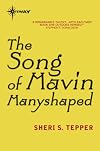
The Song of Mavin Manyshaped
by Sheri S. Tepper
Land of the True Game: Chronological (01 (Mavin 01)), Land of the True Game: Mavin (1), Land of the True Game (4)
On This Page
Description
In this part of the celebrated series, Mavin avoids sexual exploitation by escaping from Donderbat Keep. Others in the series are: The Flight of Mavin Manyshaped and The Search for Mavin Manyshaped (both 1985). Also use: King's Blood Four (1989).Tags
Recommendations






















Member Reviews
Song of Mavin contains the kernels of everything I love about Tepper's work. There's the character herself; a little dreamy but becoming determined and practical, coming into her strength by developing self-reliance and thinking far outside tradition. The threads of horror running through it, and the struggles of sexism, of being assigned by birth to baby-making with only limited freedoms. The convoluted and slow punishment of wanton destruction--very few authors could develop a wicker basket into an instrument of torture. It has her focus on chosen family, empowerment, greed and harmony, but so subtly done compared to her later work.
Where it really differs from later Tepper is the love of words and playfulness in the writing--I felt in show more the first few pages like I was reading "The Jabberwoky" put into prose form--lots of alliteration and wordplay. "Through the p'natti the shifters of all the Xhindi clans came each year at Assembly time, processions of them, stiff selves marching into the outer avenues only to melt into liquid serpentines which poured through the holes in the slything walls; into tall wands of flesh sliding through the narrowing doors; into pneumatic billows bounding over the platforms and up onto the heights all in a flurry of wings, feathers, hides, scales, conceits and frenzies which dazzled the eyes and the senses so that the children became hysterical with it..." By the time I was finished, I started imagining how it would sound aloud, deciding that it would make a lovely bedtime story read.
Since few other reviews have a synopsis, let me just say briefly that there is a young shape-shifter girl named Mavin who comes into her shape-shifting Talent, and discovers it includes obligations that anyone would fear. She encourages her older sister, Handbright, to follow her dream, and then flees the keep with her brother, five year-old Mertyn. They travel, meet the entourage of a Seer and a Wizard, and journey to their first city. Mertyn becomes deathly ill and Mavin sets off seeking a cure, meeting the legendary Shadowpeople and encountering a Ghoul.
Alas that it feels so short, and the development of their new selves so truncated; the pacing is a tad uneven, and perhaps not enough on how Mavin's inner journey progresses once outside the keep she grew up in. Alas as well for the short acid-dream passage near the end. But for that, it would be a five star book for me. It's also notable for being a young adult book with a very strong message on sexual inequality and dysfunction, unfortunately just as pertinent now as thirty years ago.
And kudos for the most innovative characterization of a sloth ever.
Cross posted at: http://clsiewert.wordpress.com/2013/05/29/the-song-of-mavin-manyshaped-by-sheri-... show less
Where it really differs from later Tepper is the love of words and playfulness in the writing--I felt in show more the first few pages like I was reading "The Jabberwoky" put into prose form--lots of alliteration and wordplay. "Through the p'natti the shifters of all the Xhindi clans came each year at Assembly time, processions of them, stiff selves marching into the outer avenues only to melt into liquid serpentines which poured through the holes in the slything walls; into tall wands of flesh sliding through the narrowing doors; into pneumatic billows bounding over the platforms and up onto the heights all in a flurry of wings, feathers, hides, scales, conceits and frenzies which dazzled the eyes and the senses so that the children became hysterical with it..." By the time I was finished, I started imagining how it would sound aloud, deciding that it would make a lovely bedtime story read.
Since few other reviews have a synopsis, let me just say briefly that there is a young shape-shifter girl named Mavin who comes into her shape-shifting Talent, and discovers it includes obligations that anyone would fear. She encourages her older sister, Handbright, to follow her dream, and then flees the keep with her brother, five year-old Mertyn. They travel, meet the entourage of a Seer and a Wizard, and journey to their first city. Mertyn becomes deathly ill and Mavin sets off seeking a cure, meeting the legendary Shadowpeople and encountering a Ghoul.
Alas that it feels so short, and the development of their new selves so truncated; the pacing is a tad uneven, and perhaps not enough on how Mavin's inner journey progresses once outside the keep she grew up in. Alas as well for the short acid-dream passage near the end. But for that, it would be a five star book for me. It's also notable for being a young adult book with a very strong message on sexual inequality and dysfunction, unfortunately just as pertinent now as thirty years ago.
And kudos for the most innovative characterization of a sloth ever.
Cross posted at: http://clsiewert.wordpress.com/2013/05/29/the-song-of-mavin-manyshaped-by-sheri-... show less
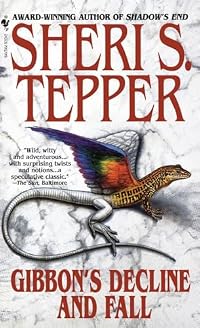
It's interesting how some people on LibraryThing hate this cover, but I find these antiquated fantasy covers genuinely beautiful, and furthermore I would take this any day over whatever generic AI slop you find on the cover of Booktok's book du jour.
This is a story about a young girl named Mavin who learns to shapeshift, in part to escape the horrifying sexual predations of her uncles in Danderbat Keep. She encounters Ghouls, Wizards, Seers, and strange furred little creatures that grace the beautiful cover (I guess I'm going to die on this hill.) It's an odd tale in many ways, there almost feels like there is a touch of LITRPG in this. It's strange but fascinating. Sometimes, I love reading old fantasy, because all the tropes we know show more and love haven't solidified yet, and you see strange combinations of lore, odd character choices, and weird storytelling tics that actually liven the book up. This isn't your paint by number routine because they were still working out the numbers people liked. This is in it's favour.
I had a good time with these stories: it's a shame they are so hard to track down but there is a lot to like for any devoted fantasy fan. Interesting and unique diversion, short and sweet. show less
This is a story about a young girl named Mavin who learns to shapeshift, in part to escape the horrifying sexual predations of her uncles in Danderbat Keep. She encounters Ghouls, Wizards, Seers, and strange furred little creatures that grace the beautiful cover (I guess I'm going to die on this hill.) It's an odd tale in many ways, there almost feels like there is a touch of LITRPG in this. It's strange but fascinating. Sometimes, I love reading old fantasy, because all the tropes we know show more and love haven't solidified yet, and you see strange combinations of lore, odd character choices, and weird storytelling tics that actually liven the book up. This isn't your paint by number routine because they were still working out the numbers people liked. This is in it's favour.
I had a good time with these stories: it's a shame they are so hard to track down but there is a lot to like for any devoted fantasy fan. Interesting and unique diversion, short and sweet. show less
Mavin keeps her new ability to shift a secret from all but her man-beleaguered elder sister which gives her just time enough to plan and escape that fate. This compact adventure is a gem, only hampered a bit by being trimmed to precede the original 3 novels of the True Game.
Read: The Song of Mavin Manyshaped, Sheri S Tepper
I read a lot of Tepper back in the late 1990s, and I’m not entirely sure why I stopped, because her books were generally good. She’s notable for starting her career late - she was in her fifties when her first novel was published. So never give up. The Song of Mavin Manyshaped is an early work, her fourth or fifth book, I think, and the first of a trilogy set on a fantasy world populated by numerous different races, which later proves to be a trilogy of trilogies and, in fact, science fiction of a sort. Mavin is a Shifter, although she has yet to come into her Talent. She’s one of only two female Shifters in Panderbat, and it’s clearly implied the women are there to provide show more sexual services for the male Shifters, and to bear children too, of course. But Mavin is not yet old enough, and her older sister is apparently infertile. After developing her Shifting ability in secret, Mavin escapes Panderbat and flees to a friendly relative’s castle. En route, her young brother - who develops a different Talent - is taken ill with “ghoul plague”, so Mavin must help the shadowpeople and defeat the ghoul king in order to cure her brother and set everything to rights. There’s numerous references to games and such, as if the world itself were a gameboard, which makes everything seem especially unreal - and reminds me a little of Jack Chalker’s Wellworld series, and… I’m sure there’s another one but it escapes me. Not The Player of Games by Iain M Banks. Vance, probably. Anyway. It’s all very light and inconsequential, but the feminist ire burns through, and I’m surprised these early works aren’t as well known as Tepper’s later novels. An oeuvre definitely worth exploring. show less
I read a lot of Tepper back in the late 1990s, and I’m not entirely sure why I stopped, because her books were generally good. She’s notable for starting her career late - she was in her fifties when her first novel was published. So never give up. The Song of Mavin Manyshaped is an early work, her fourth or fifth book, I think, and the first of a trilogy set on a fantasy world populated by numerous different races, which later proves to be a trilogy of trilogies and, in fact, science fiction of a sort. Mavin is a Shifter, although she has yet to come into her Talent. She’s one of only two female Shifters in Panderbat, and it’s clearly implied the women are there to provide show more sexual services for the male Shifters, and to bear children too, of course. But Mavin is not yet old enough, and her older sister is apparently infertile. After developing her Shifting ability in secret, Mavin escapes Panderbat and flees to a friendly relative’s castle. En route, her young brother - who develops a different Talent - is taken ill with “ghoul plague”, so Mavin must help the shadowpeople and defeat the ghoul king in order to cure her brother and set everything to rights. There’s numerous references to games and such, as if the world itself were a gameboard, which makes everything seem especially unreal - and reminds me a little of Jack Chalker’s Wellworld series, and… I’m sure there’s another one but it escapes me. Not The Player of Games by Iain M Banks. Vance, probably. Anyway. It’s all very light and inconsequential, but the feminist ire burns through, and I’m surprised these early works aren’t as well known as Tepper’s later novels. An oeuvre definitely worth exploring. show less
Sherri S. Tepper wrote three delightful little interconnected fantasy trilogies with a science fiction core back in the 1980s. These books are now rather obscure and quite difficult to find. The first trilogy features the eponymous Mavin Many-Shaped; the second, her son Peter; and the third, his sweetheart Jinian. I stumbled over the series bass-ackwards during my peripatetic youth. I spent a few years traveling between seasonal jobs and habitually browsed used bookstores to pick up cheap, interesting paperbacks, then discarded them at the next stop (I went through a lot of Dick Francis novels that way).
Thus I found Jinian Footseer. It was an imaginative fantasy novel featuring an intrepid young heroine confronting the challenges of show more adolescence as much as her magical quest, and very much a palate cleanser after the many derivative works I’d ingested by that point. About ten years ago, after I settled down, I visited a local bookstore and found The True Game omnibus edition of the Peter stories alongside The End of the Game omnibus of the Jinian stories. Although I typically do not purchase hardcover fiction, I did not hesitate to acquire these two volumes. I finally got to read Jinian’s entire story and the complementary Peter storyline. They were very much worth the wait.
I lacked only the Mavin books. Over the years, I patiently scoured used bookstores everywhere. I search online as well without success. But last year, finally, the local Half-Price Books had the entire trilogy in excellent condition—clearly someone had liquidated their inventory to my benefit. The broad parameters of the Mavin books were no surprise, given that I was already familiar with later events that built upon the earlier stories, but that did not hinder the joy of discovery. These books are all keepers, and I am glad that I can finally stop searching.
The series addresses fundamental social issues. The Mavin books feature strong feminist themes, while the Peter books (King's Blood Four, Necromancer Nine, and Wizard's Eleven) concentrate on class differences and more general social justice. Finally, the Jinian books (Jinian Footseer, Dervish Daughter, and Jinian Star-eye) take all of these and combine them with spiritual and environmental concerns on par with Aldo Leopold’s land ethic in something of a science fiction context of first contact.
The stories take place primarily in the Land of the True Game, where Gamesmen have various magical talents, such as teleporting (Elators), mindreading (Demons), telekinesis (Tragamors), flying (Sentinels), beguiling (Kings, Queens, etc.), and changing shape (Shifters). Their frequently short, interesting lives generally consist of exercising their talents in various Games, which range from one-on-one duels to large-scale wars. Caught up in these Games as well are the untalented lower-class pawns who actually keep civilization going as farmers, merchants, servants, etc. And a third class of people are the Immutables who not only are immune to the talents of Gamesmen, but also effectively neutralize their talents, thus creating a safe zone bordering the Land of the True Game.
Being a biology geek, I love the mix of familiar and strange: horses and zellers, rabbits and bunwits. Tepper creates a delightful alien world with its own ecology and logic. From the arboreal towns that straddle giant tree limbs crossing the depths of an enormous chasm in The Flight of Mavin Many-Shaped to the self-aware Chimmerdong Forest in Jinian Footseer, Tepper explores how nature and culture might commingle in new and interesting ways. Also, I particularly enjoyed the scathing satire of academia reduced to absurdity in Necromancer Nine.
In The Song of Mavin Many-Shaped, Mavin grows into her shifterish talent secretly at the onset of puberty so that she can flee her abusive home with her younger brother and free her older sister, the sole adult woman remaining in the family compound, who has been systematically raped and beaten by the family elders. As Mavin (along with her brother) hides from pursuers, she meets the Shadowpeople and the young man who becomes the Wizard Himaggery and falls into adventure.
The largest deficit in this series is the lack of diversity. In effect, we have an entire human colony filled with only white people as far as I can tell. And all of the characters are straight and able-bodied and so on. The characters are not particularly deep or complex, not surprising in plot-driven novels that average less than two hundred pages each. And they follow the standard fantasy formula of good triumphing over evil, with characters readily falling in one camp or the other. This is not to say that poignancy is lacking. Each trilogy has a bittersweet ending that encompasses profound loss as part of the cost of success, all part of the heroic formula, I suppose, along the lines of sacrifice for the greater good. And depending on your politics, you may object to the underlying political/ethical/moral messages in these stories. Personally, the Shadowpeople’s traditional greeting resonates: lolly duro balta lus lom (walk well upon the lovely land). show less
Thus I found Jinian Footseer. It was an imaginative fantasy novel featuring an intrepid young heroine confronting the challenges of show more adolescence as much as her magical quest, and very much a palate cleanser after the many derivative works I’d ingested by that point. About ten years ago, after I settled down, I visited a local bookstore and found The True Game omnibus edition of the Peter stories alongside The End of the Game omnibus of the Jinian stories. Although I typically do not purchase hardcover fiction, I did not hesitate to acquire these two volumes. I finally got to read Jinian’s entire story and the complementary Peter storyline. They were very much worth the wait.
I lacked only the Mavin books. Over the years, I patiently scoured used bookstores everywhere. I search online as well without success. But last year, finally, the local Half-Price Books had the entire trilogy in excellent condition—clearly someone had liquidated their inventory to my benefit. The broad parameters of the Mavin books were no surprise, given that I was already familiar with later events that built upon the earlier stories, but that did not hinder the joy of discovery. These books are all keepers, and I am glad that I can finally stop searching.
The series addresses fundamental social issues. The Mavin books feature strong feminist themes, while the Peter books (King's Blood Four, Necromancer Nine, and Wizard's Eleven) concentrate on class differences and more general social justice. Finally, the Jinian books (Jinian Footseer, Dervish Daughter, and Jinian Star-eye) take all of these and combine them with spiritual and environmental concerns on par with Aldo Leopold’s land ethic in something of a science fiction context of first contact.
The stories take place primarily in the Land of the True Game, where Gamesmen have various magical talents, such as teleporting (Elators), mindreading (Demons), telekinesis (Tragamors), flying (Sentinels), beguiling (Kings, Queens, etc.), and changing shape (Shifters). Their frequently short, interesting lives generally consist of exercising their talents in various Games, which range from one-on-one duels to large-scale wars. Caught up in these Games as well are the untalented lower-class pawns who actually keep civilization going as farmers, merchants, servants, etc. And a third class of people are the Immutables who not only are immune to the talents of Gamesmen, but also effectively neutralize their talents, thus creating a safe zone bordering the Land of the True Game.
Being a biology geek, I love the mix of familiar and strange: horses and zellers, rabbits and bunwits. Tepper creates a delightful alien world with its own ecology and logic. From the arboreal towns that straddle giant tree limbs crossing the depths of an enormous chasm in The Flight of Mavin Many-Shaped to the self-aware Chimmerdong Forest in Jinian Footseer, Tepper explores how nature and culture might commingle in new and interesting ways. Also, I particularly enjoyed the scathing satire of academia reduced to absurdity in Necromancer Nine.
In The Song of Mavin Many-Shaped, Mavin grows into her shifterish talent secretly at the onset of puberty so that she can flee her abusive home with her younger brother and free her older sister, the sole adult woman remaining in the family compound, who has been systematically raped and beaten by the family elders. As Mavin (along with her brother) hides from pursuers, she meets the Shadowpeople and the young man who becomes the Wizard Himaggery and falls into adventure.
The largest deficit in this series is the lack of diversity. In effect, we have an entire human colony filled with only white people as far as I can tell. And all of the characters are straight and able-bodied and so on. The characters are not particularly deep or complex, not surprising in plot-driven novels that average less than two hundred pages each. And they follow the standard fantasy formula of good triumphing over evil, with characters readily falling in one camp or the other. This is not to say that poignancy is lacking. Each trilogy has a bittersweet ending that encompasses profound loss as part of the cost of success, all part of the heroic formula, I suppose, along the lines of sacrifice for the greater good. And depending on your politics, you may object to the underlying political/ethical/moral messages in these stories. Personally, the Shadowpeople’s traditional greeting resonates: lolly duro balta lus lom (walk well upon the lovely land). show less
Early Tepper!
This has been kicking around under my ownership for a while, and I decided to read it now because the title character was mentioned, in passing, in the last Patricia McKillip book I read (Od Magic). This made me go, "Huh, is Mavin a mythological character, not just a fictional character?" No. It's just an homage.
Still, it deserves an homage.
I really liked this book. It does show that it's an early work (1985, her 4th or 5th novel, I believe). This is both good and bad. The prose is less masterful and some elements of the plot are more 'typical' than in her later works. However, while the strong feminist elements that Tepper is known for are indubitably here, the tone is less didactic than in her more recent books.
Mavin is show more a young woman who has grown up in an isolated community of rather inbred shapeshifters. This generation, the group is experiencing a severe lack of women. When the rather naive Mavin finally realizes what this situation will mean she is expected to do when she comes of age, she decides to break with tradition and set off on her own to gain her independence and discover her abilities. Unexpectedly, she is soon caught up in an adventure involving plots, politics, plague, and a legendary race of beings called 'shadowpeople.' show less
This has been kicking around under my ownership for a while, and I decided to read it now because the title character was mentioned, in passing, in the last Patricia McKillip book I read (Od Magic). This made me go, "Huh, is Mavin a mythological character, not just a fictional character?" No. It's just an homage.
Still, it deserves an homage.
I really liked this book. It does show that it's an early work (1985, her 4th or 5th novel, I believe). This is both good and bad. The prose is less masterful and some elements of the plot are more 'typical' than in her later works. However, while the strong feminist elements that Tepper is known for are indubitably here, the tone is less didactic than in her more recent books.
Mavin is show more a young woman who has grown up in an isolated community of rather inbred shapeshifters. This generation, the group is experiencing a severe lack of women. When the rather naive Mavin finally realizes what this situation will mean she is expected to do when she comes of age, she decides to break with tradition and set off on her own to gain her independence and discover her abilities. Unexpectedly, she is soon caught up in an adventure involving plots, politics, plague, and a legendary race of beings called 'shadowpeople.' show less
Finished this book so easily! I can just step right into Sheri's worlds and trust that I won't get out until I am ready. Usually that means that I take my time with her books and enjoy the stay, but this was a quick read and I got to the end before I realized! Mavin is a wonderful character, so wise at such a young age. I just love how she goes against the grain of traditional teaching to figure out her own way of being, which causes her to become so much more.
I just love Sheri S. Tepper. Plain and simple. This book is linked with the King's Blood Four series but more of a prequel. It explains how Mavin Manyshaped comes to be and I just love the character. She is definitely a strong female lead! I'm about a quarter of the way in....
I just love Sheri S. Tepper. Plain and simple. This book is linked with the King's Blood Four series but more of a prequel. It explains how Mavin Manyshaped comes to be and I just love the character. She is definitely a strong female lead! I'm about a quarter of the way in....
Members
- Recently Added By
Lists

Female Protagonist
1,056 works; 56 members
Talk Discussions
Past Discussions
Frolic of the Festive Furries in Good Show Sir! — bad science fiction and fantasy covers (December 2024)
Author Information

80+ Works 25,705 Members
Sheri S. Tepper was born Shirley Stewart Douglas on July 16, 1929 near Littleton, Colorado. She held numerous jobs before becoming a full-time author including working at Rocky Mountain Planned Parenthood from 1962 to 1986, eventually becoming the executive director. In the early 1960s, she wrote poems and children's stories under the name Sheri show more S. Eberhart. In the 1980s, she became a feminist and science fiction/fantasy writer. Her books include The Revenants, After Long Silence, The Gate to Women's Country, Grass, Shadow's End, Gibbon's Decline and Fall, The Family Tree, Six Moon Dance, Singer from the Sea, The Fresco, The Visitor, The Companions, and The Margarets. She received the Locus Award for Beauty and a World Fantasy life achievement award in 2015. She also wrote horror under the name E. E. Horlak and mysteries under the names A. J. Orde and B. J. Oliphant. She died on October 22, 2016 at the age of 87. (Bowker Author Biography) show less
Some Editions
Series


Work Relationships
Is contained in
Common Knowledge
- Canonical title
- The Song of Mavin Manyshaped
- Original publication date
- 1985
- People/Characters
- Mavin Manyshaped; Mertyn; Windlow
- First words
- Around the inner maze of Danderbat keep - with its hidden places for the elders, its sleeping chambers, kitchens and nurseries - lay the vaster labyrinth of the outer p'natti: slything walls interrupted by square-form doors, ... (show all)an endless array of narrowing pillars, climbing ups and slithering downs, launch platforms so low as to require only leaping legs and others so high that wings would be the only guarantee of no injury.
Classifications
Statistics
- Members
- 389
- Popularity
- 79,982
- Reviews
- 10
- Rating
- (3.78)
- Languages
- English
- Media
- Paper, Ebook
- ISBNs
- 2
- ASINs
- 1