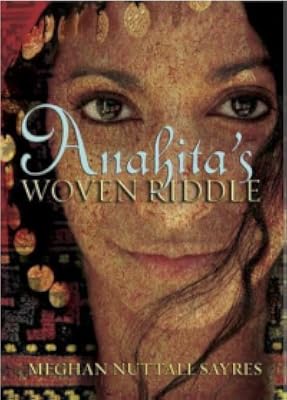
Anahita's Woven Riddle
by Meghan Nuttall Sayres 
On This Page
Description
In Iran, more than 100 years ago, a young girl with three suitors gets permission from her father and a holy man to weave into her wedding rug a riddle to be solved by her future husband, which will ensure that he has wit to match hers.Tags
Recommendations









Member Recommendations
Member Reviews
Anahita is a young woman from a nomadic tribe living in 19th century Iran. She is an excellent weaver, a dyemaster's unofficial apprentice, and very skilled at concocting riddles to amuse her father. She is also outspoken and innovative. Not the best traits for a young woman of Iran. Now, her father comes to her and tells her that the local khan has offered for her hand in marriage. Anahita is horrified. The khan is old, fat, and creepy. Plus, his last three wives have all died suddenly. She does not want her wedding dress to double as a funeral shroud. To avoid this marriage she pleads with her father to allow her to hold a riddle contest. She will weave her dowry rug and place within the fabric a riddle. Whoever can guess her riddle show more will become her new husband. However, as Anahita begins to weave she wonders if this contest is such a good idea. The khan could win after all and she would be married to a cruel man who uses the tribe's acces to water as leverage to force her into marriage. On the other hand, perhaps one of the three men she admires will win. There is the village lad she has grown up alongside, the new teacher who has taught her to read, and there is the mysterious stranger that she met at market. Which name will she weave beside her own in her riddle of silk and wool? show less
I thought the cultural details were interesting, but I felt they were often included at the expense of the story and writing. I also felt like the author was speaking down to the reader because it is YA.
Anahita is a Persian nomad who is about to reach the age of marriage. Her father is considering an arranged marriage, as is tradition, with the local khan. The match, while not appealing to Anahita, would be politically helpful to her tribe. A strong willed and independent minded young woman, Anahita gets her father to agree to the unprecedented, a contest for her hand in marriage. The suitor who can solve the riddle she has woven into her wedding carpet will be the man she marries. The stories of several potential suitors, including a prince, teacher, and childhood friend, are intertwined with the story of the preparation for Anahita leading up to the contest. Anahita dares to demand more from life that is typically allowed women in show more her culture and in the end is rewarded with the promise of her yar, her soul mate.
Sayres creates rich descriptions of life in Persia more than a hundred years ago.
The themes in the book, much like the riddle contest, focus on opposing life forces such as self-interest versus the interests of the community, the familiar versus the unknown, and the traditional versus the modern. A list of characters, place names, and glossary are included and the Farsi used in the text is explained in context. The exploration of another culture in an earlier time with a side of almost fairy-tale romance results in a satisfying read. show less
Sayres creates rich descriptions of life in Persia more than a hundred years ago.
The themes in the book, much like the riddle contest, focus on opposing life forces such as self-interest versus the interests of the community, the familiar versus the unknown, and the traditional versus the modern. A list of characters, place names, and glossary are included and the Farsi used in the text is explained in context. The exploration of another culture in an earlier time with a side of almost fairy-tale romance results in a satisfying read. show less
This book is extremely well-written, intriguing, and inspiring as well as educational. I enjoyed reading about 19th century Iran and the courageous, brave young Anahita who is a hero for young women. This book touched me very deeply in a personal way because at the time I read it, I was faced with a difficult decision of who I would marry, just as Anahita was. Anahita is a skilled weaver whose father has proposed she marry a man she does not love. She convinces him to allow her a test of wits. Whoever can solve her riddle which she has woven into her tapestry, then she will marry that man. I enjoyed the beautiful descriptions that felt as though I were standing right there in her tent with her, experiencing what she experienced. I loved show more the parts where she interacted with the dyemaster as an apprentice. What a lovely story that is sure to be enjoyable for all ages! show less
A quite charming coming of age/choosing a suitor tale set in 19th century Iran with all sort of interesting bits about weaving and dyeing, changing women's roles in muslim countries, nomadic peoples, the problem of figuring out how to balance one's duty to oneself and one's family - well really its all stuff that interests me so I had great fun. The book is well written, although it needed a slightly better copy editor -there were some typos and a few homophones that needed fixing. The pacing flagged a little bit in a couple of places and the unwanted suitor became more of a caricature as the book progressed, but these were minor flaws that didn't destroy my enjoyment.
If these are subjects that interest you then I think you will like show more the book. show less
If these are subjects that interest you then I think you will like show more the book. show less
This beautiful books traces the story of Anahita, a nomadic young woman in 19th century Iran who is trying to find her own way. When her father proposes that she marry the local khan, she asserts her own will and ends up weaving a riddle into her wedding qali or rug. Throughout the year that proceeds the actual riddle, the book follows her in her journey into adulthood and the tribes movements over Iran. This book presents the complexity of a young woman growing up in a society in the midst of great change and uses her weaving to look at the transitions of life. Middle school and high school readers would benefit from this book that has the feel of a fairy tale yet the true reality of a nomadic life are presently honestly. Sayres makes show more this difficult balance work by the truth of Anahita's voice, which pulls the reader inside her world in all its complications. show less
Anahita is a member of a nomadic tribe in 14th (?) century Iran; a time when women do not make many choices for themselves and wives go off to live with their husband's family. She is of marrying age and the local khan wants to her to be his 4th wife (the others have all died). Anahita finds him disgusting and does not want to wed him although it would be wise to do so for the good of her tribe.
She convinces her father to allow her to hold a riddle contest to choose her husband. Whoever can solve the riddle she weaves in her wedding rug will become her groom. Throughout the book, we meet several possible suitors as Anahita begins to see the results of her choice not to marry the khan.
A wonderful tale of a time that I've not often come show more across in my readings. While it is quite suitable as a YA book, as an adult, I did not feel like it was at all childish. With a cast of characters in the front and a glossary of foreign terms in the back, the book is easily followed.
It did take me the first couple of chapters to become fully engrossed in the story, but I soon was drawn in to the question of Anahita's future. The characters are pretty well developed and it is heartening that the main suitors are interested in Anahita for more than just her beauty, even if that is what first drew them to her. The historical aspect is just a bonus, to be learning about the past of this country that is still a mystery to me today.
I recommend this book to anyone who enjoys reading about other places and times and while it is more a coming of age story than an all out romance, and sometimes Anahita can seem childish, her desire for love and not just an arranged marriage is beautiful. show less
She convinces her father to allow her to hold a riddle contest to choose her husband. Whoever can solve the riddle she weaves in her wedding rug will become her groom. Throughout the book, we meet several possible suitors as Anahita begins to see the results of her choice not to marry the khan.
A wonderful tale of a time that I've not often come show more across in my readings. While it is quite suitable as a YA book, as an adult, I did not feel like it was at all childish. With a cast of characters in the front and a glossary of foreign terms in the back, the book is easily followed.
It did take me the first couple of chapters to become fully engrossed in the story, but I soon was drawn in to the question of Anahita's future. The characters are pretty well developed and it is heartening that the main suitors are interested in Anahita for more than just her beauty, even if that is what first drew them to her. The historical aspect is just a bonus, to be learning about the past of this country that is still a mystery to me today.
I recommend this book to anyone who enjoys reading about other places and times and while it is more a coming of age story than an all out romance, and sometimes Anahita can seem childish, her desire for love and not just an arranged marriage is beautiful. show less
Members
- Recently Added By
Lists

Favorite Romance Fiction
247 works; 115 members
Author Information

5+ Works 294 Members
Meghan Nuttall Sayres is a LibraryThing Author, an author who lists their personal library on LibraryThing.
Awards and Honors
Distinctions
Notable Lists
Common Knowledge
- Canonical title
- Anahita's Woven Riddle
- Original publication date
- 2008
- Important places
- Persia
- Epigraph
- Here in this carpet lies an ever-lovely spring;
Unscorched by summer's ardent flame,
Safe too from autumn's boisterous gales,
Midwinter's cruel ice and snow,
'Tis gaily blooming still.
The handsome border... (show all) is the garden wall
Protecting, preserving the Park within
For refuge and renewal; a magic space.
--unknown Sufi poet - Dedication
- For Mojdeh, Farhad, Nanas, and Anahita
To weavers everywhere
And to those who -- like nomads -- seek greener pastures - First words
- "Baba, I have a riddle for you," Anahita said, standing among the pregnant ewes corralled for an early spring shearing.
- Last words
- (Click to show. Warning: May contain spoilers.)Anahita smiled and thought, Only one short year ago, I argued with Maman that I would never weave a stranger's name into my wedding qali.
Classifications
- Genres
- Fiction and Literature, Kids, Tween, Teen, Young Adult
- DDC/MDS
- 813.6 — Literature & rhetoric American literature in English American fiction in English 2000-
- LCC
- PZ7 .S27585 .A — Language and Literature Fiction and juvenile belles lettres Fiction and juvenile belles lettres Juvenile belles lettres
- BISAC
Statistics
- Members
- 266
- Popularity
- 121,692
- Reviews
- 19
- Rating
- (3.77)
- Languages
- English
- Media
- Paper, Ebook
- ISBNs
- 5
- ASINs
- 4