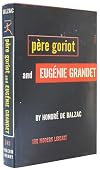
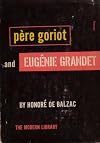
Père Goriot / Eugénie Grandet
by Honoré de Balzac
Studies of Manners (Collections and Selections — 22, 29), The Human Comedy (Collections and Selections — 26, 37)
On This Page
Description
Wealthy and doting father impoverishes himself in securing brilliant marriages for his ambitious daughters. Symbolizes the extravagance of paternal sacrifice.Tags
Recommendations




















Member Reviews
Père Goriot is, as much as anything, a character study of several residents of a Paris boarding house during the Bourbon Restoration. The title character is a retired vermicelli manufacturer sliding deeper and deeper into poverty as his two daughters, a comtesse and a baroness, divest him of everything he owns of value to fund their lavish lifestyles. The protagonist of the novel is actually the young law student Eugène de Rastignac, son of a noble but poor provincial family. Eugène’s sympathy for Old Goriot grows as he learns more of Goriot’s circumstances and of his love for his daughters. Goriot welcomes Eugène into his affections and encourages his affair with the younger daughter, the baroness de Nucingen. It’s also a show more tale of Eugène’s gradual corruption under the influence of the crook Vautrin. It’s an interesting glimpse of Parisian society at that point in time. I would have enjoyed it more without the melodrama. show less
Balzac was a French writer of the first half of the 19th century, with an unconventional way of describing and exposing the conventions of contemporary France. This book is actually two novels. "Pere Goriot" is the story of Eugene de Rastignac, a poor but ambitious social-climber who falls in love with the married daughter of a boarding-house mate, Pere Goriot. Goriot is a man whose entire being consists of father-love and sacrifice for his two daughters, who have married wealthy if not well. Eugene sees Delphine as not only his love, but a means toward the social success he craves. He is nearly led from his chosen path by Vautrin, another housemate who has recognized and rejected the hypocrisies of society, choosing to live only by his show more own lights as he sees them. When Eugene at the end sees the cruelties of high society for what they are, it leads to as satisfying a conclusion as I have seen in some time. "Eugenie Grandet", a somewhat depressing story about the young daughter of a wealthy miser and how her naivete is shattered by the avarice of those around her, is a less satisfying tale and leaves the reader feeling as sad and disillusioned as Eugenie. show less
I became furious at Pere Goriot for being such a chump. I don't see the value of this book.
Historia trata sobre una heroína, hija de un acaudalado inversionista, la cual se ve asediada por dos familias burguesas que buscan su mano. Ella permanece fiel a su verdadero amor, su primo Charles. Asfixiada por las convenciones sociales y por la avaricia de su padre, su temperamento sumiso se rebela por amor. Pero ese mismo amor que la ayuda a madurar es tambien el causante de su soledad, la monotonia y la melancolia que enmarcan su esteril existencia.
Oct 14, 2018Spanish
Ratings
Members
- Recently Added By
Lists

Favorite French Fiction
209 works; 93 members
Author Information

Born on May 20, 1799, Honore de Balzac is considered one of the greatest French writers of all time. Balzac studied in Paris and worked as a law clerk while pursuing an unsuccessful career as an author. He soon accumulated enormous debts that haunted him most of his life. A prolific writer, Balzac would often write for 14 to-16 hours at a time. show more His writing is marked by realistic portrayals of ordinary, but exaggerated characters and intricate detail. In 1834, Balzac began organizing his works into a collection called The Human Comedy, an attempt to group his novels to present a complete social history of France. Characters in this project reappeared throughout various volumes, which ultimately consisted of approximately 90 works. Some of his works include Cesar Birotteau, Le Cousin Pons, Seraphita, and Le Cousine Bette. Balzac wed his lifelong love, Eveline Hanska in March 1850 although he was gravely ill at the time. Balzac died in August of that year. (Bowker Author Biography) show less
Some Editions
Series

Studies of Manners
60 works (Collections and Selections — 22, 29)

The Human Comedy
94 works (Collections and Selections — 26, 37)
Belongs to Publisher Series
Work Relationships
Contains
Common Knowledge
- Canonical title
- Père Goriot / Eugénie Grandet
- Original title
- Eugénie Grandet [suivi de] Le Père Goriot
- Dedication
- Didziajam ir slovingajam Zofrua Sent-Ilerui, reiksdamas susizavejima jo veikalais ir genijumi, - de Balzakas
- First words
- Ponia Voke, mergautine pavarde de Konflan, apysene moteris, jau keturiasdesimt metu Paryziuje laiko miestieciu pensiona Nev Sent Zenevjevos gatveje, tarp Lotynu kvartalo ir Sen Marso priemiescio.
- Last words
- (Click to show. Warning: May contain spoilers.)Ir, iskvietes i kova Visuomene, Rastinjakas pirmuoju zygiu nuejo pietu pas ponia de Nusingen.
Classifications
- Genres
- Fiction and Literature, General Fiction
- DDC/MDS
- 843.73 — Literature & rhetoric French Literature French fiction Constitutional monarchy 1815–48 Balzac, Honoré de 1799–1850
- LCC
- PZ3 .B22 .P — Language and Literature Fiction and juvenile belles lettres Fiction and juvenile belles lettres Fiction in English
Statistics
- Members
- 305
- Popularity
- 105,445
- Reviews
- 4
- Rating
- (3.77)
- Languages
- 5 — Czech, English, French, Lithuanian, Spanish
- Media
- Paper
- ISBNs
- 6
- ASINs
- 23