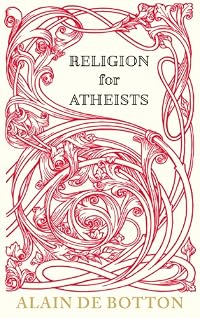
Religion for Atheists: A non-believer's guide to the uses of religion
by Alain De Botton
On This Page
Description
What if religions are neither all true nor all nonsense? The long-running and often boring debate between believers and non-believers is finally moved forward by Alain de Botton's inspiring book, which boldly argues that the supernatural claims of religion are entirely false--but that it still has some very important things to teach the secular world. Religion for Atheists suggests that rather than mocking religion, agnostics and atheists should instead steal from it--because the world's show more religions are packed with good ideas on how we might live and arrange our societies. Blending deep respect with total impiety, de Botton (a non-believer himself) proposes that we look to religion for insights into how to, among other concerns, build a sense of community, make our relationships last, overcome feelings of envy and inadequacy, inspire travel and reconnect with the natural world.--From publisher description. show lessTags
Recommendations





Member Recommendations
Member Reviews
Thankfully half the book are illustrations, so it's only half as long as it seems. There's a legitimate conversation to be had about the lack of "third places" in society - this ain't it. The book is an uncritical look at 10 aspects from architecture to kindness, where religion is presented as having 'got it' and atheism/secular society has failed. Botton has some unexplained gripe with a libertarian boogeyman as well, presented as if they had some significant impact on society - most of the time it seems to be a stand-in for strikes against capitalism or consumerism.
The argumentation goes a little like; isn't architecture soulless and ugly? Aren't churches awe-inspiring and pretty? Atheism/libertarianism is wrong to deprive us of show more beauty and we should find ways of returning to tradition by having prettier buildings. The cause and effect is all over the place and who's being blamed for the status quo makes no sense whatsoever, and apparently the megachurches that look like malls or the hole in the wall prayer rooms don't count, only pretty churches do, and represent religion as a whole.
Art is similarly "stolen" from its religious contexts and this is bad because museum goers aren't worshipping the pictures, but maybe if we arrange art thematically (Botton helpfully includes detailed museum plans for this) then by walking through the "Gallery of Suffering", Compassion, Fear, Love and Self-Knowledge we can approach what the religious get out of the Stations of the Cross? Huh?
Now these gripes about the ugly modern world and returning to tradition are staples of far right opinion makers, as well as the calls for more "community" - Botton is presumably diametrically opposed to all that but doesn't make his argument any more coherent than those pining for the lost golden age.
Other missed swings includes a defense of the liberal arts against the commercialization of education, where somehow, mysteriously, religion is a beacon we should learn from when it comes to rounded education?
The book is far worse than the half-baked "dude what if" premises that tries to tie this together, it's so full of cherrypicking and outright nonsense, it's insulting to the reader. show less
The argumentation goes a little like; isn't architecture soulless and ugly? Aren't churches awe-inspiring and pretty? Atheism/libertarianism is wrong to deprive us of show more beauty and we should find ways of returning to tradition by having prettier buildings. The cause and effect is all over the place and who's being blamed for the status quo makes no sense whatsoever, and apparently the megachurches that look like malls or the hole in the wall prayer rooms don't count, only pretty churches do, and represent religion as a whole.
Art is similarly "stolen" from its religious contexts and this is bad because museum goers aren't worshipping the pictures, but maybe if we arrange art thematically (Botton helpfully includes detailed museum plans for this) then by walking through the "Gallery of Suffering", Compassion, Fear, Love and Self-Knowledge we can approach what the religious get out of the Stations of the Cross? Huh?
Now these gripes about the ugly modern world and returning to tradition are staples of far right opinion makers, as well as the calls for more "community" - Botton is presumably diametrically opposed to all that but doesn't make his argument any more coherent than those pining for the lost golden age.
Other missed swings includes a defense of the liberal arts against the commercialization of education, where somehow, mysteriously, religion is a beacon we should learn from when it comes to rounded education?
The book is far worse than the half-baked "dude what if" premises that tries to tie this together, it's so full of cherrypicking and outright nonsense, it's insulting to the reader. show less
Religion for Atheists suggests that there is cultural value to some things that religions do, even for people who don't practice or believe any religion. But the problem with the book is apparent from its title: like the word "atheist" ("without-god") itself, it defines us by an absence. When the "missing" element was never present or relevant or meaningful in the first place, it anchors to nothing. De Botton almost always argues from some assumed shared value or history or familiarity with religious practice, rather than the inherent value of his suggestions.
De Botton says:
Here's an example: On p. 131, he suggests that "Secular education will never succeed in reaching its potential until humanities lecturers are sent to be trained by African-American Pentecostal preachers." What he's after here is those preachers' energy and engagement with their audience, calling forth wisdom through oratorical force in a kind of amped-up Socratic method. But his reference is the preachers, not Socrates: the religious practice to be substituted, not its secular equivalent. Or on p. 186: "Christianity and Judaism present marriage not as a union inspired and governed by subjective enthusiasm but rather, and more modestly, as a mechanism by which individuals can assume an adult position in society and thence, with the help of a close friend, undertake to nurture and educate the next generation"—and here De Botton missteps—"under divine guidance." The core argument of marriage equality partisans is that marriage should be entirely a civic and social institution, with no reference whatsoever to religion or divinity—is De Botton then on the other side?
Now, aside from its indirect inclusion of the thing it claims to want to eliminate, the book itself is well done. De Botton's style is personable and witty, but never frivolous; he demonstrates exactly the kind of secular wisdom he's promoting. He continues with what's becoming one of his trademarks: copious photos (probably a hundred or more, never sharing a page with the text) which add to the argument even without words. In fact, I'd say almost all of them could do without captions, leaving it to the reader to interpret them and discover their connection to the text. In that, De Botton approaches (in a very minor way) [a:W.G. Sebald|5782613|Sebald Winfried Georg|http://www.goodreads.com/assets/nophoto/nophoto-U-50x66.jpg]—and if heroes of the secular mind and spirit are still to be called "saints," then Sebald was a saint indeed.
Added later: I figured out a way to describe what I wanted this book to be vs. what it is. What it is:
De Botton says:
...[W]e invented religions to serve two central needs which continue to this day and which secular society has not been able to solve with any particular skill:show more
first, the need to live together in communities in harmony, despite our deeply rooted selfish and violent impulses. And second, the need to cope with terrifying degrees of pain which arise from our vulnerability to professional failure, to troubled relationships, to the death of loved ones and to our decay and demise. [p. 12]Those do sound like great needs indeed, and addressing them is a noble mission. The problem is that, to make his case, De Botton goes back to religious examples—of art, architecture, institutions, etc.—and shows how they can be substituted with non-religious versions to the same end.
Here's an example: On p. 131, he suggests that "Secular education will never succeed in reaching its potential until humanities lecturers are sent to be trained by African-American Pentecostal preachers." What he's after here is those preachers' energy and engagement with their audience, calling forth wisdom through oratorical force in a kind of amped-up Socratic method. But his reference is the preachers, not Socrates: the religious practice to be substituted, not its secular equivalent. Or on p. 186: "Christianity and Judaism present marriage not as a union inspired and governed by subjective enthusiasm but rather, and more modestly, as a mechanism by which individuals can assume an adult position in society and thence, with the help of a close friend, undertake to nurture and educate the next generation"—and here De Botton missteps—"under divine guidance." The core argument of marriage equality partisans is that marriage should be entirely a civic and social institution, with no reference whatsoever to religion or divinity—is De Botton then on the other side?
The redesigned universities of the future would draw upon the same rich catalogue of culture treated by their traditional counterparts, likewise promoting the study of novels, histories, plays and paintings, but they would teach this material with a view to illuminating students' lives rather than merely prodding at academic goals. [p. 121]De Botton himself has put his ideas in practice, in The School of Life in London. It looks like a marvelous thing—though right now it's advertising [a:Jonah Lehrer|428923|Jonah Lehrer|http://photo.goodreads.com/authors/1330380968p2/428923.jpg] on "genius," not imagination or creativity, and you may already know what I think of his casual conflation of such terms—and there's not the least whiff of religion about it. I wish he'd been able to keep his book as clean.
Now, aside from its indirect inclusion of the thing it claims to want to eliminate, the book itself is well done. De Botton's style is personable and witty, but never frivolous; he demonstrates exactly the kind of secular wisdom he's promoting. He continues with what's becoming one of his trademarks: copious photos (probably a hundred or more, never sharing a page with the text) which add to the argument even without words. In fact, I'd say almost all of them could do without captions, leaving it to the reader to interpret them and discover their connection to the text. In that, De Botton approaches (in a very minor way) [a:W.G. Sebald|5782613|Sebald Winfried Georg|http://www.goodreads.com/assets/nophoto/nophoto-U-50x66.jpg]—and if heroes of the secular mind and spirit are still to be called "saints," then Sebald was a saint indeed.
Added later: I figured out a way to describe what I wanted this book to be vs. what it is. What it is:
Gosh, people put so much effort into religion—what ever could be the reason? Maybe all the ceremonies and practices have some other purpose related to human fulfillment? Let's strip them down and figure out what that purpose is, and then see if we can replicate it in a non-religious context.And what I wanted it to be:
Hmm, humans have certain complex and non-obvious psychological and social needs. How could they be addressed? Wow, look! That's the same kinds of things religions do!show less
"Hi, my fellow atheists, my name is Alain and I'm a Philosopher."
"Hi, Alain. Sounds like a fun job."
"You have no idea. And when I say 'my fellow atheists', I include you lot over there who may believe in something in general but don't live actively religious lives."
"Uh, really? OK, hi."
"I wanted to talk to you about something I'm sure you, as atheists, can relate to. You know how life without religious faith is grey, stressful, depressive and focused solely on selfish personal gain? And we all agree that the world was better back when nobody was poor and everyone always helped each other out, and that religion - in particular catholicism, since they have shiny shiny robes - without exception brings out the best in man and would be the show more perfect basis of society if not for the annoying factual detail that God doesn't exist, am I right?"
"...Do you need a hug?"
"OK, let's start in this end: For thousands of years, we invented religions to fill basic needs of community, moral guidelines, inner balance, etc. And just because some of us don't believe in God anymore, those needs don't just go away overnight."
"That's probably a good point. Which is why we - "
"So I came up with this brilliant idea! Since there is absolutely nothing in secular society to fulfill those needs, we can simply steal them wholesale from religions! Let's build atheist temples, let's introduce atheist saints - for instance, fashion designers and bankers - and build new organisations with dogma that's as fixed and immutable as that of the Catholic church or McDonald's, to tell us how we should act towards ourselves and others. Clearly this 'freedom' thing isn't working out, as I'm sure we all agree, and what we need is a stern parent to tell us exactly what's good for us and what's forbidden. If it works for five-year-olds, it has to work for adult society too."
"Wait, what - "
"And build restaurants where you have to follow a liturgical script and tell the waiter about your deepest doubts to be allowed to order! And tell married women they're no longer allowed to say 'no' to us in the bedroom!"
"Because marital rape is happiness, gotcha. And 'us'? I thought you were speaking to all your fellow people here, not just 50%?"
"What's your point? Oh, and as a gold star for those who follow my rules, at the end of every year we get an ORGY where we get to have sex with anyone we want!"
"You're joking."
"Absolutely not. Look at this picture in my book where a young woman blows an older man at a huge party. Look how happy he is!"
"...You're not joking."
"And what about the universities? What kind of society are we building, anyways?"
"You mean how they just focus on careers and professions and not enough on humanities?"
"Au contraire! Did you know - I couldn't believe it myself at first when I visited an actual university, I tell you, I was shocked - that we teach university students to think critically about things like literature and history? That's obviously got to go. Today's literature is completely, to quote myself, 'ungodly,' and all that modern culture teaches us is to think in abstracts and question structures rather than just give us clear and simple rules on how to live! Christianity, on the other hand, has realised that people must be told - "
"Fine. So what do you, as an atheist philosopher, suggest we read?"
"Well, quoting myself again, 'twelve verses from Deuteronomy' should be enough. Oh, and artists and film makers and writers shouldn't be allowed to think for themselves just because they know how to paint or photograph or turn a phrase, but just like when the Pope ordered the Sistine Chapel from Michelangelo, they should get all their motives handed to them from - "
"Let me guess: self-appointed philosophers?"
"Couldn't have said it better myself!"
"I really really believe that. So basically, you want to combat the increasing polarisation of society into various dogmatic cults by starting a dogmatic cult of your own?"
"Oh no. My suggestions are perfect for all."
"And by 'all' you mean 'Alain', don't you?"
"No, it's just as generally applicable as... well, how everyone would choose Natalie Portman over Scarlett Johansson since Natalie's eyes reflect the calm we never got from our hypochondric mother. Uh, mothers."
"Oh dear god."
"Well, if you insist..."
"OK, efuckingnough. Honestly, you have a few interesting points somewhere, but your argumentation is ridiculous. Your versions of both secular and religious society are as parodically exaggerated as those of any religious fundamentalist. You pull arguments from thin air and apply copypasted out-of-context bits of religions you happen to find personally appealing like you were selling snake oil, with no hint of acknowledgment of how well they've worked or gone wrong during the past few thousand years, or why a lot of us have put considerable effort into moving away from a society controlled by arbitrary rules made and imposed by the few. Basically, you come across as terrified that society might change, and that if people stop listening to the pope, they might stop listening to you as well, and you're making a hell of a good case for doing so without even realising it. Honestly, your contempt for humanity at large doesn't bother me nearly as much as your contempt for your readers."
"It's interesting you should say that, because after reading the reviews of my book, I've come up with ten commandm... uh, virtues of modern men. Look, 'politeness' is number five. HA! Now what do you have to say?"
"..."
"Hey! Where are you going? What about my temple?" show less
"Hi, Alain. Sounds like a fun job."
"You have no idea. And when I say 'my fellow atheists', I include you lot over there who may believe in something in general but don't live actively religious lives."
"Uh, really? OK, hi."
"I wanted to talk to you about something I'm sure you, as atheists, can relate to. You know how life without religious faith is grey, stressful, depressive and focused solely on selfish personal gain? And we all agree that the world was better back when nobody was poor and everyone always helped each other out, and that religion - in particular catholicism, since they have shiny shiny robes - without exception brings out the best in man and would be the show more perfect basis of society if not for the annoying factual detail that God doesn't exist, am I right?"
"...Do you need a hug?"
"OK, let's start in this end: For thousands of years, we invented religions to fill basic needs of community, moral guidelines, inner balance, etc. And just because some of us don't believe in God anymore, those needs don't just go away overnight."
"That's probably a good point. Which is why we - "
"So I came up with this brilliant idea! Since there is absolutely nothing in secular society to fulfill those needs, we can simply steal them wholesale from religions! Let's build atheist temples, let's introduce atheist saints - for instance, fashion designers and bankers - and build new organisations with dogma that's as fixed and immutable as that of the Catholic church or McDonald's, to tell us how we should act towards ourselves and others. Clearly this 'freedom' thing isn't working out, as I'm sure we all agree, and what we need is a stern parent to tell us exactly what's good for us and what's forbidden. If it works for five-year-olds, it has to work for adult society too."
"Wait, what - "
"And build restaurants where you have to follow a liturgical script and tell the waiter about your deepest doubts to be allowed to order! And tell married women they're no longer allowed to say 'no' to us in the bedroom!"
"Because marital rape is happiness, gotcha. And 'us'? I thought you were speaking to all your fellow people here, not just 50%?"
"What's your point? Oh, and as a gold star for those who follow my rules, at the end of every year we get an ORGY where we get to have sex with anyone we want!"
"You're joking."
"Absolutely not. Look at this picture in my book where a young woman blows an older man at a huge party. Look how happy he is!"
"...You're not joking."
"And what about the universities? What kind of society are we building, anyways?"
"You mean how they just focus on careers and professions and not enough on humanities?"
"Au contraire! Did you know - I couldn't believe it myself at first when I visited an actual university, I tell you, I was shocked - that we teach university students to think critically about things like literature and history? That's obviously got to go. Today's literature is completely, to quote myself, 'ungodly,' and all that modern culture teaches us is to think in abstracts and question structures rather than just give us clear and simple rules on how to live! Christianity, on the other hand, has realised that people must be told - "
"Fine. So what do you, as an atheist philosopher, suggest we read?"
"Well, quoting myself again, 'twelve verses from Deuteronomy' should be enough. Oh, and artists and film makers and writers shouldn't be allowed to think for themselves just because they know how to paint or photograph or turn a phrase, but just like when the Pope ordered the Sistine Chapel from Michelangelo, they should get all their motives handed to them from - "
"Let me guess: self-appointed philosophers?"
"Couldn't have said it better myself!"
"I really really believe that. So basically, you want to combat the increasing polarisation of society into various dogmatic cults by starting a dogmatic cult of your own?"
"Oh no. My suggestions are perfect for all."
"And by 'all' you mean 'Alain', don't you?"
"No, it's just as generally applicable as... well, how everyone would choose Natalie Portman over Scarlett Johansson since Natalie's eyes reflect the calm we never got from our hypochondric mother. Uh, mothers."
"Oh dear god."
"Well, if you insist..."
"OK, efuckingnough. Honestly, you have a few interesting points somewhere, but your argumentation is ridiculous. Your versions of both secular and religious society are as parodically exaggerated as those of any religious fundamentalist. You pull arguments from thin air and apply copypasted out-of-context bits of religions you happen to find personally appealing like you were selling snake oil, with no hint of acknowledgment of how well they've worked or gone wrong during the past few thousand years, or why a lot of us have put considerable effort into moving away from a society controlled by arbitrary rules made and imposed by the few. Basically, you come across as terrified that society might change, and that if people stop listening to the pope, they might stop listening to you as well, and you're making a hell of a good case for doing so without even realising it. Honestly, your contempt for humanity at large doesn't bother me nearly as much as your contempt for your readers."
"It's interesting you should say that, because after reading the reviews of my book, I've come up with ten commandm... uh, virtues of modern men. Look, 'politeness' is number five. HA! Now what do you have to say?"
"..."
"Hey! Where are you going? What about my temple?" show less
I have put off writing this review for quite some time as I've been resisting outing the thoughts I have in my head regarding religion. I know, I was pretty candid when reviewing The Varieties of Scientific Experience, and very outspoken when reviewing Butler's Parables. But something about how I felt about this book just seemed much more personal.
The premise of this book is simple (if emotionally loaded). Atheists, when rejecting religion, tend to reject all the trappings and buildings and holidays and ceremonies as well. But de Botton urges us to take another look. Very few of these things have a direct relationship to the miraculous supernatural that atheists turn their noses up at. And those ceremonies have evolved over hundreds, show more maybe thousands of years of human history, to appeal to parts of our psyche, to make us feel less alone, to encourage community, humility, giving us ways to acknowledge our shortcomings... Why should we give all those things up? And how can we recreate them without appealing to gods to do the heavy lifting?
As always, I enjoy de Botton's writing style, thought it seems like there is a section in every book that makes me grind my teeth. In this book it was a section on the useful applications of the doctrine of original sin. But overall, I am very sympathetic to his position. I want shrines to generosity, altars of loneliness. I want the experience of singing hymns together without having to sing theology that I don't believe in. But then, even de Botton admires the function of congregations to create community between people from different walks of life. What if we could somehow transform the nature of those congregations so that they could unite people of different faiths as well? So that Christians, Jews, atheists, Buddhists, etc., could come together, learn more about each other, and be united by their common humanity?
Yes, this is Nikki Giovanni's vision from "Quilting the Black-Eyed Pea," and I am well aware of the theological objections to "cafeteria spirituality." At this moment, though, after reading this book, the idea makes me happy. show less
The premise of this book is simple (if emotionally loaded). Atheists, when rejecting religion, tend to reject all the trappings and buildings and holidays and ceremonies as well. But de Botton urges us to take another look. Very few of these things have a direct relationship to the miraculous supernatural that atheists turn their noses up at. And those ceremonies have evolved over hundreds, show more maybe thousands of years of human history, to appeal to parts of our psyche, to make us feel less alone, to encourage community, humility, giving us ways to acknowledge our shortcomings... Why should we give all those things up? And how can we recreate them without appealing to gods to do the heavy lifting?
As always, I enjoy de Botton's writing style, thought it seems like there is a section in every book that makes me grind my teeth. In this book it was a section on the useful applications of the doctrine of original sin. But overall, I am very sympathetic to his position. I want shrines to generosity, altars of loneliness. I want the experience of singing hymns together without having to sing theology that I don't believe in. But then, even de Botton admires the function of congregations to create community between people from different walks of life. What if we could somehow transform the nature of those congregations so that they could unite people of different faiths as well? So that Christians, Jews, atheists, Buddhists, etc., could come together, learn more about each other, and be united by their common humanity?
Yes, this is Nikki Giovanni's vision from "Quilting the Black-Eyed Pea," and I am well aware of the theological objections to "cafeteria spirituality." At this moment, though, after reading this book, the idea makes me happy. show less
This is the kind of book that will provide lots of material for criticism for those disposed to dislike it. Alain de Botton does not shy away from mixing creative, even outlandish, ideas with a sounds and fascinating analysis of what secular culture loses without religion. He does not treat religions or the religious with kid gloves nor does he give into the denigration of religion common among the "New Atheist" flag bearers. To give an idea of the tone of the book, we can start with the opening:
Yes, some of the ideas seem impractical; others are delightful. What matters is not so much the specific ideas as the overarching message that humans are multifaceted creatures, and the current secular society ignores many of those facets. I greatly enjoyed the book. show less
The most boring and unproductive question one can ask of any religion is whether or not it is true ... To save time, and at the risk of losing readers painfully early on in this project, let us bluntly state that of course no religions are trueshow more
in any God-given sense. ...If this excerpt is intriguing, you may well like the book. If it puts you on the defensive, be warned that it continues in this style.
One can be left cold by the doctrines of the Christian Trinity and the Buddhist Eightfold Path and yet at the same time be interested in the ways in which religions deliver sermons, promote morality, engender a spirit of community, make use of art and architecture, inspire travels, train minds and encourage gratitude at the beauty of spring. ...
It is when we stop believing that religions have been handed down from above or else that they are entirely daft that matters become more interesting. We can then recognize that we invented religions to serve two central needs which continue to this day and which secular society has not been able to solve with any particular skill: first, the need to live together in communities in harmony, despite our deeply rooted selfish and violent impulses. And second, the need to cope with terrifying degrees of pain which arise from our vulnerability to professional failure, to troubled relationships, to the death of loved ones and to our decay and demise. God may be dead, but the urgent issues which impelled us to make him up still stir and demand resolutions which do not go away when we have been nudged to perceive some scientific inaccuracies in the tale of the seven loaves and fishes.
The error of modern atheism has been to overlook how many aspects of the faiths remain relevant even after their central tenets have been dismissed. Once we cease to feel that we must either prostrate ourselves before them or denigrate them, we are free to discover religions as repositories of myriad ingenious concepts with which we can try to assuage a few of the most persistent and unattended ills of secular life.
Yes, some of the ideas seem impractical; others are delightful. What matters is not so much the specific ideas as the overarching message that humans are multifaceted creatures, and the current secular society ignores many of those facets. I greatly enjoyed the book. show less
An erudite atheist, de Botton makes a good case for religion. Not for the belief in god or the supernatural, but the basic fact that humans invented religion and carried it down through the ages that it must serve some good purpose. In this book he proposes adapting some of the best elements of religion to secular purposes. In chapters on subjects such as community, kindness, perspective, art, architecture, education, and institutions he identifies the best of religion and make proposals for how these things may be adapted. For example, he proposes agape restaurants where people dine and converse with strangers and universities where people read books to learn from their emotional content instead of literary analysis. At times the ideas show more are silly, but I really like de Botton's approach and open mind. As a religious person myself, I find that extreme atheists (really, anti-theist bigots) are one side of the same coin of religious fundamentalist. It's good to have ideas that move beyond the tired arguments of the extremes and work toward the betterment of humanity. show less
It would be easy to pick apart Alain de Botton's manifesto on the usefulness of religion, and indeed I'm left wishing that he had not left quite so many obvious holes through which grenades can easily be lobbed. In his generally insightful analysis of the benefits a secular society (or more specifically, secular citizens) can achieve by appropriating the mechanisms and approaches of religion, he often writes 'down' to his fellow nonbelievers, as though we were not just occasionally but always bereft of structure, guidance and certainty about how to live our lives well. He limits his examples to the rituals and traditions of Christianity, Judaism and Buddhism, ignoring the juggernaut that is Islamic culture as well as the less globally show more prominent, but no less socially significant practices of the Hindu, Shinto and animist religions. He doesn't seem to acknowledge (maybe, as a lifelong atheist, he isn't acutely aware of the fact) that religions and the religious often fail to live up to their own declared ideals and can be just as petty, grandiose, directionless and poorly grounded as the rest of us. And he virtually ignores some of the aspects of human existence that religion does deal with particularly well, such as loss and grief, in favour of a focus on more nebulous characteristics like tenderness and pessimism.
Nevertheless this is a good book, and you should read it.
Why? Because for all its omissions of fact and lapses in rigour, de Botton is onto something here. He takes as his starting point a shared presumption that no religions are true - this is a book for atheists and agnostics, not believers - but argues that religion, as a human artefact still in use after tens of thousands of years, must be getting some things right.
He examines this premise by looking at how religion structures and lends weight to our sense of community, our approach to education, the transformative powers of art and architecture, and the institutionalisation of core precepts and plans. Religion, by being about more than just the individual, confers a sense of perspective and (paradoxically perhaps) longevity. Ritual and repetition are useful constructs to help us both contemplate and internalise the lessons we learn as we go through life, and to become better people along the way.
The central thrust of his argument is that the structures of religion help us transmute knowledge into wisdom, collected facts into considered purpose, individual effort into shared endeavour, and beauty into transcendence - and if we reject those structures, simply because they are religious in origin, we lose a significant portion of our own cultural and social heritage. So he posits an appropriation of religion's structured, ritualised approach to the business of living into the secular sphere where, devoid of superstition, it can still meet our many and varied emotional and organisational needs.
You may argue that we don't need this structure, that your sense of self and community and purpose are just fine, thank you, and that the last two centuries' shift towards more individualistic, morally relative, non-judgemental societies is just as it should be. I for one have no wish to turn back the clock; I cherish my individual freedom and right to self-determination, society's growing intolerance of intolerance, and the breadth of thought, daring and ambition that is the birthright of the 21st century. But it is also true that in our headlong rush into the future we are in danger of dismissing the totality of social structures and cultural mores of the past as being of no value or relevance. This would be a mistake. De Botton deserves credit for trying to start a rational conversation about how to take the best bits with us. show less
Nevertheless this is a good book, and you should read it.
Why? Because for all its omissions of fact and lapses in rigour, de Botton is onto something here. He takes as his starting point a shared presumption that no religions are true - this is a book for atheists and agnostics, not believers - but argues that religion, as a human artefact still in use after tens of thousands of years, must be getting some things right.
He examines this premise by looking at how religion structures and lends weight to our sense of community, our approach to education, the transformative powers of art and architecture, and the institutionalisation of core precepts and plans. Religion, by being about more than just the individual, confers a sense of perspective and (paradoxically perhaps) longevity. Ritual and repetition are useful constructs to help us both contemplate and internalise the lessons we learn as we go through life, and to become better people along the way.
The central thrust of his argument is that the structures of religion help us transmute knowledge into wisdom, collected facts into considered purpose, individual effort into shared endeavour, and beauty into transcendence - and if we reject those structures, simply because they are religious in origin, we lose a significant portion of our own cultural and social heritage. So he posits an appropriation of religion's structured, ritualised approach to the business of living into the secular sphere where, devoid of superstition, it can still meet our many and varied emotional and organisational needs.
You may argue that we don't need this structure, that your sense of self and community and purpose are just fine, thank you, and that the last two centuries' shift towards more individualistic, morally relative, non-judgemental societies is just as it should be. I for one have no wish to turn back the clock; I cherish my individual freedom and right to self-determination, society's growing intolerance of intolerance, and the breadth of thought, daring and ambition that is the birthright of the 21st century. But it is also true that in our headlong rush into the future we are in danger of dismissing the totality of social structures and cultural mores of the past as being of no value or relevance. This would be a mistake. De Botton deserves credit for trying to start a rational conversation about how to take the best bits with us. show less
Members
- Recently Added By
Published Reviews
ThingScore 38
"…Religion for Atheists might be said to be our default state. We even have a name for it: we call it the Church of England. De Botton’s inspiring book manages to condemn this compromise while offering a glimpse of a more enlightened path."
added by private library
"One wonders how this impeccably liberal author would react to being told that free speech and civil rights were all bunkum, but that they had their social uses and so shouldn't be knocked. Perhaps he might have the faintest sense of being patronised."
added by private library
Lists

Ideas for "Science, Religion, and History" group reads
29 works; 9 members

Recommend the 20 best books you've read in the last five years
2,168 works; 601 members

Added to collection Sept 2014 - Aug 2015
7 works; 1 member

Books Read in 2017
4,249 works; 130 members

Real Good Religion
32 works; 1 member
Author Information

52+ Works 25,948 Members
Born in Zurich, Switzerland on December 20, 1969, Alain de Botton was educated at Cambridge University, England, and now divides his time between London and Washington, D.C. With the publication of his first novel, Essays in Love, de Botton quickly became one of the most talked about British novelists of the 1990s. Although the basic plot of show more Essays in Love (published in the U.S. as On Love) is a rather typical love story, de Botton presents it in a unique and humorous way. De Botton's other novels include The Romantic Movement: Sex, Shopping and the Novel, which is written in a similar style to Essays on Love, and Kiss and Tell, which follows a would-be biographer as he attempts to write the life story of the first person he encounters. The Course of Love is his latest novel and is on the bestsellers list. Alain de Botton is also the author of How Proust Can Change Your Life: Not a Novel. (Bowker Author Biography) show less
Some Editions
Awards and Honors
Distinctions
Common Knowledge
- Canonical title*
- Religie voor atheïsten. Een heidense gebruikersgids
- Original title
- Religion for atheists: a non-believer’s guide to the uses of religion
- Original publication date
- 2012
- Dedication
- For Bertha von Büren
- First words
- The most boring and unproductive question one can ask of any religion is whether or not it is true – in terms of being handed down from heaven to the sound of trumpets and supernaturally governed by prophets and cele... (show all)stial beings.
- Last words
- (Click to show. Warning: May contain spoilers.)Religions are intermittently too useful, effective and intelligent to be abandoned to the religious alone.
- Original language*
- Engels
*Some information comes from Common Knowledge in other languages. Click "Edit" for more information.
Classifications
Statistics
- Members
- 1,517
- Popularity
- 15,090
- Reviews
- 45
- Rating
- (3.44)
- Languages
- 16 — Chinese, Czech, Danish, Dutch, English, Finnish, French, German, Greek, Italian, Polish, Portuguese, Romanian, Spanish, Swedish, Turkish
- Media
- Paper, Audiobook, Ebook
- ISBNs
- 42
- ASINs
- 13