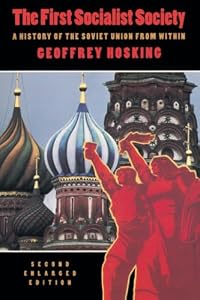
The First Socialist Society: A History of the Soviet Union from Within, Second Enlarged Edition
by Geoffrey A. Hosking
On This Page
Description
Describes the changes in the character of Soviet life from 1917 to the present, showing us how the ideas of Marxism have been transformed by unique political and economic circumstances. Discusses the experience of peasants and urban workers and professionals; the interaction of Soviet autocrats with the people; the role of religion, law and education in Soviet society; and the significance of various national groups.Tags
Recommendations




























Member Reviews
Pretty great for what it is. Broad easy overview / history of Soviet experiment. a bit too sympathetic I would say, but still well told and well paced.
The First Socialist Society is the compelling and often tragic history of what Soviet citizens have lived through from 1917 to the present, told with great sympathy and perception. It ranges over the changing lives of peasants, urban workers, and professionals; the interaction of Soviet autocrats with the people; the character and role of religion, law, education, and literature within Soviet society; and the significance and fate of various national groups. As the story unfolds, we come to understand how the ideas of Marxism have been changed, taking on almost unrecognizable forms by unique political and economic circumstances.
Hosking's analysis of this vast and complex country begins by asking how it was that the first socialist show more revolution took place in backward, autocratic Russia. Why were the Bolsheviks able to seize power and hold on to it? The core of the book lies in the years of Stalin's rule: how did he exercise such unlimited power, and how did the various strata of society survive and come to terms with his tyranny?
The later chapters recount Khrushchev's efforts to reform the worst features of Stalinism, and the unpredictable effects of his attempts within the East European satellite countries, bringing out elements of socialism that had been obscured or overlaid in the Soviet Union itself. And in the aftermath of the long Brezhnev years of stagnation and corruption, the question is posed: can Soviet society find a way to modify the rigidities inherited from the Stalinist past? show less
Hosking's analysis of this vast and complex country begins by asking how it was that the first socialist show more revolution took place in backward, autocratic Russia. Why were the Bolsheviks able to seize power and hold on to it? The core of the book lies in the years of Stalin's rule: how did he exercise such unlimited power, and how did the various strata of society survive and come to terms with his tyranny?
The later chapters recount Khrushchev's efforts to reform the worst features of Stalinism, and the unpredictable effects of his attempts within the East European satellite countries, bringing out elements of socialism that had been obscured or overlaid in the Soviet Union itself. And in the aftermath of the long Brezhnev years of stagnation and corruption, the question is posed: can Soviet society find a way to modify the rigidities inherited from the Stalinist past? show less
Ratings
Members
- Recently Added By
Author Information

37+ Works 1,248 Members
Awards and Honors
Awards
Common Knowledge
- Important places
- USSR
Classifications
- Genres
- History, Nonfiction, General Nonfiction
- DDC/MDS
- 947.084 — History & geography History of Europe Eastern European Counties and Russia Russian & Slavic History by Period 1855- 1917-1953 ; Communist period
- LCC
- DK266 .H58 — History of Europe, Asia, Africa and Oceania Russia. Soviet Union. Former Soviet Republics – Poland History of Russia. Soviet Union. Former Soviet Republics History Soviet regime, 1918-1991
- BISAC
Statistics
- Members
- 144
- Popularity
- 226,577
- Reviews
- 2
- Rating
- (3.38)
- Languages
- English
- Media
- Paper
- ISBNs
- 4
- UPCs
- 1
- ASINs
- 2