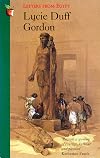
Letters from Egypt
by Lucie Duff Gordon
On This Page
Description
Diagnosed with tuberculosis, Lady Lucie Duff Gordon left her family in London in 1862 to take up permanent residence in Upper Egypt or the Saeed. There she wrote Letters from Egypt (1865), which offers an intimate portrayal of the social life of the Saeed, connecting happenings there with international politics and issues around race, class, nation, and gender.Tags
Recommendations


























Member Recommendations

k00kaburra This is a collection of Lady Duff Gordon's original letters, written fron Egypt. They're quoted a few times in "The Mistress of Nothing" and provided the inspiration for the novel.
Member Reviews
A friend to George Meredith, Thackeray, and other notables of that time, Lucie Duff Gordon (1821-1969) was raised in a radical, intellectual family and imbued with a sense of adventure; her imagination roamed father than the usual Grand Tour. In 1862, she took a tour to South Africa, attempting to recover from tuberculosis; when that didn’t succeed, she went to Egypt, where her son-in-law was a banker. Although her daughter and son-in-law lived in Alexandria, Gordon spent much of her time in Luxor, living in a ruined house above a temple. Her letters were alternately written to her husband, Sir Alexander Duff Gordon; her mother; and her daughter.
Gordon’s letters reveal someone with a high amount of inquisitiveness and cultural show more sensitivity; Gordon frees herself from the usual ways that other Europeans stereotyped Egyptians at the time. She was there just as the Europeans were modernizing Egypt, represented by the construction of the Suez Canal, which opened in 1869, the year Gordon passed away. Her letters reflect the changes to rural Egypt that were occurring, as well as observing social systems that were in place (especially criticizing the corvee, which was a system of forced labor that was used to build the Canal), and she was dismayed by the poverty that she witnessed while in Luxor.
Gordon’s tone is lively; perceptive; she had a keen interest in the Egyptian people and their history, and she interacted with the often, especially as an amateur doctor (Hakeemah). “I am in love with the Arabs’ ways, and I have contrived to see and know more of family life than many Europeans who have lived here for years,” she wrote. So we meet a wide variety of people, including Omar, her faithful servant. In all, a lively, entertaining collection of letters. show less
Gordon’s letters reveal someone with a high amount of inquisitiveness and cultural show more sensitivity; Gordon frees herself from the usual ways that other Europeans stereotyped Egyptians at the time. She was there just as the Europeans were modernizing Egypt, represented by the construction of the Suez Canal, which opened in 1869, the year Gordon passed away. Her letters reflect the changes to rural Egypt that were occurring, as well as observing social systems that were in place (especially criticizing the corvee, which was a system of forced labor that was used to build the Canal), and she was dismayed by the poverty that she witnessed while in Luxor.
Gordon’s tone is lively; perceptive; she had a keen interest in the Egyptian people and their history, and she interacted with the often, especially as an amateur doctor (Hakeemah). “I am in love with the Arabs’ ways, and I have contrived to see and know more of family life than many Europeans who have lived here for years,” she wrote. So we meet a wide variety of people, including Omar, her faithful servant. In all, a lively, entertaining collection of letters. show less
Ratings
Members
- Recently Added By
Author Information

9+ Works 114 Members
Some Editions
Series
Belongs to Publisher Series
Common Knowledge
- People/Characters
- Lucie, Lady Duff Gordon
- Important places
- Egypt
Classifications
Statistics
- Members
- 79
- Popularity
- 392,319
- Reviews
- 1
- Rating
- (4.00)
- Languages
- English, French
- Media
- Paper, Ebook
- ISBNs
- 15
- ASINs
- 2