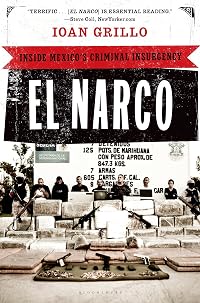
El Narco: Inside Mexico's Criminal Insurgency
by Ioan Grillo
On This Page
Description
"The world has watched stunned at the bloodshed in Mexico. Forty thousand murdered since 2006; police chiefs shot within hours of taking office; mass graves comparable to those of civil wars; car bombs shattering storefronts; headless corpses heaped in town squares. And it is all because a few Americans are getting high. Or is it? The United States throws Black Hawk helicopters, DEA assistance, and money at the problem. But in secret, Washington is confused and divided about what to do. Who show more are these mysterious figures tearing Mexico apart, they wonder. What is El Narco? El Narco draws the first definitive portrait of Mexico's cartels and how they have radically transformed in the past decade. El Narco is not a gang; it is a movement and an industry drawing in hundreds of thousands, from bullet-ridden barrios to marijuana-covered mountains. The conflict spawned by El Narco has given rise to paramilitary death squads enlisting tens of thousands of men-at-arms ready to do battle from Guatemala to the Texas border (and sometimes beyond.) Journalist Ioan Grillo has spent a decade in Mexico covering the drug war from the front lines. This piercing book joins testimonies from inside the cartels with firsthand dispatches and unsparing analysis. The devastation may be south of the Rio Grande, El Narco shows, but the United States is very much a part of the battleground."--Book jacket. show lessTags
Recommendations



Member Reviews
The world has watched stunned at the bloodshed in Mexico. Thirty thousand murdered since 2006; police chiefs shot within hours of taking office; mass graves comparable to those of civil wars; car bombs shattering storefronts; headless corpses heaped in town squares. And it is all because a few Americans are getting high. Or is it? The United States throws Black Hawk helicopters and drug agents at the problem. But in secret, Washington is confused and divided about what to do. Who are these mysterious figures tearing Mexico apart? they wonder. What is El Narco?
El Narco draws the first definitive portrait of Mexico's drug cartels and how they have radically transformed in the last decade. El Narco is not a gang; it is a movement and an show more industry drawing in hundreds of thousands from bullet-ridden barrios to marijuana-growing mountains. And it has created paramilitary death squads with tens of thousands of men-at-arms from Guatemala to the Texas border. Journalist Ioan Grillo has spent a decade in Mexico reporting on the drug wars from the front lines. This piercing book joins testimonies from inside the cartels with firsthand dispatches and unsparing analysis. The devastation may be south of the Rio Grande, El Narco shows, but America is knee-deep in this conflict. show less
El Narco draws the first definitive portrait of Mexico's drug cartels and how they have radically transformed in the last decade. El Narco is not a gang; it is a movement and an show more industry drawing in hundreds of thousands from bullet-ridden barrios to marijuana-growing mountains. And it has created paramilitary death squads with tens of thousands of men-at-arms from Guatemala to the Texas border. Journalist Ioan Grillo has spent a decade in Mexico reporting on the drug wars from the front lines. This piercing book joins testimonies from inside the cartels with firsthand dispatches and unsparing analysis. The devastation may be south of the Rio Grande, El Narco shows, but America is knee-deep in this conflict. show less
Superb. Detailed. Scary, but there's hope in this book, too. As Mr. Grillo lays out the story, it almost seems hopeless, but fortunately, he leaves breadcrumbs of hope carefully placed throughout the book. As he walks you through the bloodshed, the bleak political and economic situation, and other factors, he also tells you why and how Mexico can find its way out of this dark place. If you're looking for an understanding about what is going on in Mexico and how it affects the USA, you'll want this book. The book is well-documented, so interested readers can read more on the subject by finding the reference works cited.
 This review was written for LibraryThing Early Reviewers.
I've wanted for some time to read a good explanation of the bloody drug wars that have overtaken much of northern Mexico. This book is superb -- smart, thoughtful, and multifaceted. Ioan Grillo has covered the conflict for a decade as a journalist living in Mexico City and traveling around North, Central, and South America. The first part of the book traces the origins of the Mexican drug cartels and the historical evolution of their conflicts with each other, the Mexican government, and organized crime in other parts of Latin America. The middle chapters explore aspects of narco-culture: the economics that underpin cartel operations today; the cult of death that feeds on the ongoing violence; the paths that lead young people into show more working for the cartels. The last several chapters examine where narco-violence could go from here -- whether it could metastasize into the U.S., or whether wise policies could contain and ultimately defeat it in Mexico.
The story of El Narco involves so much brutality, so much gruesome violence, that parts of the book are difficult to read -- but Grillo warns the reader when these passages are approaching. His writing style is often informal; for this subject, that's immensely helpful, as the human touch in his writing keeps the mind from shutting down in the face of the stories he tells. For all its stylistic informality, the book is rigorously sourced and carefully organized. Grillo offers a few thoughts on how to reduce narco-violence: he suggests that drug legalization, however politically unpalatable in the U.S., would strip the cartels of their massive revenues, and he also argues that poor youth need hope for a better life to resist the seductive pull of the cartels. But the chief virtue of this book is not its blueprint for policy, but its nuanced insights into where El Narco came from and how it functions today. show less
The story of El Narco involves so much brutality, so much gruesome violence, that parts of the book are difficult to read -- but Grillo warns the reader when these passages are approaching. His writing style is often informal; for this subject, that's immensely helpful, as the human touch in his writing keeps the mind from shutting down in the face of the stories he tells. For all its stylistic informality, the book is rigorously sourced and carefully organized. Grillo offers a few thoughts on how to reduce narco-violence: he suggests that drug legalization, however politically unpalatable in the U.S., would strip the cartels of their massive revenues, and he also argues that poor youth need hope for a better life to resist the seductive pull of the cartels. But the chief virtue of this book is not its blueprint for policy, but its nuanced insights into where El Narco came from and how it functions today. show less
This review was written for LibraryThing Early Reviewers.This was a fantastic book to read, albeit a disturbing one. The gritty reality of Mexico's drug war is thrown at the reader right from the first page: cold-blooded murders in broad daylight on city streets; abductions and terrifying ransom videos, with fingers sent in the mail; the poverty that feeds the system with an endless supply of new recruits. Like all big problems, the story is so depressing not only because of the horrific acts but because the problems seems so intractable.
I have a huge amount of respect for Ioan Grillo's work in Mexico after reading this and I'll freely admit that I had to put it down on more than one occasion, just to catch my breath. The writing is great, the stories are heart-wrenching, and I appreciate the show more fact that Grillo doesn't come across as a know-it-all with a handy solution to all of these problems. Like a good journalist, he reports thoroughly about what is going down and lets the data and anecdotes speak for themselves. show less
I have a huge amount of respect for Ioan Grillo's work in Mexico after reading this and I'll freely admit that I had to put it down on more than one occasion, just to catch my breath. The writing is great, the stories are heart-wrenching, and I appreciate the show more fact that Grillo doesn't come across as a know-it-all with a handy solution to all of these problems. Like a good journalist, he reports thoroughly about what is going down and lets the data and anecdotes speak for themselves. show less
This review was written for LibraryThing Early Reviewers.This book deeply disturbed me. The once great nation of Mexico morphed into a failed state through the epidemic wrought by an out-of-control drug culture. The narco-gangster culture spawned by marijuana and cocaine seems to have taken over large territories in Mexico where the police are frequently targeted for assassination. Children act as drug mules. The horror of Mexican drug killings are clearly and shockingly described by Grillo. The butchery is staggering. Grillo has a set of cojones. Well written narrative that made me keep reading even though the subject matter was incredibly harsh and unforgiving.
This review was written for LibraryThing Early Reviewers.It seems like I have more to say about a book when I don't like it, so I'll have very little to say here. I comprehensively enjoyed this book and I recommend it highly. The author was a journalist in Mexico for years and saw the fallout from the War on Drugs up close. Incorporating his own notes and interviews with people from those days - including many who were murdered after speaking with him - he reaches far beyond his own vantage point and draws in history, military strategy, policy, geography and economics to comprehensively cover every angle of El Narco. I have finished the book feeling like I've truly gotten an education into every aspect of narcotic trafficking, policing, use and victimization. So when he reaches the inevitable show more endpoint - a discussion of "that toxic, contentious, prohibited, muddled, and crucially needed argument - the legalization debate" I am actually ready to hear what he says.
Because even as he raises impossible situations - whether Mexico is right to use the military to fight narcos, given that narcos are citizens and innocents get caught up in their net with horrible consequences, whether the United States should and could legalize drugs, or at least marijuana - he acknowledges the other side, the rocks and the hard places, the failure of current policies and the fatuous arguments for the alternatives.
These are tough, tough issues, and this is the book you should read if you want to understand them. show less
Because even as he raises impossible situations - whether Mexico is right to use the military to fight narcos, given that narcos are citizens and innocents get caught up in their net with horrible consequences, whether the United States should and could legalize drugs, or at least marijuana - he acknowledges the other side, the rocks and the hard places, the failure of current policies and the fatuous arguments for the alternatives.
These are tough, tough issues, and this is the book you should read if you want to understand them. show less
This review was written for LibraryThing Early Reviewers.El Narco is truly one of the best books of nonfiction that there is on the Mexican drug situation. I would definitely recommend this to anyone who's even remotely interested in the topic. I noticed that while looking at reviews I found one where someone calls this book "conspiratorial," "left-wing" and "Anti-American." Don't believe it. The book is frightening in its implications, because it's all too real, but the facts are well presented and thoroughly researched. Grillo's own insights and personal contributions even convey some humor to break up what is an incredibly serious situations, and he's been covering Mexico and other parts of Latin America for years and is therefore most credible. Great book.
Ioan Grillo, journalist and show more author of El Narco has based his book not only on comprehensive and impeccable research, but on firsthand accounts, his own observations and often hair-raising interviews. The roadmap for understanding this book is completely laid out in the first chapter as Grillo examines
a) the transformation of groups responsible for drug smuggling who have in the last decade or so become more militarized into "paramilitary death squads" responsible for "tens of thousands" of deaths, as well as the effects on ordinary people in Mexico;
b) the rise of these groups as a dangerous "criminal insurgency," one that threatens to become a civil war along the US/Mexico border;
c) the combined effects of the lack of success of the US war on drugs and Mexico's own political and economic issues in creating this insurgency; and
d) possible solutions based on what Grillo calls a "drastic rethinking of strategies" that should not depend on US military involvement
But before launching into the meat of the book, Grillo first examines the concept of "El Narco." He notes that in Mexico, El Narco is the collective term used for traffickers, but in reality the term also designates an entire culture in its own right, spawning its own music, co-opting religious icons and religions, its own clothing styles, etc., all based on the drug trafficker as local hero. It is an entire movement based in the "drug underworld," and as Grillo notes, the threat of El Narco and figuring out possible solutions is best understood by following its development.
As the book proceeds, it follows the above-listed guideline to provide an incredible look at how the traffic in drugs in Mexico went from a few people who dominated the poppy/opium/narcotics market to a major insurgency and an all-out war which threatens to explode into unprecedented violence and a very real threat show less
Ioan Grillo, journalist and show more author of El Narco has based his book not only on comprehensive and impeccable research, but on firsthand accounts, his own observations and often hair-raising interviews. The roadmap for understanding this book is completely laid out in the first chapter as Grillo examines
a) the transformation of groups responsible for drug smuggling who have in the last decade or so become more militarized into "paramilitary death squads" responsible for "tens of thousands" of deaths, as well as the effects on ordinary people in Mexico;
b) the rise of these groups as a dangerous "criminal insurgency," one that threatens to become a civil war along the US/Mexico border;
c) the combined effects of the lack of success of the US war on drugs and Mexico's own political and economic issues in creating this insurgency; and
d) possible solutions based on what Grillo calls a "drastic rethinking of strategies" that should not depend on US military involvement
But before launching into the meat of the book, Grillo first examines the concept of "El Narco." He notes that in Mexico, El Narco is the collective term used for traffickers, but in reality the term also designates an entire culture in its own right, spawning its own music, co-opting religious icons and religions, its own clothing styles, etc., all based on the drug trafficker as local hero. It is an entire movement based in the "drug underworld," and as Grillo notes, the threat of El Narco and figuring out possible solutions is best understood by following its development.
As the book proceeds, it follows the above-listed guideline to provide an incredible look at how the traffic in drugs in Mexico went from a few people who dominated the poppy/opium/narcotics market to a major insurgency and an all-out war which threatens to explode into unprecedented violence and a very real threat show less
Members
- Recently Added By
Published Reviews
ThingScore 100
There's no question that Mexican society has been traumatized by the violence of the past five years; but through it all, some have found a way to cope. Grillo says that in Ciudad Juarez — a town he describes as "the most murderous city on the planet" — people have started going to the opera.
"People are saying, 'Well this opera is an amazing chance for us to forget about this drug show more violence,' " Grillo says. " 'While you hear the music, it won't make anything better or improve your life; but at least for those minutes of hearing the music you can find an escape and imagine things getting better.' " show less
"People are saying, 'Well this opera is an amazing chance for us to forget about this drug show more violence,' " Grillo says. " 'While you hear the music, it won't make anything better or improve your life; but at least for those minutes of hearing the music you can find an escape and imagine things getting better.' " show less
added by John_Vaughan
Lists

Drugs
11 works; 1 member
Author Information

4 Works 573 Members
Ioan Grillo has reported on Latin America since 2001 for international media, including Time magazine, Reuters, CNN, the Associated Press, PBS NewsHour, the Houston Chronicle, CBC, and the Sunday Telegraph. His first book, El Narco: Inside Mexico's Criminal Insurgency, was translated into five languages and was a finalist for the Los Angeles Times show more Book Prize and the Orwell Prize. A native of Britain, Grillo lives in Mexico City. show less
Awards and Honors
Awards
Common Knowledge
- People/Characters
- Arturo "The Beard" Beltran Leyva; Joaquin "Chapo" Guzman; Vincente Fox; Felipe Calderon
- Important places
- Mexico; California, USA; Phoenix, Arizona, USA; Arizona, USA; Mexico City, Mexico; Tijuana, Baja California, Mexico (show all 10); Ciudad Juárez, Chihuahua, Mexico; Culiacan, Sinaloa, Mexico; Sinaloa, Mexico; Baja California, Mexico
- Related movies
- Traffic (2000 | IMDb); Drug Wars: The Camarena Story (1990 | IMDb); Blow (2001 | IMDb)
- First words
- It all seemed like a bad dream.
- Last words
- (Click to show. Warning: May contain spoilers.)This is a new son for the one that was lost. His mother has put hope in the fresh blood to grow up and make a better world than the one that killed his brother. We have to put our hope there too.
- Blurbers
- Rather, Dan; Booth, William; Padgett, Tim; Althaus, Dudley; Coampbell, Howard; Beith, Malcolm
Classifications
- Genres
- Nonfiction, General Nonfiction, History
- DDC/MDS
- 363.450972 — Society, government, & culture Social problems and social services Public Safety - Police, Crime Investigation Illegal drugs Illegal drugs - subdivisions Illegal drugs - by place Mexico
- LCC
- HV5840 .M4 .G75 — Social sciences Social pathology. Social and public welfare. Criminology Social pathology. Social and public welfare. Drug habits. Drug abuse
- BISAC
Statistics
- Members
- 346
- Popularity
- 91,724
- Reviews
- 16
- Rating
- (4.15)
- Languages
- English, French, Polish, Spanish
- Media
- Paper, Audiobook, Ebook
- ISBNs
- 17
- UPCs
- 1
- ASINs
- 7