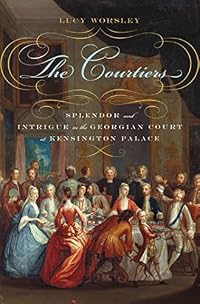
Courtiers: The Secret History of the Georgian Court
by Lucy Worsley
On This Page
Description
An 18th-century portrait of the palace most recognized as an official home of several British royal family members focuses on the Hanover family during the reigns of George I and II, describing the intrigue, ostentatious fashions and politicking that marked court life.Tags
Recommendations












Member Reviews
I bought Lucy Worlsey's history of the Georgian Court without thinking because discount but really enjoyed learning more about the first two King Georges! Worsley has a chatty descriptive style which really brings history to life, like gossiping about celebs - which is kind of what this is! We learn all about the lives and loves of Kensington Palace, from the Teutonic George I, brought in from Hanover to claim the throne, his eldest son George, who he all but disowned, popular Queen Caroline, and various mistresses and maids of honour, advisers, hangers on and servants (some of whom feature in the paintings by William Kent on the King's Staircase at Kensington, which I gather is what inspired the author). The 'gossip' includes who slept show more with who, pregnancy and childbirth, medical and personal ailments, food and drink, and the routine of life at court. I was surprised to learn that the royal court in early eighteenth century England was much the same as Versailles, regarding influence, mistresses and political power and intrigue, and that women were also given greater sexual freedom and power until the middle of the century.
One quibble I have with Worsley's take on sexual history is her discussion of gay (or 'homosexual', in her rather clinical phrasing) relationships. John Hervey, a courtier of Queen Caroline who married one of her maids of honour, was known to have both male and female lovers, yet Worsley writes: 'People in the eighteenth-century had no notion of a person’s being ‘homosexual’ as we would understand it today. But sexual relationships between people of the same gender nevertheless took place, and there’s no question that John Hervey was sexually attracted to both women and men.' I think the term she might be looking for is 'bisexual'? Even if Hervey had only married to avoid suspicion - which Worsley also states was unnecessary according to the 'private moral code' of the aristocracy - he was known to have taken other female lovers. Also, when discussing court architect William Kent and his 'lifelong patron and friend' Lord Burlington, the author skates around what is patently obvious about the two men - Kent was even buried in the Burlington family vault, next to his lover!
The real life 'characters' from history, from the King and his painful piles ('The king’s mood, even his bowel movements, could determine the fate of many, as even now he was called upon to make real decisions about the running of the country') to popular lady's maid Molly Lepel who married Hervey yet hated motherhood (‘I mortally hate children and am uneasy when they are in the room' - that's my girl!) and 'Peter the Wild Boy' (seriously), are like the cast of a modern day soap opera, casting off children and swapping lovers but I love that they were also very relatable in some ways.
Perhaps not the most comprehensive study of Georgian life but great fun to read! show less
One quibble I have with Worsley's take on sexual history is her discussion of gay (or 'homosexual', in her rather clinical phrasing) relationships. John Hervey, a courtier of Queen Caroline who married one of her maids of honour, was known to have both male and female lovers, yet Worsley writes: 'People in the eighteenth-century had no notion of a person’s being ‘homosexual’ as we would understand it today. But sexual relationships between people of the same gender nevertheless took place, and there’s no question that John Hervey was sexually attracted to both women and men.' I think the term she might be looking for is 'bisexual'? Even if Hervey had only married to avoid suspicion - which Worsley also states was unnecessary according to the 'private moral code' of the aristocracy - he was known to have taken other female lovers. Also, when discussing court architect William Kent and his 'lifelong patron and friend' Lord Burlington, the author skates around what is patently obvious about the two men - Kent was even buried in the Burlington family vault, next to his lover!
The real life 'characters' from history, from the King and his painful piles ('The king’s mood, even his bowel movements, could determine the fate of many, as even now he was called upon to make real decisions about the running of the country') to popular lady's maid Molly Lepel who married Hervey yet hated motherhood (‘I mortally hate children and am uneasy when they are in the room' - that's my girl!) and 'Peter the Wild Boy' (seriously), are like the cast of a modern day soap opera, casting off children and swapping lovers but I love that they were also very relatable in some ways.
Perhaps not the most comprehensive study of Georgian life but great fun to read! show less
I've always enjoyed history programmes and documentaries. In particular UK ones. David Starkey ignited my interest in Medieval England, and I think I've watched Alan Ereira's documentary series "Kings and Queens of England" about 6 times.
But there is one historian, whose focus is slightly closer to modern times, that has really caught my attention - and that is Dr. Lucy Worsley.
The Joint Chief Curator at Historic Royal Palaces has presented a string of extremely entertaining (and well-researched) documentaries on life in Britain in the 18th and 19th century - as well as on the private lives of those glorified figures you see on the walls of the National Portrait Gallery. So when I spotted this book at my regular Dutch auction booksale show more haunt, into my basket it went.
And what a riveting piece of social and cultural history it turned out to be, exposing the often seedy underbelly of the glamour show that was Georgian England and its court. Dr. Worsley does an excellent job of portraying the characters featured on William Kent's Great Staircase at Kensington Palace in a way that makes them come to life in your mind.
Characters like "Peter the Wild Boy", the real-life Wildling found in a Hanoverian forest and brought to the court - first at Herrenhausen, later at London - as an exotic pet. He never learnt to speak "properly" and had a penchant for eating acorns, but his "unspoiled" state made him a prime fashion accessory for the Hanoverians.
She does not pull punches - thanks to her access to contemporary medical accounts, you get all the explicit details of ailments and demises - but also the facts behind the folklore in certain cases. The list of references and the endnote section is frankly mind-boggling, and it has been hard to put down once I began reading it. show less
But there is one historian, whose focus is slightly closer to modern times, that has really caught my attention - and that is Dr. Lucy Worsley.
The Joint Chief Curator at Historic Royal Palaces has presented a string of extremely entertaining (and well-researched) documentaries on life in Britain in the 18th and 19th century - as well as on the private lives of those glorified figures you see on the walls of the National Portrait Gallery. So when I spotted this book at my regular Dutch auction booksale show more haunt, into my basket it went.
And what a riveting piece of social and cultural history it turned out to be, exposing the often seedy underbelly of the glamour show that was Georgian England and its court. Dr. Worsley does an excellent job of portraying the characters featured on William Kent's Great Staircase at Kensington Palace in a way that makes them come to life in your mind.
Characters like "Peter the Wild Boy", the real-life Wildling found in a Hanoverian forest and brought to the court - first at Herrenhausen, later at London - as an exotic pet. He never learnt to speak "properly" and had a penchant for eating acorns, but his "unspoiled" state made him a prime fashion accessory for the Hanoverians.
She does not pull punches - thanks to her access to contemporary medical accounts, you get all the explicit details of ailments and demises - but also the facts behind the folklore in certain cases. The list of references and the endnote section is frankly mind-boggling, and it has been hard to put down once I began reading it. show less
Didn’t like this as much as I thought I would. Having seen a documentary presented by Lucy Worsley on the first two Georges, which I enjoyed, I expected to like this book as much as that, if not more, but instead my engagement wavered far too often.
Parts were interesting, but many more parts weren’t. It’s not compelling reading like this author’s book on the history of the English home. This one felt a bit dry, while some of the subject matter didn’t appeal to me.
The most intriguing info was on Peter the Wild Boy. I’d never heard of this feral child before, so it was amazing to here of his discovery and how he’d lived like a woodland creature.
Parts were interesting, but many more parts weren’t. It’s not compelling reading like this author’s book on the history of the English home. This one felt a bit dry, while some of the subject matter didn’t appeal to me.
The most intriguing info was on Peter the Wild Boy. I’d never heard of this feral child before, so it was amazing to here of his discovery and how he’d lived like a woodland creature.
This is a stunningly good book, I never thought I would become so involved in the lives of the court of the first two Georges. Written with humour, compassion, pathos and a deft idea for a good story, Worsley tells the stories of various courtiers during the reigns of George I & II, their successes and travails, their ups and downs, the price they paid to be at court, and how the court usually spat them out in varying degrees of good will or shame. Some thrived, some just survived, some went to the wall. Perhaps most compelling and tragic is the story of Peter the Wild Boy, who was found in the forests of Hanover unable to speak or behave in human society and brought to London as a curiosity. Living to a ripe he old age, he lived out show more his life happily after the court tired of him in a peaceful rural community. As well as the court, Worsley details the sad lives of the royals themselves, in particular the hatred between father and son that seemed endemic in the family. She effectively humanises the kings and queens, without ignoring their frequent nastiness. A great, very readable book, I loved it. show less
Fascinating inside look at the lives of 16 courtiers represented in William Kent’s Grand Staircase painting that resides at Kensington Palace. Eighteenth century palace life seems more prison like to me than I ever could have imagined. Lucy Worsley so fantastically leads the reader through all of the escapades and secrets. Accessible and entertaining, albeit disturbing and shocking too. Humans truly are horrible.
Inspired by a painting on the King's Staircase in Kensington Palace, Lucy Worsley writes about the people who lived at court in the early Georgian era (1714 - 1760), the royal family, their servants, lovers, and friends, with the focus on the personalities rather than the politics.
Of course anyone we know anything about, even those low down on the social scale, was comparatively privileged. But nevertheless, it is a fascinating glimpse into other people's lives and there was just as much interpersonal drama as in the more popular Tudor and Regency periods. Very interesting reflections on the change in views of female sexuality just after the end of this time period. The sufferings of poor Queen Caroline at the end of her life were show more horrendous. I did feel quite melancholy when the book wrapped up with the death of the old king and a quick round up for those who survived him -- not many. show less
Of course anyone we know anything about, even those low down on the social scale, was comparatively privileged. But nevertheless, it is a fascinating glimpse into other people's lives and there was just as much interpersonal drama as in the more popular Tudor and Regency periods. Very interesting reflections on the change in views of female sexuality just after the end of this time period. The sufferings of poor Queen Caroline at the end of her life were show more horrendous. I did feel quite melancholy when the book wrapped up with the death of the old king and a quick round up for those who survived him -- not many. show less
Worsley tracks the people and art that populated the courts of George I and II of England. She has a very easy to read style, but cites well and was able to draw upon a good number of first-person sources. That said, there were three things I distinctly disliked about this book.
One, Worsley has a completely unearned appreciation for George II and his wife Caroline. Both of them seem to have been thoroughly unpleasant in several arenas, not least their treatment of their immediate family. The abuse, lack of support, and outright hatred shown by each of them toward their children soured me on both of them. In vain were Worsley's repeated reminders that Caroline was bffs with philosophers, or her assertion that George II's lack of show more reaction to Prince Frederick's death was due to "rigid royal training" (how then to explain his inattention to the funeral? Or for that matter, where was his "rigid royal training" during the ~70 years of George II throwing tantrums and exploding into feuds at the slightest instigation?).
Two, the politics, laws and wars of the age get hardly a mention. Surely actual events were just as important to understanding the Georgian court as knowing that the royal mistresses' rooms were damp?
And three, truly hideous line drawings interrupt the text to illustrate various personages. Not only do these drawings make everyone look like lumpy potatoes, but they also bear no resemblance whatsoever to their subjects' other portraits. What use ARE they? A poor choice, and an unnecessary one, given the good range and number of color paintings included. show less
One, Worsley has a completely unearned appreciation for George II and his wife Caroline. Both of them seem to have been thoroughly unpleasant in several arenas, not least their treatment of their immediate family. The abuse, lack of support, and outright hatred shown by each of them toward their children soured me on both of them. In vain were Worsley's repeated reminders that Caroline was bffs with philosophers, or her assertion that George II's lack of show more reaction to Prince Frederick's death was due to "rigid royal training" (how then to explain his inattention to the funeral? Or for that matter, where was his "rigid royal training" during the ~70 years of George II throwing tantrums and exploding into feuds at the slightest instigation?).
Two, the politics, laws and wars of the age get hardly a mention. Surely actual events were just as important to understanding the Georgian court as knowing that the royal mistresses' rooms were damp?
And three, truly hideous line drawings interrupt the text to illustrate various personages. Not only do these drawings make everyone look like lumpy potatoes, but they also bear no resemblance whatsoever to their subjects' other portraits. What use ARE they? A poor choice, and an unnecessary one, given the good range and number of color paintings included. show less
Members
- Recently Added By
Published Reviews
For many, Kensington Palace will be forever regarded as the fashionable, and perhaps rather soulless, last home of Diana, Princess of Wales...
But long before the glamorous royal took up residence in one of its elegant apartments, the palace was home to another less chic but equally controversial Princess of Wales.
To read the full review - click on the link below
But long before the glamorous royal took up residence in one of its elegant apartments, the palace was home to another less chic but equally controversial Princess of Wales.
To read the full review - click on the link below
added by CindyBytes
Anyone who climbs the King’s Grand Staircase at Kensington Palace finds themselves watched by 45 gossiping servants. Porters and pages, musicians, milliners, mistresses and maids of honour crowd together in the candlelight of the upper gallery, craning their necks over the balustrade, dangling their babies and cuddling their lapdogs.
To read the full review - click on the link below
To read the full review - click on the link below
added by CindyBytes
Courtiers – those men and women of non-servant rank who attend or divert monarchs – are a maligned lot. In 1770, William Hooper wrote that “the glory of a British monarch consists not in a handful of tinsel courtiers” but in the “freedom, the dignity and the happiness of his people”. Not many have sought to overturn that sentiment since then.
To read the full review - click on the show more link below show less
To read the full review - click on the show more link below show less
added by CindyBytes
Lists

History and Biography Read in 2016
20 works; 3 members

Books Read in 2016
4,666 works; 199 members
Author Information

40+ Works 4,164 Members
Lucy Worsley, Ph.D., is Chief Curator at Historic Royal Palaces, the charity that manages the Tower of London, Hampton Court Palace, Kensington Palace, the Banqueting House in Whitehall, and Kew Palace in England. Please visit www.lucyworsley.com.
Some Editions
Common Knowledge
- Canonical title
- Courtiers: The Secret History of the Georgian Court
- Alternate titles
- Courtiers: The Secret History of Kensington Palace; The Courtiers: Splendor and Intrigue in the Georgian Court at Kensington Palace
- Original publication date
- 2010
- People/Characters
- George I, King of Great Britain and Ireland; George II, King of Great Britain and Ireland; George III, King of the United Kingdom; Charlotte of Mecklenburg-Strelitz, Queen Consort of the United Kingdom; George Augustus, Prince of Wales; Caroline, Princess of Wales (show all 90); Frederick; Amelia; Molly Lepell; Henrietta Howard, Countess of Suffolk; John Hervey; Peter the Wild Boy; William Kent; Elizabeth Butler; Mohammed True-to-the-King; Mustapha; Dr Arbuthnot; John Gay; Ulrich Jorry; Mary Bellenden; Alexander Pope; Charles Howard; Sir David Hamilton; Philip von Königsmarck; Ehrengard Melusina von der Schulenberg; The Maypole; Sophia Charlotte von Kielmansegg; The Elephant; Robert Walpole; Charles Townshend; Mary Cowper; Charlotte Clayton; Charlotte Amelia Titchborne; Mary Meadows; Sophy Howe; Carr Hervey; Richard Boyle; Sir James Thornhill; Sir Christopher Wren; Sir Thomas Hewett; Peter Wentworth; Thomas Coke, 1st Earl of Leicester (seventh creation); Burrell Massingberd; Robert Clerece; Franciscus de Valentia; Christian Ulrich Jorry; Maria Hedewig Mohammed; Elizabeth Tempest; Horace Walpole; Jonathan Swift; Lady Mary Wortley Montagu; Thomas Burnet; Anne, Princess Royal and Princess of Orange; Princess Amelia; Princess Caroline; Prince Frederick; Princess Mary; Princess Louisa; William Chiffinch; Mrs. Jane Keen; Henry Lowman; Sarah Matts; Catherine Pollard; Charles Bridgeman; John Rowley; Mary Deloraine; Stephen Duck; Susanna Ireland; Anne Vane; Peggy Bradshaw; Margaret Cuyler; Nunty Lowther; George Berkeley; Augusta of Saxe-Gotha, Dowager Princess of Wales; Ste Fox; William Pulteney; Lady Archibald Hamilton; Henry Fox, 1st Baron Holland; Amalie von Wallmoden; Dr. John Ranby; Dr. Bussier; John Teed; Amalie Sophie Marianne Wendt; Johann Ludwig von Wallmoden; William Wyndham; Camilla Bennett; Anna Maria Mordaunt; Elizabeth Butler; Elizabeth Chudleigh; Prince William, Duke of Cumberland
- Important places
- Kensington Palace, Kensington, London, England, UK; Leicester House, Westmimster, London, England, UK; St James's Palace, Westmimster, London, England, UK; Hanover, Lower Saxony, Germany; Hampton Court Palace, Richmond, London, England, UK; Herrenhausen, Hanover, Lower Saxony, Germany
- Important events
- South Sea Bubble
- Epigraph
- 'Those who have a curiosity to see courts and courtiers dissected must bear with the dirt they find.'
John Hervey
Preface
'I will send you a general map of Courts; a region yet unexplored...all the paths are slippery, and every slip is dangerous.'
(Lord Chesterfield, 1749) - First words
- The Great Drawing Room, crammed full of courtiers, lay at the heart of the Georgian royal palace.
- Last words
- (Click to show. Warning: May contain spoilers.)They remain at their posts, watching over and welcoming the very latest arrivals to their lost world.
Classifications
Statistics
- Members
- 430
- Popularity
- 71,353
- Reviews
- 15
- Rating
- (3.89)
- Languages
- English
- Media
- Paper, Audiobook, Ebook
- ISBNs
- 7
- ASINs
- 8