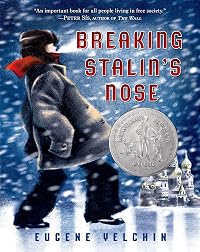
Breaking Stalin's Nose
by Eugene Yelchin
On This Page
Description
In the Stalinist era of the Soviet Union, ten-year-old Sasha idolizes his father, a devoted Communist, but when police take his father away and leave Sasha homeless, he is forced to examine his own perceptions, values, and beliefs.Tags
Recommendations












Member Reviews
I really liked this book for several reasons. I liked how the first person narrative allows readers to share Sasha’s experiences. It helps us see the optimism and hope he finds in Communism, his complete trust in Stalin, his confusion about how Stalin could allow his father to be arrested, and the pressure he faces to be a young pioneer. He even writes a letter to Stalin in the beginning stating, “Its not possible to be a true Pioneer without training one’s character in the Stalinist spirit.” With his point of view, we can also see how Sasha was blind to the realities of the world around him. His eyes gradually open to the unpleasant truth of the system he obediently trusted. This book also pushes readers to consider how fear, show more control, blind obedience, empathy and concern for others shape our humanity. In the book, the children were referred to one another as “enemies” or “criminals” if they did something wrong. When children have the mindset that anyone could be an enemy or a spy, it forces them to only trust one person—their leader, or in this case, Stalin. Today, there are still innocent people that are persecuted because of their beliefs. After reading this book, it really strengthened the pride and appreciation for all of the freedoms we have today in the US. Overall, the big picture in the book is to share a profound period in Russian history while giving an enlightening view of a people dominated by fear. show less
Ten-year old Sasha Zaichik, an aspiring Communist who hopes to emulate his father, a State Security officer, writes a letter to Stalin, saying "I want to thank you personally for my happy childhood. I am fortunate to live in the Soviet Union, the most democratic and progressive country in the world." Events that unfold in the next 48 hours cause Sasha to question his beliefs, his values and his future. Through words and striking pencil-and-ink illustrations, Eugene Yelchin has created a convincing portrait of life in early Communist USSR. Without being didactic, Yelchin has created a cautionary tale depicting the dangers of accepting something without thinking, and of a state where people are no longer allowed to question.
Sasha Zaichik has known the laws of the Soviet Young Pioneers since the age of six:
The Young Pioneer is devoted to Comrade Stalin, the Communist Party, and Communism.
A Young Pioneer is a reliable comrade and always acts according to conscience.
A Young Pioneer has a right to criticize shortcomings.
But now that it is finally time to join the Young Pioneers, the day Sasha has awaited for so long, everything seems to go awry. He breaks a classmate's glasses with a snowball. He accidentally damages a bust of Stalin in the school hallway. And worst of all, his father, the best Communist he knows, was arrested just last night.
This moving story of a ten-year-old boy's world shattering is masterful in its simplicity, powerful in its message, and show more heartbreaking in its plausibility. show less
The Young Pioneer is devoted to Comrade Stalin, the Communist Party, and Communism.
A Young Pioneer is a reliable comrade and always acts according to conscience.
A Young Pioneer has a right to criticize shortcomings.
But now that it is finally time to join the Young Pioneers, the day Sasha has awaited for so long, everything seems to go awry. He breaks a classmate's glasses with a snowball. He accidentally damages a bust of Stalin in the school hallway. And worst of all, his father, the best Communist he knows, was arrested just last night.
This moving story of a ten-year-old boy's world shattering is masterful in its simplicity, powerful in its message, and show more heartbreaking in its plausibility. show less
Sasha Zaichik is the son of a Communist hero, and he wants to be just like his father. The night before Sasha is to join the Young Pioneers (the USSR's youth movement; kind of like a cross between the Boy Scouts and the Hitler Youth), Sasha writes an adoring letter to Stalin, professing his allegiance to the Communist cause. Just hours later, Sasha's father is arrested and taken away. Sasha is bewildered, but sure it is a mistake that will soon be rectified -- after all, Stalin himself once commended Sasha's father's service. As Sasha attends school the next day, his teacher and classmates continue to treat him like the son of a hero, as they have always done . . . until word of his father's arrest gets out. Suddenly, Sasha is an show more outcast. From his new position in the back of the classroom, he suddenly starts to see all sorts of things that he had been missing before. Will Sasha still be able to join the Young Pioneers? Will he even want to do so?
This is a great, thought-provoking read. I mean to go back and reread it some time in the next few days, in fact. It's deceptively brief -- I finished it in a few hours -- but it's the sort of book that sticks with you for days after you read it. I'm still not sure what a child Sasha's age (one who doesn't have any memory of the Iron Curtain or the Cold War, and who doesn't have a clear understanding, perhaps, of who Stalin is and what he did during his regime) would make of this book, but I'm pretty sure that, like Sasha, they would soon start to see the evils inherent in the system. show less
This is a great, thought-provoking read. I mean to go back and reread it some time in the next few days, in fact. It's deceptively brief -- I finished it in a few hours -- but it's the sort of book that sticks with you for days after you read it. I'm still not sure what a child Sasha's age (one who doesn't have any memory of the Iron Curtain or the Cold War, and who doesn't have a clear understanding, perhaps, of who Stalin is and what he did during his regime) would make of this book, but I'm pretty sure that, like Sasha, they would soon start to see the evils inherent in the system. show less
This short novel packs an emotional punch, and I read it holding my breath and sick in my heart. 10 year-old Sasha loves Stalin with his whole heart, even writing him an impassioned letter of thanks the evening before he is to join the Young Pioneers, with his father, a respected and feared member of the secret police, set to be the guest of honor at the ceremony. Later that evening, however, his father is arrested (with the informing neighbor gleefully moving in only minutes later), and Sasha's world is turned upside down. Mr. Yelchin lived in the former Soviet Union, and his father, to whom the book is dedicated, survived The Great Terror. He skillfully conveys the oppressive fear and suspicion of the time. I felt the book grew a bit show more weaker toward the end, giving in to melodrama and straining credibility, but the author's note at the end of the book gives the extreme conditions in the book some historical context and authority. Mr. Yelchin's powerful illustrations perfectly complement the heart-racing story.
Curriculum: I would love to do a compare/contrast exercise using this book. It is historical fiction, describing real events and conditions. The book could be compared with a dystopian novel such as The Hunger Games by Suzanne Collins or Delirium by Lauren Oliver so students could consider similarities between fictional dystopian societies and the totalitarian society of Stalinist USSR.
Yelchin, E. (2011). Breaking Stalin's nose. New York: Henry Holt and Company. show less
Curriculum: I would love to do a compare/contrast exercise using this book. It is historical fiction, describing real events and conditions. The book could be compared with a dystopian novel such as The Hunger Games by Suzanne Collins or Delirium by Lauren Oliver so students could consider similarities between fictional dystopian societies and the totalitarian society of Stalinist USSR.
Yelchin, E. (2011). Breaking Stalin's nose. New York: Henry Holt and Company. show less
Breaking Stalin’s Nose, by Eugene Yelchin, is a hilariously realistic historical fiction book. The combination of humor and history in this story supports the themes about power and family. A ten-year-old boy, who lives in Moscow with his father, finds himself homeless and in disagreement with his previously beloved way of life: communism. Joseph Stalin, the leader of the communists, is this young boy’s idol. Throughout the book, the boy slowly begins to realize the harsh realities of communism and his true feelings about Stalin. Eugene Yelchin certainly nailed the title; towards the end of the book, the boy is marching around his school with a flag in excitement for the Young Pioneers Communist rally, when he accidentally drops the show more flag onto the statue of Stalin, breaking the nose off. After this, the boy undergoes brutal consequences that change his mind about communism. This story is also presented in a chapter book that also includes comical illustrations of the characters and events in the story. For example, there is a picture of another young boy who tattles about the broken nose. In the picture, the boy looks evil with the impression of tattling, which makes the book not only funny, but also visually present. I truly enjoyed this story and its humorously historical perspective. show less
Soviet ten-year-old Sasha Zaichik loves his father and dreams of becoming a Young Pioneer. When his father is arrested, Sasha believes it is a mistake, but slowly his eyes open to another perspective.
Quotes
Believing is the most important part. If you really believe in something, it will come true. (72)
If someone is arrested and executed, there must be a good reason for it. The State Security wouldn't be shooting people for nothing. What about my dad, then? He was arrested. (103)
"When we blindly believe in someone else's idea of what is right or wrong for us as individuals, sooner or later our refusal to make our own choices could lead to the collapse of the entire political system. An entire country. The world, even." (Luzhko, 112)
Quotes
Believing is the most important part. If you really believe in something, it will come true. (72)
If someone is arrested and executed, there must be a good reason for it. The State Security wouldn't be shooting people for nothing. What about my dad, then? He was arrested. (103)
"When we blindly believe in someone else's idea of what is right or wrong for us as individuals, sooner or later our refusal to make our own choices could lead to the collapse of the entire political system. An entire country. The world, even." (Luzhko, 112)
Members
- Recently Added By
Lists

Best middle grade books
130 works; 24 members

Best Newbery Honor Books
257 works; 32 members

A Child's Book Tour of Russia
45 works; 4 members

Sonlight Books
1,487 works; 25 members

Newbery Honor Books By year - II - 1981-2035
143 works; 4 members

Books Read in 2022
5,168 works; 114 members
Author Information

23+ Works 4,313 Members
Some Editions
Awards and Honors
Awards
Distinctions
Common Knowledge
- Original publication date
- 2011
- People/Characters
- Sasha Zaichik; Joseph Stalin
- Important places
- USSR
- Dedication
- To my father,
who survived the Great Terror - First words
- My dad is a hero and a Communist, and more than anything, I want to be like him.
- Last words
- (Click to show. Warning: May contain spoilers.)"So let's wait, Zaichik." And we do.
Classifications
Statistics
- Members
- 1,549
- Popularity
- 14,795
- Reviews
- 103
- Rating
- (3.96)
- Languages
- English, French, Italian
- Media
- Paper, Audiobook, Ebook
- ISBNs
- 17
- ASINs
- 6