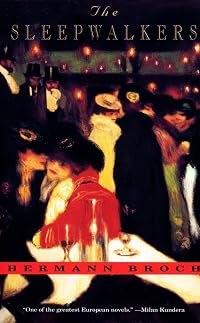
On This Page
Description
"Broch performs with an impeccable virtuosity." --Aldous Huxley With his epic trilogy, Hermann Broch established himself as one of the great innovators of modern literature, a visionary writer-philosopher equivalent of James Joyce, Thomas Mann, or Robert Musil. Even as he grounded his narratives in the intimate daily life of Germany, Broch was identifying the oceanic changes that would shortly sweep that life into the abyss. Whether he is writing about a neurotic army officer (The show more Romantic), a disgruntled bookkeeper and would-be assassin (The Anarchist), or an opportunistic war-deserter (The Realist), Broch immerses himself in the twists of his characters' psyches, and at the same time soars above them, to produce a prophetic portrait of a world tormented by its loss of faith, morals, and reason. show lessTags
Recommendations






Member Recommendations
Member Reviews
There are books weirder than The Sleepwalkers, but none that I know wear such weirdness so lightly. The experiments in structure and point-of-view you find throughout are hardly experimental—not precious, I mean, or flashy—but the logical outcome of what Broch had to say. That doesn’t mean The Sleepwalkers is an easy read. Far from it. But the story it tells of the spiritual dissolution of the German Empire, through the intersecting lives of three terrifying yet ordinary men, has no match in intimacy or panoramic scope.
Ok, commentiamo su I sonnambuli... (E chi sono io per discettare su cotanto libro?)
Si incomincia col sorriso, quasi a ritmo di walzer.
La prosa di Broch massaggia le celluline grigie scorrendo sulla pagina tersa, nitida (chiedo umilmente scusa se, per rendere l'idea, sotto sforzo, dovessi esagerare con le castronerie) ma poi il magnetismo e la tensione aumentano.
Gravitano, eterodiretti, come sonnambuli, i personaggi e, come in un vortice, la pagina cattura anche noi lettori.
Il peso specifico delle ultime pagine del terzo romanzo della trilogia è più alto del piombo (l'allegoria e il simbolismo che trovavano spazio nelle prime due parti ormai vengono messe da parte e ci troviamo davanti pagine di filosofia pura con qualche accenno e show more qualche rimando alle vicende precedentemente narrate).
E' una lettura che lascia il segno. Una bella esperienza.
Mi taccio. show less
Si incomincia col sorriso, quasi a ritmo di walzer.
La prosa di Broch massaggia le celluline grigie scorrendo sulla pagina tersa, nitida (chiedo umilmente scusa se, per rendere l'idea, sotto sforzo, dovessi esagerare con le castronerie) ma poi il magnetismo e la tensione aumentano.
Gravitano, eterodiretti, come sonnambuli, i personaggi e, come in un vortice, la pagina cattura anche noi lettori.
Il peso specifico delle ultime pagine del terzo romanzo della trilogia è più alto del piombo (l'allegoria e il simbolismo che trovavano spazio nelle prime due parti ormai vengono messe da parte e ci troviamo davanti pagine di filosofia pura con qualche accenno e show more qualche rimando alle vicende precedentemente narrate).
E' una lettura che lascia il segno. Una bella esperienza.
Mi taccio. show less
Published in three parts during the 1930s, The Sleepwalkers details the moral breakdown in German society in the decades leading up to the breakout of World War I and the devastating effect on its cohesion. Considered a masterpiece by some, a number of critics have placed this novel’s Austrian author, Hermann Broch, in the pantheon alongside the likes Thomas Mann and James Joyce.
The first part, The Romantic, is set in 1888 and deals with a neurotic young Prussian army officer wrestling about whether to marry a woman from his social class while having an affair with one from a much lower stratum. The second, The Anarchist, set in 1903, centers around a bookkeeper disgruntled over capitalist greed and attracted to anarchist beliefs. Its show more third part, The Realist, takes place during the final days of World War I when unrest and moral fragmentation throughout German society has become prevalent.
The first two parts feature very small casts of characters, while the last is much broader in scope, making it the most interesting to me. Even so, this is a book I never warmed up to. Its length, slow pace and esoteric subject matter made it a true challenge for me to complete. No doubt, there are academics who have ranked The Sleepwalkers an epic of its time and who delighted in its masterful prose. While there is no denying it is ambitious and well written, I suspect that most readers, like me, will find its frequent heavy philosophical sections a slog to wade through. show less
The first part, The Romantic, is set in 1888 and deals with a neurotic young Prussian army officer wrestling about whether to marry a woman from his social class while having an affair with one from a much lower stratum. The second, The Anarchist, set in 1903, centers around a bookkeeper disgruntled over capitalist greed and attracted to anarchist beliefs. Its show more third part, The Realist, takes place during the final days of World War I when unrest and moral fragmentation throughout German society has become prevalent.
The first two parts feature very small casts of characters, while the last is much broader in scope, making it the most interesting to me. Even so, this is a book I never warmed up to. Its length, slow pace and esoteric subject matter made it a true challenge for me to complete. No doubt, there are academics who have ranked The Sleepwalkers an epic of its time and who delighted in its masterful prose. While there is no denying it is ambitious and well written, I suspect that most readers, like me, will find its frequent heavy philosophical sections a slog to wade through. show less
'The Sleepwalkers' has proved one of the hardest books I have tried to review on Goodreads. It is over 640 pages long (in translation) and is actually not one novel but three written sequentially by Austrian novelist Hermann Broch in 1930, 1931 and 1932.
The books are in completely different styles and the final work ('The Realist') is in at least five different styles in its own right including a single burst of highly effective drama, some undistinguished and rather dull poems and didactic philosophy of which more in due course.
This is modernist experimentation and it helps to know something about Broch himself. First he was an Austrian writing about Germany (West Prussia and the Rhineland), partly historically - the first book is set show more before he was born and the second when he would have been a teenager.
It would be as if a forty something Irishman writing today (2022) living in Manchester had a sequence of novels set in rural East Anglia and London and then in the Home Counties, in, say, 1978, 1993 and 2008 and trying to find the causes of the decline of the West in that sequence.
Broch himself is a complex character. He was from the Jewish bourgeoisie (the novels contain a full understanding of business mentalities) but he converted to Catholicism when he was in his early twenties. This did not stop him divorcing his wife eventually yet religion is central to the cycle.
In what we might consider a mid-life crisis around 40, he sold off his inherited textiles business (for which he had been more than adequately trained) to study mathematics, philosophy and psychology at the University of Vienna in a somewhat Wittgensteinian trajectory.
His literary ambitions appeared at about the same time. The three books underpinning the Sleepwalkers trilogy were published in Munich just before the Nazis came to power and his university studies are integral to at least the third book.
Unfortunately, he was part of an intellectual and liberal international set. Well, fortunately, because it almost certainly saved his life by helping him to emigrate in good time. If he had not done so, he would almost certainly have ended up in the maw of the Shoah regardless of his religion.
Unfortunately that old liberal trick of appropriating a work for a-historical 'predictions' of Nazi horrors may have coloured an objective appreciation of what is very much a democratic conservative assessment that stands on its own merit regardless of what happened later.
It predicts nothing. It describes albeit in a roundabout modernist way. If you get past some literary pretentiousness, there is a great deal of superb evocation (or imagining) of life under the Empire right up to its moment of dissolution in November 1918.
When it is good, the book is a work of genius. When it is bad, it is excruciatingly dull and obscure. By the end, I dreaded the philosophical passages and skipped the 'poetry' even though what he was trying to say in the first was potentially very interesting indeed - just turgidly expressed.
There are other flaws in psychological presentation as Broch tries to be the literary experimenter par excellence but the flaws arise from literary ambition. He is quite capable of acute psychological observation whenever he is ready to tell his story straight.
For example, the protagonists of the first two novels appear in the last. It is to Broch's credit that they are credibly the same people after a gap of 30 years and 15 years respectively.
I say the same people (Joachim von Pasenow, minor West Prussian aristocrat) and August Esch ( lower middle class clerical) but what I mean is that whoever they are supposed to be in their first books, they still change credibly over the intervening time to become what they are in the last.
The first novel ('The Romantic') portrays von Pasenow as a more than slightly paranoid and confused young officer who has the basically decent values of Prussian Protestant conservatism which are eventually going to get unravelled by history.
The style is of the nineteenth century 'realist' novel with the foil of a friend who has abandoned traditionalism for business and expresses the 'God is Dead' alienation of the new bourgeois who is moving on from aristocratic expectations and values.
The modernism lies in the interplay of the philosophical narrator (present throughout the series and clearly Broch expressing himself and only himself) and what the narrator says his protagonists are thinking. Sometimes those thoughts are incoherent beyond credibility to the point of unhinged.
In fact, when Broch ceases his sometimes tiresome modernist experimentation, what is left is a stunning novel of love and the best and most honest amd sensitive version of the classic virgin-whore problem faced by the traditional male in a closed society. Yet there are no cliches here.
The dynamic between Pasenow, Bertrand (the businessman who will appear tragically later), the unstable and fiery Czech Rusena and the noble, accomplished and beautiful Elizabeth and the households of the aristocrats really does express things that are not usually expressible.
He may be satirising the realist novel of the nineteenth century but he is also excelling at its production. And, in this particular book, some of the experimentation truly enhances our understanding of the characters and their situation.
The experimentation ratchets up in the second novel ('The Anarchist') where Bertrand distantly appears but not von Pasenow. The problem of the first novel intensifies ... a young clerk's unhinged search for love is made less credible because the unhingedness is not always credible.
Yet even here we have moments of genius - that expressing the inexpressible - embedded in something that can occasionally be like swimming in literary molasses although no doubt it is precisely the sort of thing that the mid-twentieth century intellectual class would like to swim in.
The third novel ('The Realist') at least has the virtue of separating the molasses into separate short chapters. The actual 'novel' again shows the same genius for expressing the hard to express in a recognisable social context - a small town suffering the final stage of a world war.
I appreciated the off-handed unhysterical normality of references to (say) the 1918 flu epidemic and the confusion of the collapse of law and order in the days just before the armistice. This feels as if it is what would have been experienced by our characters.
If Broch sometimes under-explains internal psychologies, he does not fall into the trap of over-explaining external events. His didacticism lies in being philosophical and not historical
It does all come together at the end if in a slightly schizophrenic way. Broch tells us his concerns through fiction and then tells us them again through didactic tract which reaches a sort of crescendo in the last chapter.
You come away from the book with mixed impressions - treasuring those moments of fictional genius and the remarkable achievement of making one feel as if one was close to getting to know what it must have been like to be German at certain points in history.
This 'what is it like to be a German under the Kaiser' (related to Nagel's question of what is it like to be a bat) can never be authentically experienced in absolute terms but Broch got me closer to it than any reading of the history of the period or more conventional literature.
In achieving this, I feel ironically, Broch really did not need to dabble in modernist experimentation at all, Just a dash here and there perhaps and sometimes it works to great effect in particular character portraits but it is when he is being most 'conventional' that his genius shows.
Much to his chagrin no doubt if he had lived to read this, I would say that it is his philosophy that is transient and that he has done us a far greater service in the many moments of literary realism that he seems so eager to remove himself from.
It is as if we recognise the people he writes about as humans (and he does get better with each novel) when he allows them to be humans and to speak for themselves rather than intrude his authorial voice over and above them 'for effect'.
So what does it all mean beyond a subtle account of life under the German Empire with many insights. Well, the running thread of the authorial voice is religion or rather a philosophy of religion that is conservative, catholic and very very platonic.
Broch is interested in something that very few people may be interested in nowadays unless they are conservative-minded Christians (it has to be emphasised that Broch was not a far right-winger but a democrat closest to the Zentrum Party perhaps or modern Christian or Social Democracy).
This primary interest is the 'Fall of Man'. He sees this (the philosophical explanations were turgid as only German philosophers can make them turgid) as a process of sectarianism and fragmentation emerging from the Protestant revolt that defines the German national spirit.
This is not, however, a polemic. Debates about God and meaning, about Catholic traditionalism, about Protestant duty, about Jewish identity and about sectarianism (represented by the Salvation Army) are allowed to run without any attempt to skew them in the author's favour.
Everyone gets to speak and with great sympathy. The 'Fall of Man' is a process involving all the protagonists and others around them 'sleepwalking' towards fragmentation and loss of humanity (exemplified in both the war itself, criminality, bad faith and a private murder).
Others are just 'sleepwalking' within value systems constructed to deal with fragmentation - whether it is the duty of the uniform, bookkeeping integrity or even the 'sauve-qui-peut' of the disrupted small town business man who treats war as a sort of holiday from convention.
If the novel is about anything, it is about alienation compounding itself from an original sin that appears to be based on the departure of Germany and Germans from the unity of Catholicism into ever more broken idealisms and beliefs, all held with total sincerity even when self-delusive.
The impression left is one of literature as a massive exercise in personal psychotherapy by a conflicted and intense (and highly intelligent) man who could exercise an instinctive genius when he got off his philosophical high horse and just dealt with flawed humanity and its actions.
If he wanted to demonstrate his technical skill in reproducing various styles, then he succeeds admirably in this trilogy but one has the uncharitable feeling that his technical facility is masking some form of 'angst' that he cannot express directly but only elliptically.
I mentioned the Nazi aspect and, at the very end, there is a short passage where he writes in an impassioned way about the desire of fragmented people for a Leader 'to set things in order and show (them) the way' so he cannot have been oblivious of his situation.
The way he handles the Jews in his third novel (the throwaway character prejudices earlier merely describe attitudes at the time) is subtle and sensitive and perhaps designed deliberately to restore their humanity without privileging them.
Later he would share Canetti's and Arendt's interest in mass psychology and he worked on this during his American exile which he made permanent. He continued his mission to argue for 'irreducible ethical absolutes' along German idealist lines, looking backwards to Kant.
But this was not a man predicting events by any means. This was an intellectual struggling to describe a crisis in German society which was being extended into one that was becoming a crisis for humanity itself. His achievement lies not in the theory though but in the description.
To his credit, while he has his core values, and the philosophy is didactic when it appears, Broch makes sure it is expressed in contained and easily demarcated chapters. He is not trying to manipulate us into belief. He presents things as they are and then adds his opinion.
Personally I am not persuaded by Neo-Kantian universalism as a solution to the 'problem' but I do think he identified a problem that is only a variant (though he might have resisted this) of the problem given us by the 'fact' of God's slow death in a society of habit and expectation.
This was a vital and terrifying question in the early 1930s well before Adolf came to power. The First World War shattered stability and it allowed what was to happen to happen but the crisis predated it. We are going through a similar period of fragmentation but with a less clear trigger.
Going back to a faith-based or essentialist moral absolutism might be the way of some intellectuals even today but most people are not intellectuals (one of the virtues of the three novels is that it attempts to show us minds that are far from intellectuals) so that particular boat long since sailed.
The problem is not the lack of an abstract moral core to society but the fragmentation whatever its cause - and, in fact, that old catholic world was far more fragmented than sympathetic intellectuals allow themselves to believe.
Its unity was a construction of the Counter-Reformation in reaction to Protestantism which (if I have interpreted obscurity correctly) Broch appears to concede. It might have been reasonable in 1930 to think that order could be restored - it is almost certainly delusory in the West today. show less
The books are in completely different styles and the final work ('The Realist') is in at least five different styles in its own right including a single burst of highly effective drama, some undistinguished and rather dull poems and didactic philosophy of which more in due course.
This is modernist experimentation and it helps to know something about Broch himself. First he was an Austrian writing about Germany (West Prussia and the Rhineland), partly historically - the first book is set show more before he was born and the second when he would have been a teenager.
It would be as if a forty something Irishman writing today (2022) living in Manchester had a sequence of novels set in rural East Anglia and London and then in the Home Counties, in, say, 1978, 1993 and 2008 and trying to find the causes of the decline of the West in that sequence.
Broch himself is a complex character. He was from the Jewish bourgeoisie (the novels contain a full understanding of business mentalities) but he converted to Catholicism when he was in his early twenties. This did not stop him divorcing his wife eventually yet religion is central to the cycle.
In what we might consider a mid-life crisis around 40, he sold off his inherited textiles business (for which he had been more than adequately trained) to study mathematics, philosophy and psychology at the University of Vienna in a somewhat Wittgensteinian trajectory.
His literary ambitions appeared at about the same time. The three books underpinning the Sleepwalkers trilogy were published in Munich just before the Nazis came to power and his university studies are integral to at least the third book.
Unfortunately, he was part of an intellectual and liberal international set. Well, fortunately, because it almost certainly saved his life by helping him to emigrate in good time. If he had not done so, he would almost certainly have ended up in the maw of the Shoah regardless of his religion.
Unfortunately that old liberal trick of appropriating a work for a-historical 'predictions' of Nazi horrors may have coloured an objective appreciation of what is very much a democratic conservative assessment that stands on its own merit regardless of what happened later.
It predicts nothing. It describes albeit in a roundabout modernist way. If you get past some literary pretentiousness, there is a great deal of superb evocation (or imagining) of life under the Empire right up to its moment of dissolution in November 1918.
When it is good, the book is a work of genius. When it is bad, it is excruciatingly dull and obscure. By the end, I dreaded the philosophical passages and skipped the 'poetry' even though what he was trying to say in the first was potentially very interesting indeed - just turgidly expressed.
There are other flaws in psychological presentation as Broch tries to be the literary experimenter par excellence but the flaws arise from literary ambition. He is quite capable of acute psychological observation whenever he is ready to tell his story straight.
For example, the protagonists of the first two novels appear in the last. It is to Broch's credit that they are credibly the same people after a gap of 30 years and 15 years respectively.
I say the same people (Joachim von Pasenow, minor West Prussian aristocrat) and August Esch ( lower middle class clerical) but what I mean is that whoever they are supposed to be in their first books, they still change credibly over the intervening time to become what they are in the last.
The first novel ('The Romantic') portrays von Pasenow as a more than slightly paranoid and confused young officer who has the basically decent values of Prussian Protestant conservatism which are eventually going to get unravelled by history.
The style is of the nineteenth century 'realist' novel with the foil of a friend who has abandoned traditionalism for business and expresses the 'God is Dead' alienation of the new bourgeois who is moving on from aristocratic expectations and values.
The modernism lies in the interplay of the philosophical narrator (present throughout the series and clearly Broch expressing himself and only himself) and what the narrator says his protagonists are thinking. Sometimes those thoughts are incoherent beyond credibility to the point of unhinged.
In fact, when Broch ceases his sometimes tiresome modernist experimentation, what is left is a stunning novel of love and the best and most honest amd sensitive version of the classic virgin-whore problem faced by the traditional male in a closed society. Yet there are no cliches here.
The dynamic between Pasenow, Bertrand (the businessman who will appear tragically later), the unstable and fiery Czech Rusena and the noble, accomplished and beautiful Elizabeth and the households of the aristocrats really does express things that are not usually expressible.
He may be satirising the realist novel of the nineteenth century but he is also excelling at its production. And, in this particular book, some of the experimentation truly enhances our understanding of the characters and their situation.
The experimentation ratchets up in the second novel ('The Anarchist') where Bertrand distantly appears but not von Pasenow. The problem of the first novel intensifies ... a young clerk's unhinged search for love is made less credible because the unhingedness is not always credible.
Yet even here we have moments of genius - that expressing the inexpressible - embedded in something that can occasionally be like swimming in literary molasses although no doubt it is precisely the sort of thing that the mid-twentieth century intellectual class would like to swim in.
The third novel ('The Realist') at least has the virtue of separating the molasses into separate short chapters. The actual 'novel' again shows the same genius for expressing the hard to express in a recognisable social context - a small town suffering the final stage of a world war.
I appreciated the off-handed unhysterical normality of references to (say) the 1918 flu epidemic and the confusion of the collapse of law and order in the days just before the armistice. This feels as if it is what would have been experienced by our characters.
If Broch sometimes under-explains internal psychologies, he does not fall into the trap of over-explaining external events. His didacticism lies in being philosophical and not historical
It does all come together at the end if in a slightly schizophrenic way. Broch tells us his concerns through fiction and then tells us them again through didactic tract which reaches a sort of crescendo in the last chapter.
You come away from the book with mixed impressions - treasuring those moments of fictional genius and the remarkable achievement of making one feel as if one was close to getting to know what it must have been like to be German at certain points in history.
This 'what is it like to be a German under the Kaiser' (related to Nagel's question of what is it like to be a bat) can never be authentically experienced in absolute terms but Broch got me closer to it than any reading of the history of the period or more conventional literature.
In achieving this, I feel ironically, Broch really did not need to dabble in modernist experimentation at all, Just a dash here and there perhaps and sometimes it works to great effect in particular character portraits but it is when he is being most 'conventional' that his genius shows.
Much to his chagrin no doubt if he had lived to read this, I would say that it is his philosophy that is transient and that he has done us a far greater service in the many moments of literary realism that he seems so eager to remove himself from.
It is as if we recognise the people he writes about as humans (and he does get better with each novel) when he allows them to be humans and to speak for themselves rather than intrude his authorial voice over and above them 'for effect'.
So what does it all mean beyond a subtle account of life under the German Empire with many insights. Well, the running thread of the authorial voice is religion or rather a philosophy of religion that is conservative, catholic and very very platonic.
Broch is interested in something that very few people may be interested in nowadays unless they are conservative-minded Christians (it has to be emphasised that Broch was not a far right-winger but a democrat closest to the Zentrum Party perhaps or modern Christian or Social Democracy).
This primary interest is the 'Fall of Man'. He sees this (the philosophical explanations were turgid as only German philosophers can make them turgid) as a process of sectarianism and fragmentation emerging from the Protestant revolt that defines the German national spirit.
This is not, however, a polemic. Debates about God and meaning, about Catholic traditionalism, about Protestant duty, about Jewish identity and about sectarianism (represented by the Salvation Army) are allowed to run without any attempt to skew them in the author's favour.
Everyone gets to speak and with great sympathy. The 'Fall of Man' is a process involving all the protagonists and others around them 'sleepwalking' towards fragmentation and loss of humanity (exemplified in both the war itself, criminality, bad faith and a private murder).
Others are just 'sleepwalking' within value systems constructed to deal with fragmentation - whether it is the duty of the uniform, bookkeeping integrity or even the 'sauve-qui-peut' of the disrupted small town business man who treats war as a sort of holiday from convention.
If the novel is about anything, it is about alienation compounding itself from an original sin that appears to be based on the departure of Germany and Germans from the unity of Catholicism into ever more broken idealisms and beliefs, all held with total sincerity even when self-delusive.
The impression left is one of literature as a massive exercise in personal psychotherapy by a conflicted and intense (and highly intelligent) man who could exercise an instinctive genius when he got off his philosophical high horse and just dealt with flawed humanity and its actions.
If he wanted to demonstrate his technical skill in reproducing various styles, then he succeeds admirably in this trilogy but one has the uncharitable feeling that his technical facility is masking some form of 'angst' that he cannot express directly but only elliptically.
I mentioned the Nazi aspect and, at the very end, there is a short passage where he writes in an impassioned way about the desire of fragmented people for a Leader 'to set things in order and show (them) the way' so he cannot have been oblivious of his situation.
The way he handles the Jews in his third novel (the throwaway character prejudices earlier merely describe attitudes at the time) is subtle and sensitive and perhaps designed deliberately to restore their humanity without privileging them.
Later he would share Canetti's and Arendt's interest in mass psychology and he worked on this during his American exile which he made permanent. He continued his mission to argue for 'irreducible ethical absolutes' along German idealist lines, looking backwards to Kant.
But this was not a man predicting events by any means. This was an intellectual struggling to describe a crisis in German society which was being extended into one that was becoming a crisis for humanity itself. His achievement lies not in the theory though but in the description.
To his credit, while he has his core values, and the philosophy is didactic when it appears, Broch makes sure it is expressed in contained and easily demarcated chapters. He is not trying to manipulate us into belief. He presents things as they are and then adds his opinion.
Personally I am not persuaded by Neo-Kantian universalism as a solution to the 'problem' but I do think he identified a problem that is only a variant (though he might have resisted this) of the problem given us by the 'fact' of God's slow death in a society of habit and expectation.
This was a vital and terrifying question in the early 1930s well before Adolf came to power. The First World War shattered stability and it allowed what was to happen to happen but the crisis predated it. We are going through a similar period of fragmentation but with a less clear trigger.
Going back to a faith-based or essentialist moral absolutism might be the way of some intellectuals even today but most people are not intellectuals (one of the virtues of the three novels is that it attempts to show us minds that are far from intellectuals) so that particular boat long since sailed.
The problem is not the lack of an abstract moral core to society but the fragmentation whatever its cause - and, in fact, that old catholic world was far more fragmented than sympathetic intellectuals allow themselves to believe.
Its unity was a construction of the Counter-Reformation in reaction to Protestantism which (if I have interpreted obscurity correctly) Broch appears to concede. It might have been reasonable in 1930 to think that order could be restored - it is almost certainly delusory in the West today. show less
This is the epitome of the "philosophical" novel. In the novel Broch explains the decline of values beginning with Joachim von Pasenow's hesitation between a lower-class mistress and a noble fiance in the first part. The story ends in Joachim's wedding night when both he and Elisabeth are afraid of a possible physical act of love and they finally find deliverance in his falling asleep.
Pasenow is sure of his virtues and their meaning. Esch too knows about such virtues as justice or fidelity but ignores their substance; that is why he can be both faithful and unfaithful, and can think of murder or denunciation to find their sense.
Amoral Huguenau's only criterion is profit and he follows this maxim in all his actions. He swindles and show more murders without remorse and his dealings bring him finally to the zero point of values, a state when old values have disappeared and the new ones have not been created. This is a massive book that has had an impact on artists as disparate as Milan Kundera and Michelangelo Antonioni. show less
Pasenow is sure of his virtues and their meaning. Esch too knows about such virtues as justice or fidelity but ignores their substance; that is why he can be both faithful and unfaithful, and can think of murder or denunciation to find their sense.
Amoral Huguenau's only criterion is profit and he follows this maxim in all his actions. He swindles and show more murders without remorse and his dealings bring him finally to the zero point of values, a state when old values have disappeared and the new ones have not been created. This is a massive book that has had an impact on artists as disparate as Milan Kundera and Michelangelo Antonioni. show less
The Sleepwalkers is a novel in the form of a trilogy of novels set in Germany at different times, The Romantic (1888), The Anarchist (1903) and The Realist (1918), introducing in each some additional characters and retaining the previous, now older, characters. At its high points, it was brilliant. At many other points it was a bit flat and hollow.
From the beginning of The Romantic, Broch’s description of a Prussian aristocrat and his particular style of walking really wowed me. But as the book went on, the whole left me unmoved and it never reached its full potential. In The Anarchist, Broch has a great set up: a disgruntled book keeper who leaves that world for the world of an entertainment promoter; his idea – lady wrestlers! show more However, it never reached its full potential and I was unmoved, despite many fine chapters and passages and a few big ideas.
The final novel, The Realist, was outstanding and brought to fullness the themes and ideas Broch had only barely explored in the prior novels. Many interesting characters are set in motion in a setting that naturally brings to the fore their strengths and weaknesses and a clash of values. The style varies depending on the character and it is always well wrought. Readers of William Vollmann will appreciate the similarities between the form of The Realist and Vollman’s best: radically subjective viewpoints of each character, alternating with sequences in which the narrator narrates his own experiences and thoughts in lyrical or philosophical fashion with the narration relating, sometimes obliquely, sometimes more directly, to the events in the story. show less
From the beginning of The Romantic, Broch’s description of a Prussian aristocrat and his particular style of walking really wowed me. But as the book went on, the whole left me unmoved and it never reached its full potential. In The Anarchist, Broch has a great set up: a disgruntled book keeper who leaves that world for the world of an entertainment promoter; his idea – lady wrestlers! show more However, it never reached its full potential and I was unmoved, despite many fine chapters and passages and a few big ideas.
The final novel, The Realist, was outstanding and brought to fullness the themes and ideas Broch had only barely explored in the prior novels. Many interesting characters are set in motion in a setting that naturally brings to the fore their strengths and weaknesses and a clash of values. The style varies depending on the character and it is always well wrought. Readers of William Vollmann will appreciate the similarities between the form of The Realist and Vollman’s best: radically subjective viewpoints of each character, alternating with sequences in which the narrator narrates his own experiences and thoughts in lyrical or philosophical fashion with the narration relating, sometimes obliquely, sometimes more directly, to the events in the story. show less
This is my second reading of this masterpiece. I continue to be amazed at how these novels transition from romantic nostalgia to deep philosophical modernism. With Broch, one reaches the boundary of what can be done with literary fiction.
Members
- Recently Added By
Lists

German Literature
518 works; 55 members

In or About the 1930s
198 works; 27 members

Canon de la narrativa universal del siglo XX
254 works; 6 members

A Novel Cure
742 works; 23 members

Modernism
140 works; 8 members

Lamont's Hundred Best Novels (1947)
100 works; 4 members

1930s
262 works; 5 members

Harold Bloom - The Western Canon: D. The Chaotic Age
833 works; 24 members

Die besten Werke der deutschsprachigen Erzählliteratur von 1924 bis 2024
100 works; 2 members

The 150 Greatest Novels of All Time
150 works; 6 members

Canon de la narrativa universal del s. XX (cicutadry)
499 works; 3 members
Author Information

132+ Works 4,044 Members
Hermann Broch was a novelist, playwright, mathematician, and engineer. He was born in Vienna in 1886; he came to the United States in 1938. The Sleepwalkers (1932) Broch's prose trilogy describes three stages in the disintegration of modern European society. The Death of Virgil (1945), whom Broch considered a prototype of the modern individual, show more depicts the last eighteen hours of the life of Virgil. Broch's vision of the immanence of death will probably be regarded as his most original contribution to human experience. Broch was awarded a Guggenheim Fellowship (1941-42), a membership in the American Institute of Arts and Letters (1942), and a Rockefeller Fellowship for Philosophical and Psychological Research at Princeton (1942-44). Broch died in 1951. (Bowker Author Biography) Hermann Broch was a novelist and playwright. He was born in Vienna on November 1, 1886. Broch studied physics, mathematics, and philosophy at the University of Vienna. Broch's first major work was the trilogy, The Sleepwalkers, which used historical events in the Europe of the late 19th and early 20th centuries to illustrate the decline of European society. His book The Seducer, caused Adolf Hitler to send Broch to a Nazi prison for five months. An international group of artists that included James Joyce arranged for Broch to escape to the United States. Broch's last novel was The Death of Virgil. After its release in 1945, Broch devoted himself to works on political theory and to helping European refugees. Broch died on May 30, 1951. (Bowker Author Biography) show less
Some Editions
Awards and Honors
Series

Belongs to Publisher Series
Work Relationships
Contains
Common Knowledge
- Canonical title
- The Sleepwalkers
- Original title
- Die Schlafwandler
- Original publication date
- 1932
- People/Characters
- August Esch; Huguenau
- Important places
- Germany
- Original language*
- Deutsch
*Some information comes from Common Knowledge in other languages. Click "Edit" for more information.
Classifications
- Genres
- General Fiction, Fiction and Literature
- DDC/MDS
- 833.912 — Literature & rhetoric German & related literatures German fiction 1900- 1900-1990 1900-1945
- LCC
- PT2603 .R657 .S3213 — Language and Literature German, Dutch and Scandinavian literatures German literature Individual authors or works 1860/70-1960
- BISAC
Statistics
- Members
- 1,011
- Popularity
- 25,787
- Reviews
- 13
- Rating
- (3.98)
- Languages
- 14 — Czech, Dutch, English, Estonian, Finnish, French, German, Hebrew, Italian, Norwegian (Bokmål), Polish, Portuguese, Russian, Spanish
- Media
- Paper, Audiobook, Ebook
- ISBNs
- 28
- ASINs
- 20