On This Page
Description
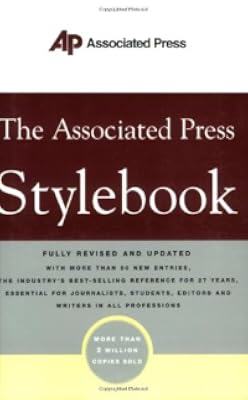
"The style of The Associated Press is the gold standard for news writing. With the AP Stylebook in hand, you can learn how to write and edit with the clarity and professionalism for which their writers and editors are famous. The AP Stylebook will help you master the AP's rules on grammar, spelling, punctuation, capitalization, abbreviation, word and numeral usage, and when to use 'more than' instead of 'over.' To make navigating these specialty chapters even easier, the Stylebook includes a show more comprehensive index. Fully revised and updated to keep pace with world events, common usage, and AP procedures, the AP Stylebook is the one reference that all writers, editors and students cannot afford to be without. This edition contains more than 300 new and revised entries, including: A new chapter on inclusive storytelling: its importance and how to achieve it; Detailed guidance on writing about people with disabilities and disabled people; Many updates on immigration, the coronavirus, gender and race-related coverage, including the capitalization of Black and expanded use of singular they; A revised chapter on religion, with guidance on when Catholic rather than Roman Catholic should be used on first reference; A thoroughly updated chapter on using social media for reporting."--Back cover. show lessTags
Recommendations












Member Reviews
If you need a guide for how to write to journalistic standards, this is definitely one place to go. The version I read, while very informative, was published before the widespread acceptance of the thing we now call the Internet, and as such, it's computer technology section may seem a bit dated.
The only thing that bugged me was that they didn't use the spelling "lede" for the introductory statements of a news story, and as a former newspaper editor, this threw me for a loop when I saw it spelled "lead." Every time I saw it, my reading flow just slowed down, as if lead (that is plumbum) were handed to me, instead of a lede.
Other than my hangups with using jargon where appropriate, this book should be used as a standard with respect to show more editing wording. However, if you're a writer of fiction, this book should be used more as a guideline, and not as a hard-and-fast styleguide. I mean, you wouldn't necessarily be abbreviating state names in your writing, now, would you? show less
The only thing that bugged me was that they didn't use the spelling "lede" for the introductory statements of a news story, and as a former newspaper editor, this threw me for a loop when I saw it spelled "lead." Every time I saw it, my reading flow just slowed down, as if lead (that is plumbum) were handed to me, instead of a lede.
Other than my hangups with using jargon where appropriate, this book should be used as a standard with respect to show more editing wording. However, if you're a writer of fiction, this book should be used more as a guideline, and not as a hard-and-fast styleguide. I mean, you wouldn't necessarily be abbreviating state names in your writing, now, would you? show less
This book brings back many bad memories of writing drills in J-School, but I still refer to it constantly.
I don't know anyone who made it through a Journalism degree without touching this book at least once. This is the oracle, mind you. I probably need an updated edition and all, but I would never get rid of this one! Too much of a sentimental attachment to it... Great reference work to have in any library.
The penultimate guide for a journalist: a dictionary, thesarus, and journalism guide all in one package. I keep it by my side for all types of writing situations, including non-journalistic ones.
This style guide is perhaps the third (or maybe fourth) choice amidst what is out there, but it is a standard. In the end it all comes down to what the instructor is expecting (and they will often tell you.) After that it mostly depends on your profession and personal taste. Any of them (Chicago, MLA, APA, or AP) are instructive in the they lay out that particular style and you know exactly what you're doing (just as long as you are consistant.)
Had intersting insight into how to write proper publically read atricles. Very informative!
This manual is organized like a dictionary with many words, government agencies, acronyms, and standard resources given. This manual is used in the publishing industry, especially for newspapers and periodicals. It is of use to the aspiring author.
Members
- Recently Added By
Lists

Books Read in 2009
464 works; 11 members
Author Information

8 Works 2,494 Members
Series

Common Knowledge
- Canonical title
- The Associated Press Stylebook
- Original publication date
- 1977
- People/Characters
- Associated Press
- Dedication
- In Memory of Christopher W. French 1940-1989 (1997 edition)
Classifications
- Genres
- Reference, Nonfiction, Politics and Government
- DDC/MDS
- 808.06607 — Literature & rhetoric Literature, rhetoric & criticism Rhetoric and collections of literary texts from more than two literatures Rhetoric and anthologies By Type Of Writing Writing non-fiction (by topic)
- LCC
- PN4783 .A83 — Language and Literature Literature (General) Literature (General) Journalism. The periodical press, etc. Technique. Practical journalism
- BISAC
Statistics
- Members
- 2,410
- Popularity
- 8,097
- Reviews
- 13
- Rating
- (3.91)
- Languages
- English
- Media
- Paper, Ebook
- ISBNs
- 44
- ASINs
- 27