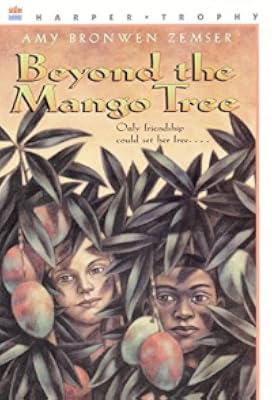
Beyond the Mango Tree
by Amy Bronwen Zemser
On This Page
Description
While living in Liberia with her possessive, diabetic mother and often-absent father, twelve-year-old Sarina longs for a friend with whom to experience the world beyond her yard.Tags
Recommendations


















Member Reviews
When I first picked up this slim book, I thought it was juvenile fiction but now I’m not so sure- the subject matter is pretty serious, dark things happen, and the local dialect I imagine could be difficult for kids to read and understand. It took me some puzzling over to figure out what some of the words meant.
The opening scene is strange: a twelve-year-old girl has been tied to a tree in her front yard, and the neighborhood kids come and poke at her. She lives in Liberia, where her family moved for her father’s job. But she doesn’t go to school and has no friends- her mother keeps her close at home and has forbidden her to associate with the local children. The mother is severely ill with uncontrolled diabetes- medication is show more unavailable and there’s no way of testing her insulin levels daily- instead the daughter Sarina and the hired help she spends most of her time with, keep a close eye on her mother’s behavior to know if she needs to eat something sweet, or to lie down and rest. The mother’s behavior is erratic and bordering on paranoid. She seems terrified of letting her child out of her sight, depending Sarina to care for her. This is a great burden for the lonely girl, who in spite of her mother’s restrictions and the hired woman afraid of disobeying (or she’ll loose her job) is desperate to find a friend. She does when a boy named Boima chases the other kids away from the mango tree and cuts her free. Sarina and Bomia sneak around together. He takes her to the large market to see the sights, and teaches her some local lore. They visit the ocean- dangerous- encounter a snake- also dangerous, and get tangled up in an issue of theft when someone in Sarina’s house tries to keep the boy from starving. Sarina herself can’t quite see it, how marginal her friend’s basic security is and when she finally realizes maybe it’s too late.
It’s a story where you have to read between the lines a lot- things happen which influence other events but the narrator doesn’t recognize what the reader sees. An incident with another, younger white girl (quite spoiled, but Sarina was jealous of the other parents’ attentions) who casually abused her pet monkey, and how Sarina changed that but nobody else saw why, is a case in point. There are deceits meant to be helpful, and attempts at helping that go awry. There is lovely, descriptive language that cuts to the quick of things. The ending is sobering and feels a bit unresolved, but I think this was based on true events from the author’s childhood (some other readers said the story is placed in the 1970’s but I haven’t verified that) and probably that’s exactly how her time in Liberia ended. show less
The opening scene is strange: a twelve-year-old girl has been tied to a tree in her front yard, and the neighborhood kids come and poke at her. She lives in Liberia, where her family moved for her father’s job. But she doesn’t go to school and has no friends- her mother keeps her close at home and has forbidden her to associate with the local children. The mother is severely ill with uncontrolled diabetes- medication is show more unavailable and there’s no way of testing her insulin levels daily- instead the daughter Sarina and the hired help she spends most of her time with, keep a close eye on her mother’s behavior to know if she needs to eat something sweet, or to lie down and rest. The mother’s behavior is erratic and bordering on paranoid. She seems terrified of letting her child out of her sight, depending Sarina to care for her. This is a great burden for the lonely girl, who in spite of her mother’s restrictions and the hired woman afraid of disobeying (or she’ll loose her job) is desperate to find a friend. She does when a boy named Boima chases the other kids away from the mango tree and cuts her free. Sarina and Bomia sneak around together. He takes her to the large market to see the sights, and teaches her some local lore. They visit the ocean- dangerous- encounter a snake- also dangerous, and get tangled up in an issue of theft when someone in Sarina’s house tries to keep the boy from starving. Sarina herself can’t quite see it, how marginal her friend’s basic security is and when she finally realizes maybe it’s too late.
It’s a story where you have to read between the lines a lot- things happen which influence other events but the narrator doesn’t recognize what the reader sees. An incident with another, younger white girl (quite spoiled, but Sarina was jealous of the other parents’ attentions) who casually abused her pet monkey, and how Sarina changed that but nobody else saw why, is a case in point. There are deceits meant to be helpful, and attempts at helping that go awry. There is lovely, descriptive language that cuts to the quick of things. The ending is sobering and feels a bit unresolved, but I think this was based on true events from the author’s childhood (some other readers said the story is placed in the 1970’s but I haven’t verified that) and probably that’s exactly how her time in Liberia ended. show less
Beyond the Mango Tree is a story narrated in first-person by twelve-year-old Sarina, an American girl from Boston who has moved to Liberia with her family. Sarina is trapped—emotionally and physically—in an unhappy home. Her father is most often away working in the bush, and her mother—severely ill with diabetes—is wildly fearful of losing her daughter. Sarina is never allowed outside the family's yard alone, and when her mother is having a bad day, she even ties Sarina to the mango tree in their front yard.
Ratings
Members
- Recently Added By
Lists

A Child's Book Tour of West Africa ::: Côte d'Ivoire, Mali, Ghana, Nigeria
59 works; 5 members
Author Information
2+ Works 165 Members
Awards and Honors
Common Knowledge
- Important places
- Liberia
Classifications
- Genres
- Fiction and Literature, Kids, Children's Books
- DDC/MDS
- 813.54 — Literature & rhetoric American literature in English American fiction in English 1900-1999 1945-1999
- LCC
- PZ7 .Z424 .B — Language and Literature Fiction and juvenile belles lettres Fiction and juvenile belles lettres Juvenile belles lettres
- BISAC
Statistics
- Members
- 85
- Popularity
- 375,754
- Reviews
- 2
- Rating
- (3.72)
- Languages
- English, German
- Media
- Paper
- ISBNs
- 6