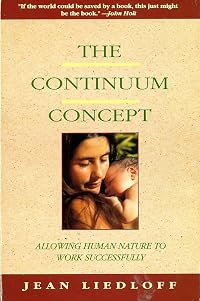
The Continuum Concept: In Search of Happiness Lost
by Jean Liedloff
On This Page
Description
A landmark treatise on how humanity lives versus how we should, what we've lost with our "progress," and how we can reclaim our true nature Jean Liedloff, an American writer, spent two and a half years in the South American jungle living with Stone Age Indians. The experience demolished her Western preconceptions of how we should live and led her to a radically different view of what human nature really is. She offers a new understanding of how we have lost much of our natural well-being and show more shows us practical ways to regain it for our children and for ourselves. show lessTags
Recommendations
















Member Reviews
I think I'm hate-reading this, and I'm not planning to go to the parenting book club that discusses this book because I don't want to alienate folks and sound like a jackass. I'm immediately skeptical of anything that has "human nature!" claims, because there's no such thing. There's also a hefty dose of noble savages, and that old well-meaning racist exotification. If I'm to read a parenting book, I want it to be backed up with real data rather than extrapolations and romanticization of the other.
My first and strongest impression of this book was that I knew the author. Although she came from the generation before mine, I feel like I knew dozens of people like her, privileged, intelligent, half-educated and profoundly dissatisfied with their home culture. I felt that I was a bit like her, but less starry-eyed.
The author's central theory is that human evolution has primed us to expect certain experiences which are necessary to our fundamental sense of well-being. She argues that tribal/primitive cultures which have evolved slowly over millennia and are resistant to change provide more of these "continuum" experiences. The most important of these is the in-arms phase for the infant, from birth until the baby begins to crawl. She show more blames many of the ills and discontentments of modern society on the fact that most of us missed out on that essential early experience, which would have given us a feeling of contentment, acceptance, and "rightness." She has a few theories about the way the continuum would have us behave in later stages of life, but that early phase is all-important.
The Continuum Concept has been enormously influential in hippie earth-mother circles, and to be honest I had hoped for more. I have no argument with the idea that babies are happier and healthier when they are in contact with a responsive caregiver, and that most are better off being carried around than being left alone in a pram, stroller, cot or crib. Maybe lots of us carry deep emotional scars from being left to cry alone when we were infants, but it;s not the answer to all our psychological problems, never mind our social issues. Basically, I agree with most of the author's recommendations about how to raise babies, but I was disappointed by her sloppy scholarship and her belief that civilization has it all wrong, when it comes to helping us be happy and fulfilled human beings.
I believe that human beings are a lot more adaptable than Jean Liedloff gives us credit for, and that while our intellectual innovations often undermine our contentment, the conscious mind, as well as instinct, can help us be happier people at any stage of life.
And now, back to my bored, attention-grabbing toddler! show less
The author's central theory is that human evolution has primed us to expect certain experiences which are necessary to our fundamental sense of well-being. She argues that tribal/primitive cultures which have evolved slowly over millennia and are resistant to change provide more of these "continuum" experiences. The most important of these is the in-arms phase for the infant, from birth until the baby begins to crawl. She show more blames many of the ills and discontentments of modern society on the fact that most of us missed out on that essential early experience, which would have given us a feeling of contentment, acceptance, and "rightness." She has a few theories about the way the continuum would have us behave in later stages of life, but that early phase is all-important.
The Continuum Concept has been enormously influential in hippie earth-mother circles, and to be honest I had hoped for more. I have no argument with the idea that babies are happier and healthier when they are in contact with a responsive caregiver, and that most are better off being carried around than being left alone in a pram, stroller, cot or crib. Maybe lots of us carry deep emotional scars from being left to cry alone when we were infants, but it;s not the answer to all our psychological problems, never mind our social issues. Basically, I agree with most of the author's recommendations about how to raise babies, but I was disappointed by her sloppy scholarship and her belief that civilization has it all wrong, when it comes to helping us be happy and fulfilled human beings.
I believe that human beings are a lot more adaptable than Jean Liedloff gives us credit for, and that while our intellectual innovations often undermine our contentment, the conscious mind, as well as instinct, can help us be happier people at any stage of life.
And now, back to my bored, attention-grabbing toddler! show less
Hmm. This book is hideously unscientific. Most of its claims are complete conjecture, based on the author's interpretation of her time with the Yequana people of Venezuela, and some of them are real doozies.
That said, I'd still recommend it to anyone with even a passing interest in psychology, sociology, parenting, or oh, I don't know, the attainment of happiness. She makes a very compelling case that our societal "wisdom" about how children should be dealt with from infancy is completely skewed, runs counter to our actual instincts, and leads to a state where "happiness ceases to be a normal condition of being alive, and becomes a goal." She claims that this deviation from the natural processes of our species (the "Continuum"), show more beginning with our failure to keep our newborns constantly "in arms", not as the center of attention, but as an observer learning how the life of adults works, drives us ever further from it, and perpetuates our constant drives to fill the holes in ourselves with money, power, love, drugs, etc. Or, as in this comic, sand: http://dresdencodak.com/images/stall10.jpg .
I think she's spot on, and my entire view of modern society has been forever altered.
TL;DR: Most of this book is silliness. But the main point - we raise our kids wrong, and it makes us an unhappy striving society, is incredibly powerful. So read it anyway. show less
That said, I'd still recommend it to anyone with even a passing interest in psychology, sociology, parenting, or oh, I don't know, the attainment of happiness. She makes a very compelling case that our societal "wisdom" about how children should be dealt with from infancy is completely skewed, runs counter to our actual instincts, and leads to a state where "happiness ceases to be a normal condition of being alive, and becomes a goal." She claims that this deviation from the natural processes of our species (the "Continuum"), show more beginning with our failure to keep our newborns constantly "in arms", not as the center of attention, but as an observer learning how the life of adults works, drives us ever further from it, and perpetuates our constant drives to fill the holes in ourselves with money, power, love, drugs, etc. Or, as in this comic, sand: http://dresdencodak.com/images/stall10.jpg .
I think she's spot on, and my entire view of modern society has been forever altered.
TL;DR: Most of this book is silliness. But the main point - we raise our kids wrong, and it makes us an unhappy striving society, is incredibly powerful. So read it anyway. show less
Some of the advice here seems sensible and useful. It seems like a good idea to relax about parenting, to carry children with you when you can, to let children be around adults and with older children. On the other hand, I found her descriptions of the 'torture' that Western parenting puts children through melodramatic and unnecessary. The reinforcement of gender stereotypes and claims that homosexuality, addiction, and criminality were all caused by bad parenting did not endear this book to me either.
I loved this when I read it in the 1990s and I found it very compelling. Looking back, I'm more skeptical from a decolonization POV. But hey, luckily I never had any babies and none of this was put to the test in my life.
I recommend this book to anyone planning to have a baby. It makes a good case for holding a child (or keeping it close to a person's body) during the first six to nine months of its life. If everyone took Liedloff's advice, the world would be a much happier place. A must read for prospective parents! Supports the theory that if you don't get that sense of security at birth, you tend to spend the rest of your life searching for semblance of it.
It makes me think people are becoming, or similar to, or meant to be, marsupials. I think the strangeness of the modern world and the challenge of guiding the younger generation really calls for this book and its simple power. How good if society can accept women carrying their babies on their backs in all kind of contexts... work, outings, meetings etc. I really believe it! Children must be really empowered by this!
Members
- Recently Added By
Lists

The Joe Rogan Experience Library
254 works; 3 members

1980s
356 works; 23 members

Books Read in 2005
183 works; 7 members

BOOKS READ IN 1980's and 1990's
52 works; 4 members
Author Information

4 Works 680 Members
Series
Belongs to Publisher Series
Common Knowledge
- Canonical title
- The Continuum Concept: In Search of Happiness Lost
- Original title
- The Continuum Concept
- Original publication date
- 1977
- First words*
- Mit diesem Buch möchte ich eine These vortragen und nicht eine Geschichte erzählen.
- Last words*
- (Click to show. Warning: May contain spoilers.)Erkennen wir erst einmal die Folgen unserer Behandlung von Babies, Kindern, anderen und uns selbst und lernen, das wirkliche Wesen unserer Gattung zu respektieren, dann werden wir unvermeidlich sehr viel mehr erfahren über unsere Anlage zur Freude.
*Some information comes from Common Knowledge in other languages. Click "Edit" for more information.
Classifications
- Genres
- Anthropology, Nonfiction, General Nonfiction
- DDC/MDS
- 155.418 — Philosophy & psychology Psychology Differential and developmental psychology Childhood General Child Psychology Applied Psychology
- LCC
- HQ767.9 .L54 — Social sciences The family. Marriage, Women and Sexuality The Family. Marriage. Women The family. Marriage. Home
- BISAC
Statistics
- Members
- 676
- Popularity
- 42,565
- Reviews
- 14
- Rating
- (4.01)
- Languages
- 9 — Czech, Dutch, English, French, German, Hungarian, Italian, Spanish, Swedish
- Media
- Paper, Audiobook, Ebook
- ISBNs
- 31
- ASINs
- 14