On This Page
Description
A collection of stories following the adventures of the Enterprise and its crew as they blast off for intergalactic intrigue in the unexplored realms of outer space.Tags
Recommendations








Member Reviews
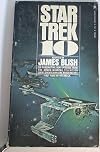
February 1974 brings another entry in Blish's series of Star Trek novelizations, Star Trek 10. This volume adapts "The Alternative Factor", "The Empath", "The Galileo Seven", "Is There in Truth No Beauty?", "A Private Little War", and "The Omega Glory".
In his introduction to this volume, Blish confirms what I suspected (and mentioned in my review of Star Trek 7): he has done as little to change the scripts he was working from as possible. In his words:
This is a shame, since Blish isn't a show more bad author and the scripts could really use some tweaking for the page. Well, it's too late now.
In "The Alternative Factor", the Enterprise encounters a strange disturbance in space, and finds a madman on an otherwise dead world who demands that they help him to defeat the monstrous man who destroyed his civilization. This story is just a mess. It was worse on screen, but this adaptation can't cure what ails it. A number of events transpire with some urgency, but fail to make any impression on the reader, until the story comes to its pat, supposedly-dramatic end.
In "The Empath", Kirk, Spock, and McCoy have their loyalty to one another tested by some aliens who hope to teach an empathic girl certain positive emotions, as a prerequisite to saving her planet from destruction. This is far from my favorite story, but it's well worth seeing the episode for the very different style--minimalist sets, shots heavily focused on the actors. The adaptation isn't bad, but the episode was better.
In "The Galileo Seven", Spock's logical style of command is put to the test when the expedition he leads is forced to crash land on an inhospitable planet. Meanwhile the Enterprise has only a limited time to search for them before they must abandon them for a greater duty. This isn't a bad story, but it feels like they were trying to force a conflict between logical and emotional choices that just didn't have to be there. Even in the end, when Spock makes the supposedly emotional decision to burn up their shuttlecraft's fuel as a flare, it doesn't seem a particularly illogical choice--either the Enterprise was nearby, and might see it, or it had already left, and conserving fuel would do no good. Whatever my disagreement with the story's interpretation, though, it's still good to see Spock in a command situation, and to see him interacting with McCoy.
In "Is There in Truth No Beauty?", the Enterprise plays host to an alien ambassador so ugly that the sight of him will drive a man mad. I liked this story because it's focused on the characters. There are unique dynamics between Miranda and each of Spock, Kirk, and Marvick, and we get a good look at Kirk and Spock's friendship, too.
"A Private Little War" is a metaphor (explicitly stated, even) for the Vietnam War. The Klingons have given one faction on a previously idyllic planet weapons with which to subjugate another faction (coincidentally favored by Kirk). Kirk ultimately determines to arm 'his' side equally to the other, maintaining a careful balance of power, to prevent either side from being totally destroyed. Is his decision correct? I wonder. It's a great story.
"The Omega Glory", frankly, is just embarrassing. It's all very rah-rah about the superiority of the United States, as depicted by a society with a truly unbelievable degree of parallel evolution with Earth, in which the communists took over the world. Don't worry, though, because the Good Guys win in the end, and Kirk recites the Pledge of Allegiance and the Preamble to the Constitution. Because America!
Star Trek 10 features several quite good stories. It's surely one of the best volumes in this series. Maybe I was just in a good mood, but even the writing seemed better in this book. Do check it out, fans of classic Trek. show less
In his introduction to this volume, Blish confirms what I suspected (and mentioned in my review of Star Trek 7): he has done as little to change the scripts he was working from as possible. In his words:
Up to that point, I'd regarded my role as nothing but that of a pipeline between the scripts and all the rest of you who can't forget the series.
...in this series it was obviously my duty to the originals to keep myself out of them as much as possible.
This is a shame, since Blish isn't a show more bad author and the scripts could really use some tweaking for the page. Well, it's too late now.
In "The Alternative Factor", the Enterprise encounters a strange disturbance in space, and finds a madman on an otherwise dead world who demands that they help him to defeat the monstrous man who destroyed his civilization. This story is just a mess. It was worse on screen, but this adaptation can't cure what ails it. A number of events transpire with some urgency, but fail to make any impression on the reader, until the story comes to its pat, supposedly-dramatic end.
In "The Empath", Kirk, Spock, and McCoy have their loyalty to one another tested by some aliens who hope to teach an empathic girl certain positive emotions, as a prerequisite to saving her planet from destruction. This is far from my favorite story, but it's well worth seeing the episode for the very different style--minimalist sets, shots heavily focused on the actors. The adaptation isn't bad, but the episode was better.
In "The Galileo Seven", Spock's logical style of command is put to the test when the expedition he leads is forced to crash land on an inhospitable planet. Meanwhile the Enterprise has only a limited time to search for them before they must abandon them for a greater duty. This isn't a bad story, but it feels like they were trying to force a conflict between logical and emotional choices that just didn't have to be there. Even in the end, when Spock makes the supposedly emotional decision to burn up their shuttlecraft's fuel as a flare, it doesn't seem a particularly illogical choice--either the Enterprise was nearby, and might see it, or it had already left, and conserving fuel would do no good. Whatever my disagreement with the story's interpretation, though, it's still good to see Spock in a command situation, and to see him interacting with McCoy.
In "Is There in Truth No Beauty?", the Enterprise plays host to an alien ambassador so ugly that the sight of him will drive a man mad. I liked this story because it's focused on the characters. There are unique dynamics between Miranda and each of Spock, Kirk, and Marvick, and we get a good look at Kirk and Spock's friendship, too.
"A Private Little War" is a metaphor (explicitly stated, even) for the Vietnam War. The Klingons have given one faction on a previously idyllic planet weapons with which to subjugate another faction (coincidentally favored by Kirk). Kirk ultimately determines to arm 'his' side equally to the other, maintaining a careful balance of power, to prevent either side from being totally destroyed. Is his decision correct? I wonder. It's a great story.
"The Omega Glory", frankly, is just embarrassing. It's all very rah-rah about the superiority of the United States, as depicted by a society with a truly unbelievable degree of parallel evolution with Earth, in which the communists took over the world. Don't worry, though, because the Good Guys win in the end, and Kirk recites the Pledge of Allegiance and the Preamble to the Constitution. Because America!
Star Trek 10 features several quite good stories. It's surely one of the best volumes in this series. Maybe I was just in a good mood, but even the writing seemed better in this book. Do check it out, fans of classic Trek. show less
The Prime Directive features prominently in this volume...pesky culturally interfering Klingons and rascally deranged Star Fleet Captains posing moral dilemmas for Kirk.
My edition has a Blish bio in the back that notes that he died at 54 of lung cancer. That history of witchcraft was never finished...what else might he have gone on to do? Blish's place in the pantheon of Golden Age SF writers should really be much higher.
My edition has a Blish bio in the back that notes that he died at 54 of lung cancer. That history of witchcraft was never finished...what else might he have gone on to do? Blish's place in the pantheon of Golden Age SF writers should really be much higher.
Finished another in my 2020 re-watch/re-read of ST:TOS in order. Star Trek 10 is the 6th book finished. No glaringly different plot or character points in this volume, which leaves me with the annoying nit-picks. It is somewhat disheartening to realize that no one, not the author, the editor or even the people at Paramount approving these books, watched the show enough to realize that you can't slam a door on the Enterprise. I'd noticed it before, but it was particularly obvious in "Is There in Truth No Beauty" here, which also included pushing a door open and a door knob.
Read while recovering from a blow to the head (just as I did STAR TREK 9). It was exactly my speed. Make of that what you will.
Another collection of stories set on he original Star Trek Enterprise
"The Alternative Factor" S01E27
"The Empath" S03E12
"The Galileo Seven" S01E16
"Is There In Truth No Beauty?" S03E05
"A Private Little War" S02E19
"The Omega Glory" S02E23
"The Empath" S03E12
"The Galileo Seven" S01E16
"Is There In Truth No Beauty?" S03E05
"A Private Little War" S02E19
"The Omega Glory" S02E23
Members
- Recently Added By
Author Information

James Benjamin Blish was born on May 23, 1921 in East Orange, N.J. Blish trained as a biologist at Rutgers and Columbia University, and spent 1942 - 1944 as a medical technician in the United States Army. After the war he became the science editor for the Pfizer pharmaceutical company. His first published story appeared in 1940, and his writing show more career progressed until he gave up his job to become a professional writer. From 1962 to 1968, he worked for the Tobacco Institute. Between 1967 and his death from lung cancer in 1975, Blish wrote authorized short story collections based upon the 1960s TV series Star Trek. He wrote 11 volumes adapting episodes of the series. He died midway through writing Star Trek 12. Perhaps Blish's most famous works were the "Okies" stories, known collectively as Cities in Flight, published in the science-fiction digest magazine Astounding Science Fiction. Some of James Blish's other works include The Vanished Jet, And All the Stars a Stage, The Quincunx of Time, and Flight of Eagles. (Bowker Author Biography) show less
Some Editions
Series

Work Relationships
Is contained in
Common Knowledge
- Canonical title
- Star Trek 10
- Original title
- Star Trek 10
- Alternate titles
- Star Trek 10
- Original publication date
- 1974-02 (eng.) (eng.)
- People/Characters
- James T. Kirk; Leonard McCoy (Bones); Spock; Pavel Chekov; Nyota Uhura; Montgomery Scott (Scotty)
- Important places
- USS Enterprise NCC-1701
- Related movies
- Star Trek (1966 | IMDb); The Alternative Factor (1967 | IMDb); The Empath (1968 | IMDb); The Galileo Seven (1967 | IMDb); Is There in Truth No Beauty? (1968 | IMDb); A Private Little War (1968 | IMDb) (show all 7); The Omega Glory (1968 | IMDb)
- Dedication
- To Karin
who also wanted to set Spock to music - First words
- The Alternative Factor:
The planet offered such routine readings to the Enterprise sensors that Kirk ordered a course laid in for the nearest Star Base. - Last words
- (Click to show. Warning: May contain spoilers.)The Omega Glory: As they broke into dazzle, Kirk turned for a last look at the old flag upright in its standard, its stars and its stripes still bright.
Classifications
Statistics
- Members
- 668
- Popularity
- 43,176
- Reviews
- 8
- Rating
- (3.60)
- Languages
- English
- Media
- Paper
- ISBNs
- 8
- ASINs
- 10