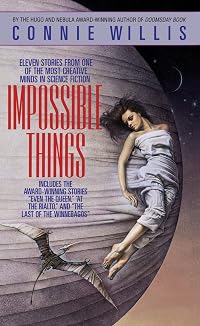
Impossible Things
by Connie Willis
On This Page
Description
Fantasy. Fiction. Science Fiction. Short Stories. HTML:Winner of six Nebula and two Hugo awards for her fiction, Connie Willis is acclaimed for her gifted imagination and bold invention. Here are eleven of her finest stories, surprising tales in which the impossible becomes real, the real becomes impossible, and strangeness lurks at every turn.The end of the world comes not with a bang but a series of whimpers over many years in "The Last of the Winnebagos."
The terror of pain and dying show more gives birth to a startling truth about the nature of the stars, a principle known as the "Schwarzschild Radius."
In "Spice Pogrom," an outrageous colony in outer space becomes the setting for a screwball comedy of bizarre complications, mistaken identities, far-too-friendly aliens—and even true love. show less
Tags
Recommendations







Member Reviews
Overall Summary and Review: Impossible Things is Connie Willis's second short story collection (her first was Fire Watch), and it was amazing. Some of the stories spoke to me more than others, of course, but they were all beautifully crafted, and not one of them was unenjoyable or out of place. The stories cover a pretty wide array of tones - from madcap comedy to wistful nostalgia, from historical to dystopian, and everywhere in between and back again. The only thing that bothered me about this book was how many of the stories seemed to feature extremely self-involved, assholish, and emotionally unavailable boyfriends/husbands, to the point where I started to wonder about Willis's relationships, or whether she was just returning to show more that well of drama for convenience's sake. But even there, she manages to flip my expectations in one of the later stories, proving that she can write about stable significant others and happy couples after all. Overall, this was one of the best collections I've read, with a good mix of sci-fi and fantasy and contemporary and historical and future, and not a bad story in the bunch. 4.5 out of 5 stars.
Individual Stories:
- "The Last of the Winnebagos" is a story set in a future USA, where non-commercial highway travel has largely become a thing of the past, and killing an animal is punishable by law, involving a photojournalist who is on assignment to photograph a couple who have, as the title says, the last Winnebago still running. This story won both the Hugo and the Nebula awards, and I can certainly see why, although it wasn't one of my favorites in the book. I thought the photographer's musings on the nature of people and portraits and their camera faces was interesting (and accurate), and I appreciated the fact that even though this story's 15 years old, it's not showing its age at all. (Actually, that's true of the book as a whole.)
- "Even the Queen" is a story at the intersection of biology and technology, so you know it's going to make me happy. It involves the cultural reaction - and maybe even backlash - to a world where women no longer have to deal with monthly menstruation. Seeing as I have personally had some of the arguments between mother and daughter in this story, almost verbatim, about whether or not taking continuous cycles of birth control (and thereby not having periods) is healthy or not, I think Willis hit the nail pretty squarely on the head, but she manages to do it with much more wit than I could.
- The Schwarzschild radius is the radius at which light can no longer escape a black hole, and "Schwarzschild Radius" is a story set during World War I, which is when Schwarzchild did his calculations, and involving the gravitation pull of not of black holes, but of events. This was one of the more complex stories in the collection, and I'm not sure that I entirely got it; I think it would benefit from a second reading.
- "Ado" is a tale of political correctness gone haywire, and what happens if you try to Bowdlerize Hamlet so that it doesn't offend *anyone*. This was a cute little story, although not particularly subtle, and I feel like I've seen its main point made elsewhere.
- "Spice Pogrom" was probably my favorite story in this collection. It's the tale of first contact with an alien species, and our protagonist has one of the alien delegates staying in her bedroom, since there's nowhere else to put him in the incredibly crowded colony. She's under strict instructions from her boyfriend not to offend the alien, but there's somewhat of a communication barrier, and he keeps bringing home all kinds of stuff that they don't have space for... including, one day, a handsome stranger. This story shows off Willis's flair for comedy - and the zany, madcap, farcical style of comedy, with people tripping over each other on the stairs, and hilarious misunderstandings abounding. It's a ton of fun, but it's also got a really sweet heart at its core as well.
- "Winter's Tale" takes on the "Did Shakespeare really write all of Shakespeare?" debate from a unique point of view: that of his wife, Anne Hathaway (and also manages to address the issue of the "second-best bed" line in Shakespeare's will). I am a huge sucker for all things Shakespeare, so of course I loved this story... and bonus points for Willis's theory actually being both plausible, and one I hadn't heard before.
- "Chance" is the story of a woman who moves back to her college town as an adult, and begins seeing visions of the events between her and her college friends that led her life to where it is now. This is the darkest story in the collection, I think. I'd even call it bleak, although some of that might be its placement so soon after "Spice Pogrom". It's devestatingly effective, though, because there are so many opportunities for the story to go a different way, and it just tragically never does.
- "In the Late Cretaceous" is a story about a paleontology department facing some restructuring. As someone entrenched in academia (and therefore university politics) myself, a lot of this hit hilariously if disturbingly close to home. The ending didn't have quite the oomph I wanted, but it fit the story quite nicely. (This may be one story that shows its age, though, if only by the fact that one character is complaining about the super-expensive $80-per-semester parking pass. If only.)
- "Time Out" was my second-favorite story; a close second behind "Spice Pogrom". It's also madcap comedy with a solid beating heart to it; it involves a scientist who has chosen an elementary school as the perfect location to test his theories about chronodisplacement (also known as time travel), and the effects his research has on the otherwise ordinary people he enlists to help him. Willis has this amazing gift for throwing a ton of random-seeming elements into her stories and having them seem like they're all over the place, only for everything to slot together perfectly by the end.
- "Jack" confused me at first. It's set in a Fire Marshall's station during the London Blitz, so it was immediately reminiscent of "Fire Watch" (and presumably also Blackout, which I've not yet read). But the time-travel historians were missing, so I wasn't getting the appropriate sci-fi twist on straight historical fiction... at first. But then it came, and it was a good one, one which I will not spoil here, but one which - like that in "A Winter's Tale" - makes total sense and is sort of surprising that I'd really never seen it done before.
- "At the Rialto" is another story of academics, physicists this time, who are at a conference on quantum physics in Hollywood, of all places, where nothing seems to be going according to plan. My knowledge of quantum physics is mostly based on The Tao of Physics, a decades-old book that I read over a decade ago, but it was enough to make this story very funny, albeit in a more subtle way than some of the other funny stories in this collection.
Recommendation: Definitely recommended. This collection is solid enough to stand alongside Willis's novels for her existing fans, and would be a fine introduction to both her style and her range for someone new to her work. And even though Willis can get kind of "techy" in her sci-fi, with the big (albeit usually fake) words that could scare non-SFF readers away, I think there's a sensibility to her work that makes it more approachable than it might seem at first to someone new to the genre. show less
Individual Stories:
- "The Last of the Winnebagos" is a story set in a future USA, where non-commercial highway travel has largely become a thing of the past, and killing an animal is punishable by law, involving a photojournalist who is on assignment to photograph a couple who have, as the title says, the last Winnebago still running. This story won both the Hugo and the Nebula awards, and I can certainly see why, although it wasn't one of my favorites in the book. I thought the photographer's musings on the nature of people and portraits and their camera faces was interesting (and accurate), and I appreciated the fact that even though this story's 15 years old, it's not showing its age at all. (Actually, that's true of the book as a whole.)
- "Even the Queen" is a story at the intersection of biology and technology, so you know it's going to make me happy. It involves the cultural reaction - and maybe even backlash - to a world where women no longer have to deal with monthly menstruation. Seeing as I have personally had some of the arguments between mother and daughter in this story, almost verbatim, about whether or not taking continuous cycles of birth control (and thereby not having periods) is healthy or not, I think Willis hit the nail pretty squarely on the head, but she manages to do it with much more wit than I could.
- The Schwarzschild radius is the radius at which light can no longer escape a black hole, and "Schwarzschild Radius" is a story set during World War I, which is when Schwarzchild did his calculations, and involving the gravitation pull of not of black holes, but of events. This was one of the more complex stories in the collection, and I'm not sure that I entirely got it; I think it would benefit from a second reading.
- "Ado" is a tale of political correctness gone haywire, and what happens if you try to Bowdlerize Hamlet so that it doesn't offend *anyone*. This was a cute little story, although not particularly subtle, and I feel like I've seen its main point made elsewhere.
- "Spice Pogrom" was probably my favorite story in this collection. It's the tale of first contact with an alien species, and our protagonist has one of the alien delegates staying in her bedroom, since there's nowhere else to put him in the incredibly crowded colony. She's under strict instructions from her boyfriend not to offend the alien, but there's somewhat of a communication barrier, and he keeps bringing home all kinds of stuff that they don't have space for... including, one day, a handsome stranger. This story shows off Willis's flair for comedy - and the zany, madcap, farcical style of comedy, with people tripping over each other on the stairs, and hilarious misunderstandings abounding. It's a ton of fun, but it's also got a really sweet heart at its core as well.
- "Winter's Tale" takes on the "Did Shakespeare really write all of Shakespeare?" debate from a unique point of view: that of his wife, Anne Hathaway (and also manages to address the issue of the "second-best bed" line in Shakespeare's will). I am a huge sucker for all things Shakespeare, so of course I loved this story... and bonus points for Willis's theory actually being both plausible, and one I hadn't heard before.
- "Chance" is the story of a woman who moves back to her college town as an adult, and begins seeing visions of the events between her and her college friends that led her life to where it is now. This is the darkest story in the collection, I think. I'd even call it bleak, although some of that might be its placement so soon after "Spice Pogrom". It's devestatingly effective, though, because there are so many opportunities for the story to go a different way, and it just tragically never does.
- "In the Late Cretaceous" is a story about a paleontology department facing some restructuring. As someone entrenched in academia (and therefore university politics) myself, a lot of this hit hilariously if disturbingly close to home. The ending didn't have quite the oomph I wanted, but it fit the story quite nicely. (This may be one story that shows its age, though, if only by the fact that one character is complaining about the super-expensive $80-per-semester parking pass. If only.)
- "Time Out" was my second-favorite story; a close second behind "Spice Pogrom". It's also madcap comedy with a solid beating heart to it; it involves a scientist who has chosen an elementary school as the perfect location to test his theories about chronodisplacement (also known as time travel), and the effects his research has on the otherwise ordinary people he enlists to help him. Willis has this amazing gift for throwing a ton of random-seeming elements into her stories and having them seem like they're all over the place, only for everything to slot together perfectly by the end.
- "Jack" confused me at first. It's set in a Fire Marshall's station during the London Blitz, so it was immediately reminiscent of "Fire Watch" (and presumably also Blackout, which I've not yet read). But the time-travel historians were missing, so I wasn't getting the appropriate sci-fi twist on straight historical fiction... at first. But then it came, and it was a good one, one which I will not spoil here, but one which - like that in "A Winter's Tale" - makes total sense and is sort of surprising that I'd really never seen it done before.
- "At the Rialto" is another story of academics, physicists this time, who are at a conference on quantum physics in Hollywood, of all places, where nothing seems to be going according to plan. My knowledge of quantum physics is mostly based on The Tao of Physics, a decades-old book that I read over a decade ago, but it was enough to make this story very funny, albeit in a more subtle way than some of the other funny stories in this collection.
Recommendation: Definitely recommended. This collection is solid enough to stand alongside Willis's novels for her existing fans, and would be a fine introduction to both her style and her range for someone new to her work. And even though Willis can get kind of "techy" in her sci-fi, with the big (albeit usually fake) words that could scare non-SFF readers away, I think there's a sensibility to her work that makes it more approachable than it might seem at first to someone new to the genre. show less
This collection of short stories by Connie Willis has perhaps been more revealing of her personality than any of her longer works, partly due to the subject matter (sometimes drawn from her own life, I suspect) and partly due to the forewords to each story in which she reveals a little of what went into each one. Regardless, this is a fine collection with many hits ("The Last of the Winnebagos", with its heartbreaking final paragraph, and the hilarious "Even the Queen", "Ado", "Spice Progrom" and "At the Rialto" (humor abounds merrily in this book, with a flavor like the old screwball comedies Willis loves), and one or two misses ("A Winter's Tale"). A good introductory book for the newcomer to Connie Willis. She is fast gaining in show more respect from me, for her humor, compassion and ideas, if not always for the clarity of her plots. show less
Witty and wise, poignant and playful, this collection of Connie Willis' short stories blends a bit of science fiction, a pinch of speculative history, and a dash of satire and screwball comedy. All of the stories are beautifully written, and each is prefaced by a brief explanation of its history or origin---how Willis came up with the idea or what she hoped to achieve in the writing of it. Some of the stories made me laugh, a handful made me cry, and a couple of them made me wish I'd thought to pick up a degree in physics while I was busily chipping away at my BA. If you're looking for a superbly written short story or just some very smart science fiction, give Impossible Things a read.
I picked up this book and almost put it back in the “to be read” pile thinking to myself, “How many times can I read some of these stories?” Apparently, the answer is, a lot of times.
The minute I began to read “The Last of the Winnebagos” (for the umpteenth time), I remembered the power and skill Willis wields in her writing. Simply stated, Willis is one of the best writers out there. And this collection is testament to that skill. Award-winners are included (“Even the Queen”, “At the Rialto”, and the previously mentioned Winnebagos). But every story is worth reading and, all together, they provide a fine representation of her various approaches and styles that invariably lead to success. Even when things slow down a show more little, the stories are still top-notch. Whether she is dealing with quantum physics and chaos theory, or the personal lives of people at the whimpering end of the world, her deft touch results in memorable stories that linger long after the reading. show less
The minute I began to read “The Last of the Winnebagos” (for the umpteenth time), I remembered the power and skill Willis wields in her writing. Simply stated, Willis is one of the best writers out there. And this collection is testament to that skill. Award-winners are included (“Even the Queen”, “At the Rialto”, and the previously mentioned Winnebagos). But every story is worth reading and, all together, they provide a fine representation of her various approaches and styles that invariably lead to success. Even when things slow down a show more little, the stories are still top-notch. Whether she is dealing with quantum physics and chaos theory, or the personal lives of people at the whimpering end of the world, her deft touch results in memorable stories that linger long after the reading. show less
In this collection of short stories, mostly published in the ‘80s and early ‘90s, Connie Willis showcases her remarkable imagination, humor, love of literature, and knowledge of quantum physics. I’ve really enjoyed all of her books that I’ve read so far, and this anthology is no exception. Though I enjoyed some stories more than others, they’re all interesting and unique – no clunkers! Here are my thoughts on the individual stories:
.....“The Last of the Winnebagos” – Sometime in the near future, it’s a felony to kill animals, and the Humane Society has become a totalitarian secret police. I found this story a bit hard to follow at first, but it all came together in the end.
.....“Even the Queen” – After a show more radically egalitarian revolution called the Liberation, women no longer have to experience menstruation. This was a very funny story about the far-reaching implications that such a development might have.
.....“Schwarzschild Radius” – A young scientist’s thesis about black holes becomes tied to a German soldier’s horrific experiences in World War I. One of the darker stories in this collection, it’s also one of the least emotionally impactful, in my opinion.
.....“Ado” – A college professor tries to teach Shakespeare without offending anyone. This is a lightweight but extremely funny satire about what would happen if political correctness were taken to its logical extreme.
.....“Spice Pogrom” – A woman on a space colony desperately attempts to communicate with the local aliens, but she is frequently hindered by overcrowding, language barriers, and two insufferable little girls. I absolutely loved this homage to the great Hollywood screwball comedies – definitely one of my favorites in the bunch!
.....“Winter’s Tale” – Willis takes on the question of Who Was Shakespeare, Really from a unique perspective. I disagree with her ultimate theory but thought the story was extremely interesting.
.....“Chance” – An unhappily married woman, having just moved back to her college town, relives a tragic incident from her past. This is a great but ultimately heartbreaking story.
.....“In the Late Cretaceous” – A university’s paleontology department must face radical reorganization and budget cuts; the professors are trapped in this madness until one of them decides she’s had enough. I enjoyed this satire about academia, especially the jokes about the parking Nazis (it’s not every day you read a story where a character is described as “an adolescent Himmler”!).
.....“Time Out” – A science experiment intended to prove that time travel is possible wreaks havoc on a small Midwestern town. I really liked this story, which had an interesting balance of humor and psychological insight.
.....“Jack” – In World War II-era London, a group of air raid wardens struggles to survive the war while rescuing people who have been trapped beneath piles of rubble. At first this story seems like an average horros-of-war story, but it soon takes a really cool turn!
.....“At the Rialto” – Confronted with the chaos of a physics convention being hosted in a Hollywood hotel, a scientist begins to draw parallels between the insanity around her and quantum physics. This comic story is another one of my favorites in the collection. show less
.....“The Last of the Winnebagos” – Sometime in the near future, it’s a felony to kill animals, and the Humane Society has become a totalitarian secret police. I found this story a bit hard to follow at first, but it all came together in the end.
.....“Even the Queen” – After a show more radically egalitarian revolution called the Liberation, women no longer have to experience menstruation. This was a very funny story about the far-reaching implications that such a development might have.
.....“Schwarzschild Radius” – A young scientist’s thesis about black holes becomes tied to a German soldier’s horrific experiences in World War I. One of the darker stories in this collection, it’s also one of the least emotionally impactful, in my opinion.
.....“Ado” – A college professor tries to teach Shakespeare without offending anyone. This is a lightweight but extremely funny satire about what would happen if political correctness were taken to its logical extreme.
.....“Spice Pogrom” – A woman on a space colony desperately attempts to communicate with the local aliens, but she is frequently hindered by overcrowding, language barriers, and two insufferable little girls. I absolutely loved this homage to the great Hollywood screwball comedies – definitely one of my favorites in the bunch!
.....“Winter’s Tale” – Willis takes on the question of Who Was Shakespeare, Really from a unique perspective. I disagree with her ultimate theory but thought the story was extremely interesting.
.....“Chance” – An unhappily married woman, having just moved back to her college town, relives a tragic incident from her past. This is a great but ultimately heartbreaking story.
.....“In the Late Cretaceous” – A university’s paleontology department must face radical reorganization and budget cuts; the professors are trapped in this madness until one of them decides she’s had enough. I enjoyed this satire about academia, especially the jokes about the parking Nazis (it’s not every day you read a story where a character is described as “an adolescent Himmler”!).
.....“Time Out” – A science experiment intended to prove that time travel is possible wreaks havoc on a small Midwestern town. I really liked this story, which had an interesting balance of humor and psychological insight.
.....“Jack” – In World War II-era London, a group of air raid wardens struggles to survive the war while rescuing people who have been trapped beneath piles of rubble. At first this story seems like an average horros-of-war story, but it soon takes a really cool turn!
.....“At the Rialto” – Confronted with the chaos of a physics convention being hosted in a Hollywood hotel, a scientist begins to draw parallels between the insanity around her and quantum physics. This comic story is another one of my favorites in the collection. show less
I was talking with a friend the other day who made the comment that good short stories are hard to find, but oh-so-wonderful when they are found. Connie Willis is a very intelligent woman who mixes her knowledge of history and science to make super believable science fiction landscapes in which to couch clever tales that almost always have more meaning that one initially suspects. I particularly liked her tribute 40's era romance plots in "Spice Program", and her super intelligent cut at political correctness using, of all things, Shakespeare! in "Ado", and finally, the depressing but beautiful "Schwarzchild Radius" in which she makes life mimic science. Oh, so much fun!
This book has eleven stories, three of which were Hugo and/or Nebula award winners. But, if you ask me, these stories are all winners.
Every one of these stories drew me in. They are all well-crafted and I enjoyed the broad range of subjects that she presented -- from quantum physics to menstruation. "Jack" was probably my favorite story to read as it was set during the Blitz and I think she just does a fantastic job every time she writes in that time period. The story didn't get a five though because I thought one tiny aspect of it was a bit cheesy. (If anyone is familiar with the story, I would love to chat about it!) "Ado" and "Spice Pogrom" were comedies and I thought they were hilarious. "Spice Pogrom" was probably really a 4/4+ show more story but I had so much fun reading it that I gave it full marks. Some of the reviewers on LT really didn't like her sense of humor (and yet they claimed to have loved To Say Nothing of the Dog -- go figure!) but I really enjoyed it. I think I do best with science fiction when there's an element of humor involved, like with Douglas Adams and Jasper Fforde.
http://webereading.com/2013/02/eleven-impossible-to-ignore-stories.html show less
Every one of these stories drew me in. They are all well-crafted and I enjoyed the broad range of subjects that she presented -- from quantum physics to menstruation. "Jack" was probably my favorite story to read as it was set during the Blitz and I think she just does a fantastic job every time she writes in that time period. The story didn't get a five though because I thought one tiny aspect of it was a bit cheesy. (If anyone is familiar with the story, I would love to chat about it!) "Ado" and "Spice Pogrom" were comedies and I thought they were hilarious. "Spice Pogrom" was probably really a 4/4+ show more story but I had so much fun reading it that I gave it full marks. Some of the reviewers on LT really didn't like her sense of humor (and yet they claimed to have loved To Say Nothing of the Dog -- go figure!) but I really enjoyed it. I think I do best with science fiction when there's an element of humor involved, like with Douglas Adams and Jasper Fforde.
http://webereading.com/2013/02/eleven-impossible-to-ignore-stories.html show less
Members
- Recently Added By
Lists

Speculative Fiction to Read
706 works; 32 members

KayStJ's to-read list
1,616 works; 11 members

Allie's Wishlist
217 works; 2 members
Author Information

102+ Works 40,946 Members
Connie Willis lives in Greeley, Colorado, with her family. (Publisher Provided) Connie Willis was born on December 31, 1945. She graduated from Colorado State College in 1967. Her first story, The Secret of Santa Titicaca, was published in Worlds of Fantasy in 1971. After receiving an NEA grant in 1982, she left her teaching job to become a show more full-time writer. Her works include Doomsday Book, Lincoln's Dreams, Bellwether, To Say Nothing of the Dog, Fire Watch, Blackout, and All Clear. She has received 10 Hugo Awards, 11 Locus Poll Awards and 6 Nebula Awards. In 2009, she was inducted into the Science Fiction Hall of Fame. (Bowker Author Biography) show less
Some Editions
Awards and Honors
Awards
Work Relationships
Contains
Common Knowledge
- Canonical title
- Impossible Things
- Original title
- Impossible Things
- Original publication date
- 1993 Impossible Things (this collection) (this collection); 1988 (The Last of the Winnebagos) (The Last of the Winnebagos); 1992 (Even the Queen) (Even the Queen); 1987 (Schwarzschild Radius) (Schwarzschild Radius); 1988 (Ado) (Ado); 1986 (Spice Pogrom) (Spice Pogrom) (show all 12); 1987 (Winter's Tale) (Winter's Tale); 1986 (Chance) (Chance); 1991 (In the Late Cretaceous) (In the Late Cretaceous); 1989 (Time Out) (Time Out); 1991 (Jack) (Jack); 1989 (At the Rialto) (At the Rialto)
- Epigraph
- Alice laughed. "There's no use trying," she said: "One can't believe impossible things."
"I daresay you haven't had much practice," said the Queen. "When I was your age, I always did it for half-an-hour a day. Why, ... (show all)sometimes I've believed as many as six impossible things before breakfast."
-Lewis Carroll, Through the Looking Glass
Nothing can save us that is possible. -W. H. Auden, For the Time Being - Dedication
- Dedicated with love and gratitude to Mrs. Jones and Lenora Mattingly Weber
- First words
- Connie Willis's first published story, "The Secret of Santa Titicaca," was ferreted out of a magazine slush pile by an eager, bright-eyed young slush reader named Gardner Dozois, and was published in the winter 1970 issue of ... (show all)Worlds of Fantasy magazine. (Foreword by Garner Dozois)
On the way out to Tempe, I saw a dead jackal in the road. I was in the far left lane of Van Buren, ten lanes away from it, and its long legs were facing away from me, the squarish muzzle flat against the pavement so it looked... (show all) narrower than it really was, and for a minute I thought it was a dog. -The Last of the Winnebagos - Original language
- English
- Canonical DDC/MDS
- 813.54
- Canonical LCC
- PS3573.I45652
Classifications
Statistics
- Members
- 1,261
- Popularity
- 19,560
- Reviews
- 29
- Rating
- (3.98)
- Languages
- Dutch, English, French, Italian
- Media
- Paper, Ebook
- ISBNs
- 8
- ASINs
- 9