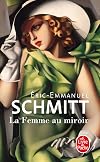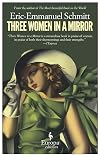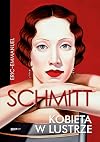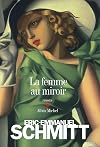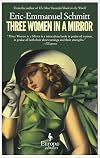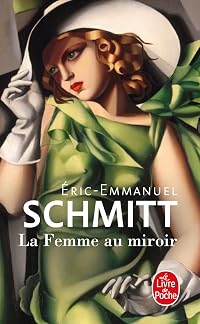
Three Women in a Mirror
by Eric-Emmanuel Schmitt
On This Page
Description
Despite the centuries that divide them, the stories of three young women--Anne, a 16th century mystic; Hanna, a young 20th century noblewoman; and Anny, a Hollywood star of the 2000s--intersect in surprising ways.Tags
Recommendations
















Member Recommendations

Member Reviews
Bonjour,
Voici mon retour sur "la femme au miroir" d’Éric-Emmanuel Schmitt.
Pour commencer, je voudrais remercier l’amie qui m’a conseillé cette lecture.
J’ai eu un vrai coup de coeur pour ce livre et pour l’auteur.
Écrit dans un style cinématographique, les paragraphes se succèdent entre les trois héroïnes, donnant l’envie de tourner page après page.
Il m’est cela dit difficile de dire pourquoi j’ai tant aimé, car à première vue les histoires de ses trois femmes sont assez banales. Pourtant la magie a opéré sur moi, il me tardait de retourner à ma lecture.
Une fois le livre fini, j’ai ressenti un manque, j’étais encore obsédé par elles, j’avais envie de recommencer la lecture depuis le début. show more
Éric-Emmanuel Schmitt m’a ensorcelé. show less
Voici mon retour sur "la femme au miroir" d’Éric-Emmanuel Schmitt.
Pour commencer, je voudrais remercier l’amie qui m’a conseillé cette lecture.
J’ai eu un vrai coup de coeur pour ce livre et pour l’auteur.
Écrit dans un style cinématographique, les paragraphes se succèdent entre les trois héroïnes, donnant l’envie de tourner page après page.
Il m’est cela dit difficile de dire pourquoi j’ai tant aimé, car à première vue les histoires de ses trois femmes sont assez banales. Pourtant la magie a opéré sur moi, il me tardait de retourner à ma lecture.
Une fois le livre fini, j’ai ressenti un manque, j’étais encore obsédé par elles, j’avais envie de recommencer la lecture depuis le début. show more
Éric-Emmanuel Schmitt m’a ensorcelé. show less
I won this book through Goodreads and it is an uncorrected proof translated from the original French version. This did not impact my reading it at all.
This book is written in three voices - Anne from Bruges in the 1600's, Hanna from Vienna at the turn of the 20th century and Anny in current time. Anne and Anny write in narrative but Hanna's chapters are in letter form to a cousin named Gretchen. Each chapter reflects on their day to day lives during a small time period in each woman's life - observations, feelings and interactions with the world around them and how it affects them. Supporting characters for each woman add to her character (Anne's spiteful cousin Ida, Hanna's fawning husband Franz and Anny's overbearing agent Johanna) show more Each story progresses seamlessly...then turns a sharp corner - Anne's tragically but Hanna and Anny's surprisingly.
I enjoyed the historical references to the Church and religion in 17th century Europe and that of Sigmund Freud and the birth of psychoanalysis - they enhanced the story without overpowering it. The author's sensitive portrayals of the womens' lives were poignant and bittersweet. A well written book that I am glad to recommend. show less
This book is written in three voices - Anne from Bruges in the 1600's, Hanna from Vienna at the turn of the 20th century and Anny in current time. Anne and Anny write in narrative but Hanna's chapters are in letter form to a cousin named Gretchen. Each chapter reflects on their day to day lives during a small time period in each woman's life - observations, feelings and interactions with the world around them and how it affects them. Supporting characters for each woman add to her character (Anne's spiteful cousin Ida, Hanna's fawning husband Franz and Anny's overbearing agent Johanna) show more Each story progresses seamlessly...then turns a sharp corner - Anne's tragically but Hanna and Anny's surprisingly.
I enjoyed the historical references to the Church and religion in 17th century Europe and that of Sigmund Freud and the birth of psychoanalysis - they enhanced the story without overpowering it. The author's sensitive portrayals of the womens' lives were poignant and bittersweet. A well written book that I am glad to recommend. show less
Three different women, three different time periods and destinies, but what if they are one and the same woman? This is what we are meant to reflect upon as we read the alternating narratives, which start with beautiful Anne, in Bruges, sometime in the 16th century. She is getting ready for her wedding day, and everyone envies Anne her gorgeous fiancé, especially her cousin Ida, who envies her beyond all common sense. But Anne is more interested in staring at butterflies and the way a ray of sun spreads across the room, and soon she is running away to freedom and nature to hide in the woods and commune with an ancient tree. Some think she has the makings of a saint. Others think she is in league with the devil.
Hanna is living in show more Vienna at the beginning of the 20th century. She has just married into one of the wealthiest and most prestigious families of the upper classes. Her husband adores her and desires her constantly; every night she goes to concerts and performances of the highest caliber, when she's not invited to elegant dinner parties; she wears to most up-to-date fashions, and her private fortune can afford her every luxury, yet she is unhappy and deeply neurotic. A relative introduces her to a strange new fad called psychoanalysis. She can't be seen by Freud himself because he is a Jew and good families don't mix with those people, but things are arranged for her to meet with one of his disciples.
Then there is Anny. She's the hottest commodity in Hollywood and her favourite pastime is drinking, taking drugs, and sleeping with every man she can get her hands on. Things quickly get out of control and an accident lands her in hospital where she meets Ethan, a male nurse who wants to help her get healthy, but will her publicist let her make the right choices?
I have mixed feelings about this book. One the one hand, I was captivated with the stories of both Anne of Bruges and Hanna in 20th century Vienna. All three women have independent spirits and are at odds with what society expects of them. Or at least, Anna and Hanna are, but Anny seemed like too much of a cliché of the kind we see in tabloids every day, and I couldn't stop the image of Lindsay Lohan forming in my mind every time her turn came around. But Schmitt writes beautifully and since his Mr. Ibrahim and the Flowers of the Koran—the only other book I've read by him so far—he can do no wrong in my eyes. This is his latest venture and a hot commodity on the French market. It should make it's way to the English world before too long. I'd be surprised if it didn’t: it's got too much bestseller potential not to. show less
Hanna is living in show more Vienna at the beginning of the 20th century. She has just married into one of the wealthiest and most prestigious families of the upper classes. Her husband adores her and desires her constantly; every night she goes to concerts and performances of the highest caliber, when she's not invited to elegant dinner parties; she wears to most up-to-date fashions, and her private fortune can afford her every luxury, yet she is unhappy and deeply neurotic. A relative introduces her to a strange new fad called psychoanalysis. She can't be seen by Freud himself because he is a Jew and good families don't mix with those people, but things are arranged for her to meet with one of his disciples.
Then there is Anny. She's the hottest commodity in Hollywood and her favourite pastime is drinking, taking drugs, and sleeping with every man she can get her hands on. Things quickly get out of control and an accident lands her in hospital where she meets Ethan, a male nurse who wants to help her get healthy, but will her publicist let her make the right choices?
I have mixed feelings about this book. One the one hand, I was captivated with the stories of both Anne of Bruges and Hanna in 20th century Vienna. All three women have independent spirits and are at odds with what society expects of them. Or at least, Anna and Hanna are, but Anny seemed like too much of a cliché of the kind we see in tabloids every day, and I couldn't stop the image of Lindsay Lohan forming in my mind every time her turn came around. But Schmitt writes beautifully and since his Mr. Ibrahim and the Flowers of the Koran—the only other book I've read by him so far—he can do no wrong in my eyes. This is his latest venture and a hot commodity on the French market. It should make it's way to the English world before too long. I'd be surprised if it didn’t: it's got too much bestseller potential not to. show less
Trois trames distinctes liées à la fin par un effort après-coup, dont une seule qui retenait l'intérêt. Déception.
> La Femme au miroir/ Critiques : Eric-Emmanuel-Schmitt - Le site officiel
> TROIS FEMMES, UNE ÉNIGME. — Une mystique au temps des bûchers ecclésiaux, une bourgeoise autrichienne au temps de Sigmund Freud, une star d’Hollywood en notre temps d’idolâtrie audiovisuelle : trois femmes, Anne, Hanna et Anny, qui peut-être n’en font qu’une, qui en tout cas nous posent une même question au-delà des siècles : est-il possible de sortir des normes de son époque pour pénétrer dans la vraie vie ?
Les derniers ouvrages d’Éric-Emmanuel Schmitt étaient plutôt des contes, des recueils de nouvelles, des essais. Avec La Femme au miroir, il revient en beauté au roman. Beauté toute féminine, mais d'une féminité qui se dit – show more ou plutôt se cherche – en trois époques distinctes. Et qui doit donc s'extraire d'un carcan de normes à chaque fois différent : pour Anne de Bruges, qui a choisi la vie libre du béguinage, ce carcan est celui d'une religiosité catholique fermée, et d'autant plus crispée qu'elle est bousculée par les débuts de la Réforme ; pour Hanna de Vienne, l'obstacle est le confort moral du mariage bourgeois, qu'elle brisera pour entrer dans le monde bouleversant de la psychanalyse ; pour Anny Lee, star de cinéma esclave de ses excès (alcool, drogues, sexe…), il faudra surmonter l'emprise de son agent, les écueils de la séduction, le miroir aux alouettes de l'image médiatique.
Car tout est question de miroirs dans ce roman à la structure subtilement recherchée, qui emprunte son titre à un thème récurrent de l'iconographie occidentale, depuis l'Antiquité jusqu'à Picasso : la Femme au miroir est celle qui se sent intimement différente de l'image que la société lui renvoie, celle qui se regarde dans la glace et ne se reconnaît pas dans l'être social que l’on voudrait lui faire prendre pour son être réel. Ses proches ne la comprennent pas, que ce soit la cousine d’Anne de Bruges qui jalouse sa grâce, le mari aristocrate d'Hanna qui ne peut même pas saisir l'enjeu de sa libération, ou l’agent artistique d'Anny Lee, offusquée par sa brusque transformation qui signe l'arrêt de sa carrière. Ces trois femmes n'en font qu'une, au sens où elles incarnent sous des facettes différentes la femme réfractaire au monde de pouvoir qu’on tente de lui imposer. Pour paraphraser l'évangéliste, chacune à sa manière est dans le monde, mais non pas du monde, elle appartient à un territoire étranger dont elle ne peut prendre conscience qu'en brisant une gangue – religieuse, morale ou médiatique.
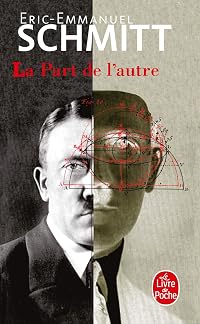
Encore une fois, Éric-Emmanuel Schmitt (dont les succès phénoménaux ont tendance à nous faire oublier qu'il est agrégé de philosophie) nous parle d’identité. D’une façon aussi troublante que dans La Part de l’autre, où il imaginait ce qu'aurait pu être la biographie du peintre Adolf H, s'il n’avait pas été recalé au concours des Beaux-Arts le 8 octobre 1908, il nous fait toucher du doigt ces moments cruciaux où une vie peut basculer. En l’occurrence, ces trois femmes basculent non dans l’horreur et dans une identité de haine, mais dans le choix assumé d’une vie plus libre.
*La Femme au miroir, par Eric-Emmanuel Schmitt, Albin Michel, 464 pages, 22 €
—L’Homme en Question, (31), Été 2011, (p. 3) show less
> TROIS FEMMES, UNE ÉNIGME. — Une mystique au temps des bûchers ecclésiaux, une bourgeoise autrichienne au temps de Sigmund Freud, une star d’Hollywood en notre temps d’idolâtrie audiovisuelle : trois femmes, Anne, Hanna et Anny, qui peut-être n’en font qu’une, qui en tout cas nous posent une même question au-delà des siècles : est-il possible de sortir des normes de son époque pour pénétrer dans la vraie vie ?
Les derniers ouvrages d’Éric-Emmanuel Schmitt étaient plutôt des contes, des recueils de nouvelles, des essais. Avec La Femme au miroir, il revient en beauté au roman. Beauté toute féminine, mais d'une féminité qui se dit – show more ou plutôt se cherche – en trois époques distinctes. Et qui doit donc s'extraire d'un carcan de normes à chaque fois différent : pour Anne de Bruges, qui a choisi la vie libre du béguinage, ce carcan est celui d'une religiosité catholique fermée, et d'autant plus crispée qu'elle est bousculée par les débuts de la Réforme ; pour Hanna de Vienne, l'obstacle est le confort moral du mariage bourgeois, qu'elle brisera pour entrer dans le monde bouleversant de la psychanalyse ; pour Anny Lee, star de cinéma esclave de ses excès (alcool, drogues, sexe…), il faudra surmonter l'emprise de son agent, les écueils de la séduction, le miroir aux alouettes de l'image médiatique.
Car tout est question de miroirs dans ce roman à la structure subtilement recherchée, qui emprunte son titre à un thème récurrent de l'iconographie occidentale, depuis l'Antiquité jusqu'à Picasso : la Femme au miroir est celle qui se sent intimement différente de l'image que la société lui renvoie, celle qui se regarde dans la glace et ne se reconnaît pas dans l'être social que l’on voudrait lui faire prendre pour son être réel. Ses proches ne la comprennent pas, que ce soit la cousine d’Anne de Bruges qui jalouse sa grâce, le mari aristocrate d'Hanna qui ne peut même pas saisir l'enjeu de sa libération, ou l’agent artistique d'Anny Lee, offusquée par sa brusque transformation qui signe l'arrêt de sa carrière. Ces trois femmes n'en font qu'une, au sens où elles incarnent sous des facettes différentes la femme réfractaire au monde de pouvoir qu’on tente de lui imposer. Pour paraphraser l'évangéliste, chacune à sa manière est dans le monde, mais non pas du monde, elle appartient à un territoire étranger dont elle ne peut prendre conscience qu'en brisant une gangue – religieuse, morale ou médiatique.
Encore une fois, Éric-Emmanuel Schmitt (dont les succès phénoménaux ont tendance à nous faire oublier qu'il est agrégé de philosophie) nous parle d’identité. D’une façon aussi troublante que dans La Part de l’autre, où il imaginait ce qu'aurait pu être la biographie du peintre Adolf H, s'il n’avait pas été recalé au concours des Beaux-Arts le 8 octobre 1908, il nous fait toucher du doigt ces moments cruciaux où une vie peut basculer. En l’occurrence, ces trois femmes basculent non dans l’horreur et dans une identité de haine, mais dans le choix assumé d’une vie plus libre.
*La Femme au miroir, par Eric-Emmanuel Schmitt, Albin Michel, 464 pages, 22 €
—L’Homme en Question, (31), Été 2011, (p. 3) show less
Sep 8, 2020 (Edited)French
Cet ouvrage m'a presque réconcilée avec Eric-Emmanuel Schmitt que je trouvais jusqu'à présent plutôt sirupeux. Le récit présente en contrepoint trois femmes, Anne au 16e siècle, Hanna au début du 20e et Anny au 21e, à la recherche d'un sens à donner à leur vie, que ce soit par la religion, la psychanalyse ou la gloire hollywoodienne. Au-delà, ce roman montre que la quête de la liberté intérieure est universelle.
Jan 7, 2012French
Roman trop décousu pour être passionnant. Les trois personnages, 3 femmes qui se veulent différentes et veulent vivre différemment de ce que leur époque attend d'elles, sont peu attachantes malgré leurs démarches d'indépendance. L'auteur finit par faire se rejoindre les 3 femmes, par delà les époques éloignées dans lesquelles elles vivent, mais je n'y ai guère cru.
Sep 26, 2011French
Members
- Recently Added By
Author Information

135+ Works 7,889 Members
Some Editions
Series
Belongs to Publisher Series
Fischer Taschenbuch (19556)
Common Knowledge
- Canonical title
- Three Women in a Mirror
- Original title
- La femme au miroir
- Original publication date
- 2011
- First words*
- Je me sens différente, murmura-t-elle.
- Original language*
- Français
*Some information comes from Common Knowledge in other languages. Click "Edit" for more information.
Classifications
- Genres
- Fiction and Literature, General Fiction, Historical Fiction
- DDC/MDS
- 843.914 — Literature & rhetoric French Literature French fiction 1900- 20th Century 1945-1999
- LCC
- PQ2679 .C37844 .F46 — Language and Literature French, Italian, Spanish and Portuguese literatures French literature Modern literature 1961-2000
- BISAC
Statistics
- Members
- 172
- Popularity
- 190,561
- Reviews
- 8
- Rating
- (3.60)
- Languages
- 8 — Dutch, English, French, German, Italian, Polish, Romanian, Spanish
- Media
- Paper, Audiobook, Ebook
- ISBNs
- 21
- ASINs
- 6