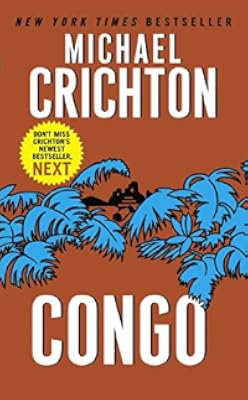
Congo
by Michael Crichton
On This Page
Description
Deep in the African rain forest, near the ruins of the Lost City of Zinj, members of a field expedition are brutally killed. At the Houston-based Earth Resources Technology Services, a horrified supervisor watches a gruesome video transmission of that ill-fated group and sees a haunting, grainy, man-like blur moving amongst the bodies. In San Francisco, an extraordinary gorilla named Amy, who has a 620-sign vocabulary, may hold the secret to that fierce carnage. Immediately, a new expedition show more is sent to the Congo with Amy in tow, descending into a secret, forbidden world where the only escape may be through the grisliest death. show lessTags
Recommendations







Member Recommendations

Member Reviews
This had strikingly Rider Haggard-esque elements. Diamonds! Ruined city! Lost civilization! Dangerous unknown species of ape! Volcano! Darkest Africa! Rider Haggard would have loved the plot device of the signing gorilla who joins the expedition -- of course, gorillas didn't communicate with humans in his day, but it would have added so much to African adventure stories of the Victorian era if they did. But if Rider Haggard had written the book, I think the people who died in the story might have had more personality, even the Africans. Crichton's victims had names but they were, in Star Trek terms, just red shirts. The surviving scientists and the mercenary guide had reasonable depth, but Amy the gorilla was the most fully realized show more character in the story.
This book is the reason why Michael Crichton is no longer on my list of always-buy authors at booksales! show less
This book is the reason why Michael Crichton is no longer on my list of always-buy authors at booksales! show less
"Their entrance into the Lost City of Zinj… was accomplished with none of the mystery and romance of nineteenth-century accounts of similar journeys." (pg. 247)
A more-or-less conventional adventure story, Congo is a fun read but surprisingly uneven by Michael Crichton's standards. The through-line of the story is relatively simple, and recalls the likes of Rider Haggard: a scientific expedition journeys into the dark heart of the Congo rainforest in order to find a lost city. The main characters each have their own motivations, and there's plenty of pace and action to the story. There are also Crichton's signature info-dumps, which seem to be charming only when they come from this author.
The problem I had with the book was that it show more seemed misaligned. We never know which of the main characters to orient ourselves around, or which opponent to entrench ourselves against (Karen Ross is looking for blue diamonds; her adversaries are rival corporate expeditions, whilst Peter Elliot is looking to 'get out of town', and the adversaries he focuses the reader on are the troop of aggressive gorillas in the Congo). The character of Amy is completely charming – she is the ape brought along by Elliot, and has been taught to communicate with sign-language – but Munro is the stereotypical mercenary/white-hunter type and, aside from one or two good lines, has no real depth.
There are races against the clock, attacks on the jungle camp, tensions with Amy, and everything else Crichton can think of to add some vim, but these things rarely jive with each other. The first half of the book is rather slow, while the second half is too fast: with just a few chapters to go, we've not even reached the lost city, but then in a few dozen pages [spoiler] we have the discovery of the lost city, gorilla attacks, an escape, skirmishes with the army and with tribal warriors, and a volcanic eruption. While fleeing this, our characters conjure a hot-air balloon, of all the things, and the book then immediately ends with an epilogue telling us who got married and who didn't. [end spoiler]
It's hard to know what to make of this. It's not underwhelming, only uneven, and adventure thrillers rightly get a lot of leeway when it comes to plot and characterisation. We're here for easy fun, after all. Even so, the lost city was a damp squib, the grey gorillas aren't given the attention they deserve, and the greater part of the plot is crammed into the final fifty pages or so. A journey to a lost city is pointless if we can't savour it when we get there. Adversaries are disappointing and lack threat when they are defeated offscreen, as it were. And the tech ideas – which must have been stimulating in 1980, when the book was written – are now very much outdated.
This latter criticism is hardly Crichton's fault, of course, but when he devotes his signature extensive passages to rhapsodies on VCRs, electronic messages beamed by satellites, and computers with 256k memories, it's to the book's detriment when read in 2021. It strips the sheen away from the story, but whereas some books – and some of Crichton's – are robust enough to survive this stripping, Congo is rather brittle-boned beneath. The best Crichton books continue to teach, but between its talking apes, uneven plot and outdated tech, Congo shows itself to be too fanciful to do this. We get a decent adventure thriller, but one with an expiry date that, regrettably, has long since passed. show less
A more-or-less conventional adventure story, Congo is a fun read but surprisingly uneven by Michael Crichton's standards. The through-line of the story is relatively simple, and recalls the likes of Rider Haggard: a scientific expedition journeys into the dark heart of the Congo rainforest in order to find a lost city. The main characters each have their own motivations, and there's plenty of pace and action to the story. There are also Crichton's signature info-dumps, which seem to be charming only when they come from this author.
The problem I had with the book was that it show more seemed misaligned. We never know which of the main characters to orient ourselves around, or which opponent to entrench ourselves against (Karen Ross is looking for blue diamonds; her adversaries are rival corporate expeditions, whilst Peter Elliot is looking to 'get out of town', and the adversaries he focuses the reader on are the troop of aggressive gorillas in the Congo). The character of Amy is completely charming – she is the ape brought along by Elliot, and has been taught to communicate with sign-language – but Munro is the stereotypical mercenary/white-hunter type and, aside from one or two good lines, has no real depth.
There are races against the clock, attacks on the jungle camp, tensions with Amy, and everything else Crichton can think of to add some vim, but these things rarely jive with each other. The first half of the book is rather slow, while the second half is too fast: with just a few chapters to go, we've not even reached the lost city, but then in a few dozen pages [spoiler] we have the discovery of the lost city, gorilla attacks, an escape, skirmishes with the army and with tribal warriors, and a volcanic eruption. While fleeing this, our characters conjure a hot-air balloon, of all the things, and the book then immediately ends with an epilogue telling us who got married and who didn't. [end spoiler]
It's hard to know what to make of this. It's not underwhelming, only uneven, and adventure thrillers rightly get a lot of leeway when it comes to plot and characterisation. We're here for easy fun, after all. Even so, the lost city was a damp squib, the grey gorillas aren't given the attention they deserve, and the greater part of the plot is crammed into the final fifty pages or so. A journey to a lost city is pointless if we can't savour it when we get there. Adversaries are disappointing and lack threat when they are defeated offscreen, as it were. And the tech ideas – which must have been stimulating in 1980, when the book was written – are now very much outdated.
This latter criticism is hardly Crichton's fault, of course, but when he devotes his signature extensive passages to rhapsodies on VCRs, electronic messages beamed by satellites, and computers with 256k memories, it's to the book's detriment when read in 2021. It strips the sheen away from the story, but whereas some books – and some of Crichton's – are robust enough to survive this stripping, Congo is rather brittle-boned beneath. The best Crichton books continue to teach, but between its talking apes, uneven plot and outdated tech, Congo shows itself to be too fanciful to do this. We get a decent adventure thriller, but one with an expiry date that, regrettably, has long since passed. show less
I like Michael Crichton books on the whole, and was always under the impression that his earlier works were better than his late stuff, which became more and more issue-bound and prosaic. Not so. Congo is the very definition of prosaic, as its plot and characters provide a barely coherent frame on which to hang lengthy expositions on satellite communications technology in particular, IT in general, and of course gorillas. And given that Crichton wrote this in the 1970s, it's seriously dated. Not recommended.
(Original Review, 1980-11-15)
Here is how Michael Crichton describes Amy, the principal love object in "Congo": "She could be coy, she responded to flattery, she was preoccupied with her appearance, loved make-up, and was very fussy about the collar of the sweaters she wore in the winter." Although she is quite short, Amy weighs 140 pounds. She has a vocabulary of 620 words, which is remarkably good for a gorilla. Karen Ross, the other female in "Congo," is almost six feet tall, attractive but ungainly. She is a mathematical prodigy, brilliant but insensitive, determined to succeed at any cost. Her feminine wiles have been confined to technology. Peter Elliot, a young professor working in the field of primate communication, has taught show more Amy to talk - not in words, but sign language. His whole life is dominated by Amy. By the time you have read this far in "Congo," you will be wondering how Peter and Karen are going to be brought together, and how this will affect Amy.
Crichton is the Alvin Toffler of suspense fiction, and "Congo" might be described as a romance of technology. Computers and all kinds of electronic equipment are pitted against the primeval, in the form of gorillas, the rain forest of the Congo, and a volcano.
Crichton is also virtuoso of research. He can describe the look and feel of a rain forest as well as the latest safari gadgetry. When Karen and Peter go to the Congo with Amy, their equipment suggests an L. L. Bean catalog of the next century. Readers of suspense novels seem to be willing to absorb any amount of information in the process of being entertained, and Crichton has quite a lot to say about theories of communication, about the information industry and technology, about computers, the warfare of the future, and other such arcane subjects. He also describes a typical Pygmy meal, the current status of cannibalism in Africa, shooting rabbits in a rubber raft and fighting off a murderous attack by hippos. At one point, Amy saves Peter from a male gorilla by treating him as her infant.
"Congo" also includes an ancient city buried in the jungle and guarded by a tribe of "missing links" who talk by sighing and crush intruders' heads between stone spoons. We've come a long way from Tarzan.
It would not be fair to tell you who wins the battle of the sexes. It is enough to say that both Amy and Karen are formidable females. For these and all the usual reasons, "Congo" is very amusing reading, even if, in its originality, Crichton denies us some of the vulgar gratifications of the genre. show less
Here is how Michael Crichton describes Amy, the principal love object in "Congo": "She could be coy, she responded to flattery, she was preoccupied with her appearance, loved make-up, and was very fussy about the collar of the sweaters she wore in the winter." Although she is quite short, Amy weighs 140 pounds. She has a vocabulary of 620 words, which is remarkably good for a gorilla. Karen Ross, the other female in "Congo," is almost six feet tall, attractive but ungainly. She is a mathematical prodigy, brilliant but insensitive, determined to succeed at any cost. Her feminine wiles have been confined to technology. Peter Elliot, a young professor working in the field of primate communication, has taught show more Amy to talk - not in words, but sign language. His whole life is dominated by Amy. By the time you have read this far in "Congo," you will be wondering how Peter and Karen are going to be brought together, and how this will affect Amy.
Crichton is the Alvin Toffler of suspense fiction, and "Congo" might be described as a romance of technology. Computers and all kinds of electronic equipment are pitted against the primeval, in the form of gorillas, the rain forest of the Congo, and a volcano.
Crichton is also virtuoso of research. He can describe the look and feel of a rain forest as well as the latest safari gadgetry. When Karen and Peter go to the Congo with Amy, their equipment suggests an L. L. Bean catalog of the next century. Readers of suspense novels seem to be willing to absorb any amount of information in the process of being entertained, and Crichton has quite a lot to say about theories of communication, about the information industry and technology, about computers, the warfare of the future, and other such arcane subjects. He also describes a typical Pygmy meal, the current status of cannibalism in Africa, shooting rabbits in a rubber raft and fighting off a murderous attack by hippos. At one point, Amy saves Peter from a male gorilla by treating him as her infant.
"Congo" also includes an ancient city buried in the jungle and guarded by a tribe of "missing links" who talk by sighing and crush intruders' heads between stone spoons. We've come a long way from Tarzan.
It would not be fair to tell you who wins the battle of the sexes. It is enough to say that both Amy and Karen are formidable females. For these and all the usual reasons, "Congo" is very amusing reading, even if, in its originality, Crichton denies us some of the vulgar gratifications of the genre. show less
It's been a long time since I first read this book and while Crichton's overall style didn't change much, his approach has. Boy is this novel full of awkward info dumps. That's pretty normal for him, but in this one he just threw stuff out there and didn't even attempt to disguise it as conversation or explanations to the uninitiated, say in a meeting, which is something he did later. Having also just read Jurassic Park, the difference is noticeable. It's still kind of clunky, but in books like this in which a lot of the plot hinges on things highly technical, it's important to clue the reader in. I just wish there was another way to do it.
And because technology changes and changes fast, Congo feels really, really dated. There's all show more kinds of emphasis placed on computing time and how fast computers can spit out scenarios and answers as opposed to our sluggish brains. Then there's how hard it is to get a satellite link, probably because at the time there was probably only 3 of them up there. Funny. These days with cell phones and a zillion satellites, the issues the Congo team had to deal with are obsolete. It was fun to compare Crichton's speculations on where personal and industrial computing would go and where it actually did go.
Another aspect that felt forced and preachy was the whole issue of animal treatment in research. I think these days both the public and the scientists who employ animals are a whole lot more attuned to the animal's awareness and suffering. In the book Crichton grinds that ax but good and also makes a point to inform us of exactly how brutal chimpanzees are, but how much more highly regarded they are than gorillas. Strange, but I've always known that gorillas are much more gentle and less aggressive than chimps. Maybe it's from books like this that the world view was implanted in my brain. Or from knowing about the research from both Fossey and Goodall with the respective animals.
The ending was benign though; no one gets the diamonds. I'm still not sure if Ross's explosions triggered the volcano that buried the mines, and the lost city, but it was convenient. show less
And because technology changes and changes fast, Congo feels really, really dated. There's all show more kinds of emphasis placed on computing time and how fast computers can spit out scenarios and answers as opposed to our sluggish brains. Then there's how hard it is to get a satellite link, probably because at the time there was probably only 3 of them up there. Funny. These days with cell phones and a zillion satellites, the issues the Congo team had to deal with are obsolete. It was fun to compare Crichton's speculations on where personal and industrial computing would go and where it actually did go.
Another aspect that felt forced and preachy was the whole issue of animal treatment in research. I think these days both the public and the scientists who employ animals are a whole lot more attuned to the animal's awareness and suffering. In the book Crichton grinds that ax but good and also makes a point to inform us of exactly how brutal chimpanzees are, but how much more highly regarded they are than gorillas. Strange, but I've always known that gorillas are much more gentle and less aggressive than chimps. Maybe it's from books like this that the world view was implanted in my brain. Or from knowing about the research from both Fossey and Goodall with the respective animals.
The ending was benign though; no one gets the diamonds. I'm still not sure if Ross's explosions triggered the volcano that buried the mines, and the lost city, but it was convenient. show less
I am a huge Michael Crichton fan already, and he did not disappoint me with this. Amy the gorilla stole the show for me, with her 'teenage antics' and bad language. I love how he created a series of ambitious, intelligent, skilled and yet highly flawed characters each trying to further their own agendas.
Another thing that will always be a selling point for me was the distinct lack of any sort of forced romance between the characters. It is such a relief sometimes when the characters actually focus on their mission without the need to clutter it up with weirdly intense and unhealthy whirlwind romances. The story is more than enough without it!
Overall this was a brilliant story, with a fascinating plot line steeped in science (although show more most of it is probably outdated now, and some of it is definitely questionable which Crichton himself was happy enough to point out at times). The narration was also top notch with everyone given their own clear voice (listened to on Audible read by Julia Whelan). show less
Another thing that will always be a selling point for me was the distinct lack of any sort of forced romance between the characters. It is such a relief sometimes when the characters actually focus on their mission without the need to clutter it up with weirdly intense and unhealthy whirlwind romances. The story is more than enough without it!
Overall this was a brilliant story, with a fascinating plot line steeped in science (although show more most of it is probably outdated now, and some of it is definitely questionable which Crichton himself was happy enough to point out at times). The narration was also top notch with everyone given their own clear voice (listened to on Audible read by Julia Whelan). show less
I am a huge Michael Crichton fan already, and he did not disappoint me with this. Amy the gorilla stole the show for me, with her 'teenage antics' and bad language. I love how he created a series of ambitious, intelligent, skilled and yet highly flawed characters each trying to further their own agendas.
Another thing that will always be a selling point for me was the distinct lack of any sort of forced romance between the characters. It is such a relief sometimes when the characters actually focus on their mission without the need to clutter it up with weirdly intense and unhealthy whirlwind romances. The story is more than enough without it!
Overall this was a brilliant story, with a fascinating plot line steeped in science (although show more most of it is probably outdated now, and some of it is definitely questionable which Crichton himself was happy enough to point out at times). The narration was also top notch with everyone given their own clear voice (listened to on Audible read by Julia Whelan). show less
Another thing that will always be a selling point for me was the distinct lack of any sort of forced romance between the characters. It is such a relief sometimes when the characters actually focus on their mission without the need to clutter it up with weirdly intense and unhealthy whirlwind romances. The story is more than enough without it!
Overall this was a brilliant story, with a fascinating plot line steeped in science (although show more most of it is probably outdated now, and some of it is definitely questionable which Crichton himself was happy enough to point out at times). The narration was also top notch with everyone given their own clear voice (listened to on Audible read by Julia Whelan). show less
Members
- Recently Added By
Lists

Read the book and saw the movie
1,170 works; 195 members

Books Read in 2013
1,630 works; 51 members

Carole's List
445 works; 13 members

BingoDOG - Animals in Adult Fiction
78 works; 20 members

Books Read in 2015
3,299 works; 129 members

Africa
109 works; 8 members

The Joe Rogan Experience Library
254 works; 3 members

Books Read in 2021
5,361 works; 114 members

Stories set on African soil
183 works; 2 members

Ranking
66 works; 1 member

1980 great books
63 works; 1 member

Best Science Fiction Novels
816 works; 430 members
Author Information

142+ Works 172,197 Members
John Michael Crichton, known as Michael Crichton, was born on October 28, 1942 in Chicago, Illinois. He wrote novels while attending Harvard University and Harvard Medical School to help pay the tuition. One of these, The Andromeda Strain, which was published in 1969, became a bestseller. After graduating summa cum laude, he was a postdoctoral show more fellow at the Salk Institute in California before becoming a full-time writer and film director. His carefully researched novels included Eaters of the Dead, The Terminal Man, The Great Train Robbery, Congo, Sphere, Jurassic Park, Rising Sun, Disclosure, The Lost World, Airframe, and Micro. He also wrote non-fiction works including Five Patients: The Hospital Explained, Jasper Johns, and Travels. In the late 1960s, he also wrote under the pen names Jeffrey Hudson and John Lange. He has received several awards including Writer of the Year in 1970 from the Association of American Medical Writers and two Edgar Awards in 1968 and in 1979. Many of his novels have been made into highly successful films, six of which he directed. He was also the creator and executive producer of the Emmy Award-winning television series ER. In addition to his writing and directorial success, his expertise in information science enabled him to run a software company and develop a computer game. He died of cancer on November 4, 2008 at the age of 66. (Bowker Author Biography) show less
Awards and Honors
Awards
Distinctions
Series
Belongs to Publisher Series
Work Relationships
Is contained in
Has the adaptation
Is abridged in
Kirjavaliot - Kongo / Tohtori Gibsonin vastaanotto / Kohtaaminen Firenzessä / Oikeuden voitto by Valitut Palat
Reader's Digest Auswahlbücher 124 - Vogelfrei. Wettlauf mit dem weißen Tod. Mein linker Fuß. Expedition Kongo. by Reader's Digest
Common Knowledge
- Canonical title
- Congo
- Original title
- Congo
- Original publication date
- 1980
- People/Characters
- Karen Ross; Peter Elliot; Amy (gorilla)
- Important places
- Africa; Congo; Lost City of Zinj; River Congo
- Related movies
- Congo (1995 | IMDb)
- Epigraph
- The more experience and insight I obtain into human nature, the more convinced do I become that the greater portion of a man is purely animal. --Henry Morton Stanley, 1887
The large male [gorilla] held my attention. . . . He gave an impression of dignity and restrained power, of absolute certainty in his majestic appearance. I felt a desire to communicate with him. . . . Never before had I had ... (show all)this feeling on meeting an animal. As we watched each other across the valley, I wondered if he recognized the kinship that bound us. --George B. Schaller, 1964 - Dedication
- For Bob Gottlieb
- First words
- Dawn came to the Congo rain forest. The pale sun burned away the morning chill and the clinging damp mist, revealing a gigantic silent world.
- Last words
- (Click to show. Warning: May contain spoilers.)From there, the balloon slid across the Zaire border, moving southeast toward Kenya--and civilization.
- Original language*
- English
*Some information comes from Common Knowledge in other languages. Click "Edit" for more information.
Classifications
- Genres
- Science Fiction, Fiction and Literature, Suspense & Thriller, Horror
- DDC/MDS
- 813.54 — Literature & rhetoric American literature in English American fiction in English 1900-1999 1945-1999
- LCC
- PS3553 .R48 .C6 — Language and Literature American literature American literature Individual authors 1961-
- BISAC
Statistics
- Members
- 8,801
- Popularity
- 1,234
- Reviews
- 100
- Rating
- (3.29)
- Languages
- 19 — Czech, Danish, Dutch, English, Finnish, French, German, Hungarian, Italian, Japanese, Norwegian (Bokmål), Norwegian, Polish, Portuguese, Russian, Sinhalese, Slovenian, Spanish, Swedish
- Media
- Paper, Audiobook, Ebook
- ISBNs
- 84
- UPCs
- 2
- ASINs
- 42