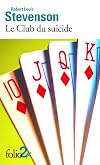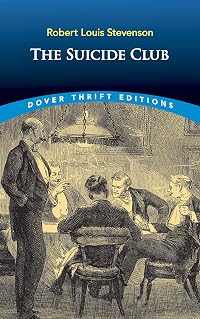
The Suicide Club
by Robert Louis Stevenson
On This Page
Description
Gripping trilogy of short stories involving a club for people who wish to end their lives. The ""Story of the Young Man with the Cream Tarts,"" ""Story of the Physician and the Saratoga Trunk,"" and ""The Adventure of the Hansom Cab"" chronicle the exploits of Prince Florizel of Bohemia and Colonel Geraldine as they travel incognito through some of 19th-century London's most dangerous haunts.
Tags
Recommendations





























Member Reviews
A trilogy of short stories based around the suicide club. The club is only really explored in the first tale and it a pretty interesting idea. One of those ideas you might see used in an episode of the Twilight Zone, Black Mirror etc.
It doesn't really get examined as much as i would of liked. The other two stories come across as more detective style fiction. The writing is good throughout but the perspectives from which the stories are told are both a good and bad thing.
Th problem is that if your paying attention then you can tell whats going on which removes a lot of the mystery on the other hand if you weren't paying attention then things are REALLY confusing.
Overall an interesting set but not as good as i was hoping given the show more initial setup. show less
It doesn't really get examined as much as i would of liked. The other two stories come across as more detective style fiction. The writing is good throughout but the perspectives from which the stories are told are both a good and bad thing.
Th problem is that if your paying attention then you can tell whats going on which removes a lot of the mystery on the other hand if you weren't paying attention then things are REALLY confusing.
Overall an interesting set but not as good as i was hoping given the show more initial setup. show less
Robert Louis Stevenson as I had never seen him. This set of three short stories which actually make up one longish short story is written to a formula. The hero is Prince Florizel of Bohemia, a Tin-Tin-esque character who is good at heart and good at things he does. A range of lesser mortals wander in and out of his purview - mostly he sets the good ones straight while vigorously sorting out the bad guys. The Prince continues as a character in the later Rajah's Diamond, and only in the last paragraph of that work do we see Stevenson's tongue firmly in cheek - as he loses his throne and sets up a cigar store! Interesting, but for me, not compelling writing. Read September 2013.
An intriguing three part mystery story based around the Prince of Bohemia and his discovery of a secret club for men who want to end their lives. After discovering the club, the Prince then takes it upon himself to make the leader of the club pay for his crimes.
I enjoyed the first part of the story where we are first introduced to the Suicide Club itself. I didn't enjoy the second and third parts of the story quite as much, but it was interesting how they were all connected to each other.
I enjoyed the first part of the story where we are first introduced to the Suicide Club itself. I didn't enjoy the second and third parts of the story quite as much, but it was interesting how they were all connected to each other.
relatos
8481300748
Members
- Recently Added By
Author Information

2,826+ Works 139,928 Members
Novelist, poet, and essayist Robert Louis Stevenson was born in Edinburgh, Scotland. A sickly child, Stevenson was an invalid for part of his childhood and remained in ill health throughout his life. He began studying engineering at Edinburgh University but soon switched to law. His true inclination, however, was for writing. For several years show more after completing his studies, Stevenson traveled on the Continent, gathering ideas for his writing. His Inland Voyage (1878) and Travels with a Donkey (1878) describe some of his experiences there. A variety of essays and short stories followed, most of which were published in magazines. It was with the publication of Treasure Island in 1883, however, that Stevenson achieved wide recognition and fame. This was followed by his most successful adventure story, Kidnapped, which appeared in 1886. With stories such as Treasure Island and Kidnapped, Stevenson revived Daniel Defoe's novel of romantic adventure, adding to it psychological analysis. While these stories and others, such as David Balfour and The Master of Ballantrae (1889), are stories of adventure, they are at the same time fine studies of character. The Master of Ballantrae, in particular, is a study of evil character, and this study is taken even further in The Strange Case of Dr. Jekyll and Mr. Hyde (1886). In 1887 Stevenson and his wife, Fanny, went to the United States, first to the health spas of Saranac Lake, New York, and then on to the West Coast. From there they set out for the South Seas in 1889. Except for one trip to Sidney, Australia, Stevenson spent the remainder of his life on the island of Samoa with his devoted wife and stepson. While there he wrote The Wrecker (1892), Island Nights Entertainments (1893), and Catriona (1893), a sequel to Kidnapped. He also worked on St. Ives and The Weir of Hermiston, which many consider to be his masterpiece. He died suddenly of apoplexy, leaving both of these works unfinished. Both were published posthumously; St. Ives was completed by Sir Arthur Quiller-Couch, and The Weir of Hermiston was published unfinished. Stevenson was buried on Samoa, an island he had come to love very much. Although Stevenson's novels are perhaps more accomplished, his short stories are also vivid and memorable. All show his power of invention, his command of the macabre and the eerie, and the psychological depth of his characterization. (Bowker Author Biography) show less
Series
Belongs to Publisher Series
Work Relationships
Common Knowledge
- Canonical title
- The Suicide Club
- Original title
- The Suicide Club
- Original publication date
- 1878
- Important places*
- Londres, Inglaterra, Reino Unido
- First words
- During his residence in London, the accomplished Prince Florizel of Bohemia gained the affection of all classes by the seduction of his manner and by a well-considered generosity.
- Last words
- (Click to show. Warning: May contain spoilers.)The Prince, it is superfluous to mention, forgot none of those who served him in this great exploit, and to this day his authority and influence help them forward in their public career, while his condescending friendship adds a charm to their private life.
- Original language*
- Inglés
*Some information comes from Common Knowledge in other languages. Click "Edit" for more information.
Classifications
Statistics
- Members
- 506
- Popularity
- 59,476
- Reviews
- 9
- Rating
- (3.30)
- Languages
- 11 — Catalan, Czech, Danish, Dutch, English, French, German, Italian, Portuguese (Portugal), Spanish, Swedish
- Media
- Paper, Audiobook, Ebook
- ISBNs
- 60
- UPCs
- 2
- ASINs
- 17