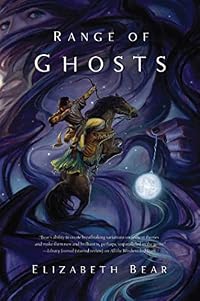
On This Page
Description
Going into exile after barely escaping a war waged by his cousin and brother, Temur, the grandson and heir of the Great Khan, teams up against an enemy cult with former princess Samarkar, who after a series of bitter betrayals has pursued a life of magical study.Tags
Recommendations







Member Reviews
For me this book went by thirds: I loved the first third, slumped in the middle, then found the last very strong. That might be me: I noticed I liked it when they were on journeys, not in the palace and temple. The first third was most Mongolian, with a steppe journey and most attention paid to the horses (I missed them later); the last third had writing that wowed me and I was caught up in the climatic action. Had my interest been equal throughout, or had the scenes seemed to me more even, it’d be a five.
Most importantly, the characters are people I can like, unstereotyped, in fact it’s clear she’s been consciously anti-stereotype. Temur, a steppe prince, is a fine young lad, likeable; Samarkar who becomes his journey-partner is show more significantly older. She’s still learning her strength after humiliations in the past; she’s turned late to wizardry to escape the palace.
I haven’t read fantasy for years (used to) but I’m into steppe history, that’s why I came. A steppe-set fantasy? Great. From time to time I was impatient with the fantasy elements – I found the evil wizard tired, but I guess that’s why I don’t go for fantasy now.
There was heaps in here that was genuinely Mongolian or with other authentic input from historic societies – enough to keep me fascinated. For a start, the individualised horses, given the detail they are in steppe epic (and those epical flying horses, too). The idea that wizards have to be neutered: I’ve seen the logic of this with shamans who need to be infertile to practice. Even the moons in the sky, for the clan members of the Great Khan Temusan (hi Temujin) reminded me of the Mongolian fancy that we each have a star that blinks out when we die. I can on like this – I don’t know whether I’m stretching. We meet a woman-king – not a queen – and I think of a couple of woman khans who existed in the 12th century on the west steppe.
That brings me to why this book got on the James Tiptree Award honours list. I’m a fan of James Tiptree and that’s one award I care about. This book absolutely rids itself of sex stereotypes. Which isn’t easy to do – it’s rarely done. The different societies of the novel have different attitudes to women – you can see the feeds from around the medieval east – but what you won’t find is an assumption stood on sex. I love it. show less
Most importantly, the characters are people I can like, unstereotyped, in fact it’s clear she’s been consciously anti-stereotype. Temur, a steppe prince, is a fine young lad, likeable; Samarkar who becomes his journey-partner is show more significantly older. She’s still learning her strength after humiliations in the past; she’s turned late to wizardry to escape the palace.
I haven’t read fantasy for years (used to) but I’m into steppe history, that’s why I came. A steppe-set fantasy? Great. From time to time I was impatient with the fantasy elements – I found the evil wizard tired, but I guess that’s why I don’t go for fantasy now.
There was heaps in here that was genuinely Mongolian or with other authentic input from historic societies – enough to keep me fascinated. For a start, the individualised horses, given the detail they are in steppe epic (and those epical flying horses, too). The idea that wizards have to be neutered: I’ve seen the logic of this with shamans who need to be infertile to practice. Even the moons in the sky, for the clan members of the Great Khan Temusan (hi Temujin) reminded me of the Mongolian fancy that we each have a star that blinks out when we die. I can on like this – I don’t know whether I’m stretching. We meet a woman-king – not a queen – and I think of a couple of woman khans who existed in the 12th century on the west steppe.
That brings me to why this book got on the James Tiptree Award honours list. I’m a fan of James Tiptree and that’s one award I care about. This book absolutely rids itself of sex stereotypes. Which isn’t easy to do – it’s rarely done. The different societies of the novel have different attitudes to women – you can see the feeds from around the medieval east – but what you won’t find is an assumption stood on sex. I love it. show less
Welcome to a world where the sky changes based on who rules the land. A world where magic is real but requires sacrifices. A world where love, bravery and loyalty guide people's choices - and not always for the best.
In a land based on the empires of the Steppes of Asia, the great Khagan had died and his relatives are yielding a bloody war for control of the empire. The Eternal Sky, their God and the sky above the lands, is keeping track of the relatives by having a moon for anyone still alive, allowing everyone to know who is still alive and fighting by just glancing at the night sky. Temur, a grandson of the Khagan has no interest in fighting but when the novel opens he had just survived a war that killed everyone else he ever knew show more and forced him to run.
And while he runs, he need to find his destiny. On the road he will meet his companions - a Tiger-woman by the name of Hrahima (who is there to give a warning to the people but is also related in an intricate way to Temur), the wizard Samarkar (who left a court life and dreams and sorrows behind to become what she is) and the monk Hsiung (who is not talking and for whom I am still not sure what his role is but I suspect we will learn soon).
This novel, a first of a trilogy, spends some time with each of our travelers before they meet, showing us how they got where they are now and building the back stories and the intricate connections between them and at the same time introducing the intricate world they live in with all its diversity. Of course we also meet the bad guys - with their own world of sacrifices and blood and the bloody ghosts that they can control.
Unlike most fantasy worlds which are based on medieval Europe, Bear's uses exclusively the Eastern empires to base her tribes on - the Mongols and the Chinese, the Muslims and almost anyone else you can think from Asia. You can see the different influences but she also mixes them - the tribe where the women are veiled has the men also veiled most of the time and the main God is in fact a woman; in the world of magic, you need to give up your chance of having children for a chance in getting the gift of magic.
Add to all this young love (well... let's call it that even Temur is not exactly faithful), huge birds (replacing the almost mandatory dragons in this kind of storied), an abducted woman (something need to get Temur off his aimlessness after all), battles and court games, a horse that seems to be more than just a regular horse (or is a very intelligent one). And an intricate world building which leaves a lot to the imagination but at the same time sketches the world exactly as much as it should - building the religions, myths and ways of all of the involved peoples and even succeeding at showing the same legend from more than one side - the way real worlds work.
Somehow a novel that should have sounded tired and known manages to be surprising and fresh - even if the outline can be valid for most of the fantasy novels ever written. It's a very good start of the trilogy and I am looking forward to reading the next novel. show less
In a land based on the empires of the Steppes of Asia, the great Khagan had died and his relatives are yielding a bloody war for control of the empire. The Eternal Sky, their God and the sky above the lands, is keeping track of the relatives by having a moon for anyone still alive, allowing everyone to know who is still alive and fighting by just glancing at the night sky. Temur, a grandson of the Khagan has no interest in fighting but when the novel opens he had just survived a war that killed everyone else he ever knew show more and forced him to run.
And while he runs, he need to find his destiny. On the road he will meet his companions - a Tiger-woman by the name of Hrahima (who is there to give a warning to the people but is also related in an intricate way to Temur), the wizard Samarkar (who left a court life and dreams and sorrows behind to become what she is) and the monk Hsiung (who is not talking and for whom I am still not sure what his role is but I suspect we will learn soon).
This novel, a first of a trilogy, spends some time with each of our travelers before they meet, showing us how they got where they are now and building the back stories and the intricate connections between them and at the same time introducing the intricate world they live in with all its diversity. Of course we also meet the bad guys - with their own world of sacrifices and blood and the bloody ghosts that they can control.
Unlike most fantasy worlds which are based on medieval Europe, Bear's uses exclusively the Eastern empires to base her tribes on - the Mongols and the Chinese, the Muslims and almost anyone else you can think from Asia. You can see the different influences but she also mixes them - the tribe where the women are veiled has the men also veiled most of the time and the main God is in fact a woman; in the world of magic, you need to give up your chance of having children for a chance in getting the gift of magic.
Add to all this young love (well... let's call it that even Temur is not exactly faithful), huge birds (replacing the almost mandatory dragons in this kind of storied), an abducted woman (something need to get Temur off his aimlessness after all), battles and court games, a horse that seems to be more than just a regular horse (or is a very intelligent one). And an intricate world building which leaves a lot to the imagination but at the same time sketches the world exactly as much as it should - building the religions, myths and ways of all of the involved peoples and even succeeding at showing the same legend from more than one side - the way real worlds work.
Somehow a novel that should have sounded tired and known manages to be surprising and fresh - even if the outline can be valid for most of the fantasy novels ever written. It's a very good start of the trilogy and I am looking forward to reading the next novel. show less
This is one of those stories that aren't from the average western cannon, there are little hints of western myth and places but this is on the Steppes and takes from mythology around that place and from legendary things from there. Temur is the last survivor of a battlefield where he was left for dead and he has to fight to stay alive. Once-Princess Samarkar has sacrificed her womb for magic and now she has to learn how to wield it.
The two of them, when they come together will fight for good and try to stop civil war from disrupting everything they value. I want more in this world, it was refreshingly different.
The two of them, when they come together will fight for good and try to stop civil war from disrupting everything they value. I want more in this world, it was refreshingly different.
Welcome to a world loosely based on the Silk Road, where every empire rules under a different sky. Two dispossessed heirs, Temur of the great horse clans, and Samarkar once-princess and now wizard-in-training, meet and journey across the endless miles gathering allies and fighting against a murderous cult of the Goddess of Knowledge. The setting is amazing: weird and fantastic and grounded all at once, with believable versions of real Earth cultures without a return to the oddly democratic and Christian kingdom so commonly found in generic fantasy. Bear also treats horses as living creatures, rather than legged motorcycles.
The thing is that aside from the setting, the characters are empty vessels into which the Quest can be poured. show more Despite their royal blood, cosmopolitan learning, and understated yet exceptional skills, Temur and Samarkar have little agency. They run for survival, pray to their gods, and seek revenge. al-Sepher, the head of an assassin-like cult, at least seems to have a plan, even if his machinations seem to come down to sending outmatched goon squads against our heroes.
Having read another Silk Road themed fantasy recently (book 1 of The Mongoliad) I can safely say that Range of Ghosts is much much better. But while it has some really cool nuggets of detail, the overall plot isn't enough for me to actively seek out the sequels. Maybe if there's a sale, otherwise, my stack of books to read is deep enough these are going on the back-burner. show less
The thing is that aside from the setting, the characters are empty vessels into which the Quest can be poured. show more Despite their royal blood, cosmopolitan learning, and understated yet exceptional skills, Temur and Samarkar have little agency. They run for survival, pray to their gods, and seek revenge. al-Sepher, the head of an assassin-like cult, at least seems to have a plan, even if his machinations seem to come down to sending outmatched goon squads against our heroes.
Having read another Silk Road themed fantasy recently (book 1 of The Mongoliad) I can safely say that Range of Ghosts is much much better. But while it has some really cool nuggets of detail, the overall plot isn't enough for me to actively seek out the sequels. Maybe if there's a sale, otherwise, my stack of books to read is deep enough these are going on the back-burner. show less
I really enjoyed this. Part of that is the setting--I'm pretty easy in general for non-Euro fantasy settings, and especially right now for Mongols. But mostly it's that Bear really makes that setting some to life, peopled with compelling characters and exploring intrinsic conflicts. Cultures get cemented into reality by their world myths genuinely being the truth (best exemplified by the variations in the sky as the story passes from a country where one sky-god myth holds sway to one with a different option) and that "realism" is constantly spiced by out-and-out wonder (like tiger people) and somehow the whole thing really holds together.
I was particularly pleased by both the inclusion of multiple pregnancies (somehow, once you have a show more little one, you see a lot more kids / pregnant ladies around, so it's nice to have that new reality of mine reflected on the page) and the presence of an older(ish)-lady kick-ass wizard. show less
I was particularly pleased by both the inclusion of multiple pregnancies (somehow, once you have a show more little one, you see a lot more kids / pregnant ladies around, so it's nice to have that new reality of mine reflected on the page) and the presence of an older(ish)-lady kick-ass wizard. show less
I first heard of Range of Ghosts on John Scalzi's blog. Like with Throne of the Crescent Moon (Crescent Moon Kingdoms) (also a discovery via Scalzi's Big Idea series), I was intrigued by the idea of an epic fantasy that eschews a Euro-centric setting and the "restore the rightful monarch" type plot.
Range of Ghosts is set in a world with cultures similar to eastern Europe and Asia - from Turkey to Mongolia to China. The skies are different in each land, depending on who the ruler is and what they believe. In the country of the Eternal Sky, The Great Khagan has fallen and there was a bloody civil war for his succession between Temur's usurping uncle Qori Buqa has prevailed, which means Temur, the rightful heir now that his brother has show more been killed, has to flee for his life. But it's not just enough to hide outside the borders of the Khaganate - Qori Buqa is consorting with dark and dangerous powers and has his eyes set on conquering the world. Meanwhile, Samarkar, who was once a Rasan princess, has given up her title for the real power of a wizard of Tsarepheth. Together they form an unlikely alliance that just might save the world.
The setting of this book makes it really come to life - from the stark and desolate steppes and mountains to the splendour of the city of Tsarepheth. Bear accomplishes the equivalent of paragraphs of description in just a few well chosen words. This also applies to her characters, she paints in broad but precise strokes and is very matter of fact about what they're thinking or how they feel, but we get to know them very well. The societies and customs are very well described - Bear takes care to mention why certain things are the case, which I love!
The breadth of characters is also great; especially of women. Despite being a pretty traditional male dominated world, males are heavily outnumbered. There's the new wizard Samarkar who risked death for power, Hrahima the human tiger (Cho-Tse) adventurer (who reminded me of Pyanfar from Pride of Chanur), Tsering the wise wizard, Payma the courageous, young, and pregnant harem member, Edene the stubborn Qersnyk woman that refuses to let her spirit be broken, the nomadic "king" Tzitzik, Saadet the loyal servant and assassin, Nilufer, who won herself a small kingdom in a story that has become folklore - and even Bansh the mare. Of course there are plenty of men too, but they tend to be more stereotypical - probably because there are a lot more stereotypes in fantasy that apply to men. Despite this large cast of characters, the book never gets weighed down and most of the characters have their own unique voice.
The plot seems fairly straightforward at first, but takes some delightful twists and turns along the way. People's motivations are not what they seem, and there's a fair amount of scheming. Characters make their own choices and are proud of it. (I'm usually annoyed by stories in which heroism is largely a matter of circumstance and luck - Tad Williams, I'm looking at you.)
Although we get a climactic battle and an ending, it's fairly apparent that this is not a stand alone book. The ending isn't exactly a cliff hanger, but it definitely leaves you in anticipation. If that sort of thing bothers you, you should probably wait for the next two books to come out before you read it. But you should definitely read it! show less
Range of Ghosts is set in a world with cultures similar to eastern Europe and Asia - from Turkey to Mongolia to China. The skies are different in each land, depending on who the ruler is and what they believe. In the country of the Eternal Sky, The Great Khagan has fallen and there was a bloody civil war for his succession between Temur's usurping uncle Qori Buqa has prevailed, which means Temur, the rightful heir now that his brother has show more been killed, has to flee for his life. But it's not just enough to hide outside the borders of the Khaganate - Qori Buqa is consorting with dark and dangerous powers and has his eyes set on conquering the world. Meanwhile, Samarkar, who was once a Rasan princess, has given up her title for the real power of a wizard of Tsarepheth. Together they form an unlikely alliance that just might save the world.
The setting of this book makes it really come to life - from the stark and desolate steppes and mountains to the splendour of the city of Tsarepheth. Bear accomplishes the equivalent of paragraphs of description in just a few well chosen words. This also applies to her characters, she paints in broad but precise strokes and is very matter of fact about what they're thinking or how they feel, but we get to know them very well. The societies and customs are very well described - Bear takes care to mention why certain things are the case, which I love!
The breadth of characters is also great; especially of women. Despite being a pretty traditional male dominated world, males are heavily outnumbered. There's the new wizard Samarkar who risked death for power, Hrahima the human tiger (Cho-Tse) adventurer (who reminded me of Pyanfar from Pride of Chanur), Tsering the wise wizard, Payma the courageous, young, and pregnant harem member, Edene the stubborn Qersnyk woman that refuses to let her spirit be broken, the nomadic "king" Tzitzik, Saadet the loyal servant and assassin, Nilufer, who won herself a small kingdom in a story that has become folklore - and even Bansh the mare. Of course there are plenty of men too, but they tend to be more stereotypical - probably because there are a lot more stereotypes in fantasy that apply to men. Despite this large cast of characters, the book never gets weighed down and most of the characters have their own unique voice.
The plot seems fairly straightforward at first, but takes some delightful twists and turns along the way. People's motivations are not what they seem, and there's a fair amount of scheming. Characters make their own choices and are proud of it. (I'm usually annoyed by stories in which heroism is largely a matter of circumstance and luck - Tad Williams, I'm looking at you.)
Although we get a climactic battle and an ending, it's fairly apparent that this is not a stand alone book. The ending isn't exactly a cliff hanger, but it definitely leaves you in anticipation. If that sort of thing bothers you, you should probably wait for the next two books to come out before you read it. But you should definitely read it! show less
I can easily say this is my favorite book by Elizabeth Bear. I liked the two main characters very much, the writing was smooth as silk, and probably most importantly, I loved the depth of the mythology.
I have a soft spot in my heart for stories within stories, and I have nothing but good things to say about Eternal Night and the Carrion King. The mythology works both as a gorgeous backdrop to the action as well as an excellent world-building tool.
Several images, like fields of butterflies along the steeps, the swimming horses, the plane of skulls, or even the armies of ghosts, all of it deeply serves the story and it was all a delight.
It had so much, from the tiger peoples, part of the Chinese culture, all the way to germanic legends, show more but most importantly, this is a tale of the Kahns. Magic is everywhere. So much happens.
More than anything, this tale acts and feels legendary.
The characters never get so far away from us that we ever lose the sense of who and what they are, and I think the tale gets only better when everything finally interweaves. I'm glad I finally got around to reading this. I think I like Bear's fantasy a lot more than her SF. :) show less
I have a soft spot in my heart for stories within stories, and I have nothing but good things to say about Eternal Night and the Carrion King. The mythology works both as a gorgeous backdrop to the action as well as an excellent world-building tool.
Several images, like fields of butterflies along the steeps, the swimming horses, the plane of skulls, or even the armies of ghosts, all of it deeply serves the story and it was all a delight.
It had so much, from the tiger peoples, part of the Chinese culture, all the way to germanic legends, show more but most importantly, this is a tale of the Kahns. Magic is everywhere. So much happens.
More than anything, this tale acts and feels legendary.
The characters never get so far away from us that we ever lose the sense of who and what they are, and I think the tale gets only better when everything finally interweaves. I'm glad I finally got around to reading this. I think I like Bear's fantasy a lot more than her SF. :) show less
Members
- Recently Added By
Published Reviews
ThingScore 100
However, despite that scale, the book never loses its grounding in interpersonal interactions and the significance of a single life, united with other single lives. This novel plays with the rules of high fantasy and epic fantasy, sidestepping many classic and contemporary tropes with ease while constructing a fabulous second-world populated with powerful women, moments of kindness and show more stillness amidst the horror of war, and the personal made intensely political. show less
added by PhoenixFalls
Elizabeth Bear is one of the best writers in genre today. Period. She’s dipped her pen into more and more subgenres of Fantasy and Science Fiction and now, it seems, she seems intent on conquering epic fantasy. Given her abilities and strength of craft, if you have the slightest interest in epic fantasy, Range of Ghosts will push your buttons in all the right ways. It would take a tremendous show more set of other books from other authors for the rest of the year for Range of Ghosts not to make my 2012 Hugo ballot. show less
added by PhoenixFalls
Range of Ghosts is a highly enjoyable read, due mostly to how it effortlessly mingles old-school narrative structure with original worldbuilding. Its narrative foundation is the much-beloved quest-based epic fantasy...Elizabeth Bear builds upon that foundation with fantastic worldbuilding - instead of going with the standard pseudo-European setting, Bear borrows from Asian and Middle Eastern show more cultures ... show less
added by feeling.is.first
Lists

Fantasy by Women Who Broke Away from Europe
144 works; 12 members

KayStJ's to-read list
1,616 works; 11 members

Books Read in 2016
4,666 works; 197 members

infjsarah's wishlist
408 works; 2 members
Author Information

176+ Works 16,464 Members

Elizabeth Bear is a LibraryThing Author, an author who lists their personal library on LibraryThing.
Some Editions
Awards and Honors
Awards
Distinctions
Series

Common Knowledge
- Canonical title
- Range of Ghosts
- Original publication date
- 2012-03-27
- People/Characters
- Re Temur; Samarkar; Tsareg Edene; Tsering; Hrahima; Hsiung (show all 9); Mukhtar ai-Idoj; Bansh; Buldshak
- Dedication
- This book is for Sunil Robert and Naveen Alexander Srinivasan Shipman, great-great-great-(...)grandsons of Genghis Khan.
- First words
- Ragged vultures spiraled up a cherry sky.
- Last words
- (Click to show. Warning: May contain spoilers.)A loving voice echoed her silently. Yes. Edene. That is how it shall be. When you are Queen.
- Publisher's editor
- Meacham, Beth
- Original language
- English
Classifications
Statistics
- Members
- 815
- Popularity
- 33,726
- Reviews
- 37
- Rating
- (3.82)
- Languages
- English
- Media
- Paper, Audiobook, Ebook
- ISBNs
- 7
- ASINs
- 4