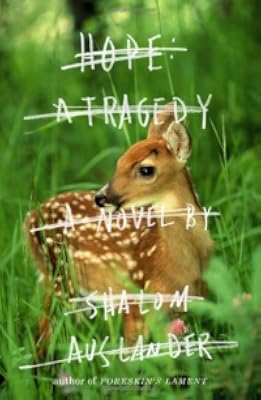
Hope: A Tragedy: A Novel
by Shalom Auslander
On This Page
Description
Relocating his family to an unremarkable rural town in New York in the hopes of starting over, Solomon Kugel must cope with his depressive mother, a local arsonist, and the discovery of a believed-dead historical specimen hiding in his attic.Tags
Recommendations




















Member Reviews
“Toys in the Attic”
Solomon Kugel wants a fresh start. He moves his family, consisting of his wife, young son and ailing mother, to a small town in upstate New York. They settle into a big old country house. Unfortunately, things begin to go south in a hurry. First, there is a bad smell emanating from the vents and then there is news that a serial-arsonist is setting fire to local farmhouses. And to top it off, Kugel makes a discovery in his attic. There is an old, feeble but fiercely bitter woman living there and she claims to be Anne Frank.
Okay, this book will not be for everyone. Let’s make that clear right now. Some will find it outrageously funny and insightful (I‘m in this group), others will find it vulgar and offensive. show more Yes, it is both of these too, but for me, it works. A twisted little gem, that I laughed out loud to, on several occasions, something I rarely do while reading.
Here is some of that coal-black humor, as Kugel recalls visiting a Death Camp, with his mother, as a boy:
“ I hope you’re happy, she said once they had taken their seats. You ruined the whole concentration camp for me, you know that? You ruined the whole damn camp.
Kugel felt bad. She had been looking forward to it.” show less
Solomon Kugel wants a fresh start. He moves his family, consisting of his wife, young son and ailing mother, to a small town in upstate New York. They settle into a big old country house. Unfortunately, things begin to go south in a hurry. First, there is a bad smell emanating from the vents and then there is news that a serial-arsonist is setting fire to local farmhouses. And to top it off, Kugel makes a discovery in his attic. There is an old, feeble but fiercely bitter woman living there and she claims to be Anne Frank.
Okay, this book will not be for everyone. Let’s make that clear right now. Some will find it outrageously funny and insightful (I‘m in this group), others will find it vulgar and offensive. show more Yes, it is both of these too, but for me, it works. A twisted little gem, that I laughed out loud to, on several occasions, something I rarely do while reading.
Here is some of that coal-black humor, as Kugel recalls visiting a Death Camp, with his mother, as a boy:
“ I hope you’re happy, she said once they had taken their seats. You ruined the whole concentration camp for me, you know that? You ruined the whole damn camp.
Kugel felt bad. She had been looking forward to it.” show less
 This review was written for LibraryThing Early Reviewers.
When I turned the last page of Shalom Auslander's Hope: A Tragedy (Riverhead, 2012), my first thought was "Huh. What a funny/odd/sad book." Because it is all of those things (and a fascinating read as well).
Our protagonist is Sol Kugel, a first-time homeowner with a gluten allergy, a dying mother who refuses to die (she's also convinced she survived the Holocaust and has something of an obsession with Alan Dershowitz), and a wife at the end of her rope. Plus there's the arsonist burning down houses just like his, the strange tapping coming from the attic, and that smell ...
There's no sweetness and light to be found here; Auslander chose his subtitle wisely, so let the reader beware. The humor is biting, the oddness is suffused show more throughout, and the sadness is profound. show less
Our protagonist is Sol Kugel, a first-time homeowner with a gluten allergy, a dying mother who refuses to die (she's also convinced she survived the Holocaust and has something of an obsession with Alan Dershowitz), and a wife at the end of her rope. Plus there's the arsonist burning down houses just like his, the strange tapping coming from the attic, and that smell ...
There's no sweetness and light to be found here; Auslander chose his subtitle wisely, so let the reader beware. The humor is biting, the oddness is suffused show more throughout, and the sadness is profound. show less
This book has the absolute craziest premise - Anne Frank is alive and well and living in the attic of a man's house in Stockton, New York! And she is foul mouthed to boot! Of course he can't kick her out, because he is Jewish, and if she is in fact Anne Frank, he doesn't want to be known as the Jew who betrayed her after she escaped the Nazis! Anne is working on a new book (after all, her first one was such an international success!) , and she enlists the poor guy into being her connection to the outside world, buying her supplies and such. And he is not at all happy about it, saying irreverently, "Fucking Anne Frank, man." Just crazy! He also spends a great deal of time thinking about what to say for his "last words" when he dies and show more treats us to many of the famous, and not so famous, final utterances of people throughout history. He even keeps a Last Words notebook! This book is often super funny, but funny in that cringing, extremely inappropriate way. Wow. I also enjoyed the style of the writing, specifically that the dialogue is not surrounded by quotation marks! Different for sure, but refreshing to read it that way! The ending was unsatisfying for me, but seems appropriate for such a strange and tragic tale. show less
Pity Solomon Kugel. He is a man plagued by bodily functions and malfunctions; obsessed with settling on the perfect last words for the day he dies; burdened with family responsibilities and unable to arrive at the simplest of sensible decisions. Kugel has moved his family to an old farmhouse in a rural village, to avoid the hazards of city living and to make a fresh start after a terrible year in which his always sickly son, Jonah, nearly died of an “FUO”---fever of unknown origin.
Solomon feels guilty about his son’s illness, but this is not a new feeling. His first words to the infant Jonah were “I’m sorry”---an apology for bringing this tiny vulnerable person into the world at all. At the age of three, having survived the show more mysterious “bug”, Jonah seems to grasp life on a more sophisticated level than either of his parents. “We almost lost you there, little buddy, Kugel whispered to Jonah on the morning of their discharge…Lost me where? Jonah had asked…It means you almost died” his mother explained. “I’d rather be dead than lost", Jonah said…"Because if I’m dead I won’t know it.”
Solomon’s mother is part of his household, and she carries a mighty weight of suffering. Living in a town with no historical baggage whatsoever, she defines herself by a history in which she did not participate. She blames all personal troubles on “the war”, by which she means the Holocaust, despite the fact that she was born in 1945 in Brooklyn, a third generation American with no known relatives who were victims of the extermination. Mother periodically brings out a lampshade and claims it is Solomon’s grandfather, or uncle, or cousin. When the Made in Taiwan stamp on the shade is pointed out to her, her response is “Well, they’re not going to write ‘Made in Buchenwald’ on there, are they?” Mother is a terrible burden, but her doctors have assured Solomon that she has very little time to live, so he cannot just tell her to leave, as his wife demands. He humors Mother by strewing the back yard with fruits and vegetables, which she “harvests” on a daily basis, under the illusion that they have grown there from seeds she planted.
The house itself is beset by mysterious tapping sounds and horrendous smells. Not haunted, exactly, but something…no, as it turns out, someone is definitely living in the attic. That someone is a very old woman who claims that she is Anne Frank and that she has been living in this very same attic for 50 years--that she “comes with the house” and cannot leave until she finishes the novel she is writing. She’s responsible for both the noise and the stench that are making the house virtually uninhabitable, driving out the paying tenant who is essential to the financial stability of the Kugel household. Solomon can’t evict her, either. What if she really is Anne Frank, taking refuge again in an attic…and a Jew threw her out?
One can see that Hope: A Tragedy is meant to be darkly funny, like M.A.S.H. or Catch-22. But not one of the characters ever winks at the reader as if to say “You see how ridiculous??”, so humor fails to gain the upper hand. We are left with a cast of one-dimensional unsympathetic characters who bludgeon us with the point that life is downright nasty, and hope will just make you crazy. show less
Solomon feels guilty about his son’s illness, but this is not a new feeling. His first words to the infant Jonah were “I’m sorry”---an apology for bringing this tiny vulnerable person into the world at all. At the age of three, having survived the show more mysterious “bug”, Jonah seems to grasp life on a more sophisticated level than either of his parents. “We almost lost you there, little buddy, Kugel whispered to Jonah on the morning of their discharge…Lost me where? Jonah had asked…It means you almost died” his mother explained. “I’d rather be dead than lost", Jonah said…"Because if I’m dead I won’t know it.”
Solomon’s mother is part of his household, and she carries a mighty weight of suffering. Living in a town with no historical baggage whatsoever, she defines herself by a history in which she did not participate. She blames all personal troubles on “the war”, by which she means the Holocaust, despite the fact that she was born in 1945 in Brooklyn, a third generation American with no known relatives who were victims of the extermination. Mother periodically brings out a lampshade and claims it is Solomon’s grandfather, or uncle, or cousin. When the Made in Taiwan stamp on the shade is pointed out to her, her response is “Well, they’re not going to write ‘Made in Buchenwald’ on there, are they?” Mother is a terrible burden, but her doctors have assured Solomon that she has very little time to live, so he cannot just tell her to leave, as his wife demands. He humors Mother by strewing the back yard with fruits and vegetables, which she “harvests” on a daily basis, under the illusion that they have grown there from seeds she planted.
The house itself is beset by mysterious tapping sounds and horrendous smells. Not haunted, exactly, but something…no, as it turns out, someone is definitely living in the attic. That someone is a very old woman who claims that she is Anne Frank and that she has been living in this very same attic for 50 years--that she “comes with the house” and cannot leave until she finishes the novel she is writing. She’s responsible for both the noise and the stench that are making the house virtually uninhabitable, driving out the paying tenant who is essential to the financial stability of the Kugel household. Solomon can’t evict her, either. What if she really is Anne Frank, taking refuge again in an attic…and a Jew threw her out?
One can see that Hope: A Tragedy is meant to be darkly funny, like M.A.S.H. or Catch-22. But not one of the characters ever winks at the reader as if to say “You see how ridiculous??”, so humor fails to gain the upper hand. We are left with a cast of one-dimensional unsympathetic characters who bludgeon us with the point that life is downright nasty, and hope will just make you crazy. show less
This review was written for LibraryThing Early Reviewers.[This is a review of the uncorrected proof provided by the publisher]
The main character in Shalom Auslander’s excellent “Hope: A Tragedy”, Solomon Kugel, grew up with, and continues to live with the Holocaust hanging over his head like a cartoon storm cloud. From a family unaffected by the Holocaust, Kugel’s Mother apparently deals with her sense of guilt by fabricating an entire family history of Holocaust victims and survivors (“See this lampshade? This is your grandfather.”). And she is determined to ensure that Kugel feels her pain.
“Hope: A Tragedy” is the story of the Kugel family (Solomon, his wife Bree, their son Jonah) trying to escape this self-destructive survivor guilt and inject some new life into their show more marriage by moving into an old farmhouse near a small New York town. Though having Kugel’s mother move in with them (supposedly her last days) may have been enough to destroy the Kugel’s hopes of a rebirth, Kugel’s discovery of who is living in the attic promises to destroy them all.
Auslander has expertly used dark humor to ease the pain of peering directly into Kugel’s real and metaphorical attic – his indecision in dealing with the unexpected occupant and his general angst. There are a few laughs, and the subject is treated with a light heart and a bit of tongue-in-cheek, but the real emotional issues addressed in “Hope” gives this work a weight that makes it well worth a first, and probably a second, read.
Os. show less
The main character in Shalom Auslander’s excellent “Hope: A Tragedy”, Solomon Kugel, grew up with, and continues to live with the Holocaust hanging over his head like a cartoon storm cloud. From a family unaffected by the Holocaust, Kugel’s Mother apparently deals with her sense of guilt by fabricating an entire family history of Holocaust victims and survivors (“See this lampshade? This is your grandfather.”). And she is determined to ensure that Kugel feels her pain.
“Hope: A Tragedy” is the story of the Kugel family (Solomon, his wife Bree, their son Jonah) trying to escape this self-destructive survivor guilt and inject some new life into their show more marriage by moving into an old farmhouse near a small New York town. Though having Kugel’s mother move in with them (supposedly her last days) may have been enough to destroy the Kugel’s hopes of a rebirth, Kugel’s discovery of who is living in the attic promises to destroy them all.
Auslander has expertly used dark humor to ease the pain of peering directly into Kugel’s real and metaphorical attic – his indecision in dealing with the unexpected occupant and his general angst. There are a few laughs, and the subject is treated with a light heart and a bit of tongue-in-cheek, but the real emotional issues addressed in “Hope” gives this work a weight that makes it well worth a first, and probably a second, read.
Os. show less
This review was written for LibraryThing Early Reviewers.*This is a review of an uncorrected proof that was won through Librarything.com.
After his son pulls through a life-threatening illness, Solomon Kugel decides to leave the city and heads to the country for a fresh start with his family. They buy an old farmhouse in the quite town of Stockton, New York which was "famous for nothing. No one famous had lived there, no famous battles had been waged there, no famous movements arose there, no famous concerts had been held there." Or so Kugel thought. Little does he know, he's got a living piece of dead history up in the attic stinking up the whole place. There's also an arsonist on the loose burning down old farm houses, his marriage is strained, and his career is quickly loosing steam. On show more it's most basic level, Hope: A Tragedy is about Kugel's attempt to deal with these situations. But the novel is also about the attempts, vain attempts as Professor Jove (Kugel's (imagined?) therapist) might say, to deal with living.
For a book about dealing with living, death is more often than not the subject of Kugel's every waking thought. He's obsessed with last words, and keeps a journal of possible winners for his own death bed utterance. Throughout the novel we're also treated to the last words, real or not, of a multitude of famous people. He's got two old ladies at death's door to deal with, who both believe they are holocaust survivors. One of them is his mother. The other is...well, I can't really give it away, but there's plenty of disbelief and irony associated with the discovery. His mother's favorite refrain is "those sons of bitches" and "ever since the war." This began shortly after Kugel's father left, and his mother continues to appropriate Holocaust history as her own, even stealing lines from Anne Frank, the "Jewish Jesus" of eternal victimhood. When he was eight, Kugel's mother brought him a lamp and told him that it was his grandfather. This give poor Kugel an innate fear of inanimate objects:
"If the lamp shade could be his grandfather, was the sofa his cousin? Was the ottoman his aunt? The armoire, he was certain, was giving him filthy looks. For weeks he crept outside and peed against the apartment house wall, concerned that perhaps the toilet was his uncle, the bathroom mirror an unknown but all-seeing relation disgusted by his most secret rituals."
Tied up in this black little novel is the question of survivor's guilt. Or, more precisely, the guilt of those who have not suffered at all. Though Jewish, the Kugels are fifth-generation Americans with only the most distant relations victims of the Holocaust. As his unwillingness to deal with his mother (who has taken up a valuable rentable room in their new house because she's supposedly dying) and the attic dweller continues, his marriage and sanity deteriorate.
In this book, hope, the belief that things can or will get better, is the greatest tragedy of all. Optimism is a curse and Kugel's constant hope that things will get better for him and for his family provides much of the tragi-comedy of this novel. Heartbreaking is not a word I would use to describe this story, even though the reader is witness to the quiet dissolution of a family and the protagonist's plummet towards death; it's too black, and more than anything too funny, to be considered heartbreaking. It's also too dead-pan. There are no emotional punches here, no sentimentality; the tone is utterly flat and unforgiving. While driving down the road one day, Kugel spies a small group of deer standing on the side of the road, staring at some bushes on the other. getting out to investigate he finds a fawn with a huge gash in her belly, dying:
"He rested the tips of his first two fingers on the fawn's chest--shh--feeling her heart underneath racing, desperate; slowly, delicately Kugel pressed his two fingers into the gash on her belly. She blinked, licked her lips. She felt warm inside and wet; Kugel moved his fingers slightly, pressing them in deeper until he could feel her terrified heart thumping against the tips of his fingers. Kugel glanced up to the deer watching him from across the way; they seemed to think he was helping, or that there was a chance he might, and for a moment he felt remorse forgiving them such hope. Was that such a crime though Professor? Was a moment of false hope going to make their loss any greater? What was the greater kindness? Wasn't pretending like this, lying, faking, his fingertips on her heart, a crease on his brow, the least he could do? The few moments he kept his fingers inside her--doing nothing--were a few moments more that they could believe in some answer; wasn't that the kindest thing he could do for them?
The Lord is my shepherd, I shall not want.
Ask and thou shall receive.
For God so loved the world He gave His only begotten son, that whosoever believes in Him will not perish but will have everlasting life.
Bullshit, sure, but good bullshit. The best bullshit. A lie, but the whole thing was a lie, what was one more to ease the pain?
And then the fawn sighed deeply, and rested her head, and Kugel pressed his fingers against her heart and it stopped. After a moment, Kugel gently removed his fingers from her wound; they were warm, wet, covered with dark red, almost black, blood. Kugel held his fingers up to his nose, inhaled deeply, and then, slowly, slowly, he placed them into his mouth and closed his eyes.
Fuck all of you motherfuckers, he thought.
Toodle-oo."
Freudian kicks aside, this is the quietest, most intimate moment in the novel, and it's interrupted by someone crashing into the car Kugel left in the middle of the road. For a father concerned enough about his son to move to the country, and for a man on the brink of losing his wife, the novel spends very little time with them. Though the novel is set in third-person PoV, it might as well be first person, as the reader is privy (or trapped, depending on how comfy you are in his head) almost exclusively to Kugel's often, hilarious, often utterly depressing musings. While I wouldn't call him unreliable, I don't entirely trust the words of a man clearly loosing his sanity.
Also tied up in this book are questions of the past, what it means, why we insist on remembering it, and how often we rewrite it to suit our own needs. There were many passages I loved in this book, underlined and dog-eared. This book won't be for everyone, and the main reason I loved it was because it's always nice to see your own cynicism reflected back at you in witty, neatly packaged phrases and sentences. I laughed aloud, hard, several times while reading Auslander's novel. If hope is the greatest tragedy of humanity, then sometimes it's just enough to have a good, black laugh now and then. If that's what you're in the mood for, then I'd highly recommend this book. If you prefer to always look on the bright side of life, wait fifty years and then give this novel a try. For more information on Shalom Auslander and his other works, please visit his webpage at www.shalomauslander.com. Hope: A Tragedy will be published by Riverhead Books on January 12th, 2012. show less
After his son pulls through a life-threatening illness, Solomon Kugel decides to leave the city and heads to the country for a fresh start with his family. They buy an old farmhouse in the quite town of Stockton, New York which was "famous for nothing. No one famous had lived there, no famous battles had been waged there, no famous movements arose there, no famous concerts had been held there." Or so Kugel thought. Little does he know, he's got a living piece of dead history up in the attic stinking up the whole place. There's also an arsonist on the loose burning down old farm houses, his marriage is strained, and his career is quickly loosing steam. On show more it's most basic level, Hope: A Tragedy is about Kugel's attempt to deal with these situations. But the novel is also about the attempts, vain attempts as Professor Jove (Kugel's (imagined?) therapist) might say, to deal with living.
For a book about dealing with living, death is more often than not the subject of Kugel's every waking thought. He's obsessed with last words, and keeps a journal of possible winners for his own death bed utterance. Throughout the novel we're also treated to the last words, real or not, of a multitude of famous people. He's got two old ladies at death's door to deal with, who both believe they are holocaust survivors. One of them is his mother. The other is...well, I can't really give it away, but there's plenty of disbelief and irony associated with the discovery. His mother's favorite refrain is "those sons of bitches" and "ever since the war." This began shortly after Kugel's father left, and his mother continues to appropriate Holocaust history as her own, even stealing lines from Anne Frank, the "Jewish Jesus" of eternal victimhood. When he was eight, Kugel's mother brought him a lamp and told him that it was his grandfather. This give poor Kugel an innate fear of inanimate objects:
"If the lamp shade could be his grandfather, was the sofa his cousin? Was the ottoman his aunt? The armoire, he was certain, was giving him filthy looks. For weeks he crept outside and peed against the apartment house wall, concerned that perhaps the toilet was his uncle, the bathroom mirror an unknown but all-seeing relation disgusted by his most secret rituals."
Tied up in this black little novel is the question of survivor's guilt. Or, more precisely, the guilt of those who have not suffered at all. Though Jewish, the Kugels are fifth-generation Americans with only the most distant relations victims of the Holocaust. As his unwillingness to deal with his mother (who has taken up a valuable rentable room in their new house because she's supposedly dying) and the attic dweller continues, his marriage and sanity deteriorate.
In this book, hope, the belief that things can or will get better, is the greatest tragedy of all. Optimism is a curse and Kugel's constant hope that things will get better for him and for his family provides much of the tragi-comedy of this novel. Heartbreaking is not a word I would use to describe this story, even though the reader is witness to the quiet dissolution of a family and the protagonist's plummet towards death; it's too black, and more than anything too funny, to be considered heartbreaking. It's also too dead-pan. There are no emotional punches here, no sentimentality; the tone is utterly flat and unforgiving. While driving down the road one day, Kugel spies a small group of deer standing on the side of the road, staring at some bushes on the other. getting out to investigate he finds a fawn with a huge gash in her belly, dying:
"He rested the tips of his first two fingers on the fawn's chest--shh--feeling her heart underneath racing, desperate; slowly, delicately Kugel pressed his two fingers into the gash on her belly. She blinked, licked her lips. She felt warm inside and wet; Kugel moved his fingers slightly, pressing them in deeper until he could feel her terrified heart thumping against the tips of his fingers. Kugel glanced up to the deer watching him from across the way; they seemed to think he was helping, or that there was a chance he might, and for a moment he felt remorse forgiving them such hope. Was that such a crime though Professor? Was a moment of false hope going to make their loss any greater? What was the greater kindness? Wasn't pretending like this, lying, faking, his fingertips on her heart, a crease on his brow, the least he could do? The few moments he kept his fingers inside her--doing nothing--were a few moments more that they could believe in some answer; wasn't that the kindest thing he could do for them?
The Lord is my shepherd, I shall not want.
Ask and thou shall receive.
For God so loved the world He gave His only begotten son, that whosoever believes in Him will not perish but will have everlasting life.
Bullshit, sure, but good bullshit. The best bullshit. A lie, but the whole thing was a lie, what was one more to ease the pain?
And then the fawn sighed deeply, and rested her head, and Kugel pressed his fingers against her heart and it stopped. After a moment, Kugel gently removed his fingers from her wound; they were warm, wet, covered with dark red, almost black, blood. Kugel held his fingers up to his nose, inhaled deeply, and then, slowly, slowly, he placed them into his mouth and closed his eyes.
Fuck all of you motherfuckers, he thought.
Toodle-oo."
Freudian kicks aside, this is the quietest, most intimate moment in the novel, and it's interrupted by someone crashing into the car Kugel left in the middle of the road. For a father concerned enough about his son to move to the country, and for a man on the brink of losing his wife, the novel spends very little time with them. Though the novel is set in third-person PoV, it might as well be first person, as the reader is privy (or trapped, depending on how comfy you are in his head) almost exclusively to Kugel's often, hilarious, often utterly depressing musings. While I wouldn't call him unreliable, I don't entirely trust the words of a man clearly loosing his sanity.
Also tied up in this book are questions of the past, what it means, why we insist on remembering it, and how often we rewrite it to suit our own needs. There were many passages I loved in this book, underlined and dog-eared. This book won't be for everyone, and the main reason I loved it was because it's always nice to see your own cynicism reflected back at you in witty, neatly packaged phrases and sentences. I laughed aloud, hard, several times while reading Auslander's novel. If hope is the greatest tragedy of humanity, then sometimes it's just enough to have a good, black laugh now and then. If that's what you're in the mood for, then I'd highly recommend this book. If you prefer to always look on the bright side of life, wait fifty years and then give this novel a try. For more information on Shalom Auslander and his other works, please visit his webpage at www.shalomauslander.com. Hope: A Tragedy will be published by Riverhead Books on January 12th, 2012. show less
This review was written for LibraryThing Early Reviewers.This is a weird, wacky book, but I totally loved it. I loved Auslander's writing, which is slightly cynical but often funny. I loved the characterizations, even though I'm pretty sure half the characters could be diagnosed with various forms of insanity. I loved the whole concept of the novel, which is basically examining the hold past events, even ones we never could have experienced, can have on our lives. I'm not Jewish and my German-American ancestry goes back way too far to be affected by the legacy of the Holocaust, but I could completely see the position from which Auslander is writing.
I must admit, I skipped to the ending and skimmed over the last few pages before I finished the book. Surprisingly, I think knowing the outcome show more actually helped me discover the irony of the build-up to the climax, an irony which is at the root of the novel's title. For once, being an impatient reader was a positive, because I doubt that I would have caught this meaning without knowing the conclusion beforehand. Anyway, Hope: A Tragedy provided a great read for the close of this year, one which I believe is going to stick in my mind for a long time. show less
I must admit, I skipped to the ending and skimmed over the last few pages before I finished the book. Surprisingly, I think knowing the outcome show more actually helped me discover the irony of the build-up to the climax, an irony which is at the root of the novel's title. For once, being an impatient reader was a positive, because I doubt that I would have caught this meaning without knowing the conclusion beforehand. Anyway, Hope: A Tragedy provided a great read for the close of this year, one which I believe is going to stick in my mind for a long time. show less
This review was written for LibraryThing Early Reviewers.Members
- Recently Added By
Lists

Fiction Featuring Cranky, Eccentric Old Folks
80 works; 35 members

jewish themed novels
25 works; 5 members

living room bookshelf
150 works; 1 member
Author Information

14+ Works 2,120 Members
Some Editions
Awards and Honors
Distinctions
Notable Lists
Series
Belongs to Publisher Series
Common Knowledge
- Original publication date
- 2012-01-12
- People/Characters
- Solomon Kugel; Bree; Jonah Kugel; Professor Jove; Mother; Anne Frank (show all 8); Wilbur Messerschmidt, Jr. 'Will'; Wilbur Messerschmidt, Sr. 'Senior'
- Important places
- Stockton, New York, USA
- First words
- It's funny: it isn't the fire that kills you, it's the smoke.
- Quotations
- Upstairs.
In the attic.
A ticking?
A tapping.
As if some mouse were gently crapping, crapping on his attic floor. - Canonical DDC/MDS
- 813.6
- Canonical LCC
- PS3601.U85
Classifications
Statistics
- Members
- 605
- Popularity
- 48,279
- Reviews
- 51
- Rating
- (3.52)
- Languages
- 6 — Dutch, English, French, German, Italian, Spanish
- Media
- Paper, Audiobook, Ebook
- ISBNs
- 20
- ASINs
- 5