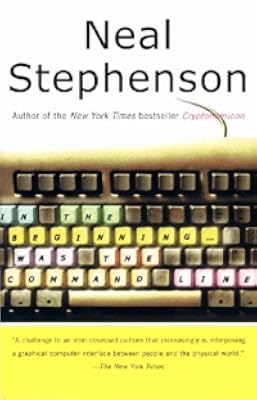
In the Beginning...was the Command Line
by Neal Stephenson
On This Page
Description
This is "the Word" -- one man's word, certainly -- about the art (and artifice) of the state of our computer-centric existence. And considering that the "one man" is Neal Stephenson, "the hacker Hemingway" (Newsweek) -- acclaimed novelist, pragmatist, seer, nerd-friendly philosopher, and nationally bestselling author of groundbreaking literary works (Snow Crash, Cryptonomicon, etc., etc.) -- the word is well worth hearing. Mostly well-reasoned examination and partial rant, Stephenson's In show more the Beginning... was the Command Line is a thoughtful, irreverent, hilarious treatise on the cyber-culture past and present; on operating system tyrannies and downloaded popular revolutions; on the Internet, Disney World, Big Bangs, not to mention the meaning of life itself. show lessTags
Recommendations

















Member Reviews
Stephenson goes on a rant, amusing for the most part, to make the argument that computer operating systems (OS's) inherently lend themselves to crowd-sourcing, and it is bad business strategy on the part of Microsoft, Apple, and any other business to commit themselves to maintaining a proprietary OS. Overall, I find his argument persuasive.
Along the way, Stephenson discusses the concept and consequences of the metaphors employed in various OS's, especially those linked to GUIs; argues the strengths & weaknesses of Microsoft ("a software company") and Apple ("a hardware company"); and explores the merits of a few other OS's (notably, UNIX, LINUS, and BeOS -- the latter of which I'd never heard). He also surveys the various interfaces show more used with computers over time: batch processing, command line, GUIs.
Stephenson argues that buying an OS amounts to buying into a set of metaphors used to navigate the underlying code which directs the CPU and thereby the rest of a computer. This is useful because it simplifies the process, and users don't need to learn source code (or even object code) to use their computer. It is dangerous, he suggests, not only because it adds another "semiotic layer" between the user and the computer, but between the user and other users. "[W]hat we're buying into is the underlying assumption that metaphors are a good way of dealing with the world," [64] later discussing the concept of 'cruft' and implying we are crufting our selves and our interfaces with the world when we inconsiderately use pre-packaged metaphors while navigating our lives. Not a closely argued position, but a suggestive one.
In the beginning ... is a nice primer on a variety of topics, though naturally the historical overview ends in 1999 when it was written. There's anecdotal evidence that Stephenson has had second thoughts about some of the points made in this essay, but I'm not sure which those would be. I'd still recommend the essay. show less
Along the way, Stephenson discusses the concept and consequences of the metaphors employed in various OS's, especially those linked to GUIs; argues the strengths & weaknesses of Microsoft ("a software company") and Apple ("a hardware company"); and explores the merits of a few other OS's (notably, UNIX, LINUS, and BeOS -- the latter of which I'd never heard). He also surveys the various interfaces show more used with computers over time: batch processing, command line, GUIs.
Stephenson argues that buying an OS amounts to buying into a set of metaphors used to navigate the underlying code which directs the CPU and thereby the rest of a computer. This is useful because it simplifies the process, and users don't need to learn source code (or even object code) to use their computer. It is dangerous, he suggests, not only because it adds another "semiotic layer" between the user and the computer, but between the user and other users. "[W]hat we're buying into is the underlying assumption that metaphors are a good way of dealing with the world," [64] later discussing the concept of 'cruft' and implying we are crufting our selves and our interfaces with the world when we inconsiderately use pre-packaged metaphors while navigating our lives. Not a closely argued position, but a suggestive one.
In the beginning ... is a nice primer on a variety of topics, though naturally the historical overview ends in 1999 when it was written. There's anecdotal evidence that Stephenson has had second thoughts about some of the points made in this essay, but I'm not sure which those would be. I'd still recommend the essay. show less
At 160 pages, this slim volume is more of an extended essay than a full-blown book. Even at that brief length, however, what Stephenson attempts is fairly audacious: a history of personal-computer operating systems from 1984 to 1999; an introduction to Linux and the concept of free, open-source software; and (for lack of a better term) a philosophical inquiry into the nature of operating systems and their impact on the way users interact with and think about computers. That's a tall order for 160 pages, and it's not all equally successful.
The historical survey of the contrasting approaches to operating-system development taken by Microsoft and Apple is fascinating, but it is brief: a history of concepts and business models rather than show more of the evolution of either Windows or Mac OS as actual pieces of usable software. The introduction to Linux is equally brief, but (from my non-Linux-using perspective) more comprehensive and more successful at conveying a sense of what Linux is and how it works. Stephenson's heart, however, is clearly in the third section of the book: The philosophical discussion of operating systems. He writes with eloquence and considerable passion about the power, flexibility, and customizability of Unix and Linux (its free, open-source descendent), and bemoans the preference of 98% of computer users for the expensive, bug-ridden, failure-prone, heavily mediated commercial alternatives: Windows and Mac OS.
A lot of this philosophical material is interesting, regardless of what operating system one uses. Stevenson makes interesting points about graphical user interfaces (GUIs) and "mediated experience," about the differences between Windows and Linux tech support, and a dozen other things as well. He is frequently insightful, nearly always amusing to read, and makes an honest attempt to understand the position of the 98% of computer users who don’t think like he does. Yet, at some fundamental level, he Doesn't Get It.
The most fundamental division in the computer-using world may be that separating those who care about how their OS works and those who care that it works. Stephenson clearly belongs to the first group and is just as clearly writing for members of the second group (his own cohort already knows the difference between source code and object code, the meaning of "open source," and other things he explains with such admirable clarity). Stephenson frames his arguments, however, as if he was writing for his own group . . . not those of us on the other side of the divide. He lauds the power, flexibility, and adaptability of Linux with the verve of someone who sees them as absolute virtues. He describes the steep learning curve and in-your-face complexity of Linux with the diffidence of someone who sees them as a challenge. Most of his intended audience would likely differ with him on both counts. The moderately powerful, flexible, reliable "devil you know" is, for most users, likely preferable to the more powerful, flexible, and reliable – but utterly alien – system that it would take months or years to become comfortable with, if that devil does the tasks they require of it with reasonable speed and efficiency. Usability is not a cardinal virtue on Stephenson's side of the divide, but it is perhaps the cardinal virtue on the side occupied by most rank-and-file users.
None of this renders Stephenson's arguments void . . . Linux does have huge advantages, and the future of operating systems may well lie in free, open-source software. It does, however, give both author and book a huge blind spot, symbolized by Stephenson's apparent puzzlement that Linux hasn't triumphed yet. show less
The historical survey of the contrasting approaches to operating-system development taken by Microsoft and Apple is fascinating, but it is brief: a history of concepts and business models rather than show more of the evolution of either Windows or Mac OS as actual pieces of usable software. The introduction to Linux is equally brief, but (from my non-Linux-using perspective) more comprehensive and more successful at conveying a sense of what Linux is and how it works. Stephenson's heart, however, is clearly in the third section of the book: The philosophical discussion of operating systems. He writes with eloquence and considerable passion about the power, flexibility, and customizability of Unix and Linux (its free, open-source descendent), and bemoans the preference of 98% of computer users for the expensive, bug-ridden, failure-prone, heavily mediated commercial alternatives: Windows and Mac OS.
A lot of this philosophical material is interesting, regardless of what operating system one uses. Stevenson makes interesting points about graphical user interfaces (GUIs) and "mediated experience," about the differences between Windows and Linux tech support, and a dozen other things as well. He is frequently insightful, nearly always amusing to read, and makes an honest attempt to understand the position of the 98% of computer users who don’t think like he does. Yet, at some fundamental level, he Doesn't Get It.
The most fundamental division in the computer-using world may be that separating those who care about how their OS works and those who care that it works. Stephenson clearly belongs to the first group and is just as clearly writing for members of the second group (his own cohort already knows the difference between source code and object code, the meaning of "open source," and other things he explains with such admirable clarity). Stephenson frames his arguments, however, as if he was writing for his own group . . . not those of us on the other side of the divide. He lauds the power, flexibility, and adaptability of Linux with the verve of someone who sees them as absolute virtues. He describes the steep learning curve and in-your-face complexity of Linux with the diffidence of someone who sees them as a challenge. Most of his intended audience would likely differ with him on both counts. The moderately powerful, flexible, reliable "devil you know" is, for most users, likely preferable to the more powerful, flexible, and reliable – but utterly alien – system that it would take months or years to become comfortable with, if that devil does the tasks they require of it with reasonable speed and efficiency. Usability is not a cardinal virtue on Stephenson's side of the divide, but it is perhaps the cardinal virtue on the side occupied by most rank-and-file users.
None of this renders Stephenson's arguments void . . . Linux does have huge advantages, and the future of operating systems may well lie in free, open-source software. It does, however, give both author and book a huge blind spot, symbolized by Stephenson's apparent puzzlement that Linux hasn't triumphed yet. show less
This is an odd little essay about the nature of computer systems and user interfaces, though it's a little too dated to truly inform today's users except in a very broad sense.
For example, Stephenson proclaims his love for Linux, but reassures us it's actually pretty hard to use -- which is no longer true (most Linux distros offer nice, clean, *fast* GUIs that I prefer to Windows and the Mac).
He deconstructs the earlier years of Apple and Microsoft in an amusing and interesting way, and while his analogies often run pretty far afield, they do serve to illustrate the essential madness that defined Apple and Microsoft in the 1990s.
The value in this (for me) was his explanation of open source development and what it offers the end user. I show more arrived at many of the same conclusions independently (I was a hardcore Mac user from 1985 to 1995 when the Mac's constant crashes pushed me to Windows, though after a few days with Windows Vista on a new laptop, I installed Ubuntu Linux, which is now an easy-installing, easy-to-use OS).
I now run my 25 year-old marketing and consulting business from four Linux machines, so I understand Stephenson's love of the OS.
I'm less understanding of some of the wild digressions found in the book, and ultimately think I'm giving it three stars instead of two because I think several of his points are spot on (if a little hard to uncover).
For example, Writers should probably heed his warnings about proprietary file formats -- as a fulltime professional writer, 95% of my copy is written on programmer's text editors (including the Emacs editor Stephenson mentions in the book).
And yes, Linux is hugely elegant and offers users a choice of GUI or command line (it's not a coincidence the Mac OS is built atop a free version of Unix).
Interestingly, Stephenson -- a longtime Emacs text editor proponent -- said in an interview his latest book (Reamde) was written in Scrivener, a commercial Mac-only piece of writer's software that makes it easy to stitch together (and rearrange) scenes and chapters of a book.
I don't know if that means he's abandoned his beloved Linux in favor of the Mac (there is now a beta version of Scrivener available for Mac & Linux, though I don't believe it was available when he wrote the book), but it does mean portions of this book are no longer accurate. show less
For example, Stephenson proclaims his love for Linux, but reassures us it's actually pretty hard to use -- which is no longer true (most Linux distros offer nice, clean, *fast* GUIs that I prefer to Windows and the Mac).
He deconstructs the earlier years of Apple and Microsoft in an amusing and interesting way, and while his analogies often run pretty far afield, they do serve to illustrate the essential madness that defined Apple and Microsoft in the 1990s.
The value in this (for me) was his explanation of open source development and what it offers the end user. I show more arrived at many of the same conclusions independently (I was a hardcore Mac user from 1985 to 1995 when the Mac's constant crashes pushed me to Windows, though after a few days with Windows Vista on a new laptop, I installed Ubuntu Linux, which is now an easy-installing, easy-to-use OS).
I now run my 25 year-old marketing and consulting business from four Linux machines, so I understand Stephenson's love of the OS.
I'm less understanding of some of the wild digressions found in the book, and ultimately think I'm giving it three stars instead of two because I think several of his points are spot on (if a little hard to uncover).
For example, Writers should probably heed his warnings about proprietary file formats -- as a fulltime professional writer, 95% of my copy is written on programmer's text editors (including the Emacs editor Stephenson mentions in the book).
And yes, Linux is hugely elegant and offers users a choice of GUI or command line (it's not a coincidence the Mac OS is built atop a free version of Unix).
Interestingly, Stephenson -- a longtime Emacs text editor proponent -- said in an interview his latest book (Reamde) was written in Scrivener, a commercial Mac-only piece of writer's software that makes it easy to stitch together (and rearrange) scenes and chapters of a book.
I don't know if that means he's abandoned his beloved Linux in favor of the Mac (there is now a beta version of Scrivener available for Mac & Linux, though I don't believe it was available when he wrote the book), but it does mean portions of this book are no longer accurate. show less
I read this piece right around when it first came out (on a Palm PDA, no less), and last year when I went back to using Linux part-time I wanted to reread it, because I remembered it fondly. As other reviews here at GR point out, it's very dated and a lot of the criticisms of the GUI don't hold up and may have been off-base even then. Stephenson said in the mid-2000s that the essay needed a completely overhaul but he was unlikely to do it.
BeOS is gone, of course, and Linux now has a GUI and competes with Windows and Apple's OS in terms of ease of usability in some of its distros.
But what's interesting is that some of the essay still resonates, at least it does for me. The conspiracy theory parts and the intellectual condescension are show more a bit much, but some of the metaphors are great. Windows as a big unwieldy station wagon or ATV (yep, still true), Apple as a sportscar (mostly true although diminishing), and the split between reliance on software and reliance on hardware respectively (still true despite the app store). Also, rereading this at a time when Apple has lot a bunch of value because of flat or declining mobile phone sales and Microsoft is increasing profits through their cloud focus feels a bit like a similar inflection point. I doubt Apple is going under or Microsoft will pull away from the pack, but it's a reminder that these cycles are fast.
If you were too young or not paying attention to these battles in the 1990s and early 2000s, or you just want a flavor of what being on the internet was like back in Olden Times, this is still a fun read. But I strongly recommend that you read it here, with Garrett Birkel's annotations. They're from 2004, which is still a long time ago, but they make a great companion to Stephenson's original argument (and Stephenson approved it).
This review is also terrific: https://www.goodreads.com/review/show...
I much enjoyed returning to this world and era. I think it explains why I keep trying to do everything in Linux from the command line even though it is so much easier to use the GUI. show less
BeOS is gone, of course, and Linux now has a GUI and competes with Windows and Apple's OS in terms of ease of usability in some of its distros.
But what's interesting is that some of the essay still resonates, at least it does for me. The conspiracy theory parts and the intellectual condescension are show more a bit much, but some of the metaphors are great. Windows as a big unwieldy station wagon or ATV (yep, still true), Apple as a sportscar (mostly true although diminishing), and the split between reliance on software and reliance on hardware respectively (still true despite the app store). Also, rereading this at a time when Apple has lot a bunch of value because of flat or declining mobile phone sales and Microsoft is increasing profits through their cloud focus feels a bit like a similar inflection point. I doubt Apple is going under or Microsoft will pull away from the pack, but it's a reminder that these cycles are fast.
If you were too young or not paying attention to these battles in the 1990s and early 2000s, or you just want a flavor of what being on the internet was like back in Olden Times, this is still a fun read. But I strongly recommend that you read it here, with Garrett Birkel's annotations. They're from 2004, which is still a long time ago, but they make a great companion to Stephenson's original argument (and Stephenson approved it).
This review is also terrific: https://www.goodreads.com/review/show...
I much enjoyed returning to this world and era. I think it explains why I keep trying to do everything in Linux from the command line even though it is so much easier to use the GUI. show less
This is a historical document about operating systems, which I expect would be interesting to very few people these days. I picked it up because 1.) I just recently returned to the command line myself, and 2.) Neal Stephenson is writing about computers and that's, like, my favorite. It's a little immature and a lot biased, plus the metaphors get completely out of hand. But rarely have I seen a final essay so nicely tie up a book like this, and as everyone knows, I'm a sucker for a good ending.
Quick and Fun: "In the Beginning... was the Command Line" is that rarest of specimens: a short book written by Neal Stephenson. In truth, "Command Line" isn't really a book. It began its life as an online post, and was only published after the fact. In it, Stephenson sketches out a brief outline of the development of computers - especially personal computers and their operating systems - during the 1980s and '90s. It is a quick and fun read, filled with Stephensonian humor and creative metaphors that both entertain and enlighten.
In the course of "Command Line," Stephenson briefly touches on the basics of programming before moving on to discuss the history of operating systems over the last twenty years. He looks at the main operating show more systems out there (specifically Mac, Windows, Linux, BeOS), how they evolved, and their attractions and advantages. His main points are that "it is the fate of operating systems to become free" and that Microsoft's commitment to maintaining its own closed operating system will cripple its broader software development activities, much in the way Apple was hurt by its insistence on producing its own hardware. Though not much is developed, there is a lot of interesting food for thought in these few pages.
Stephen works largely through metaphors, and "Command Line" is written for the layperson. Few people should have any difficulty getting through the book, even without computer experience. Amazon's insistence that the book was written "for an audience of coders and hackers" strikes me as bizarre. There is almost nothing technical in "Command Line," and what is technical (a brief discussion of the Linux file tree is the only topic that comes to mind) is not critical to understanding any of his points and arguments.
In addition to summarizing the history of operating systems, Stephenson also considers some related cultural topics, such as the significance of the graphical user interface as opposed to the command line. Although some of this was interesting, there were a few digressions I thought didn't work particularly well, and which I would have expected to be edited out (or at least significantly revised) before publishing.
Although "Command Line" was written five years ago (a long time in the computer world), its age does not damage it much (especially in the historical sections). If you're interested in the history of personal computing over the last twenty years, "In the Beginning... was the Command Line" is a quick read that can serve as an entertaining introduction. Although it doesn't have much substance, it still manages to make many interesting points. Unless you are a hard-core Stephenson fanatic, "Command Line" is probably not worth purchasing. Since it was originally nothing more than a post on the Internet, it can still easily be found online. show less
In the course of "Command Line," Stephenson briefly touches on the basics of programming before moving on to discuss the history of operating systems over the last twenty years. He looks at the main operating show more systems out there (specifically Mac, Windows, Linux, BeOS), how they evolved, and their attractions and advantages. His main points are that "it is the fate of operating systems to become free" and that Microsoft's commitment to maintaining its own closed operating system will cripple its broader software development activities, much in the way Apple was hurt by its insistence on producing its own hardware. Though not much is developed, there is a lot of interesting food for thought in these few pages.
Stephen works largely through metaphors, and "Command Line" is written for the layperson. Few people should have any difficulty getting through the book, even without computer experience. Amazon's insistence that the book was written "for an audience of coders and hackers" strikes me as bizarre. There is almost nothing technical in "Command Line," and what is technical (a brief discussion of the Linux file tree is the only topic that comes to mind) is not critical to understanding any of his points and arguments.
In addition to summarizing the history of operating systems, Stephenson also considers some related cultural topics, such as the significance of the graphical user interface as opposed to the command line. Although some of this was interesting, there were a few digressions I thought didn't work particularly well, and which I would have expected to be edited out (or at least significantly revised) before publishing.
Although "Command Line" was written five years ago (a long time in the computer world), its age does not damage it much (especially in the historical sections). If you're interested in the history of personal computing over the last twenty years, "In the Beginning... was the Command Line" is a quick read that can serve as an entertaining introduction. Although it doesn't have much substance, it still manages to make many interesting points. Unless you are a hard-core Stephenson fanatic, "Command Line" is probably not worth purchasing. Since it was originally nothing more than a post on the Internet, it can still easily be found online. show less
Neal Stephenson'dan işletim sistemlerinin tarihi olarak özetleyebileceğimiz bir makale. Her ne kadar günümüz için bilgi anlamında eski olsa da içindeki fikirler ve birçok yorum hâlâ güncelliğini koruyor. Özellikle bilgisayarlar ve işletim sistemleri konusunda meraklı ancak yeni başlayan birisi için şahane bir başlangıç olabilir. Ancak bunun biraz daha ötesine geçmişler için Neal Stephenson'un yorumlarını öğrenmek dışında çok bir katkısı olmayacaktır.
Tüm bunların yanında okuması fazlasıyla keyifli ve eğlenceli. Tavsiye etmemek gibi bir lüksüm yok özetle.
Tüm bunların yanında okuması fazlasıyla keyifli ve eğlenceli. Tavsiye etmemek gibi bir lüksüm yok özetle.
Members
- Recently Added By
Lists

Geek Books
27 works; 7 members

Top 10 technology books
11 works; 3 members
Author Information

80+ Works 118,765 Members
Neal Stephenson, the science fiction author, was born on October 31, 1959 in Maryland. He graduated from Boston University in 1981 with a B.A. in Geography with a minor in physics. His first novel, The Big U, was published in 1984. It received little attention and stayed out of print until Stephenson allowed it to be reprinted in 2001. His second show more novel was Zodiac: The Eco-Thriller was published in 1988, but it was his novel Snow Crash (1992) that brought him popularity. It fused memetics, computer viruses, and other high-tech themes with Sumerian mythology. Neal Stephenson has won several awards: Hugo for Best Novel for The Diamond Age (1996), the Arthur C. Clarke for Best Novel for Quicksilver (2004), and the Prometheus Award for Best Novel for The System of the World (2005). He recently completed the The Baroque Cycle Trilogy, a series of historical novels. It consists of eight books and was originally published in three volumes and Reamde. His latest novel is entitled The Rise and Fall of D. O. D. O. Stephenson also writes under the pseudonym Stephen Bury. (Bowker Author Biography) show less
Common Knowledge
- Original title
- In the Beginning ... Was the Command Line
- Original publication date
- 1999
- First words
- About twenty years ago Jobs and Wozniak, the founders of Apple, came up with the very strange idea of selling information processing machines for use in the home.
- Quotations
- It is the fate of manufactured goods to slowly and gently depreciate as they get old and have to compete against more modern products.
It is the fate of operating systems to become free. [37]
There is massively promiscuous metaphor-mixing going on here, and I could deconstruct it till the cows come home, but I won't. [63] - Last words
- (Click to show. Warning: May contain spoilers.)He would probably tell you that life is a very hard and complicated thing; that no interface can change that; that anyone who believes otherwise is a sucker; and that if you don't like having choices made for you, you should start making your own.
- Original language
- English
Classifications
- Genres
- Technology, General Nonfiction, Religion & Spirituality, History, Nonfiction
- DDC/MDS
- 005.43 — Computer science, information & general works Computer science, knowledge & systems Artificial Intelligence/Virtual Reality Systems programming and programs Systems programs
- LCC
- QA76.76 .O63 .S7369 — Science Mathematics Mathematics Instruments and machines Calculating machines Electronic computers. Computer science Computer software
- BISAC
Statistics
- Members
- 2,323
- Popularity
- 8,529
- Reviews
- 31
- Rating
- (3.73)
- Languages
- Catalan, English, German, Spanish
- Media
- Paper, Ebook
- ISBNs
- 8
- ASINs
- 6