On This Page
Description
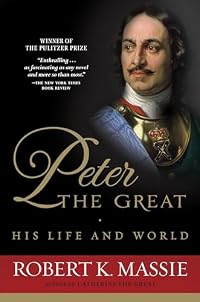
This superbly told story brings to life one of the most remarkable rulers––and men––in all of history and conveys the drama of his life and world. The Russia of Peter's birth was very different from the Russia his energy, genius, and ruthlessness shaped. Crowned co-Tsar as a child of ten, after witnessing bloody uprisings in the streets of Moscow, he would grow up propelled by an unquenchable curiosity, everywhere looking, asking, tinkering, and learning, fired by Western ideas. We show more see Peter in his twenties traveling "incognito" with his ambassadors to the courts of Europe; as the victorious soldier proclaimed Emperor; as the simple workman at his forge; and as the visionary statesman who single-handedly created a formidable world power. Impetuous and stubborn, bawdy and stern, relentless in his perseverance, he was capable of the greatest generosity and the greatest cruelty.. show less
Tags
Recommendations















Member Recommendations

Member Reviews
Na, ez a könyv pont annyira fantasztikus, mint amekkora. Massie szórakoztatóan és alaposan kivesézi nemcsak a kor Oroszországát, hanem úgy egyáltalán: a XVIII. század első harmadának Európáját szőröstül-bőröstül. Ebben segítségére van maga Péter cár is, aki megteszi neki azt a szívességet, hogy uralkodótól szokatlan módon bejárja a fél világot, ahová pedig nem jut el, azzal háborúba bonyolódik. Így Massie-nek alkalma nyílik bemutatni a korszak valamennyi fontosabb figuráját Orániai Vilmostól XII. Károly svéd uralkodón és legendás hadvezéren át magáig a Napkirályig*. Csupa színes, izgalmas alak kavarog e könyv lapjain, és még magyar vonatkozás is akad: egyrészt Rákóczi rövid show more vendégszereplése, másrészt az eszméletlen mennyiségű tokaji bor, amit Péter jóízűen elfogyaszt.
Amúgy meg ez a Péter egy nagy franc volt. Volt egy missziója, át akarta ráncigálni a Nagy Orosz Anyácskát keletről nyugatra, és ettől nem igazán hagyta magát elrettenteni. Éhen haltak a parasztok a sok hadiadó miatt? Ez van, ezt kell szeretni. Szentpétervár építésekor hullottak a munkások, mint a legyek? Hát most mit csináljon velük. Persze, csodás dolog, ha egy nagy formátumú uralkodó üldögél az ember feje felett, de az a helyzet, hogy a nagy formátumú uralkodókat általában utólag szokták szeretni. Közben nem feltétlenül. Persze meglehet, hogy ez az orosz néplélek, ez a keleti fatalizmus szinte kihívja ezt: hogy a dolgok ne folyamatukban fejlődjenek ki, kisebb-nagyobb döccenőkkel, hanem jöjjön egy diktátor, egy agyagbálvány véres mancsokkal, és a szakállánál fogva rángassa ki a népet a derítőgödörből. Vagy vissza az derítőgödörbe – mert ez is egy opció.
De nem akarok én túlságosan igazságtalan lenni Péterrel – bár talán megérdemelné. Amúgy egy igazán tündökletes, izgalmas személyiség volt, akinek tetterejét nehéz nem bámulni így háromszáz év távlatából, és alighanem nagyobb szíve és nyitottabb elméje volt, mint korabeli kollégáinak. Ő a maga részéről igazán jót akart – csak éppen abból a magasságból, ahol ő élt, talán alig tűntek nagyobbnak az emberek, mint a bolhák. Pláne hogy szemét folyton előre szegezte: a vágyott napnyugat felé. Ahol azóta is hiába várják őket.
* Na mondjuk vele Péter pont nem találkozott se civilben, se a hadszíntéren, de sebaj, az író ravaszul megoldja, hogy róla is rittyentsen egy bájos portrét. És jól teszi, a korszak másik legjelentősebb figuráját bűn lenne kihagyni egy ilyen apróság miatt. show less
Amúgy meg ez a Péter egy nagy franc volt. Volt egy missziója, át akarta ráncigálni a Nagy Orosz Anyácskát keletről nyugatra, és ettől nem igazán hagyta magát elrettenteni. Éhen haltak a parasztok a sok hadiadó miatt? Ez van, ezt kell szeretni. Szentpétervár építésekor hullottak a munkások, mint a legyek? Hát most mit csináljon velük. Persze, csodás dolog, ha egy nagy formátumú uralkodó üldögél az ember feje felett, de az a helyzet, hogy a nagy formátumú uralkodókat általában utólag szokták szeretni. Közben nem feltétlenül. Persze meglehet, hogy ez az orosz néplélek, ez a keleti fatalizmus szinte kihívja ezt: hogy a dolgok ne folyamatukban fejlődjenek ki, kisebb-nagyobb döccenőkkel, hanem jöjjön egy diktátor, egy agyagbálvány véres mancsokkal, és a szakállánál fogva rángassa ki a népet a derítőgödörből. Vagy vissza az derítőgödörbe – mert ez is egy opció.
De nem akarok én túlságosan igazságtalan lenni Péterrel – bár talán megérdemelné. Amúgy egy igazán tündökletes, izgalmas személyiség volt, akinek tetterejét nehéz nem bámulni így háromszáz év távlatából, és alighanem nagyobb szíve és nyitottabb elméje volt, mint korabeli kollégáinak. Ő a maga részéről igazán jót akart – csak éppen abból a magasságból, ahol ő élt, talán alig tűntek nagyobbnak az emberek, mint a bolhák. Pláne hogy szemét folyton előre szegezte: a vágyott napnyugat felé. Ahol azóta is hiába várják őket.
* Na mondjuk vele Péter pont nem találkozott se civilben, se a hadszíntéren, de sebaj, az író ravaszul megoldja, hogy róla is rittyentsen egy bájos portrét. És jól teszi, a korszak másik legjelentősebb figuráját bűn lenne kihagyni egy ilyen apróság miatt. show less
Peter was a whirlwind of a man, and his tenacity was incredible. He single-handedly dragged Russia, kicking and screaming, into the modern age.
I struggled to reconcile his tolerance in so many areas with his physical abuse of subordinates and his liberal practice of torture. Massie tries to downplay this as a product of the times Peter lived in, but the man had his own son tortured to death for crying out loud!
Peter the Great: His Life and World is a remarkable synthesis. I can't imagine a better book on the subject for the general reader(*). It is both informative and enjoyable, wry with humor, par excellence pacing, quality quotes, and a variety of subject. Massie builds a rich tapestry that transports the reader into the period. Lavish descriptions of the every-day like what it's like to ride in a coach, the foods they ate, the clothes they worse, home interiors, are speckled throughout like a spice that bring a dish alive. It was published in 1980, when the USA was emerging from a funk into the electric energy of the 80s and the spirit and mood of that time is mirrored in the book's subject of the emergence of Russia from the Medieval to show more Modern, when women saw greater freedoms, secularism was on the rise, and technology was challenging ideology. All history books are a product of the milieu in which they are written and this is no exception, to its credit.
The main subjects of the book, almost mini-books onto themselves, are Peter's Great Embassy which Massies calls one of the great events of his life and takes the reader on a journey around the capital cities of Europe at the turn of the 18th century. Next is the Great North War (1700-1721), with major battles including Narva (1700) and Poltava (1709), the later being a positive change in the fortunes and history of Russia. Sweden's Charles XII is an interesting character and his coverage shadows Peter during this period, there is almost a complete biography of Charles. His famous ride across Europe, the debacle in Turkey, etc.. Then there is the incident involving Peter's son, with material enough for a TV soap it was a drama played out for all of Europe to watch. The ending is brutal and speaks volumes to the character of Peter and the times. Finally there is the consolidation of the Russian institutions in his later years and some minor conflicts with Persia and Turks. One can see patterns of conflict between neighboring powers that exist to this day in Russia.
(*) general reader - Some reviewers have criticized it as popular history. This is a mistake. Everyone is a general reader, at some point, we only become specialists after a great teacher excites us to learn more. Books such as this are important and not easy to make, works of art onto themselves. show less
The main subjects of the book, almost mini-books onto themselves, are Peter's Great Embassy which Massies calls one of the great events of his life and takes the reader on a journey around the capital cities of Europe at the turn of the 18th century. Next is the Great North War (1700-1721), with major battles including Narva (1700) and Poltava (1709), the later being a positive change in the fortunes and history of Russia. Sweden's Charles XII is an interesting character and his coverage shadows Peter during this period, there is almost a complete biography of Charles. His famous ride across Europe, the debacle in Turkey, etc.. Then there is the incident involving Peter's son, with material enough for a TV soap it was a drama played out for all of Europe to watch. The ending is brutal and speaks volumes to the character of Peter and the times. Finally there is the consolidation of the Russian institutions in his later years and some minor conflicts with Persia and Turks. One can see patterns of conflict between neighboring powers that exist to this day in Russia.
(*) general reader - Some reviewers have criticized it as popular history. This is a mistake. Everyone is a general reader, at some point, we only become specialists after a great teacher excites us to learn more. Books such as this are important and not easy to make, works of art onto themselves. show less
It took me 397 days to read this massive and immensely interesting biography of Peter the Great. Why so long? Several times in the year that I was reading across, there were several incidents of real life getting too real. My reading rate dropped in half through the entire year. That I continued reading this book through all that is a testament to it's actual fascination to me.
I knew that Peter the Great was a fascinating and historically significant figure. Little could I imagine how fascinating and how critically significant his reign was to Russia. While I knew he had taken Russia from basically an undeveloped country to a major player in the European world during his lifetime, I did not realize the challenges to doing that at all. show more It took Peter's massive energy and a man who really could see the future for his country to accomplish this incredible leap forward what seemed to me to be more than a century of technological, domestic policy and foreign policy development.
Highly recommended. show less
I knew that Peter the Great was a fascinating and historically significant figure. Little could I imagine how fascinating and how critically significant his reign was to Russia. While I knew he had taken Russia from basically an undeveloped country to a major player in the European world during his lifetime, I did not realize the challenges to doing that at all. show more It took Peter's massive energy and a man who really could see the future for his country to accomplish this incredible leap forward what seemed to me to be more than a century of technological, domestic policy and foreign policy development.
Highly recommended. show less
What a masterwork? Massie has taken the life of Peter the Great and presented a detailed and fascinating tour of the 17th century. He has successfully introduced the man and set him in context.
Peter the Great was a force of nature. Frightened as a child as he saw the unchecked violence of the palace guard, Peter grew up apart from the ruling class, assuming he would never be called upon to rule. Through the deaths of several relatives, Peter became Tsar, a task he did not take seriously at first. Eventually, he warmed to the idea and plunged into the task of modernizing Russia. His Great Embassy in which he traveled "incognito" furthered his ambitions. Only a man of his incredible strength and ambition could have successfully overcome show more the inertia of tradition bound Russia. The navy, the army, the aristocracy, all were recreated. This allowed Russia to assume a new place in world politics as seen in the ultimately successful Great Northern War. After expansion and consolidation, Peter began work on government itself. In this, he was less successful. Corruption and inefficiency still ruled. He was never able to change that facet of Russian life. He died leaving behind a new Russia. He was a great man if not a good one. Though not as cruel as many of his era, he was nevertheless a hard taskmaster who placed a heavy weight upon his people as he drove them into the modern era.
Massie is the best kind of historian. His writing is lively and well researched. He understands people. He is not afraid of judgment when necessary though he is tempered by the careful understanding of the life and times of his subjects. This work is a beautiful insight into a strange land and a strange time. show less
Peter the Great was a force of nature. Frightened as a child as he saw the unchecked violence of the palace guard, Peter grew up apart from the ruling class, assuming he would never be called upon to rule. Through the deaths of several relatives, Peter became Tsar, a task he did not take seriously at first. Eventually, he warmed to the idea and plunged into the task of modernizing Russia. His Great Embassy in which he traveled "incognito" furthered his ambitions. Only a man of his incredible strength and ambition could have successfully overcome show more the inertia of tradition bound Russia. The navy, the army, the aristocracy, all were recreated. This allowed Russia to assume a new place in world politics as seen in the ultimately successful Great Northern War. After expansion and consolidation, Peter began work on government itself. In this, he was less successful. Corruption and inefficiency still ruled. He was never able to change that facet of Russian life. He died leaving behind a new Russia. He was a great man if not a good one. Though not as cruel as many of his era, he was nevertheless a hard taskmaster who placed a heavy weight upon his people as he drove them into the modern era.
Massie is the best kind of historian. His writing is lively and well researched. He understands people. He is not afraid of judgment when necessary though he is tempered by the careful understanding of the life and times of his subjects. This work is a beautiful insight into a strange land and a strange time. show less
wow, nearly nine hundred pages of thorough biography and this unique life is a gripping read throughout. Act 1, Peter develops in constant contact with foreign experts and playing at war. Act 2, Transformation from hemmed in co-tsar to emperor with a mission on an embassy to Europe disguised and playing the apprentice. Act 3, The Great Northern War is not playing and many years of struggle with Sweden play out. Act 4, a wiser emperor methodically modernizes and westernizes Russian institutions. The flight and downfall of the Tsarevich Alexis is one of many detailed subplots. Tell me more of other intrigues, like Ivan VI, tsar as a baby then secret state prisoner until death!
The extreme and controversial nature of Peter the Great's personality explodes through the whole book. It's as if he was constantly torn between being the most beneficial, progressive monarch in history and the most cruel one. It was painful to read about the torture that he endorsed and sometimes even participated in (!), being close to paranoid (not always without basis, it has to be admitted) about betrayal; freedom of speech was not the thing under his reign, for he was greatly feared. But at the same time, progress meant everything to him: he established the first Russian newspaper, the Academy of Sciences, he decreed in favor of women (giving them more freedoms, abolishing arranged marriages, etc.), and what of his ventures abroad show more to learn and to build a new fleet, a new outstanding city!...
The most dramatic personal issue Peter had to deal with was the unwillingness of his son Alexis (from his first marriage) to become his heir. The young man was totally opposite of his father in nature, going as far as fleeing the country, lying to his father, while Peter tried to "break" him, to prepare him for being an emperor - all of which finally ended in great tragedy. This drama was aptly described by Massie.
Quite a big portion of the book is given to King Charles XII of Sweden, almost equal to Peter in cruelty and quite war-crazy, as well as the description of Sweden, a close Russian neighbor and a ferocious opponent. Also, one cannot ignore Peter's unique relationship with Catherine, his second wife (of modest origins) - at times, she was the only one who could appease his rages as well as his epileptic fits and frequent fevers, and who could understand him like nobody else.
The reason that I didn't care for this book as much as for other Massie's biographies ("Catherine the Great", "Nicolas and Alexandra") is probably the tedious, extremely detailed description of brutal warfare, as well as the very elusive feeling that I had while reading: that of the author as if just recounting in his own words (albeit very skillfully) what he has read from other sources (and of course there are plenty on this subject! so it was unavoidable), while his other books had more of his own input and analysis, it seemed.
But it all goes back to Peter's personality in the end. On his deathbed, the great tsar said: "I hope God will forgive me my many sins because of the good I have tried to do for my people". show less
The most dramatic personal issue Peter had to deal with was the unwillingness of his son Alexis (from his first marriage) to become his heir. The young man was totally opposite of his father in nature, going as far as fleeing the country, lying to his father, while Peter tried to "break" him, to prepare him for being an emperor - all of which finally ended in great tragedy. This drama was aptly described by Massie.
Quite a big portion of the book is given to King Charles XII of Sweden, almost equal to Peter in cruelty and quite war-crazy, as well as the description of Sweden, a close Russian neighbor and a ferocious opponent. Also, one cannot ignore Peter's unique relationship with Catherine, his second wife (of modest origins) - at times, she was the only one who could appease his rages as well as his epileptic fits and frequent fevers, and who could understand him like nobody else.
The reason that I didn't care for this book as much as for other Massie's biographies ("Catherine the Great", "Nicolas and Alexandra") is probably the tedious, extremely detailed description of brutal warfare, as well as the very elusive feeling that I had while reading: that of the author as if just recounting in his own words (albeit very skillfully) what he has read from other sources (and of course there are plenty on this subject! so it was unavoidable), while his other books had more of his own input and analysis, it seemed.
But it all goes back to Peter's personality in the end. On his deathbed, the great tsar said: "I hope God will forgive me my many sins because of the good I have tried to do for my people". show less
Members
- Recently Added By
Published Reviews
ThingScore 50
The specialist cannot in good conscience recommend this book to fellow historians. Yet it would be misleading as well as unfair to leave it at that. For Massie's work strikes this reviewer as, at the same time, an outstanding example of that somewhat ambiguous literary genre known as popular (or commercial) history... A colorful, dramatic, at times gripping story is told here in fine detail show more and effortless prose. show less
added by eromsted
Lists

Top Five Books of 2020
982 works; 350 members

Non-Fiction Worth Reading
1,015 works; 253 members

World History
4 works; 1 member

Top Five Books of 2016
795 works; 228 members

All Things Russia
459 works; 11 members

Vote - Bookmarque's Teetering TBR Tower
33 works; 8 members

Books Read in 2016
4,666 works; 197 members

al.vick-parents books
301 works; 1 member

1980 great books
63 works; 1 member
Author Information

18+ Works 14,897 Members
Robert Kinloch Massie III (1929-) is an American historian, author, Pulitzer Prize recipient. He has devoted much of his career to studying the House of Romanov, Russia's royal family from 1613-1917. Massie was born in Lexington, Kentucky. He spent much of his youth in Nashville, Tennessee and currently resides in the village of Irvington, New show more York. He studied United States and modern European history at Yale and Oxford University, respectively, on a Rhodes Scholarship. Massie went to work as a journalist for Newsweek from 1959 to 1962 and then took a position at the Saturday Evening Post. In 1969 he wrote and published his breakthrough book, Nicholas and Alexandra. Massie was the president of the Authors Guild from 1987 to 1991, and he still serves as a council member. While president of the Guild, he famously called on authors to boycott any store refusing to carry Salman Rushdie's The Satanic Verses. His title Catherine the Great: Portrait of a Woman made The New York Times Best Seller List for 2012. (Bowker Author Biography) show less
Awards and Honors
Awards
Distinctions
Notable Lists
Series


Belongs to Publisher Series
Work Relationships
Contains
Has the adaptation
Has as a student's study guide
Common Knowledge
- Canonical title
- Peter the Great: His Life and World
- Original title
- Peter the Great: his life and world
- Original publication date
- 1980
- People/Characters
- Peter the Great; Empress Elizabeth of Russia; Charles XII, King of Sweden; Empress Catherine I of Russia
- Important places
- Moscow, Russia; St. Petersburg, Russia
- Related movies
- Peter the Great (1986 | IMDb)
- Dedication
- For Mary Kimball Todd and James Madison Todd
and in memory of Robert Kinloch Massie - First words
- Around Moscow, the country rolls gently up from the rivers winding in silvery loops around the pleasant landscape.
- Original language*
- Anglais (USA) (USA)
- Canonical DDC/MDS
- 947.050924
- Canonical LCC
- DK131
*Some information comes from Common Knowledge in other languages. Click "Edit" for more information.
Classifications
- Genres
- History, Biography & Memoir, Nonfiction, General Nonfiction
- DDC/MDS
- 947.050924 — History & geography History of Europe Russia and neighboring east European countries Russian & Slavic History by Period Peter the Great 1689-1725
- LCC
- DK131 — History of Europe, Asia, Africa and Oceania Russia. Soviet Union. Former Soviet Republics – Poland History of Russia. Soviet Union. Former Soviet Republics History House of Romanov, 1613-1917
- BISAC
Statistics
- Members
- 3,035
- Popularity
- 5,797
- Reviews
- 42
- Rating
- (4.35)
- Languages
- 10 — Dutch, English, French, German, Hungarian, Italian, Portuguese, Spanish, Swedish, Turkish
- Media
- Paper, Audiobook, Ebook
- ISBNs
- 47
- UPCs
- 1
- ASINs
- 26