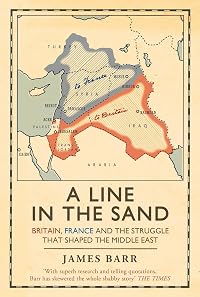
A Line in the Sand: Britain, France and the Struggle That Shaped the Middle East
by James Barr
On This Page
Description
Uses recently declassified French and British government documents to describe how the two countries secretly divided the Middle East during World War I and the effect these mandates had on local Arabs and Jews.Tags
Recommendations

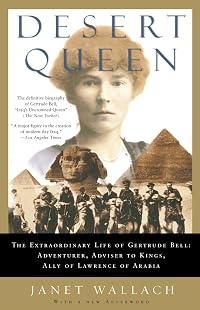
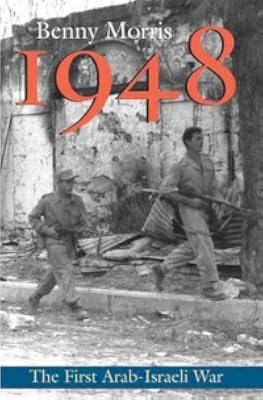
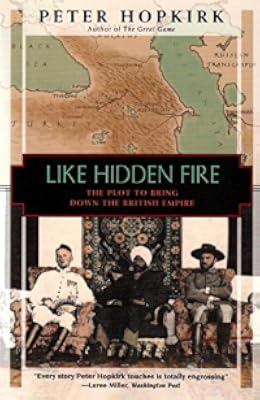
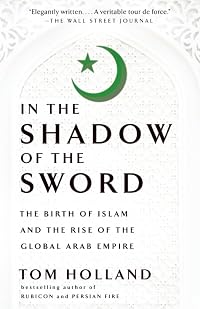


Member Recommendations
Member Reviews
The origins of the crises that might yet turn us all into radioactive ash - Chinese aspirations to acquire Taiwan, Russian concerns about national security to its West- are no more intractable for contemporary understanding than the consequences of the collapse of the Ottoman Empire.
Most people observing the vicious and unholy assault on Gaza by Israel, the collapse of Syria into quasi-Islamism, earlier collapses into anarchy in Iraq and Libya, the re-emergence of Persia as regional power and so many other phenomena tend to have a fairly primitive black and white view.
As always, things are generally more complicated. Each case has its history that can take us back as far as you like but the causes of the modern network of crises in the show more Middle East are best centred on the near-final clash of empires that took place in the First World War.
The full story is far too complex to re-tell in a mere book review but Barr's account of imperial struggle between Britain and France between 1915 and 1948 is almost essential reading for anyone who thinks they should have an opinion on the matter today.
The central problem was that two already overburdened and potentially vulnerable empires (rather like the US today) were around to fill a vacuum left by the collapse of an aged and less developed empire (the Ottoman), perhaps the last heir of Rome itself.
During the First World War, victory for Britain and France was far from assured (certainly in 1915-1917) when the dumbest and most cowardly document in twentieth century history (the Balfour Declaration) set in motion a horrendous process that is still with us today.
A weak Foreign Secretary created the conditions for the incursion of an unnecessary 'Crusader Street' just at the time when other forces in the British Empire (more obviously progressive if self interested) were working to encourage conservative Arab nationalism to win the war and secure India.
At the same time (the main subject of Barr's book) a mutually distrustful France and Britain, with totally different conceptions of empire, were almost absent-mindedly carving up the Ottoman Empire (the Sykes-Picot Agreement) well before it had actually fallen.
And there we have it - a Palestine gifted to well funded ethno-nationalists over the heads of the local population, the encouragement and creation of a new Arab ethno-nationalism masked as conservative dynasticism and the latter betrayed not just by the first but by imperial ambition.
From this point on, it is all down hill as the increasing numbers of Jews in Palestine demand security and protection, Arab greed and disorganisation is always one step behind and France encourages (eventually) Jewish terrorism just as the British encouraged Arab resistance to French imperialism.
Barr covers the story in a very readable narrative style with considerable attention to detail. Every move in the local version of the Great Game is presented and explained. Emotion is removed so we can see the players precisely for what they were.
The British are their usual self-interested, lazily rational selves spoiled by inept politicians ... so not much change there. Their involvement is fundamentally one of protecting the communications and eventually oil flow across the empire. Egypt and India are what matter.
For London, the Arabs are there to be much like any other subservient affiliate of empire protecting a flank and denying rivals (which includes the French) from getting too close to essential interests. This is what the dumb Balfour Declaration totally screwed up.
The last period of the British mandate in Palestine shows just how out of its depth Britain was as its empire began the process of complete degeneration. The road to India was, of course, going to be less important after 1947. The surge of British brutality was nasty, desperate and actually out of character.
The French are just vicious. Their approach to empire can only be described as thuggish and overtly exploitative, run by officials who gave empire its bad name and who were much more happy working as Vichy than as Free French (a subsidiary story covered well by Barr).
De Gaulle was an exasperating narcissistic handful for the British and about as trustworthy as a rattle snake, mostly from weakness. For the French, whatever international law might say, Syria and Lebanon were 'possessions' to be possessed regardless of the natives.
The British by the twentieth century actually tried to be pretty decent without questioning that the fundaments of their rule were indecent. The French did not even bother to try. The Americans have proven that hegemony can enforce tolerance of the criminal on supine 'allies'.
The Zionists come across as one step from fanatic. In fact, let us call this straight. They were manipulative terrorists who did a right old post war number on the American people with their extremely astute exploitation of 'spin' and celebrity. Actors look stupid then as now.
No better than Arafat in his heyday or Hamas, Irgun and the Stern Gang's terrorism, funded and assisted by the French and American Jews, murdered Arabs and British soldiers and administrators alike. This makes the power of the Israel lobby in the UK today all the more impressive.
This leaves the Arabs. It is a picture that is not flattering in terms of organisational ability or coherence. Arab intellectuals are great talkers and love grandstanding events but they seem to have a problem organising a clear shared ideology or avoiding flattery and corruption.
Constantly out-played by Zionists and what amount to French Fascists (to all intents and purposes), the path to brutal dictatorship or flaccid Western-backed dynasticism or futile terrorism in response to what were masters at the trade is marked out during these years.
Certainly the Arab propensity to conspiracy theory and narratives of betrayal is borne out by much of the evidence in the book although much of any British betrayal is as much down to incompetence as deliberation. The French never promised anything in the first place.
Meanwhile two stories are unfolding outside this book that will come into play later. The first is the emergence of Islamism as the primary form of Egyptian resistance to colonialism and the second is the exploitation of the resources of Iran which will lead eventually to Mossadeq's overthrow.
What a mess! But the book is not a mess. Barr has produced an important narrative account of how we got to where we are today. Nor does it make judgements. It simply lays out the facts. I have my interpretation and yours may be different (if you have the courage to escape your prejudices).
And a conclusion? Perhaps that, when desiring the collapse of ramshackle of empires, we should be careful of what we wish for if the successor operations are exploitative, cynical and less-than-competent vampires who hate each other.
As to the self-determination which Woodrow Wilson threw into the pot and which the British were pragmatically prepared to concede in order to protect the whole, again, be careful of what you wish for if the ethnic entities involved are ruthless and mad on the one side or ill-formed on the other.
There are no solutions in this book. The two main Western empires are now virtually defunct despite their posturings. The great successor empire in Washington is grappling with the chaos with precisely the same mix of incompetencies, barren ideology and self interest.
The heir of the Jewish ethno-nationalists is a monster that the West, playing Dr. Frankenstein, refuses to recognise as one. The Arabs in the region of Sykes-Picot are either battered basket cases (Syria, Lebanon) or constantly living on the edge of becoming one (Jordan, Iraq).
As to the Palestinians - the poorly led front line victims of all these imperial shenanigans - they are 'busted' with the best on offer being a confined puppet state on the West Bank, humanitarian 'ethnic cleansing' and what many now consider localised 'genocide'.
Over a century after Sykes-Picot and the Balfour Declaration, perhaps the biggest loser is the self-image of the 'West' (whatever that is) as the good guy. As the histories are told (and there are many of them now), the old rhetoric looks like a coating of cream on a pile of poo.
Traditional narrative history has often got lost in the drive to bore us with critical theory and minor academics wallowing in 'discourses'. Nobody reads that rubbish and so nothing changes. If you bother to read the facts and think for yourself, maybe our elites can actually be brought to account. show less
Most people observing the vicious and unholy assault on Gaza by Israel, the collapse of Syria into quasi-Islamism, earlier collapses into anarchy in Iraq and Libya, the re-emergence of Persia as regional power and so many other phenomena tend to have a fairly primitive black and white view.
As always, things are generally more complicated. Each case has its history that can take us back as far as you like but the causes of the modern network of crises in the show more Middle East are best centred on the near-final clash of empires that took place in the First World War.
The full story is far too complex to re-tell in a mere book review but Barr's account of imperial struggle between Britain and France between 1915 and 1948 is almost essential reading for anyone who thinks they should have an opinion on the matter today.
The central problem was that two already overburdened and potentially vulnerable empires (rather like the US today) were around to fill a vacuum left by the collapse of an aged and less developed empire (the Ottoman), perhaps the last heir of Rome itself.
During the First World War, victory for Britain and France was far from assured (certainly in 1915-1917) when the dumbest and most cowardly document in twentieth century history (the Balfour Declaration) set in motion a horrendous process that is still with us today.
A weak Foreign Secretary created the conditions for the incursion of an unnecessary 'Crusader Street' just at the time when other forces in the British Empire (more obviously progressive if self interested) were working to encourage conservative Arab nationalism to win the war and secure India.
At the same time (the main subject of Barr's book) a mutually distrustful France and Britain, with totally different conceptions of empire, were almost absent-mindedly carving up the Ottoman Empire (the Sykes-Picot Agreement) well before it had actually fallen.
And there we have it - a Palestine gifted to well funded ethno-nationalists over the heads of the local population, the encouragement and creation of a new Arab ethno-nationalism masked as conservative dynasticism and the latter betrayed not just by the first but by imperial ambition.
From this point on, it is all down hill as the increasing numbers of Jews in Palestine demand security and protection, Arab greed and disorganisation is always one step behind and France encourages (eventually) Jewish terrorism just as the British encouraged Arab resistance to French imperialism.
Barr covers the story in a very readable narrative style with considerable attention to detail. Every move in the local version of the Great Game is presented and explained. Emotion is removed so we can see the players precisely for what they were.
The British are their usual self-interested, lazily rational selves spoiled by inept politicians ... so not much change there. Their involvement is fundamentally one of protecting the communications and eventually oil flow across the empire. Egypt and India are what matter.
For London, the Arabs are there to be much like any other subservient affiliate of empire protecting a flank and denying rivals (which includes the French) from getting too close to essential interests. This is what the dumb Balfour Declaration totally screwed up.
The last period of the British mandate in Palestine shows just how out of its depth Britain was as its empire began the process of complete degeneration. The road to India was, of course, going to be less important after 1947. The surge of British brutality was nasty, desperate and actually out of character.
The French are just vicious. Their approach to empire can only be described as thuggish and overtly exploitative, run by officials who gave empire its bad name and who were much more happy working as Vichy than as Free French (a subsidiary story covered well by Barr).
De Gaulle was an exasperating narcissistic handful for the British and about as trustworthy as a rattle snake, mostly from weakness. For the French, whatever international law might say, Syria and Lebanon were 'possessions' to be possessed regardless of the natives.
The British by the twentieth century actually tried to be pretty decent without questioning that the fundaments of their rule were indecent. The French did not even bother to try. The Americans have proven that hegemony can enforce tolerance of the criminal on supine 'allies'.
The Zionists come across as one step from fanatic. In fact, let us call this straight. They were manipulative terrorists who did a right old post war number on the American people with their extremely astute exploitation of 'spin' and celebrity. Actors look stupid then as now.
No better than Arafat in his heyday or Hamas, Irgun and the Stern Gang's terrorism, funded and assisted by the French and American Jews, murdered Arabs and British soldiers and administrators alike. This makes the power of the Israel lobby in the UK today all the more impressive.
This leaves the Arabs. It is a picture that is not flattering in terms of organisational ability or coherence. Arab intellectuals are great talkers and love grandstanding events but they seem to have a problem organising a clear shared ideology or avoiding flattery and corruption.
Constantly out-played by Zionists and what amount to French Fascists (to all intents and purposes), the path to brutal dictatorship or flaccid Western-backed dynasticism or futile terrorism in response to what were masters at the trade is marked out during these years.
Certainly the Arab propensity to conspiracy theory and narratives of betrayal is borne out by much of the evidence in the book although much of any British betrayal is as much down to incompetence as deliberation. The French never promised anything in the first place.
Meanwhile two stories are unfolding outside this book that will come into play later. The first is the emergence of Islamism as the primary form of Egyptian resistance to colonialism and the second is the exploitation of the resources of Iran which will lead eventually to Mossadeq's overthrow.
What a mess! But the book is not a mess. Barr has produced an important narrative account of how we got to where we are today. Nor does it make judgements. It simply lays out the facts. I have my interpretation and yours may be different (if you have the courage to escape your prejudices).
And a conclusion? Perhaps that, when desiring the collapse of ramshackle of empires, we should be careful of what we wish for if the successor operations are exploitative, cynical and less-than-competent vampires who hate each other.
As to the self-determination which Woodrow Wilson threw into the pot and which the British were pragmatically prepared to concede in order to protect the whole, again, be careful of what you wish for if the ethnic entities involved are ruthless and mad on the one side or ill-formed on the other.
There are no solutions in this book. The two main Western empires are now virtually defunct despite their posturings. The great successor empire in Washington is grappling with the chaos with precisely the same mix of incompetencies, barren ideology and self interest.
The heir of the Jewish ethno-nationalists is a monster that the West, playing Dr. Frankenstein, refuses to recognise as one. The Arabs in the region of Sykes-Picot are either battered basket cases (Syria, Lebanon) or constantly living on the edge of becoming one (Jordan, Iraq).
As to the Palestinians - the poorly led front line victims of all these imperial shenanigans - they are 'busted' with the best on offer being a confined puppet state on the West Bank, humanitarian 'ethnic cleansing' and what many now consider localised 'genocide'.
Over a century after Sykes-Picot and the Balfour Declaration, perhaps the biggest loser is the self-image of the 'West' (whatever that is) as the good guy. As the histories are told (and there are many of them now), the old rhetoric looks like a coating of cream on a pile of poo.
Traditional narrative history has often got lost in the drive to bore us with critical theory and minor academics wallowing in 'discourses'. Nobody reads that rubbish and so nothing changes. If you bother to read the facts and think for yourself, maybe our elites can actually be brought to account. show less
This is one of those books that seem to have been written in reverse: Barr started out from what was apparently a chance discovery in "a newly-declassified document" he was looking at, that showed that France had been sponsoring Zionist terrorists operating in the British mandate of Palestine in the 1940s, and decided to go back over the history of Anglo-French relations in the Middle East to work out how things had got to that point.
He identifies as starting point the secret Sykes-Picot Agreement of January 1916, in which Britain and France, faced with the disintegration of Ottoman power in the Middle East, assigned themselves spheres of influence divided along an arbitrary line on the map "from the 'e' in Acre to the last 'k' in show more Kirkuk". Making, of course, no allowances for the way the world had moved on since the "race for Africa" of the 1870s, or for the complex religious and political history of the region, and laying the foundations for no end of trouble in the century to come.
Barr charts the continued distrust and jockeying for strategic advantage between the two countries, complicated no end by a succession of mavericks on both sides determined to pursue their private agendas in the Middle East by "unconventional methods" — T.E. Lawrence was only the most famous of many semi-official troublemakers. Not to mention an equally impressive succession of incompetent administrators and overconfident military commanders.
Barr is undoubtedly right that a lot of the past and present problems of the Middle East can be traced to the arrogance of both countries in the way they assumed they knew best for the area, and to Britain's selfish preoccupation with protecting the Suez Canal and the oil supplies for its Mediterranean fleet and France's concern to project its image as a successful colonial power despite the damage done by the two World Wars. And he tells a convincing and lively story, with a lot of detail I didn't know about in between the more familiar big events.
I did wonder a bit, however, if he is giving Britain and France too much credit. Even with the best of management, Suez and the oil resources were clearly strategic problems that would lead to conflict (and still do) whichever powers established themselves in the region. Arab nationalism wasn't invented by T.E. Lawrence, it was always going to play an important part as Ottoman influence faded and self-determination became a norm for people all over the world to aspire to. And Zionism had its roots in the situation of Jews in the Russian Empire and Germany: even if the British and French had kept their fingers out of the pie, it would have found sponsors somewhere, in the US if not in Europe, and as soon as it did, there would have been emigration to Palestine, making conflict with the Arabs almost certain. show less
He identifies as starting point the secret Sykes-Picot Agreement of January 1916, in which Britain and France, faced with the disintegration of Ottoman power in the Middle East, assigned themselves spheres of influence divided along an arbitrary line on the map "from the 'e' in Acre to the last 'k' in show more Kirkuk". Making, of course, no allowances for the way the world had moved on since the "race for Africa" of the 1870s, or for the complex religious and political history of the region, and laying the foundations for no end of trouble in the century to come.
Barr charts the continued distrust and jockeying for strategic advantage between the two countries, complicated no end by a succession of mavericks on both sides determined to pursue their private agendas in the Middle East by "unconventional methods" — T.E. Lawrence was only the most famous of many semi-official troublemakers. Not to mention an equally impressive succession of incompetent administrators and overconfident military commanders.
Barr is undoubtedly right that a lot of the past and present problems of the Middle East can be traced to the arrogance of both countries in the way they assumed they knew best for the area, and to Britain's selfish preoccupation with protecting the Suez Canal and the oil supplies for its Mediterranean fleet and France's concern to project its image as a successful colonial power despite the damage done by the two World Wars. And he tells a convincing and lively story, with a lot of detail I didn't know about in between the more familiar big events.
I did wonder a bit, however, if he is giving Britain and France too much credit. Even with the best of management, Suez and the oil resources were clearly strategic problems that would lead to conflict (and still do) whichever powers established themselves in the region. Arab nationalism wasn't invented by T.E. Lawrence, it was always going to play an important part as Ottoman influence faded and self-determination became a norm for people all over the world to aspire to. And Zionism had its roots in the situation of Jews in the Russian Empire and Germany: even if the British and French had kept their fingers out of the pie, it would have found sponsors somewhere, in the US if not in Europe, and as soon as it did, there would have been emigration to Palestine, making conflict with the Arabs almost certain. show less
This book charts the amazing story of Anglo-French rivalry in the Middle East, which was surprisingly virulent. Although both countries might have been officially allies, in the region there was no doubt who was the real enemy, and the age old colonial conflict between Britain and France was very much alive.
Two things stand out for me from reading this book: one was the surprising lengths the French would go to to thwart British ambitions in the area, including helping zionists assassinate British officials. The other is the stunning callousness with which the British would make promises to various parties when it was convenient, and then go back on them, when these commitments would prove inconvenient. Neither country comes out very show more well.
The story is told in a series of vignettes. This makes it more readable, but inevitably makes for gaps and shortcuts in the general narrative. If you want a full and systematic account, with detailed analysis, you'd have to do further reading. show less
Two things stand out for me from reading this book: one was the surprising lengths the French would go to to thwart British ambitions in the area, including helping zionists assassinate British officials. The other is the stunning callousness with which the British would make promises to various parties when it was convenient, and then go back on them, when these commitments would prove inconvenient. Neither country comes out very show more well.
The story is told in a series of vignettes. This makes it more readable, but inevitably makes for gaps and shortcuts in the general narrative. If you want a full and systematic account, with detailed analysis, you'd have to do further reading. show less
This book is an essential read for anyone trying to understand the modern middle east and the central conflict there between what is now the State of Israel and the Arabs of the region. For anyone familiar with the history of the relationship between the British Mandatory government and the Palestinian Jewish community – deteriorating from its high point following the Balfour Declaration of 1917, which promised a national homeland in Palestine for the Jewish people, to the open warfare of 1946/7 – this book provides a much broader context for understanding the shifts and turns in British policy over that period. Like many of the arbitrary borders established by colonial powers, the line in the book’s title - defining the unquiet show more border between Israel and Lebanon - is still very much relevant today.
The author tells the story of two “Great Powers” – Britain and France – both of whom acted - in the grand tradition of 19th century colonialism - solely in the interest of perpetuating their own influence in the area. The problem was that, by the time that this story begins – toward the end of the World War 1 – the 19th century was history; there was a new spirit abroad, championed by the American President Woodrow Wilson, which demanded respect for the aspirations of local peoples to self-determination. Great Britain and France thus had to modify their imperialist goals – or at least cloak them – by seeking “mandates” from the newborn League of Nations, which authorised them to exercise so-called protective power over various parts of the now defunct Ottoman empire until such time as these territories were judged to be competent to rule themselves.
France wished to control Syria (including modern Lebanon), in order to resume a supposed association with that area going back to the time of the crusades, and which had been interrupted by a mere seven hundred years of Moslem occupation. Britain was interested in acquiring control over Palestine (which then included what is now the Kingdom of Jordan) and Mesopotamia (modern Iraq). Before the war was over, a deal had been done and the two spheres of interest had been defined and delineated by the line, the “Sykes-Picot Line”. France’s motivations seemed more to do with “La Gloire” and reinforcing its self perception – somewhat dented by its poor showing in the war – as a world power. Britain on the other hand had much more practical reasons; it had already made a strategic decision to change the fuel of the British navy from coal to oil, so control over the oil fields of Iraq was a priority. Palestine would serve an entirely different purpose; it would provide a cordon sanitaire between the zone of French interest in Syria and the British-controlled Suez Canal. This may not have been – as the author maintains – the sole motivation behind the Balfour Declaration. However, in the context of the bitter rivalry between Britain and France, it certainly would have furnished another persuasive reinforcer.
In 1916, during the course of the war, Sir Henry McMahon the British High Comissioner in Egypt had already secretly floated an offer to the the local ruler of Mecca, Sherif Husein, of an “independent” Arab state covering most of the area, including greater Syria. (As always the devil is in the details; the rather vaguely worded exclusions to this area were meant to define Palestine, which the British government – or some of its actors evidently had in mind for another purpose –which may or may not have been a Jewish Homeland. The impression of right and left hands acting totally independently is certainly evident.) The purpose of this offer was part of a strategy – of which T.E. Lawrence’s actions on the ground were the other part - to encourage the Arabs to revolt against the Ottoman Turks, hence accelerating the demise of the latter and also establishing Britain as the new “protecting” Great Power in the region. In the negotiations that led up to the Sykes-Picot carve-up later the same year, the French insisted on their rights to Syria, putting Britain in the situation where they effectively reneged on McMahon’s offer. In the event, the 1917 Ottoman defeat in Syria was very much an Arab achievement – organized and assisted by T.E. Lawrence – which made France’s claims to a mandate there particularly unsavory to the Arabs.
Once the two countries’ spheres of influence were agreed and established, each set about trying to undermine the other. The British tried to install one of Sherif Husein’s sons, who was favorable towards them, as the future ruler of Syria; he was run out of the country by the French; the British promptly made him the king of Iraq. In the 1920’s, the Druze of Syria revolted against the French; they were given material support from Palestine by the British. The French repaid the compliment a decade later, when the Arabs of Palestine were in revolt against the British. At the end of the second world war, French rule in Syria and Lebanon was increasingly resented, and British operatives there did their best to speed the departure of the colonial power. In 1946/7, when the British were faced with a full-scale Jewish insurgency in Palestine, Ezel, the most militant of the Jewish groups was allowed to recruit and buy arms in France itself, as well as taking refuge from the British in French-controlled Lebanon. The echoes of this struggle and the scars that it left can be traced right down to 1963, when De Gaulle, once again in power in France, effectively vetoed Harold Macmillan’s application for Britain to enter the European Common Market.
In most history books dealing with the first half of the 20th century, the second world war would have to play a major role. In this book it is almost incidental, a sideshow to the bitter struggle between these two “allies” for enduring influence in the middle east. There are really only two points at which the war intrudes; once the Germans had been defeated at the battle of El Alamein in 1943, the British could feel relaxed about the security of Egypt and the Suez canal, and focus once more on screwing France. The Free French under De Gaulle very reluctantly agreed to “allow” the British to assist in the liberation of Syria and Lebanon from the Vichy government’s control. Although this relieved the - by then remote – risk of a German invasion of Palestine from the north, it left most of the previous Vichy officials – now professing loyalty to the Free French - in place. Plus ca change…
The author tells the story with great clarity and liveliness; there is a very full cast of characters – some familiar, like T.E. Lawrence, Lloyd George, Churchill and Charles De Gaulle, and others less so – the analysis of whose personalities and backgrounds adds much to one’s appreciation of this account of, double-dealing, mutual distrust, manipulation and outright treachery . show less
The author tells the story of two “Great Powers” – Britain and France – both of whom acted - in the grand tradition of 19th century colonialism - solely in the interest of perpetuating their own influence in the area. The problem was that, by the time that this story begins – toward the end of the World War 1 – the 19th century was history; there was a new spirit abroad, championed by the American President Woodrow Wilson, which demanded respect for the aspirations of local peoples to self-determination. Great Britain and France thus had to modify their imperialist goals – or at least cloak them – by seeking “mandates” from the newborn League of Nations, which authorised them to exercise so-called protective power over various parts of the now defunct Ottoman empire until such time as these territories were judged to be competent to rule themselves.
France wished to control Syria (including modern Lebanon), in order to resume a supposed association with that area going back to the time of the crusades, and which had been interrupted by a mere seven hundred years of Moslem occupation. Britain was interested in acquiring control over Palestine (which then included what is now the Kingdom of Jordan) and Mesopotamia (modern Iraq). Before the war was over, a deal had been done and the two spheres of interest had been defined and delineated by the line, the “Sykes-Picot Line”. France’s motivations seemed more to do with “La Gloire” and reinforcing its self perception – somewhat dented by its poor showing in the war – as a world power. Britain on the other hand had much more practical reasons; it had already made a strategic decision to change the fuel of the British navy from coal to oil, so control over the oil fields of Iraq was a priority. Palestine would serve an entirely different purpose; it would provide a cordon sanitaire between the zone of French interest in Syria and the British-controlled Suez Canal. This may not have been – as the author maintains – the sole motivation behind the Balfour Declaration. However, in the context of the bitter rivalry between Britain and France, it certainly would have furnished another persuasive reinforcer.
In 1916, during the course of the war, Sir Henry McMahon the British High Comissioner in Egypt had already secretly floated an offer to the the local ruler of Mecca, Sherif Husein, of an “independent” Arab state covering most of the area, including greater Syria. (As always the devil is in the details; the rather vaguely worded exclusions to this area were meant to define Palestine, which the British government – or some of its actors evidently had in mind for another purpose –which may or may not have been a Jewish Homeland. The impression of right and left hands acting totally independently is certainly evident.) The purpose of this offer was part of a strategy – of which T.E. Lawrence’s actions on the ground were the other part - to encourage the Arabs to revolt against the Ottoman Turks, hence accelerating the demise of the latter and also establishing Britain as the new “protecting” Great Power in the region. In the negotiations that led up to the Sykes-Picot carve-up later the same year, the French insisted on their rights to Syria, putting Britain in the situation where they effectively reneged on McMahon’s offer. In the event, the 1917 Ottoman defeat in Syria was very much an Arab achievement – organized and assisted by T.E. Lawrence – which made France’s claims to a mandate there particularly unsavory to the Arabs.
Once the two countries’ spheres of influence were agreed and established, each set about trying to undermine the other. The British tried to install one of Sherif Husein’s sons, who was favorable towards them, as the future ruler of Syria; he was run out of the country by the French; the British promptly made him the king of Iraq. In the 1920’s, the Druze of Syria revolted against the French; they were given material support from Palestine by the British. The French repaid the compliment a decade later, when the Arabs of Palestine were in revolt against the British. At the end of the second world war, French rule in Syria and Lebanon was increasingly resented, and British operatives there did their best to speed the departure of the colonial power. In 1946/7, when the British were faced with a full-scale Jewish insurgency in Palestine, Ezel, the most militant of the Jewish groups was allowed to recruit and buy arms in France itself, as well as taking refuge from the British in French-controlled Lebanon. The echoes of this struggle and the scars that it left can be traced right down to 1963, when De Gaulle, once again in power in France, effectively vetoed Harold Macmillan’s application for Britain to enter the European Common Market.
In most history books dealing with the first half of the 20th century, the second world war would have to play a major role. In this book it is almost incidental, a sideshow to the bitter struggle between these two “allies” for enduring influence in the middle east. There are really only two points at which the war intrudes; once the Germans had been defeated at the battle of El Alamein in 1943, the British could feel relaxed about the security of Egypt and the Suez canal, and focus once more on screwing France. The Free French under De Gaulle very reluctantly agreed to “allow” the British to assist in the liberation of Syria and Lebanon from the Vichy government’s control. Although this relieved the - by then remote – risk of a German invasion of Palestine from the north, it left most of the previous Vichy officials – now professing loyalty to the Free French - in place. Plus ca change…
The author tells the story with great clarity and liveliness; there is a very full cast of characters – some familiar, like T.E. Lawrence, Lloyd George, Churchill and Charles De Gaulle, and others less so – the analysis of whose personalities and backgrounds adds much to one’s appreciation of this account of, double-dealing, mutual distrust, manipulation and outright treachery . show less
An extremely relevant narrative of the imperial rivalry between the UK and France that led to the creation of the Zionist state in Palestine. The book is slanted towards the British point of view, but nonetheless one can clearly see the missteps that have led to the current genocide. May God give peace to the people of Palestine whose only sin is to be indigenous to a land that Europeans fantasize belongs to themselves.
What the chart of my progress below does not reveal is that the day I started this was in fact in May 2013 whereas I didn’t finish it, after a vast effort, until Sept. 2014. I used to read a great amount of non-fiction and this kind of history in particular. With that experience, I can tell you that Barr excels at taking what is a complex and intriguing series of historical events and rendering them as dull as watching water evaporate.
If you’re into writers who can actually write this kind of book (Tolland, Shirer, Fisk or Beevor come to mind), you will be very disappointed by Barr’s inability to make any character memorable or to connect themes so that you feel like you are following some kind of connected historical narrative. show more Individual chapters are a complete lottery. Some are fast paced and focussed. Others seem to be inserted just to pad the book out.
This is a great shame because there aren’t many books out there that deal with topic for the layman. After all, we are all living in the legacy of the horrendous decisions that Britain and France made at the time. It is the responsibility of the writers of history to interpret the past so that we understand that the present is its result. Barr fails to do this in an engaging manner and thus risks burying this message in badly constructed narrative.
The writing aside, I came away with my dislike of the role of the French in 21st century history reinforced. Common belief was that they were our allies in WW2. They were, but only so far as it served to rid them of an enemy they couldn’t keep at bay themselves. Meanwhile, they were very much stabbing Britain in the back in the Levant. More of their despicable exploits should be widely known: their needless massacre of Syrians after WW2 and their arming of Jewish terrorist groups being two that Barr brought to my attention.
But Britain comes off scarcely better. Desperate to oust the French from the area, they connived with any and every Arab faction that was sympathetic to this cause. And it is the direct impact of their policies on Jewish/Palestinian populations in what was to become Israel and the West Bank which we see on the news virtually every day. We got involved where we should not have done and screwed up.If Barr could write better, more people would know this. show less
If you’re into writers who can actually write this kind of book (Tolland, Shirer, Fisk or Beevor come to mind), you will be very disappointed by Barr’s inability to make any character memorable or to connect themes so that you feel like you are following some kind of connected historical narrative. show more Individual chapters are a complete lottery. Some are fast paced and focussed. Others seem to be inserted just to pad the book out.
This is a great shame because there aren’t many books out there that deal with topic for the layman. After all, we are all living in the legacy of the horrendous decisions that Britain and France made at the time. It is the responsibility of the writers of history to interpret the past so that we understand that the present is its result. Barr fails to do this in an engaging manner and thus risks burying this message in badly constructed narrative.
The writing aside, I came away with my dislike of the role of the French in 21st century history reinforced. Common belief was that they were our allies in WW2. They were, but only so far as it served to rid them of an enemy they couldn’t keep at bay themselves. Meanwhile, they were very much stabbing Britain in the back in the Levant. More of their despicable exploits should be widely known: their needless massacre of Syrians after WW2 and their arming of Jewish terrorist groups being two that Barr brought to my attention.
But Britain comes off scarcely better. Desperate to oust the French from the area, they connived with any and every Arab faction that was sympathetic to this cause. And it is the direct impact of their policies on Jewish/Palestinian populations in what was to become Israel and the West Bank which we see on the news virtually every day. We got involved where we should not have done and screwed up.If Barr could write better, more people would know this. show less
A well researched book that reveals the complexities of the Anglo-French relationship in the middle east. Covering the years 1915-1949, this narrative brings out all of the conflicts, large and small, between these "Mandate" holders., that eventually culminate in a hasty retreat from the region by both powers. Looking forward to reading "Lords of the desert', Barr's follow up book documenting the rivalry between Britain and the United states for the same region.
Members
- Recently Added By
Lists

The Emergence of the Modern Middle East
289 works; 13 members

Unread books
1,063 works; 87 members

In Our Time books
4,934 works; 2 members
Author Information

5 Works 1,049 Members
James Barr is the author of Setting the Desert on Fire: T. E. Lawrence and Britain's Secret War in Arabia, 1916-1918. He was awarded a visiting fellowship at St Antony's College, Oxford, to conduct research for A Line in the Sand. He lives in London.
Some Editions
Awards and Honors
Distinctions
Common Knowledge
- Canonical title
- A Line in the Sand: Britain, France and the Struggle That Shaped the Middle East
- Original publication date
- 2011
- People/Characters
- François Georges-Picot; Sir Tatton Mark Sykes, 6th Baronet; T. E. Lawrence; Edward Grey; Ronald Storrs; David Lloyd George (show all 69); Winston Churchill; Gertrude Bell; Lieutenant Colonel Sir Arthur Henry McMahon; Théophile Delcassé; Charles de Gaulle; Arthur Balfour; Woodrow Wilson; Hussein ibn Ali al-Hashimi, Sharif of Mecca; Herbert Kitchener; Abdullah I bin al-Hussein, King of Jordan; Faisal I, King of Iraq; Chaim Weizmann; H. H. Asquith; General Sir Edmund H. H. Allenby; Brigadier Sir Gilbert Falkingham Clayton; Georges Clemenceau; Henri Joseph Eugène Gouraud; Stephen Jean-Marie Pichon; Jules-Martin Cambon; Robert de Caix de Saint-Aymour; Henry Churchill King; Charles Richard Crane; Major-General Sir Percy Zachariah Cox; Avraham Stern; Jamil Mardam Bey; Sultan al-Atrash; Walter Edward Guinness, 1st Baron Moyne; Edward Spears; Sir Henry Wilson; Archibald Wavell, 1st Earl Wavell; Claude Auchinleck; Riad Al Solh; Abdul Rahman Shahbandar; Shukri al-Quwatli; Fares al-Khoury; Fawzi al-Qawuqji; Mohammed Amin al-Husseini; Herbert Samuel; Sir Harold Alfred MacMichael; Walter Francis Stirling; Field Marshal Herbert Plumer; Orde Wingate; John Glubb; Maurice Sarrail; Henri Fernand Dentz; Henry de Jouvenel des Ursins; Jean Helleu; Yves Chataigneau; Henry Maitland Wilson; George Nathaniel Curzon; Maurice Hankey; Lord Robert Cecil; Archibald Murray; Anthony Eden; Georges-Augustin Bidault; Georges Catroux; Émile Eddé; Bechara El Khoury; Sir Gilbert Mackereth; Paul Beynet; René Massigli; Duff Cooper; Fernand François Oliva Roget
- Important places
- Aleppo, Syria; Jerusalem, Israel; Aqaba, Jordan; Mosul, Iraq; Damascus, Syria; Daraa, Syria (show all 19); Cairo, Egypt; Iskenderun, Turkey; Istanbul, Turkey; Baghdad, Iraq; As-Suwayda, Syria; Palmyra, Syria; Deir ez-Zor, Syria; Paris, Île-de-France, France; London, England, UK; Haifa, Israel; Tel Aviv, Israel; Beirut, Lebanon; Middle East
- Important events
- Gallipoli Campaign (1915); World War I (1914 | 1918); Versailles Peace Conference (1919); Sykes–Picot Agreement (1916); Arab Revolt (1916-1918); Great Druze Revolt (1925–1927)
- Original language
- English
Classifications
- Genres
- History, Nonfiction, General Nonfiction
- DDC/MDS
- 956.03 — History & geography History of Asia Middle East Asia: Turkey, Iraq, Syria, Lebanon, Israel, Jordan Middle East
- LCC
- DS63 .B33 — History of Europe, Asia, Africa and Oceania Asia History of Asia Middle East. Southwestern Asia. Ancient Orient. History
- BISAC
Statistics
- Members
- 645
- Popularity
- 44,669
- Reviews
- 10
- Rating
- (3.87)
- Languages
- 5 — English, French, Italian, Polish, Turkish
- Media
- Paper, Audiobook, Ebook
- ISBNs
- 10
- UPCs
- 1
- ASINs
- 11