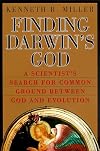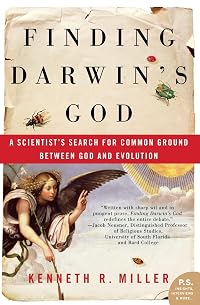
Finding Darwin's God: A Scientist's Search for Common Ground Between God and Evolution
by Kenneth R. Miller
On This Page
Description
Focusing on the ground-breaking and often controversial science of Charles Darwin, the author seeks to bridge the gulf between science and religion on the subject of human evolution.Tags
Recommendations











Member Reviews
Although this isn't meant as an introduction to the current evolution/intelligent design debate, it suffices nicely, with a lively, non-confrontational tone. Miller does an excellent job outlining the current state of evolutionary theory, and an unequivocal job eviscerating the assault by young earth creationists and their disavowed bretheren the Intelligent Design movement. Being a molecular design biologist, Miller takes extra care refuting Michael Behe's "Darwin's Black Box", during which time he may veer a little too far into the extremes of enzymes for the lay reader's taste. Otherwise, very well done and engaging presentation. In the latter third of the book, Miller, a devout Catholic, works very hard to reconcile his faith with show more what he concedes is compelling and truthful science. Where he ends up, depending on your point of view, is a position of peace, or perhaps yet another incarnation of the "god of the gaps" cosmology. I found Miller's sincerity and tone to be always engaging, and it is certain that he, and perhaps others, can find a place for faith in the face of their own well-reasoned scientific stance. He may not have convinced me, but I think we'd get along at a backyard barbeque. show less
Finding Darwin’s God by Kenneth R. Miller does an excellent job of showing the people with a fish on their cars that they can have their god and science, too. That’s the first half of the book–-pointing out the flaws in the various Creationist arguments. The second half is supposed to be aimed at nonbelievers, I think, but his arguments then fall apart. He does make some excellent points about the main problems in the arguments from atheists, though, which made me examine the reasons for my own beliefs more closely.
One of his points that I found most interesting was that science and religion answer different questions–science offers explanations of how we’re here and religion handles the why. I hadn’t thought about it in show more that way, but it’s a fair point. (Unfortunately, some religious people would say they were put here to make nonreligious people crazy–as well as the people who don’t follow their own religion.) And I still think any person with half a brain should be able to figure out that life is less stressful if you’re not an asshole. Miller argues that if it were possible to argue the majority of people out of their religion then pandemonium would reign. Now, I want to give people credit for not being stupid but… yeah, he’s probably right. Some people will always need a supernatural boogieman to keep them in line.
My big problem with Creationists was that I couldn’t figure out why they didn’t just say, ‘God created evolution. Isn’t he clever?’ Which is Miller’s premise. He then goes to explain how that could be possible and how the god that did that would be much more interesting than a god who did everything in one day (or seven). One of my favourite bits was when he said that once a woman told him she didn’t believe in evolution because it would have taken too long and Miller thought, “Because god, with all of eternity, was in a rush.”
My other favourite part was when he referenced St Augustine (a 4th theologian) who begged Christians not to stand up in public and make fools of themselves about science because that only made all Christians look stupid. I’m thinking of quoting that bit to the next Bible-thumper who says the Earth is flat or what-have-you.
I was lucky enough to have lunch with Mr Miller after reading his book and I thanked him for at least giving us a way to get along. As much as I admire Richard Dawkins, I don’t think that doing away with religion would do away with all the horrible things on the planet–even without a god on their side jackholes would still be jackholes. There would still be wars over land and money and all those fun things, the only difference would be that the war-makers would have one less thing to use against their enemies. But you can turn a group of strangers into arch-nemeses without invoking their mythologies by simply pointing out all the other ways they’re different from you and yours. Yes, it’d be nice for everyone to be completely rational–I’d like to be more rational about some things–but I’d settle for people just not being jerks. Miller makes a step toward that on at least this one issue. show less
One of his points that I found most interesting was that science and religion answer different questions–science offers explanations of how we’re here and religion handles the why. I hadn’t thought about it in show more that way, but it’s a fair point. (Unfortunately, some religious people would say they were put here to make nonreligious people crazy–as well as the people who don’t follow their own religion.) And I still think any person with half a brain should be able to figure out that life is less stressful if you’re not an asshole. Miller argues that if it were possible to argue the majority of people out of their religion then pandemonium would reign. Now, I want to give people credit for not being stupid but… yeah, he’s probably right. Some people will always need a supernatural boogieman to keep them in line.
My big problem with Creationists was that I couldn’t figure out why they didn’t just say, ‘God created evolution. Isn’t he clever?’ Which is Miller’s premise. He then goes to explain how that could be possible and how the god that did that would be much more interesting than a god who did everything in one day (or seven). One of my favourite bits was when he said that once a woman told him she didn’t believe in evolution because it would have taken too long and Miller thought, “Because god, with all of eternity, was in a rush.”
My other favourite part was when he referenced St Augustine (a 4th theologian) who begged Christians not to stand up in public and make fools of themselves about science because that only made all Christians look stupid. I’m thinking of quoting that bit to the next Bible-thumper who says the Earth is flat or what-have-you.
I was lucky enough to have lunch with Mr Miller after reading his book and I thanked him for at least giving us a way to get along. As much as I admire Richard Dawkins, I don’t think that doing away with religion would do away with all the horrible things on the planet–even without a god on their side jackholes would still be jackholes. There would still be wars over land and money and all those fun things, the only difference would be that the war-makers would have one less thing to use against their enemies. But you can turn a group of strangers into arch-nemeses without invoking their mythologies by simply pointing out all the other ways they’re different from you and yours. Yes, it’d be nice for everyone to be completely rational–I’d like to be more rational about some things–but I’d settle for people just not being jerks. Miller makes a step toward that on at least this one issue. show less
Kenneth Miller, a professor of biology at Brown University, has made a name for himself in communities that are deeply concerned with the intersection of religion and science, both on the atheist/skeptical side and the religious side. He successfully manages to irritate both camps because he says that supporting evolution and deistic belief are not necessarily contradictory. (Miller is a Catholic.) This shouldn’t be too controversial of a statement for someone who has thought about the issue for more than a few minutes, but it still seems to disconcert people.
“Finding Darwin’s God: A Scientist’s Search for Common Ground Between God and Evolution” works in some ways, but it is not what it is advertised to be. Judging from the show more title alone, you might guess that it involves a lot of digging through Darwin’s papers for his (non)religious inclinations, and to be fair we do get a very small amount of this. It will probably come as no surprise that Darwin was at different times throughout his life more conflicted and sometimes less conflicted about the existence of a Christian God, or even the God of deism. Earlier in his career, he was very convinced by the arguments of renowned eighteenth-century English scientist William Paley’s watchmaker analogy set forth in his “Natural Theology,” but seemed to become more skeptical as the publication of “Origin of Species” approached, and certainly toward the end of his life.
First, the part of the book that I wasn’t expecting: approximately the first two-thirds of this book is dedicated to demolishing creationist “science” (not really science at all), and particularly youth earth creationism. I realize the continuing need for popularizing science education, but I was more interested in the “Finding Darwin’s God” angle than a re-hashing of basic high school biology and chemistry which we all *supposed* to have learned. Even though this part of the book was a slog, he was extraordinarily thorough. He shows how a literal interpretation of Genesis no longer makes any sense considering what we know about morphology, radioactive dating, and the fossil record. He also equips someone who might be less familiar with pro-evolution arguments with examples, including the biochemical details of the blood clotting cascade and the development of the eukaryotic cilium. There is also a wonderful part of the book that explains how Gould’s punctuated equilibrium only exists as a different-looking phenomenon when you use shortened geological time scales, and that when you re-elongate these scales, you get the evolutionary tree of common descent that would have been more recognizable to Darwin himself. These couple of hundred pages were largely designed to arm the non-biologist with technical arguments to combat creationist nonsense, and they do a fine job.
The last two chapters are where Miller finally starts to explore the possible arguments for God. None of his arguments are convincing. He even says a couple of things that are embarrassing for a scientist of his caliber, like when he wanders into the field of cosmology: “…when one makes a run backwards in time to the moment before the big bang, one must imagine inconceivable amounts of mass and energy concentrated at a single point in space” (p. 225). Except that even talking about “before the big bang” makes no sense, since that very event is what created space and time as we know it. There was no time before the big bang that we know of. It’s like talking about cakes before the time of baking. It seems that he might be trying to raise the question of what allowed the big bang to occur. A great question, and we have the greatest minds in science working on it. The current answer? We don’t know.
A bit later, Miller delves into the miraculous: “What can science say about a miracle? Nothing. By definition, the miraculous is beyond explanation, beyond our understanding, beyond science. This does not mean that miracles do not occur. A key doctrine in my own faith is that Jesus was born of a virgin, even though it makes no scientific sense – there is the matter of Jesus’s Y-chromosome to account for. But that is the point. Miracles, by definition, do not have to make scientific sense” (p. 239). This truly is a disappointing argument from someone who just spent two-hundred pages arguing against creationism because it *doesn’t make scientific sense*. One of the points of science is to try to build heuristic models that explain the universe around us, or some aspect of that universe, that account for the most observable data. We must either reject or be agnostic about those phenomena which cannot be assimilated into these models.
Miller sometimes waxes philosophical, with about as much success. On God’s eternality: “This means that God, who always has been and always will be, transcends time and therefore is the master of it” (p. 242). I realize this is a stock-in-trade argument from classical Christian theology, but it is fundamentally flawed: something cannot exist outside of time because time is a predicate of existence. To exist means to have *come into existence*. The popular formulation of this argument is when a theist asks an atheist “What caused the big bang?” and the atheist responds “What caused God?” If you’re operating under the assumption that everything needs a cause, as classical Christian theology does, saying that God is an exception to your own rule isn’t going to work. It’s a logical fallacy called special pleading.
So, why does Kenneth Miller believe in God? One reason is his acceptance of the God of the Gaps arguments; he seems to be perplexed by the fact that we don’t have all of cosmology explained away. The second is his peculiar interpretation of quantum mechanics. He thinks that the random events of quantum mechanics and the simultaneous orderliness of the universe have something to with a God, though he never comes out and explicitly states it, and never clarifies how the indeterminacy of quantum mechanics would provide evidence for God.
What kind of God does Miller believe in? In the closing lines of the book, he quotes Darwin: “There is grandeur in this view of life; with its several powers having been originally breathed by the Creator into a few forms or into one; and that, whilst this planet has gone cycling on according to the fixed law of gravity, from so simple a beginning endless forms most wonderful and most beautiful have been, and are being evolved” (p. 292). This is awe-filled Darwin at his most wondrous. However, even when Darwin indulged these sentiments, this is clearly the God of deism: a world set into motion by a distant, non-personal God who created natural laws and then let happen what may. It doesn’t at all comport with the fundamental tenets of the Catholic Church (the virgin birth, the assumption, et cetera) in which Miller claims to believe.
Darwin’s God wasn’t the God of miracles, and therefore isn’t Miller’s God. He was the God of reverence for the mysteries of the universe, which have been slowly decreasing in number since the rise of modern science. This number will never reach zero; there will always be something new to learn, and science will never disappear. But looking for God in the unexplained nooks and crannies of science leaves a smaller and smaller place for Him/Her/It with each passing year, and this seems to be a theological approach in danger of having God slip through its very fingers. show less
“Finding Darwin’s God: A Scientist’s Search for Common Ground Between God and Evolution” works in some ways, but it is not what it is advertised to be. Judging from the show more title alone, you might guess that it involves a lot of digging through Darwin’s papers for his (non)religious inclinations, and to be fair we do get a very small amount of this. It will probably come as no surprise that Darwin was at different times throughout his life more conflicted and sometimes less conflicted about the existence of a Christian God, or even the God of deism. Earlier in his career, he was very convinced by the arguments of renowned eighteenth-century English scientist William Paley’s watchmaker analogy set forth in his “Natural Theology,” but seemed to become more skeptical as the publication of “Origin of Species” approached, and certainly toward the end of his life.
First, the part of the book that I wasn’t expecting: approximately the first two-thirds of this book is dedicated to demolishing creationist “science” (not really science at all), and particularly youth earth creationism. I realize the continuing need for popularizing science education, but I was more interested in the “Finding Darwin’s God” angle than a re-hashing of basic high school biology and chemistry which we all *supposed* to have learned. Even though this part of the book was a slog, he was extraordinarily thorough. He shows how a literal interpretation of Genesis no longer makes any sense considering what we know about morphology, radioactive dating, and the fossil record. He also equips someone who might be less familiar with pro-evolution arguments with examples, including the biochemical details of the blood clotting cascade and the development of the eukaryotic cilium. There is also a wonderful part of the book that explains how Gould’s punctuated equilibrium only exists as a different-looking phenomenon when you use shortened geological time scales, and that when you re-elongate these scales, you get the evolutionary tree of common descent that would have been more recognizable to Darwin himself. These couple of hundred pages were largely designed to arm the non-biologist with technical arguments to combat creationist nonsense, and they do a fine job.
The last two chapters are where Miller finally starts to explore the possible arguments for God. None of his arguments are convincing. He even says a couple of things that are embarrassing for a scientist of his caliber, like when he wanders into the field of cosmology: “…when one makes a run backwards in time to the moment before the big bang, one must imagine inconceivable amounts of mass and energy concentrated at a single point in space” (p. 225). Except that even talking about “before the big bang” makes no sense, since that very event is what created space and time as we know it. There was no time before the big bang that we know of. It’s like talking about cakes before the time of baking. It seems that he might be trying to raise the question of what allowed the big bang to occur. A great question, and we have the greatest minds in science working on it. The current answer? We don’t know.
A bit later, Miller delves into the miraculous: “What can science say about a miracle? Nothing. By definition, the miraculous is beyond explanation, beyond our understanding, beyond science. This does not mean that miracles do not occur. A key doctrine in my own faith is that Jesus was born of a virgin, even though it makes no scientific sense – there is the matter of Jesus’s Y-chromosome to account for. But that is the point. Miracles, by definition, do not have to make scientific sense” (p. 239). This truly is a disappointing argument from someone who just spent two-hundred pages arguing against creationism because it *doesn’t make scientific sense*. One of the points of science is to try to build heuristic models that explain the universe around us, or some aspect of that universe, that account for the most observable data. We must either reject or be agnostic about those phenomena which cannot be assimilated into these models.
Miller sometimes waxes philosophical, with about as much success. On God’s eternality: “This means that God, who always has been and always will be, transcends time and therefore is the master of it” (p. 242). I realize this is a stock-in-trade argument from classical Christian theology, but it is fundamentally flawed: something cannot exist outside of time because time is a predicate of existence. To exist means to have *come into existence*. The popular formulation of this argument is when a theist asks an atheist “What caused the big bang?” and the atheist responds “What caused God?” If you’re operating under the assumption that everything needs a cause, as classical Christian theology does, saying that God is an exception to your own rule isn’t going to work. It’s a logical fallacy called special pleading.
So, why does Kenneth Miller believe in God? One reason is his acceptance of the God of the Gaps arguments; he seems to be perplexed by the fact that we don’t have all of cosmology explained away. The second is his peculiar interpretation of quantum mechanics. He thinks that the random events of quantum mechanics and the simultaneous orderliness of the universe have something to with a God, though he never comes out and explicitly states it, and never clarifies how the indeterminacy of quantum mechanics would provide evidence for God.
What kind of God does Miller believe in? In the closing lines of the book, he quotes Darwin: “There is grandeur in this view of life; with its several powers having been originally breathed by the Creator into a few forms or into one; and that, whilst this planet has gone cycling on according to the fixed law of gravity, from so simple a beginning endless forms most wonderful and most beautiful have been, and are being evolved” (p. 292). This is awe-filled Darwin at his most wondrous. However, even when Darwin indulged these sentiments, this is clearly the God of deism: a world set into motion by a distant, non-personal God who created natural laws and then let happen what may. It doesn’t at all comport with the fundamental tenets of the Catholic Church (the virgin birth, the assumption, et cetera) in which Miller claims to believe.
Darwin’s God wasn’t the God of miracles, and therefore isn’t Miller’s God. He was the God of reverence for the mysteries of the universe, which have been slowly decreasing in number since the rise of modern science. This number will never reach zero; there will always be something new to learn, and science will never disappear. But looking for God in the unexplained nooks and crannies of science leaves a smaller and smaller place for Him/Her/It with each passing year, and this seems to be a theological approach in danger of having God slip through its very fingers. show less
I admire Kenneth Miller, he is walking on a very thin rope stretching across a deep chasm. All the while he is fencing with two different, opposing, enemies. In short, he is courageous.
My family is a very Catholic family. I studied in Catholic schools under nuns and Jesuits. Yet I’d never for once doubted or think twice about evolution. I – and a lot of people around me – accept it as a fact. The priests taught us that the Bible is a compilation of experiences of people of a long time ago, when science was not as advanced as now. Imagine the surprise when I found out that there are people who think that evolution is a fake. Those creationists must be joking. But, apparently out there, there are a lot of people who think that show more it’s Darwin instead who is a joker.
Miller’s first attack was aimed at these people. First he explains evolution and the science of biology. Then he devoted the next chapter ‘God the Charlatan’ to attack the young-earth creationists, those people who choose to ignore all scientific evidence showing that earth is billions year old, and accept the Bible literally instead, believing the earth is no older than 10,000 year old. In the ‘God the Magician’ chapter he fights those who do not think that there is evidence of evolution from fossil and that all living things are designed by an intelligent being instead. The title came from these creationists’ believe that species just pop up from nowhere, like if God is a magician. In ‘God the Mechanic’ he argues brilliantly against those who do not accept evolution on the basis that a lot of life and living things are irreducibly complex.
Then in ‘God of Disbelief’ chapter he begins to attack the other side – those scientists who do not accept God and religion, saying that it is their severe attack on God and religion that has made anti-evolutionists more defensive and alienate them further. In the next two chapters he explores science to see where religion, believe and God can fit. He looks at quantum theory and postulate that the indeterminate nature of quantum material could be one of those areas where God materialise Himself.
Miller’s God is not that of the deists. His God cares about people and still actively involves in life. It is therefore not strange for him to pray to this God. Yet, his God is not the god of the creationists, because his God follows the law of nature that He creates.
Miller, a Roman Catholic biology professor, is a good author. He’s also a prominent figure in the field of biology. His explanation of evolution is clear and concise. He’s definitely thought long and hard about the reconciliation between science and religion. He researched the subject thoroughly; the bibliography is extensive.
Will Miller’s book sway people, both from the creationist group and the non-believer group into believing evolutionists like him? I doubt it. However this book will definitely help those who are like him, are searching for the common ground between science and religion. show less
My family is a very Catholic family. I studied in Catholic schools under nuns and Jesuits. Yet I’d never for once doubted or think twice about evolution. I – and a lot of people around me – accept it as a fact. The priests taught us that the Bible is a compilation of experiences of people of a long time ago, when science was not as advanced as now. Imagine the surprise when I found out that there are people who think that evolution is a fake. Those creationists must be joking. But, apparently out there, there are a lot of people who think that show more it’s Darwin instead who is a joker.
Miller’s first attack was aimed at these people. First he explains evolution and the science of biology. Then he devoted the next chapter ‘God the Charlatan’ to attack the young-earth creationists, those people who choose to ignore all scientific evidence showing that earth is billions year old, and accept the Bible literally instead, believing the earth is no older than 10,000 year old. In the ‘God the Magician’ chapter he fights those who do not think that there is evidence of evolution from fossil and that all living things are designed by an intelligent being instead. The title came from these creationists’ believe that species just pop up from nowhere, like if God is a magician. In ‘God the Mechanic’ he argues brilliantly against those who do not accept evolution on the basis that a lot of life and living things are irreducibly complex.
Then in ‘God of Disbelief’ chapter he begins to attack the other side – those scientists who do not accept God and religion, saying that it is their severe attack on God and religion that has made anti-evolutionists more defensive and alienate them further. In the next two chapters he explores science to see where religion, believe and God can fit. He looks at quantum theory and postulate that the indeterminate nature of quantum material could be one of those areas where God materialise Himself.
Miller’s God is not that of the deists. His God cares about people and still actively involves in life. It is therefore not strange for him to pray to this God. Yet, his God is not the god of the creationists, because his God follows the law of nature that He creates.
Miller, a Roman Catholic biology professor, is a good author. He’s also a prominent figure in the field of biology. His explanation of evolution is clear and concise. He’s definitely thought long and hard about the reconciliation between science and religion. He researched the subject thoroughly; the bibliography is extensive.
Will Miller’s book sway people, both from the creationist group and the non-believer group into believing evolutionists like him? I doubt it. However this book will definitely help those who are like him, are searching for the common ground between science and religion. show less
This book is absolutely perfect - for the first half. The author does a wonderful job of explaining evolution and the evidence, but then in the second half of the book, when he feels the need to explain his continued belief in God, most of his arguments become much more like desperate pleading and fall flat on their face. Having just spent half the book effectively arguing against a God of the Gaps argument, the author resorts to what is essentially a God of the Gaps argument to justify his own belief. Read the first half, but spare the author by leaving the second half on the shelf. He is too smart for the argument he made there.
This treatise is a great attempt to reconcile religion and science. Dr. Miller makes an elegant argument that religion and science don't have to be opposed to one other. Miller does an excellent job of showing how modern evolutionary theory can fit within a non-literalist interpretation of someone’s faith. All the while Miller destroys the various creation myths and Intelligent Design “theories “with good science, but he also makes theological arguments as to how those theories are incompatible with faith or non-faith. Never once did the book become overly preachy or condescending.
While I disagree with the tenant that religion and science are not in opposition, I do agree that science and faith can co-exist; and lead to important show more discoveries about our place in the universe. show less
While I disagree with the tenant that religion and science are not in opposition, I do agree that science and faith can co-exist; and lead to important show more discoveries about our place in the universe. show less
This book can best be described as split into three parts. The first is a really fantastic refutal of so-called creation science, intelligent design, and other supposedly scientific alternatives to evolution that are primarily motivated by religion. Miller is a very competent scientist and presents his arguments and information in an easy to understand but still in-depth manner, with no small amount of wit and good humor. Any readers still harboring doubts as to the falsehood of the alleged alternatives to evolution should accept that they are a lot of hogwash by page 112.
After settling the fact that evolution is true, Miller goes into a discussion on the nature of the modern debate between religion and evolution from both points of show more view. It was very refreshing to not only see the objections members of the religious sphere have with scientists, but the many biting dismissals that some prominent scientists have of religion of all stripes.
The final segment is really Miller's thesis, his personal reconciliation between his science and his very real faith in God. He presents a world view where the two are in no way conflicted, and in which it should be easy for a person to believe in the Creator and the atom. As a non-religious person, I found this last segment occasionally tedious and far fetched, but then again I am not his audience at that point.
At times, this work seems to lose itself in information, anecdotes, and stray ideas, some of which can become alienating to those who do not agree with Dr. Miller's faith. None the less, it is a powerful work in the debate, and well worth picking up even if you have to stop half-way through. In a way, there's a little something for everyone. show less
After settling the fact that evolution is true, Miller goes into a discussion on the nature of the modern debate between religion and evolution from both points of show more view. It was very refreshing to not only see the objections members of the religious sphere have with scientists, but the many biting dismissals that some prominent scientists have of religion of all stripes.
The final segment is really Miller's thesis, his personal reconciliation between his science and his very real faith in God. He presents a world view where the two are in no way conflicted, and in which it should be easy for a person to believe in the Creator and the atom. As a non-religious person, I found this last segment occasionally tedious and far fetched, but then again I am not his audience at that point.
At times, this work seems to lose itself in information, anecdotes, and stray ideas, some of which can become alienating to those who do not agree with Dr. Miller's faith. None the less, it is a powerful work in the debate, and well worth picking up even if you have to stop half-way through. In a way, there's a little something for everyone. show less
Members
- Recently Added By
Lists

Ideas for "Science, Religion, and History" group reads
29 works; 9 members
Author Information

29 Works 1,516 Members
Kenneth R. Miller is professor of biology at Brown University and the critically acclaimed bestselling author of Only a Theory, Finding Darwin's God. Among his honors are the Stephen Jay Could Prize from the Society for the Study of Evolution, the Laetare Medal from the University of Notre Dame, and the Award for Public Engagement with Science show more from the American Association for the Advancement of Science. show less
Classifications
Statistics
- Members
- 830
- Popularity
- 33,296
- Reviews
- 17
- Rating
- (4.05)
- Languages
- English
- Media
- Paper
- ISBNs
- 3
- ASINs
- 7