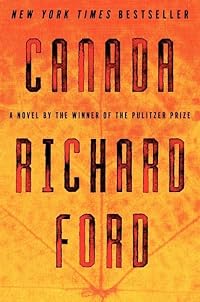
Canada
by Richard Ford
On This Page
Description
After his parents are arrested and imprisoned for robbing a bank, fifteen-year-old Dell Parsons is taken in by Arthur Remlinger who, unbeknownst to Dell, is hiding a dark and violent nature that interferes with Dell's quest to find grace and peace on the prairie of Saskatchewan.Tags
Recommendations



















Member Reviews
The first two sentences of Richard Ford’s Canada are, I suspect, destined to be among the most quoted of 2012. Even so, I cannot resist using them here, too, because they are the perfect opening for the book:
“First, I’ll tell you about the robbery our parents committed. Then about the murders, which happened later.”
These words are spoken by 65-year-old Dell Parsons, the book’s narrator, as he considers the fifteen-year old boy he was in 1960 just before his parents made the stupid decision that would almost destroy him and Berner, his twin sister. The Parsons had been transferred to Montana by the U.S. Air Force, but now Dell’s father is a civilian, and having decided that Great Falls is a good place to raise his family, show more Bev Parsons is struggling to find a job that will allow him to do that. To young Dell, nothing is more important than the fast-approaching start of his freshman year in the town’s public high school. Up to now, the twins have been encouraged not to develop ties to the places they pass through with the Air Force, so Dell is eager to transform Great Falls into the hometown he has never known.
But when Dell’s parents are arrested for a North Dakota bank robbery, his hopes of finally settling down and making long term friends are destroyed before he can even set foot in his new school. Dell and Berner are surprised to find themselves, at least temporarily, forgotten by the legal system that has both their parents locked tight in the city jail. After Berner, the worldly twin, strikes out on her own, his mother’s only friend agrees to deliver Dell to her brother in the remote prairies of Saskatchewan in order to keep him from falling into the hands of Montana juvenile authorities.
There, still a very naïve child at fifteen, Dell falls under the control and influence of two men who will further destroy his sense of who he is. Charlie Quarters, the Leonard Hotel’s strange, half-breed hunting guide into whose charge Dell is delivered, will use him as an extra pair of hands. Arthur Remlinger, an American hiding out in Canada for reasons of his own, is the hotel’s owner. Unfortunately for Dell, Remlinger, a sociopath of sorts, will never be the father figure he needs so badly, and will, instead, almost finish the job of destroying his life.
Canada is a character-driven novel with the plot of a crime thriller, a literary novel that will keep the reader turning pages. Throughout his narrative, Dell Parsons gives intriguing little hints that all is not as it seems and that he should have figured things out sooner than he did. Ford’s characters are so well developed that even their most bizarre actions are believable in the context of who the reader knows them to be. With perhaps one exception (Charlie Quarters), there are no black and white characters in Canada. Each has a distinct set of strengths, weaknesses, and motivations that allows them to be sucked into whatever happens around them.
Canada is about borders – literal ones and symbolic ones – and what they really mean. The lesson for Dell Parsons is that once some borders are crossed, they are crossed forever. There is no going back.
Rated at: 5.0 show less
“First, I’ll tell you about the robbery our parents committed. Then about the murders, which happened later.”
These words are spoken by 65-year-old Dell Parsons, the book’s narrator, as he considers the fifteen-year old boy he was in 1960 just before his parents made the stupid decision that would almost destroy him and Berner, his twin sister. The Parsons had been transferred to Montana by the U.S. Air Force, but now Dell’s father is a civilian, and having decided that Great Falls is a good place to raise his family, show more Bev Parsons is struggling to find a job that will allow him to do that. To young Dell, nothing is more important than the fast-approaching start of his freshman year in the town’s public high school. Up to now, the twins have been encouraged not to develop ties to the places they pass through with the Air Force, so Dell is eager to transform Great Falls into the hometown he has never known.
But when Dell’s parents are arrested for a North Dakota bank robbery, his hopes of finally settling down and making long term friends are destroyed before he can even set foot in his new school. Dell and Berner are surprised to find themselves, at least temporarily, forgotten by the legal system that has both their parents locked tight in the city jail. After Berner, the worldly twin, strikes out on her own, his mother’s only friend agrees to deliver Dell to her brother in the remote prairies of Saskatchewan in order to keep him from falling into the hands of Montana juvenile authorities.
There, still a very naïve child at fifteen, Dell falls under the control and influence of two men who will further destroy his sense of who he is. Charlie Quarters, the Leonard Hotel’s strange, half-breed hunting guide into whose charge Dell is delivered, will use him as an extra pair of hands. Arthur Remlinger, an American hiding out in Canada for reasons of his own, is the hotel’s owner. Unfortunately for Dell, Remlinger, a sociopath of sorts, will never be the father figure he needs so badly, and will, instead, almost finish the job of destroying his life.
Canada is a character-driven novel with the plot of a crime thriller, a literary novel that will keep the reader turning pages. Throughout his narrative, Dell Parsons gives intriguing little hints that all is not as it seems and that he should have figured things out sooner than he did. Ford’s characters are so well developed that even their most bizarre actions are believable in the context of who the reader knows them to be. With perhaps one exception (Charlie Quarters), there are no black and white characters in Canada. Each has a distinct set of strengths, weaknesses, and motivations that allows them to be sucked into whatever happens around them.
Canada is about borders – literal ones and symbolic ones – and what they really mean. The lesson for Dell Parsons is that once some borders are crossed, they are crossed forever. There is no going back.
Rated at: 5.0 show less
The Short of It:
The anatomy of a crime, as told by one of the characters most affected by it.
The Rest of It:
"First, I’ll tell about the robbery our parents committed. Then about the murders, which happened later. The robbery is the more important part, since it served to set my and my sister’s lives on the courses they eventually followed. Nothing would make complete sense without that being told first." (First lines of Canada)
Those opening lines set the stage for Dell’s story. His parents, struggling to make a life for themselves in Great Falls, Montana, rob a bank after getting involved in an illegal business deal. Their hope, is to pay off their debt and begin again. What Bev Parsons does not know, is that his wife Neeva show more sees this criminal act as a way to escape a lifetime with the man she married. Dell and his sister Berner are left to a family friend who has plans to get them out of the country. But as twins, and only fifteen, they are not sure what to make of the things happening around them.
What a book. I’ve never read Richard Ford before but when my book club picked it for January I had to give it a try. It’s not a book a reader can love. The story is too bleak for that, but I did appreciate the languid writing. Some of the members in the group compared Ford to Richard Russo and I agree. His writing reminded me a lot of Russo.
Many of the details shared are “day in the life” type details but at the same time, Ford uses foreshadowing to string the reader along. It works. I read these 400+ pages in two sittings. Telling the story from Dell’s sheltered perspective is somewhat limiting at times, but his wide-eyed wonder at the things going on around him made him vulnerable which lent the story a fragile, precarious quality.
What I most enjoyed, is the discussion that took place afterward. It’s hard to imagine what drives people to do the things they do, but it was fun to discuss it. Dell’s parents were never normal, in the traditional sense of the word. They kept their kids sheltered, were not successful in any way and tried to remain under the radar. Living in that small town, they managed to avoid most of their neighbors and didn’t seem to know how to interact with the people around them, or each other. This should have helped them in the end, but it’s really what did them in.
Ford can tell a tale and his sense of place is strong here. I enjoyed his style of writing so much, that I will be sure to seek out his other books. Have you read any of his books?
For more reviews, visit my blog: Book Chatter. show less
The anatomy of a crime, as told by one of the characters most affected by it.
The Rest of It:
"First, I’ll tell about the robbery our parents committed. Then about the murders, which happened later. The robbery is the more important part, since it served to set my and my sister’s lives on the courses they eventually followed. Nothing would make complete sense without that being told first." (First lines of Canada)
Those opening lines set the stage for Dell’s story. His parents, struggling to make a life for themselves in Great Falls, Montana, rob a bank after getting involved in an illegal business deal. Their hope, is to pay off their debt and begin again. What Bev Parsons does not know, is that his wife Neeva show more sees this criminal act as a way to escape a lifetime with the man she married. Dell and his sister Berner are left to a family friend who has plans to get them out of the country. But as twins, and only fifteen, they are not sure what to make of the things happening around them.
What a book. I’ve never read Richard Ford before but when my book club picked it for January I had to give it a try. It’s not a book a reader can love. The story is too bleak for that, but I did appreciate the languid writing. Some of the members in the group compared Ford to Richard Russo and I agree. His writing reminded me a lot of Russo.
Many of the details shared are “day in the life” type details but at the same time, Ford uses foreshadowing to string the reader along. It works. I read these 400+ pages in two sittings. Telling the story from Dell’s sheltered perspective is somewhat limiting at times, but his wide-eyed wonder at the things going on around him made him vulnerable which lent the story a fragile, precarious quality.
What I most enjoyed, is the discussion that took place afterward. It’s hard to imagine what drives people to do the things they do, but it was fun to discuss it. Dell’s parents were never normal, in the traditional sense of the word. They kept their kids sheltered, were not successful in any way and tried to remain under the radar. Living in that small town, they managed to avoid most of their neighbors and didn’t seem to know how to interact with the people around them, or each other. This should have helped them in the end, but it’s really what did them in.
Ford can tell a tale and his sense of place is strong here. I enjoyed his style of writing so much, that I will be sure to seek out his other books. Have you read any of his books?
For more reviews, visit my blog: Book Chatter. show less
I think a lot of readers might complain that Richard Ford's "Canada" is, well, a lot like a lot of other novels. It's a coming of age tale set in the big, wide-open American West and, later, the location indicated by the title. We get lots of descriptions of the flat, empty plains and the big big blue sky and, though a series of events, both ordinary and extraordinary, our narrator, Dell Parsons grows from boyhood to manhood. As might be expected of a novel set in a time-frame that is still fairly accessible to us (the late fifites) and in rather unexciting small Western towns, Ford's focus (ha ha!) is on the small stuff. His eye is drawn to detail, and his narrator, who admits that he's cursed with a good memory, recalls half-buried show more mental strategems and fleeting assumptions from most of a lifetime ago. This book isn't without it's share of action, but few readers would call it exciting.
There's another side to the text, though, that's a bit more adventurous. Dell's the product of a friendly, open Alabama military man and the introverted daughter of Polish Jewish immigrants. Dell doesn't have too many thoughts about his Jewish heritage, but still muses on assimilation: how do you become part of a place? How do you become a person like other people? How does this relate to the process of maturation and of becoming an adult? In fact, the assimilation that goes on here concerns Dell's journey from the American Great Plains to the Canadian West -- which, for some writers, and, perhaps even for some residents of those places -- would seem hardly worth mentioning. But, then again, Ford's drawn to the small stuff, and he's able to use these seemingly small geographical shifts as a jumping-off points for a larger discourse about what belonging and separateness might mean.
I was also impressed by Ford's evocation of childhood. Ford shows that Dell's experience as a boy of fifteen who lives in Great Falls, Montana but has failed to integrate with the town's residents in any significant way is exceptionally limited, and the events that destabilize his expected progression constitute a sort of exploring of a larger world. But Ford's also a perceptive enough writer to know that people Dell's age can be immature and mature at the same time, simultaneously wary and trusting. There's no definitive before-and-after for Dell: his development isn't always evenly paced, and the most shocking events in the novel aren't necessarily the ones that change him most. Ford seems to understand how tricky growing up can be and how amorphous young people can be at that age, too. I didn't love this one, but it's the sort of novel that I'd recommend to teachers and to those who spend their working lives among young people who are still in the process of sorting themselves out. I expect that most actual fifteen year-olds won''t have the patience for it, though. show less
There's another side to the text, though, that's a bit more adventurous. Dell's the product of a friendly, open Alabama military man and the introverted daughter of Polish Jewish immigrants. Dell doesn't have too many thoughts about his Jewish heritage, but still muses on assimilation: how do you become part of a place? How do you become a person like other people? How does this relate to the process of maturation and of becoming an adult? In fact, the assimilation that goes on here concerns Dell's journey from the American Great Plains to the Canadian West -- which, for some writers, and, perhaps even for some residents of those places -- would seem hardly worth mentioning. But, then again, Ford's drawn to the small stuff, and he's able to use these seemingly small geographical shifts as a jumping-off points for a larger discourse about what belonging and separateness might mean.
I was also impressed by Ford's evocation of childhood. Ford shows that Dell's experience as a boy of fifteen who lives in Great Falls, Montana but has failed to integrate with the town's residents in any significant way is exceptionally limited, and the events that destabilize his expected progression constitute a sort of exploring of a larger world. But Ford's also a perceptive enough writer to know that people Dell's age can be immature and mature at the same time, simultaneously wary and trusting. There's no definitive before-and-after for Dell: his development isn't always evenly paced, and the most shocking events in the novel aren't necessarily the ones that change him most. Ford seems to understand how tricky growing up can be and how amorphous young people can be at that age, too. I didn't love this one, but it's the sort of novel that I'd recommend to teachers and to those who spend their working lives among young people who are still in the process of sorting themselves out. I expect that most actual fifteen year-olds won''t have the patience for it, though. show less
After hesitating to try it at all (comparisons of Ford to John Updike really put me off), and then being disinfected* by some style issues in the first few chapters, I found myself totally engrossed with this novel, in which Dell Parsons, from a perspective of 50 years hence, tells us about a presumably formative period of his life--the year he was almost 16, when his parents, by stupidly attempting to rob a bank, effectively abandoned Dell and his twin sister, Berner. In order to prevent her children's ending up in the hands of the juvenile authorities in the event of her arrest (which she seems to have had wits enough to realize was inevitable), Mrs. Parsons arranged for a friend to spirit them away to Canada where presumably they show more could start life over without the inconvenient baggage of convicted bank robbers for parents. Berner had other ideas, but Dell ended up under the dubious protection of a big fish in the mighty small pond of Fort Royal, Saskatchewan, a place where nothing much happened other than goose hunting, and where he had plenty of time to ponder questions that had already started to bother him: does a man's character show in his face? are you destined to be who you become by some fundamental element of your makeup? does it really matter what happens to you, or will you become your true self regardless? It's a quiet journey Dell takes, despite a bit of violence here and there, and ultimately he believes he ended up precisely where he would have, had his parents gone on with their "ordinary" lives, sent him to college and never dreamed of robbing a bank or sending him off to be fostered by strangers in a strange land. I'm not sure when I stopped minding Ford's style, or if he dropped the awkward quirks that broke my reading stride early on, but by page 75 or so, I was just caught in the story, and that part of my brain that is aware of the author was sound asleep in a corner somewhere. I'm docking the novel 1/2 a star for the rocky start, although that may have been my own fault. I am very glad to have made Richard Ford's acquaintance, and am happy to say I find him much more in affinity with John Irving (Last Night in Twisted River came to mind) than with Updike.
*cf Bucky Katt
Review written March 2015 show less
*cf Bucky Katt
Review written March 2015 show less
Is a man born a bank robber? Is he born a murderer? And if not, at what point does he become a bank robber or a murderer, such that in describing him we might, rightly, note that his bank robbery or the murders he commits were there in him all along? That transition, the border between what might be and what is, fascinates the narrator of Canada as he looks back over 50 years to his life as a fifteen year old boy in Great Falls, Montana. Dell and his twin sister Berner are the children of Neeva and Bev Parsons, who, in the course of a very few days transform themselves from ineffectual parents to ineffectual bank robbers. Dell struggles to see where or when precisely the transformation took place. It is almost a metaphysical show more transformation, something abstract, yet with real consequences. Those consequences include further transformations for Dell and Berner and their flight from Great Falls – west for Berner on her own, and north to Canada for Dell where he will learn that having bank robbers as parents is not the worst thing that can (and does) happen to him.
Ford’s writing here is lean and awkward, like the boy in whose voice he recounts these events. Only later, when we realize that Dell is really narrating his story from his vantage point as a 65-year-old high school English teacher, do we begin to appreciate how subtle Ford’s narrative has been. In the first third of the novel Dell sounds like a stilted, backward, child, almost implausibly naïve. When does he himself transform into the man he will become? Is it when he crosses the practically non-existent border into Canada (these events take place in 1960)? Or does it take something more, something definite? At one point a character tells Dell, “Doing things for the right reasons is the key to Canada.” And that might be our cue. It is actions themselves that make things what they are. We see this in Dell’s fascination with the game of chess, whose rules he has studied and stratagems imaginatively exploited, but which he never gets to play. But it is in the playing, one move following another, that a game becomes what it is.
Canada draws deep on Ford’s Montana stories (e.g. Rock Springs) and in so doing sets a markedly different tone to his Frank Bascombe novels. Thoughtful and deliberate here, as against frenetically immediate there, one can only admire Ford’s range and mastery. I think this is a novel that bears rereading and that it will become more significant on each pass. And on that basis, I recommend it. show less
Ford’s writing here is lean and awkward, like the boy in whose voice he recounts these events. Only later, when we realize that Dell is really narrating his story from his vantage point as a 65-year-old high school English teacher, do we begin to appreciate how subtle Ford’s narrative has been. In the first third of the novel Dell sounds like a stilted, backward, child, almost implausibly naïve. When does he himself transform into the man he will become? Is it when he crosses the practically non-existent border into Canada (these events take place in 1960)? Or does it take something more, something definite? At one point a character tells Dell, “Doing things for the right reasons is the key to Canada.” And that might be our cue. It is actions themselves that make things what they are. We see this in Dell’s fascination with the game of chess, whose rules he has studied and stratagems imaginatively exploited, but which he never gets to play. But it is in the playing, one move following another, that a game becomes what it is.
Canada draws deep on Ford’s Montana stories (e.g. Rock Springs) and in so doing sets a markedly different tone to his Frank Bascombe novels. Thoughtful and deliberate here, as against frenetically immediate there, one can only admire Ford’s range and mastery. I think this is a novel that bears rereading and that it will become more significant on each pass. And on that basis, I recommend it. show less
a story of a boy who survives the foolish acts of adults. His parents rob a bank and are arrested, his sister runs away and his mother has arranged that he is taken to Canada to live with unreliable strangers, completely alone. This is not giving anything away, the reader always knows because the boy, Del, tells you. The setting is 1960. I really had a hard time believing some of this story but then, maybe. Del was a twin. He wanted to go to school. He had interests such as bee keeping. He was a good kid. What really held me was the narration. Something about Del's voice was very compelling. It's a story that looks at marginalized life, breakdown of family and the effects of crime on the children.
Richard Ford is one of my favorite authors. No American male should go through life without reading the Harry Bascombe trilogy. This novel, like his earlier one Wildlife, is a reflective piece where the narrator looks back at his life. Now a days as we have the ability to download a sample of the novel, I was pretty much hooked by the first sentence. "First, I’ll tell about the robbery our parents committed. Then about the murders, which happened later. The robbery is the more important part, since it served to set my and my sister’s lives on the courses they eventually followed. Nothing would make complete sense without that being told first." The book goes on to detail how the narrator (Dell) and his sister moved around during show more their earlier years, children of a retired military man in the 60's. His father's inability to find work led him to develop a scheme of selling meat, slaughtered by the Cree Indians and sold to the railroad. He was the middleman and the one stuck in the middle when the deal went south. Soon after that Dell and his sister's life goes south as well as a failed bank robbery leaves them as virtual orphans. The narrative then moves into Dell's experience in Canada, living with an eccentric brother of his mother's friend. It is a harsh experience, but Dell manages to reflect how to adjust to the changes life throws at you.
"The world doesn’t usually think about bank robbers as having children — though plenty must. But the children’s story — which mine and my sister’s is — is ours to weigh and apportion and judge as we see fit. . . . Ruskin wrote that composition is the arrangement of unequal things. Which means it’s for the composer to determine what’s equal to what, and what matters more and what can be set to the side of life’s hurtling passage onward.” This is an important theme in the novel, and one that is appropriate to suit some of the events in my life right now - the idea of tolerating loss well.
I would recommend this book to others. If you are new to Richard Ford , start at the Sportswriter. the Harry Bascombe books, like Updike's Rabbit novels, are essential American reading experiences. show less
"The world doesn’t usually think about bank robbers as having children — though plenty must. But the children’s story — which mine and my sister’s is — is ours to weigh and apportion and judge as we see fit. . . . Ruskin wrote that composition is the arrangement of unequal things. Which means it’s for the composer to determine what’s equal to what, and what matters more and what can be set to the side of life’s hurtling passage onward.” This is an important theme in the novel, and one that is appropriate to suit some of the events in my life right now - the idea of tolerating loss well.
I would recommend this book to others. If you are new to Richard Ford , start at the Sportswriter. the Harry Bascombe books, like Updike's Rabbit novels, are essential American reading experiences. show less
Members
- Recently Added By
Lists

Recommend the 20 best books you've read in the last five years
2,168 works; 606 members

Novels from The Guardian's Great American Novelist Tournament
148 works; 24 members

2013 Notable Books for Adults
26 works; 5 members

Favourite Books
1,817 works; 316 members

Top Five Books of 2020
982 works; 349 members

Books Read in 2017
4,249 works; 130 members

Five star books
1,755 works; 108 members

Indie Next Picks
196 works; 4 members

The American novels that should have won the Booker prize
16 works; 3 members

Books Read in 2020
4,379 works; 124 members

Llibres que he llegit el 2018
46 works; 1 member
American Lit for Eng 11 Research Project
368 works; 6 members

IMPAC Dublin Literary Award 2014 longlist
150 works; 3 members

Canada
42 works; 3 members
Books With Our Favorite First Lines
168 works; 104 members
Author Information

64+ Works 17,860 Members
He was born in Jackson, Mississippi, in 1944 & grew up there & in Little Rock, Arkansas. He graduated from Michigan State University & received an M. F. A. in 1970 from the University of California at Irvine. He has received a Guggenheim Fellowship and grants from the National Endowment for the Arts & American Academy of Arts & Letters Award for show more Literature. He was also given the 1994 Rea Award. In 2001 he was awarded the PEN/Malamud prize. He made The New York Times Best Seller List for his title's Canada and Let Me Be Frank with You. He was also a finalist for the Pulitzer Prize for Fiction with his title, Let Me Be Frank With You. (Publisher Provided) show less
Some Editions
Awards and Honors
Awards
Distinctions
Common Knowledge
- Canonical title*
- Canada
- Original title
- Canada
- Original publication date
- 2012-06
- People/Characters
- Dell Parsons; Berner Parsons; Arthur Remlinger; Charley Quarters; Neeva Parsons; Bev Parsons
- Important places
- Great Falls, Montana, USA; Fort Royal, Saskatchewan; Partreau, Saskatchewan
- Dedication
- Kristina
- First words
- First, I'll tell about the robbery our parents committed. Then about the murders, which happened later.
- Last words
- (Click to show. Warning: May contain spoilers.)We try.
- Blurbers
- Oates, Joyce Carol; Banville, John; Lee, Hermione; Kakutani, Michiko
- Canonical DDC/MDS
- 813.54
- Canonical LCC
- PS3556.O713
*Some information comes from Common Knowledge in other languages. Click "Edit" for more information.
Classifications
Statistics
- Members
- 2,482
- Popularity
- 7,743
- Reviews
- 140
- Rating
- (3.62)
- Languages
- 14 — Catalan, Czech, Danish, Dutch, English, French, German, Italian, Norwegian (Bokmål), Polish, Russian, Spanish, Swedish, Portuguese (Portugal)
- Media
- Paper, Audiobook, Ebook
- ISBNs
- 66
- ASINs
- 23