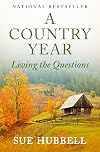
A Country Year: Living the Questions
by Sue Hubbell
On This Page
Description
Alone on a small Missouri farm after a thirty-year marriage, Sue Hubbell found a new love-of the winged, buzzing variety. Left with little but the commercial beekeeping and honey-producing business she started with her husband, Hubbell found solace in the natural world. Then she began to write, challenging herself to tell the absolute truth about her life and the things she cared about. Describing the ups and downs of beekeeping from one springtime to the next, A Country Year transports show more readers to a different, simpler place. In a series of exquisite vignettes, Hubbell reveals the joys of a life attuned to nature in this heartfelt memoir about life on the land, and of a woman finding her way in middle age. show lessTags
Recommendations














Member Reviews
It's been a while since I've read a book that felt so comfortable to absorb. Certainly some of it is the setting: a fairly isolated rural farm in the Ozarks. Plus, the author's expertise and keen interest in the natural life around her: bees, birds, deer, termites, you name it. And she is very much a fine wordsmith. But what set it truly apart for me is how she, as a "character" in her tale, blended so well with all those around her, keeping her distance brought on by individual differences while still finding and taking full advantage of the things that brought her together with them in mutually beneficial ways. She knows very well how to be her own self and still provide satisfactory links to others without letting her accounting of show more personal relations become out of balance. I am confident most readers would be as comfortable as I was spending time with her. show less
Wonderful tone -- no attempt to be literary just a personal account of what makes living in the Ozarks and raising bees so irresistible. Although she's descriptive enough to make it clear that this is no picnic -- a lot of hard, manual labor for little profit -- she also makes it clear that if you really enjoy being with yourself, and have an inquisitive mind that can stay fascinated with an alien world (bees) that there can be exquisite enjoyment. Very fast read, and well worthy of having a successor. The kind of book that makes you want to have dinner with the author.
When I ran into my 8th grade biology teacher about a month and a half ago (my favorite science teacher of all time, hands down), we naturally had a discussion combining the subjects that we teach: science and literature. Once we professed our mutual love for Barbara Kingsolver, she recommended Sue Hubbell to me.
What an awesome book. Maybe I appreciate it more because she reflects on life in the Ozarks and observes the flora and fauna I'm familiar with, but her calm and intriguing style is accessible to all. I say anyone who has lived in Missouri should read this book in order to either acquaint themselves with the natural habitat or to foster a deeper understanding and appreciation for the state. She loves and is acutely aware of her show more surroundings--bees, fixing trucks, dogs-domestic and wild, termites, Good Old Boys and Simple Lifers, copperheads vs. cottonmouths, carpentry, chicken telepathy, serviceberry, water politics, just to name a few. This is an easy-going read with easy-going language and chapters of easy-going length. And while she wrote this coming out of a divorce, she examines her connection as a strong and independent woman to the natural world rather than taking on an "Oh, God, what do I do now?" stance, which I also appreciated.
You should read it. show less
What an awesome book. Maybe I appreciate it more because she reflects on life in the Ozarks and observes the flora and fauna I'm familiar with, but her calm and intriguing style is accessible to all. I say anyone who has lived in Missouri should read this book in order to either acquaint themselves with the natural habitat or to foster a deeper understanding and appreciation for the state. She loves and is acutely aware of her show more surroundings--bees, fixing trucks, dogs-domestic and wild, termites, Good Old Boys and Simple Lifers, copperheads vs. cottonmouths, carpentry, chicken telepathy, serviceberry, water politics, just to name a few. This is an easy-going read with easy-going language and chapters of easy-going length. And while she wrote this coming out of a divorce, she examines her connection as a strong and independent woman to the natural world rather than taking on an "Oh, God, what do I do now?" stance, which I also appreciated.
You should read it. show less
” Living in a world where the answers to questions can be so many and so good is what gets me out of bed and into my boots every morning.”
A Country Year is a simple little memoir that I couldn’t put down, an endearing telling of an everyday life lived by an older woman whose child was grown and gone, and whose husband had also left. About her dogs, her chickens, and especially her bees, the little vignettes made me smile. Learning to make do on her own, sifting through her husband’s abandoned tools, sorting the hardware into “Round Things” and “Things That Fasten Other Things Together in Unusual Ways”, she takes us into her mind and her days as a beekeeper in the Ozarks of Missouri. She sorts through her surroundings as show more she sorted her tools, and reading about her study of the hills and trees, insects and animals in her world made for a sweet nature read. Ruminating on older women in our society:
” We have Time, or at least the awareness of it. We have lived long enough and seen enough to understand in a more than intellectual way that we will die, and so we have learned to live as though we are mortal, making our decisions with care and thought because we will not be able to make them again. Time for us will have an end; it is precious, and we have learned its value.” show less
A Country Year is a simple little memoir that I couldn’t put down, an endearing telling of an everyday life lived by an older woman whose child was grown and gone, and whose husband had also left. About her dogs, her chickens, and especially her bees, the little vignettes made me smile. Learning to make do on her own, sifting through her husband’s abandoned tools, sorting the hardware into “Round Things” and “Things That Fasten Other Things Together in Unusual Ways”, she takes us into her mind and her days as a beekeeper in the Ozarks of Missouri. She sorts through her surroundings as show more she sorted her tools, and reading about her study of the hills and trees, insects and animals in her world made for a sweet nature read. Ruminating on older women in our society:
” We have Time, or at least the awareness of it. We have lived long enough and seen enough to understand in a more than intellectual way that we will die, and so we have learned to live as though we are mortal, making our decisions with care and thought because we will not be able to make them again. Time for us will have an end; it is precious, and we have learned its value.” show less
Sue Hubbell, author of [b:A Book of Bees And How to Keep Them|597969|A Book of Bees And How to Keep Them|Sue Hubbell|http://photo.goodreads.com/books/1176149354s/597969.jpg|584600]- a delightful book which has as much to do with naturalism and our place in nature as it does about bees -- lives in the Ozark mountains on some 95-100 acres where she maintains 300 beehives throughout the surrounding hills.
She writes extremely well, and in this book she reflects on nature's intricacies and "queerness" and man's place in the world. She (and the reader) become captivated by such oddities as the chigger whose chewing on the human for food causes an allergic reaction which leads to its destruction; i.e. the human scratches killing the chigger, show more clearly a case of "lack of host adaptation" or evolutionarily speaking a Terrible Mistake. In a very Gouldian chapter she muses, with the help of her entomologist cousin, on moth ear mites and bats and their inter-relationship. Bats love these moths, but the moths have evolved the ability to hear the sonar emissions of the bats and thus can evade the oncoming enemy . The mites which need to survive in the ear of the moth (I never really thought of moths having ears) cause hearing loss in the moth which would be evolutionarily a dead end but curiously the mites live and attack one ear only thus preserving not only the moth but the mites as well. Hubbell ponders the human's psychomythology toward nature. We fear bats, spiders, snakes; an irrational fear, which leads to more misinformation about these creatures because we fear to observe.
Her part of the Ozarks is populated, as is much of the South, by the brown recluse spider, known for its venom. After being bitten one day on her way to a swim, and suffering no more than a mild reaction she ruminates on the fear of her friends. They refuse to come to the Ozarks, yet the venomous nature of these spiders was not commonly known until the early hazard since they inhabit the same kinds of places humans enjoy. Coexistence has been successful for thousands of years. Why worry now? Of course, a major benefit is the reduction in the tourist population. We live in a world that is not only queerer than we think but queerer than we can think. The human is part of all this, and being human we insist on meddling and interfering; but, having a mind we can hopefully recognize that some meddling causes more reverberations throughout "the whole" than others. show less
She writes extremely well, and in this book she reflects on nature's intricacies and "queerness" and man's place in the world. She (and the reader) become captivated by such oddities as the chigger whose chewing on the human for food causes an allergic reaction which leads to its destruction; i.e. the human scratches killing the chigger, show more clearly a case of "lack of host adaptation" or evolutionarily speaking a Terrible Mistake. In a very Gouldian chapter she muses, with the help of her entomologist cousin, on moth ear mites and bats and their inter-relationship. Bats love these moths, but the moths have evolved the ability to hear the sonar emissions of the bats and thus can evade the oncoming enemy . The mites which need to survive in the ear of the moth (I never really thought of moths having ears) cause hearing loss in the moth which would be evolutionarily a dead end but curiously the mites live and attack one ear only thus preserving not only the moth but the mites as well. Hubbell ponders the human's psychomythology toward nature. We fear bats, spiders, snakes; an irrational fear, which leads to more misinformation about these creatures because we fear to observe.
Her part of the Ozarks is populated, as is much of the South, by the brown recluse spider, known for its venom. After being bitten one day on her way to a swim, and suffering no more than a mild reaction she ruminates on the fear of her friends. They refuse to come to the Ozarks, yet the venomous nature of these spiders was not commonly known until the early hazard since they inhabit the same kinds of places humans enjoy. Coexistence has been successful for thousands of years. Why worry now? Of course, a major benefit is the reduction in the tourist population. We live in a world that is not only queerer than we think but queerer than we can think. The human is part of all this, and being human we insist on meddling and interfering; but, having a mind we can hopefully recognize that some meddling causes more reverberations throughout "the whole" than others. show less
After many years of marriage and with their son grown and gone, Sue Hubbell and her husband gave up their careers in New England academia. A back-to-the-land dream took them to the Ozark Mountains of Missouri, where they bought a cabin with some land and began planning for their new-found freedom from the world of work. Soon after making the move to the hills an even greater change occurred as Hubbell’s marriage dissolved and she found herself alone and struggling to support herself. Her book, A Country Year: Living the Questions, is a collection of personal essays in which Hubbell shares her transition to a new life – her new home, her new livelihood as beekeeper, and her growing appreciation for the beauty of the natural world show more around her.
The essays are loosely grouped into five seasonal sections. The book begins in the spring, proceeds through the year and finishes the following spring. Most of the essays are short and to the point, but always with some connection between Hubbell’s Ozark hillside and the greater world beyond. The seasonal focus serves more as a frame to provide boundaries and a point of reference for the essays rather than as a structure upon which to attach them.
Few of the essays are season-specific: there may be an initiating event that starts the essay, such as the ones related to the working world of a commercial beekeeper, but Hubbell then makes seamless segues into the world at large, closing with appreciation for the timeless relevance of the natural world. In one summer essay, as Hubbell talks about a day spent cutting wood to provide fuel for winter’s fires, she moves easily from physical labor in the forest to ruminations on the roles people play in tinkering with nature.
Hubbell’s departing husband had the grace to leave her with a full set of tools and we walk alongside as she treads a path from abandoned and disoriented ex-wife to competent and capable independent woman grateful for the twists and turns of fate that led to her new life. She vacillates between appreciation for the skills and support of her mountain neighbors and her occasional difficulty in reconciling their mountain-born-and-bred views with her own, developed over years of life as a socially and environmentally responsible urbanite. However different their perspectives may be, though, she strives to appreciate each for who they are without judgment. “But in the very long run I’m not so sure, and as in most lofty matters…I suspect that all our opinions are simply an expression of a personal sense of what is fitting and proper.” (p.141)
Hubbell invites us along for company as she comes to know and better understand her fellow creatures and makes new trails for herself along the way. As the essays progress she gradually reveals to us her growing comfort with her new circumstances. We are there with her as she moves from resignation to acceptance to a full embrace of the changes that have brought her to a new life and a new understanding of her world. show less
The essays are loosely grouped into five seasonal sections. The book begins in the spring, proceeds through the year and finishes the following spring. Most of the essays are short and to the point, but always with some connection between Hubbell’s Ozark hillside and the greater world beyond. The seasonal focus serves more as a frame to provide boundaries and a point of reference for the essays rather than as a structure upon which to attach them.
Few of the essays are season-specific: there may be an initiating event that starts the essay, such as the ones related to the working world of a commercial beekeeper, but Hubbell then makes seamless segues into the world at large, closing with appreciation for the timeless relevance of the natural world. In one summer essay, as Hubbell talks about a day spent cutting wood to provide fuel for winter’s fires, she moves easily from physical labor in the forest to ruminations on the roles people play in tinkering with nature.
Hubbell’s departing husband had the grace to leave her with a full set of tools and we walk alongside as she treads a path from abandoned and disoriented ex-wife to competent and capable independent woman grateful for the twists and turns of fate that led to her new life. She vacillates between appreciation for the skills and support of her mountain neighbors and her occasional difficulty in reconciling their mountain-born-and-bred views with her own, developed over years of life as a socially and environmentally responsible urbanite. However different their perspectives may be, though, she strives to appreciate each for who they are without judgment. “But in the very long run I’m not so sure, and as in most lofty matters…I suspect that all our opinions are simply an expression of a personal sense of what is fitting and proper.” (p.141)
Hubbell invites us along for company as she comes to know and better understand her fellow creatures and makes new trails for herself along the way. As the essays progress she gradually reveals to us her growing comfort with her new circumstances. We are there with her as she moves from resignation to acceptance to a full embrace of the changes that have brought her to a new life and a new understanding of her world. show less
Since I cannot live on a farm. Since I can not begin another life as a naturalist. Since I can not become a beekeeper while living within city limits. Since I can not imagine sharing my life with bob cats, deer, opossums, snakes of every kind, spiders of every variety...I must live vicariously through the essays and observations of others. Sue Hubbell is gentle and smart and brings all her experiences to me in this wonderful book that is 30 years old and has sat in my unread collection of books unearthed in the Library Cellar of the Lex public Library.
Members
- Recently Added By
Lists

Recommended Nature Writing
346 works; 180 members

500 Great Books by Women
507 works; 60 members

Mountain Adventures
26 works; 1 member
Author Information

18+ Works 1,802 Members
Sue Hubbell was born Suzanne Gilbert in Kalamazoo, Michigan on January 28, 1935. She received a bachelor's degree in journalism from the University of Southern California in 1956 and a master's degree in library science from Drexel University in 1965. She worked as a librarian at Trenton State College and as a periodicals librarian at Brown show more University. In 1972, she and her first husband moved to a farm in the Ozark Mountains of Missouri and took up beekeeping. To supplement the income from honey sales, she wrote freelance articles for The St. Louis Post-Dispatch, The New York Times, and The New Yorker. After they divorced, she continued to run the large beekeeping operation. She also wrote several books including A Country Year: Living the Questions, A Book of Bees: And How to Keep Them, Far-Flung Hubbell: Essays from the American Road, and Waiting for Aphrodite: Journeys Into the Time Before Bones. She suffered from dementia and decided to stop eating and drinking on September 9, 2018 because she did not want to eventually be placed under indefinite institutional care. She died on October 13, 2018 at the age of 83. (Bowker Author Biography) show less
Awards and Honors
Series
Belongs to Publisher Series
Gallimard, Folio (2605)
Common Knowledge
- Original publication date
- 1983; 1988 (French) (French)
- Important places
- Ozarks, USA; Missouri, USA
- Epigraph
- . . . Be patient toward all this is unsolved in your heart and try to love the questions themselves . . . Do not . . . seek the answers, which cannot be given you because you would not be able to live them. And the point is ... (show all)to live everything. Live the questions now. Perhaps you will . . . gradually, without noticing it, live along some distant day into the answer.
Ranier Maria Rilke,
Letters to a Young Poet. Letter No. 4.
Translated by M. D. Herter.
Norton, 1934, 1935. - Dedication
- The Wild Things helped
- First words
- Foreword:
There are three big windows that go from floor to ceiling on the south side of my cabin.
Chapter 1:
The river to the north of my place is claimed by the U.S. Park Service, and the creek to the south is under the protection of the Missouri State Conservation Department, so I am surrounded by government land. - Quotations
- Living in a world where the answers to questions can be so many and so good is what gets me out of bed and into my boots every morning.
My bees cover one thousand square miles of land that I do not own in their foraging flights, flying from flower to flower for which I pay no rent, stealing nectar but pollinating plants in return. It is an unruly, benign kin... (show all)d of agriculture, and making a living by it has such a wild, anarchistic, raffish appeal that is unsuits me for any other, except possibly robbing banks.
We have Time, or at least the awareness of it. We have lived long enough and seen enough to understand in a more than intellectual way that we will die, and so we have learned to live as though we are mortal, making our deci... (show all)sions with care and thought because we will not be able to make them again. Time for us will have an end; it is precious, and we have learned its value. - Last words
- (Click to show. Warning: May contain spoilers.)The search for what may or may not be sawfly larvae seems quite a good one this springtime.
Classifications
Statistics
- Members
- 661
- Popularity
- 43,703
- Reviews
- 24
- Rating
- (4.28)
- Languages
- 5 — Chinese, English, French, German, Spanish
- Media
- Paper, Audiobook, Ebook
- ISBNs
- 23
- UPCs
- 1
- ASINs
- 6