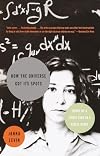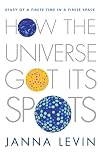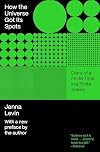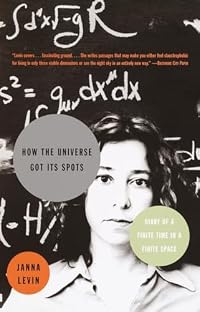
How the Universe Got Its Spots: Diary of a Finite Time in a Finite Space
by Janna Levin
On This Page
Description
Is the universe infinite, or is it just really big? Does nature abhor infinity? In startling and beautiful prose, Janna Levin's diary of unsent letters to her mother describes what we know about the shape and extent of the universe, about its beginning and its end. She grants the uninitiated access to the astounding findings of contemporary theoretical physics and makes tangible the contours of space and time—those very real curves along which apples fall and planets orbit.Levin guides the show more reader through the observations and thought-experiments that have enabled physicists to begin charting the universe. She introduces the cosmic archaeology that makes sense of the pattern of hot spots left over from the big bang, a pursuit on the verge of discovering the shape of space itself. And she explains the topology and the geometry of the universe now coming into focus—a strange map of space full of black holes, chaotic flows, time warps, and invisible strings. Levin advances the controversial idea that this map is edgeless but finite—that the universe is huge but not unending—a radical revelation that would provide the ultimate twist to the Copernican revolution by locating our precise position in the cosmos.As she recounts our increasingly rewarding attempt to know the universe, Levin tells her personal story as a scientist isolated by her growing knowledge. This book is her remarkable effort to reach across the distance of that knowledge and share what she knows with family and friends—and with us. Highly personal and utterly original, this physicist’s diary is a breathtaking contemplation of our deep connection with the universe and our aspirations to comprehend it. show lessTags
Recommendations





Member Recommendations
Member Reviews
I thought this little primer on physics was perfectly delightful. I've never seen anyone explain physics in quite this way before, but it was absolutely charming. The biggest points (for me) were on the topology of the universe. Geometry trumps General Relativity. For, as we know, neither General Relativity or Quantum Physics can describe the actual shape of the universe. No predictive power at all.
But then, even Einstein said there would have to be yet another comprehensive paradigm shift.
I personally like to think that all science will always have to do successive paradigm shifts as if it, too, followed the Marxian axiom. It means there will never be an end to learning, and THAT is something gorgeous to behold. :)
ANYWAY, back to this show more book. Levin's prose takes the highly unusual tack of posing as letters to her mom, being awesomely personal and revealing while also illustrating just how much she loves the science she does. The mix, far from being awkward, turns the whole struggle and acquisition of knowledge into an end that we can all admire greatly. It also makes it REAL in a way I rarely see in these kinds of non-fiction books. Or perhaps it's not all that rare, because I do get a very awesome sense of the people for whom the science is everything, but in her case, I just feel love, sympathy, and shared joy.
This is not your standard boilerplate introductory pop-sci text. Rather, it is a personal and gorgeous love-note to the ideas that shine so bright, always asking more questions, demanding more sacrifices, and, in the end, revealing even more of the universe.
Totes respect. show less
But then, even Einstein said there would have to be yet another comprehensive paradigm shift.
I personally like to think that all science will always have to do successive paradigm shifts as if it, too, followed the Marxian axiom. It means there will never be an end to learning, and THAT is something gorgeous to behold. :)
ANYWAY, back to this show more book. Levin's prose takes the highly unusual tack of posing as letters to her mom, being awesomely personal and revealing while also illustrating just how much she loves the science she does. The mix, far from being awkward, turns the whole struggle and acquisition of knowledge into an end that we can all admire greatly. It also makes it REAL in a way I rarely see in these kinds of non-fiction books. Or perhaps it's not all that rare, because I do get a very awesome sense of the people for whom the science is everything, but in her case, I just feel love, sympathy, and shared joy.
This is not your standard boilerplate introductory pop-sci text. Rather, it is a personal and gorgeous love-note to the ideas that shine so bright, always asking more questions, demanding more sacrifices, and, in the end, revealing even more of the universe.
Totes respect. show less
After listening to an interview with Janna Levin on the NPR program Speaking of Faith, I became interested in reading her books. Levin is an astrophysicist and author interested in sharing her interest in topics from quantum mechanics to a Theory of Everything.
In the book How the Universe Got Its Spots, Levin uses a diary/letter style to explain contemporary theoretical physics in a way that is accessible to a layperson like me. She weaves the science through stories from everyday life. Her engaging writing style and excellent examples makes complex topics such as Einstein's theories easier to understand. It's interesting to learn how much we know and how much we still don't know about our universe. Is the universe finite or infinite? show more We really don't know.
One of the most amazing aspects of the book is her interest in cosmic archaeology which examines the patterns of hot spots left over from the big bang. I was also fascinated by her explanations of topology and geometry of the universe. I've always been interested in the idea of more than three dimensions, but it wasn't until I read this book that I began to understand how these other dimensions might work.
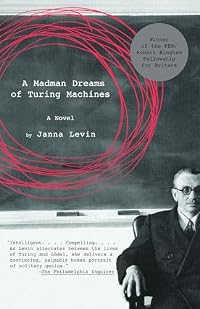
It's been nearly a decade since this book was written. I look forward to reading her newer, award-winning book titled A Madman Dreams of Turing Machines.
Here's one of my favorite quotes from the book:
“…there are no walls built in the human mind making some of us scientists and some of us artist. They are branches of the same tree, rooted in a common human essence. Maybe it’s our ability to step between the different disciplines, weaving strange loops all the while, that’s the core of our creativity.” (p. 193) show less
In the book How the Universe Got Its Spots, Levin uses a diary/letter style to explain contemporary theoretical physics in a way that is accessible to a layperson like me. She weaves the science through stories from everyday life. Her engaging writing style and excellent examples makes complex topics such as Einstein's theories easier to understand. It's interesting to learn how much we know and how much we still don't know about our universe. Is the universe finite or infinite? show more We really don't know.
One of the most amazing aspects of the book is her interest in cosmic archaeology which examines the patterns of hot spots left over from the big bang. I was also fascinated by her explanations of topology and geometry of the universe. I've always been interested in the idea of more than three dimensions, but it wasn't until I read this book that I began to understand how these other dimensions might work.
It's been nearly a decade since this book was written. I look forward to reading her newer, award-winning book titled A Madman Dreams of Turing Machines.
Here's one of my favorite quotes from the book:
“…there are no walls built in the human mind making some of us scientists and some of us artist. They are branches of the same tree, rooted in a common human essence. Maybe it’s our ability to step between the different disciplines, weaving strange loops all the while, that’s the core of our creativity.” (p. 193) show less
Do you believe that the universe is infinite? In this book Levin gives a compelling argument that may cause you to reexamine that belief. It begins with the question "Is the Universe Infinite or Just Really Big?" and launches into a fascinating topological exploration of very large-scale phenomena (particularly the cosmic microwave background). The style, cleverness, and clarity with which she writes is unmatched by most authors today. Reading this will not only cause you to laugh outloud but will also allow your mind to grasp some highly technical and theoretical concepts that when presented in most other texts are largly unintelligible. For anyone who is interested in the workings of the universe at large I highly recommend it.
I was recommended this book by the illustrious E. I paraphrase, but I think he described it as a book about cosmology and heartbreak. Janna Levin, is a leading young scientists in theoretical astrophysics and wrote this book in the form of a collection of explanatory letters to her mother. She peppers her descriptions of concepts in cosmology with occasional glimpses of her life, one composed of a series of dismal english apartments and constant travel.
Cosmology is something that I have only the vaguest knowledge of. In my mind it's a sort of amalgam of pieces from Einstein's relativity and philosopher's questions of the nature of the universe. Levin does a remarkable job explaining it without making the reader feel dense. She describes show more the nature of infinity, and infinities which are larger than other infinities. She spends quite a bit of time on topology and topology in different dimensions, and she ends with a discussion of the universe and how we may one day perceive its finiteness, if it is indeed finite. I came away from the book with the sense that we are waiting for ripples of light from the shores of the universe, but of course there are no shores to speak of, are there?
I'm quite sure I didn't understand all that was in this book. Nonetheless, this is an interesting book with just enough cosmology to whet the tastes of the uninitiated, like myself. show less
Cosmology is something that I have only the vaguest knowledge of. In my mind it's a sort of amalgam of pieces from Einstein's relativity and philosopher's questions of the nature of the universe. Levin does a remarkable job explaining it without making the reader feel dense. She describes show more the nature of infinity, and infinities which are larger than other infinities. She spends quite a bit of time on topology and topology in different dimensions, and she ends with a discussion of the universe and how we may one day perceive its finiteness, if it is indeed finite. I came away from the book with the sense that we are waiting for ripples of light from the shores of the universe, but of course there are no shores to speak of, are there?
I'm quite sure I didn't understand all that was in this book. Nonetheless, this is an interesting book with just enough cosmology to whet the tastes of the uninitiated, like myself. show less
This was my introduction to COBY and other data relating to the early universe. Dr. Levin is a beautiful storyteller integrating history with the physics and engineering involved to build and discover information from the early universe.
For me, the first chapter took me a bit off guard, only because I hadn't encountered science communication in this style... But she definitely had me hooked and have since looked forward to reading all her work.
Give me more!
For me, the first chapter took me a bit off guard, only because I hadn't encountered science communication in this style... But she definitely had me hooked and have since looked forward to reading all her work.
Give me more!
This was my T and bedside book for a while. It was written in a letter/journal form, but the concepts were intense and had to be taken in small doses. Gravity is falling along curves in space. Topography is confusing but fascinating. I totally didn't get what she was trying to tell me about string theory, but I liked that she was trying to. The personal details held the narrative together and made me want to understand her passion and her work. (March 10, 2005)
I got one third of the way through, but the math/physics got too heavy, and the memoir bits were too short to be relevant. I probably would have loved this when I was taking physics in college, but that was three decades ago BK. It is gracefully written; Levin does have a way with words.
And I did manage to learn some interesting things I'd never understood before:
Newton suggested that gravitational mass... and inertial mass... were one and the same... [and] elevated this notion to a universal principle, suggesting that all masses pulled all other masses and that the strength of this pull grew weaker with distance."
"Newton invented calculus, the mathematics essential to modern physics. With calculus we can understand in equations how show more dynamic systems evolve with time."
See, the thing is, my high school never offered calculus, and my college assumed I'd had it, so I've always been very confused....
"So what is gravity if it is not a force? It is the shape of space. Gravity is a field and mass is the charge.... Mass, like electic charge, creates a field around it in the form of curved space, a gravitational field as opposed to an electric field."" show less
And I did manage to learn some interesting things I'd never understood before:
Newton suggested that gravitational mass... and inertial mass... were one and the same... [and] elevated this notion to a universal principle, suggesting that all masses pulled all other masses and that the strength of this pull grew weaker with distance."
"Newton invented calculus, the mathematics essential to modern physics. With calculus we can understand in equations how show more dynamic systems evolve with time."
See, the thing is, my high school never offered calculus, and my college assumed I'd had it, so I've always been very confused....
"So what is gravity if it is not a force? It is the shape of space. Gravity is a field and mass is the charge.... Mass, like electic charge, creates a field around it in the form of curved space, a gravitational field as opposed to an electric field."" show less
Members
- Recently Added By
Author Information

7+ Works 1,854 Members
Janna Levin is a professor of physics and astronomy at Barnard College of Columbia University.
Common Knowledge
- Canonical title
- How the Universe Got Its Spots: Diary of a Finite Time in a Finite Space
- Original title
- How the Universe Got Its Spots: Diary of a Finite Time in a Finite Space
- Original publication date
- 2002-02-28
- First words
- Some of the great mathematicians killed themselves.
- Last words
- (Click to show. Warning: May contain spoilers.)It's Warren.
Classifications
Statistics
- Members
- 539
- Popularity
- 54,983
- Reviews
- 13
- Rating
- (3.78)
- Languages
- 6 — Czech, Dutch, English, Italian, Spanish, Swedish
- Media
- Paper, Audiobook, Ebook
- ISBNs
- 20
- ASINs
- 5