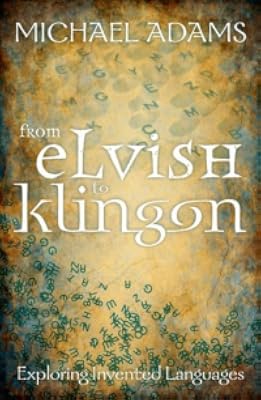
From Elvish to Klingon: Exploring Invented Languages
by Michael Adams
On This Page
Description
How are languages invented? Why are they invented? Who uses them? What are the cultural effects of invented languages? This fascinating book looks at all manner of invented languages and explores the origins, purpose, and usage of these curious artefacts of culture. Written by experts in thefield, chapters discuss languages from Esperanto to Klingon and uncover the motives behind their creation, and the outcomes of their existence.Introduction by Michael AdamsLinking all invented languages, show more Michael Adams explains how creating a language is intimidating work; no one would attempt to invent one unless driven by a serious purpose or aspiration. He explains how the origin and development of each invented language illustrates inventors' and users'dissatisfaction with the language(s) already available to them, and how each invented language expresses one or more of a wide range of purposes and aspirations: political, social, aesthetic, intellectual, and technological.Chapter 1: International Auxiliary Languages by Arden SmithFrom the mythical Language of Adam to Esperanto and Solresol, this chapter looks at the history, linguistics, and significance of international or universal languages (including sign languages).Chapter 2: Invented Vocabularies: Newspeak and Nadsat by Howard JacksonLooking at the invented vocabularies of science fiction, for example 1984's 'Newspeak' and Clockwork Orange's 'Nadsat', this chapter discusses the feasibility of such vocabularies, the plausibility of such lexical change, and the validity of the Sapir-Whorfian echoes heard in such literaryexperiments.Chapter 3: 'Oirish' Inventions: James Joyce, Samuel Beckett, Paul Muldoon by Stephen WattThis chapter looks at literary inventions of another kind, nonsense and semi-nonsense languages, including those used in the works of James Joyce and Samuel Beckett.Chapter 4: Tolkien's Invented Languages by Edmund WeinerFocussing on the work of the accomplished philologist J.R.R. Tolkien, the fifteen languages he created are considered in the context of invented languages of other kinds.Chapter 5: Klingon and other Science Fiction Languages by Marc Okrand, Judith Hendriks-Hermans, and Sjaak KroonKlingon is the most fully developed of fictional languages (besides Tolkien's). Used by many, this chapter explores the speech community of 'Trekkies', alongside other science fiction vocabularies.Chapter 6: Logical Languages by Michael AdamsThis chapter introduces conlangs, 'constructed languages'. For example, Laaden, created to express feminine experience better than 'patriarchal' languages.Chapter 7: Gaming Languages and Language Games by James PortnowLanguages and games are both fundamentally interactive, based on the adoption of arbitrary sign systems, and come with a set of formal rules which can be manipulated to express different outcomes. This being one of the drivers for the popularity of invented languages within the gaming community,James Portnow looks at several gaming languages and language games, such as Gargish, D'ni, Simlish, and Logos.Chapter 8: Revitalized Languages as Invented Languages by Suzanne RomaineThe final chapter looks at language continuation, renewal, revival, and resurrection - in the cases of Gaelic, Welsh, Cornish, and Breton - as well as language regulation. show lessTags
Recommendations











Member Recommendations
Member Reviews
Suspect I'm not going to get through the remaining appendices anytime soon. As ever with a collection of essays, some high points and some low points. The chapter on languages in games was rather superficial, the chapter on Tolkien was good, the chapters on Cornish and other revived languages was interesting but could have covered more.
Ratings
Members
- Recently Added By
Lists

Great Books About Language
73 works; 48 members
Author Information

6 Works 573 Members
Michael Adams is Professor of English and Chair of the Department of English at Albright College.
All Editions
Common Knowledge
- Canonical title
- From Elvish to Klingon: Exploring Invented Languages
- Original publication date
- 2011-10
- First words
- Every year, thousands of English professors in the United States, perhaps around the world, receive a circular offering them 'Shakespeare in the original language'--Klingon, the invented language of a warrior race in the inve... (show all)nted future world of the television and film franchise, Star Trek.
- Last words
- (Click to show. Warning: May contain spoilers.)Language renewal, revitalization, and reconstrution and all of their structural, historical, and ideological implications invite us to reconsider the revolution of invented language.
Classifications
- Genres
- Nonfiction, General Nonfiction
- DDC/MDS
- 499.99 — Language Other languages Non-Austronesian languages of Oceania, Austronesian languages, miscellaneous languages Miscellaneous languages Artificial languages
- LCC
- PM8008 .A33 — Language and Literature Hyperborean, Native American, and artificial languages Hyperborean, Indian, and artificial languages Artificial languages--Universal languages
- BISAC
Statistics
- Members
- 139
- Popularity
- 235,955
- Reviews
- 1
- Rating
- (3.93)
- Languages
- English
- Media
- Paper, Ebook
- ISBNs
- 3
- ASINs
- 2