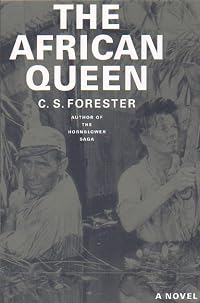
The African Queen
by C. S. Forester
On This Page
Description
This is not the 1940 version but is based on the edition originally published in 1935 in the US by Little, Brown: Boston. The African Queen is a tale replete with vintage Forester drama-unrelenting suspense, reckless heroism, impromptu military manoeuvres, near-death experiences-and a good old-fashioned love story to boot. As World War I reaches the heart of the African jungle, Charlie Allnutt and Rose Sayer, a dishevelled trader and an English spinster missionary, find themselves thrown show more together by circumstance. Fighting time, heat, malaria, and bullets, they make their escape on the rickety steamboat The African Queen . . . and hatch their own outrageous military plan. show lessTags
Recommendations
























Member Reviews
i quickly became engrossed by the african queen, drawn into a tale of harrowing adventure and survival with two very unconventional characters, a "spinster" sister of a missionary and a cockney mechanic of dubious virtue (he's portrayed as weak-willed, simple, and pusillanimous). rosie blossoms in newfound freedom after her brother dies and she teams up with mr. allnut for a journey down the ulanga river in the hopes of striking a blow for God and country against the germans, who have the affrontry to be at war with britain. on this journey, rosie finds within herself such skills and strength that i'm a little in awe of her determination (be it foolhardy/fanatic or courageous) as she assumes the leadership of their mission. i was show more honestly very surprised to find such a character in this book. rosie and charlie's relationship is an odd but intriguing one to chart in its growth through the story and their journey down the river. they battle through so much together, and seem to truly come into their own, making each other better and stronger – charlie, for his part, finds his manhood - that i'm immensely pleased at the love that springs up between them. which is why i am more than a little taken aback by the ending forester metes out to them singly and as a pair. is it in concession to the impossibility of such characters, or, ironically, the impossibility of these characters' success beyond the sphere of africa/within the confines of "civilization," that forester brings their adventure to a perfunctory close that is anticlimactic and disillusioning? or does he treat these two (and, by extension, the cause of empire and religion to which rosie so fanatically adheres) ironically and a little disparagingly throughout, so that the last trick ends up being played on the reader in forester's withholding of a "happily ever after?" this is still a very interesting and fun read, but the ending is nothing like the movie, so beware if you are of a romantic frame of mind. show less
I suppose there are people who have neither read this book nor seen the movie. For their sakes, herewith the plot.
It is the early days of World War I. For some years, Rose and her brother, the Reverend Samuel Sayer, have been toiling to save souls for the Lord in German Central Africa, "he for God only, she for God in him". But now the German troops have descended on their village, carried away souls both converted and unconverted to toil for the Army, and illness carries away Samuel. At that moment, Charley Allnutt, a cockney engineer employed by a Belgian mining company, arrives in The African Queen, a rickety steam launch. The launch is carrying blasting gelatine and other supplies for the mine, but that, too, has fallen to the show more Germans.
So this odd pair team up to flee the Germans. But Rose decides that they ought to strike a blow for the British, and talks Allnutt into a mad plan to go down the river, past a German stronghold and over cataracts, and with jury-rigged torpedoes blast the Königin Luise to the bottom of the lake it guards.
Their adventures, and their unlikely love story, adapted by James Agee, John Huston and Peter Viertel, made for a delightful comedic film. It is a much-praised classic (for which Bogart won an Oscar, and Hepburn, Huston and Agee were nominated), and deservedly so. But the book is even better.
The love story is actually less unlikely in the book than in the film. It is so because Forester can show us more of the characters' depths, describe their background and their sensibilities, which in many ways make Rose and Allnutt much more alike than they seem in the film. (Huston made Allnutt a Canadian, not a Cockney, and Rose a mite higher-class than the tradesman's daughter Forester created. Forester makes clear that there was no difficulty of difference of social rank between them.) The book is, therefore, able to make the sexual and emotional relationship between the two much more credible.
The difference between film and book can be summed up by the passage that occurs their first night on the boat, when Allnutt is drinking gin.
Film:
Allnutt: What about a cup o' tea, Miss?
Rose: I'd like a cup of tea.
Novel:
"What about a cup o' tea, Miss?"
Tea! Heat and thirst and fatigue and excitement had done their worst for Rose. She was limp and weary, and her throat ached. The imminent prospect of a cup of tea roused her to trembling excitement. Twelve cups of tea, each, Samuel and she had drunk daily for years. To-day she had had none -- she had eaten no food either, but at the moment that meant nothing to her. Tea! A cup of tea! Two cups of tea! Half a dozen great mugs of tea, strong, delicious, revivifying! Her mind was suffused with rosy pictures of an evening's tea drinking, a debauch compared with which the spring sowing festivities at the village by the mission station were only a pale shade.
"I'd like a cup of tea," she said.
The ending, too, is quite different from the film and, I think, better. (SPOILER ALERT).
In the film, The African Queen having been sunk in a storm, Allnutt and Rosie are captured by the Königen Luise and sentenced to hang. Allnutt asks the German captain to marry them, and as the brief ceremony ends, the Luise hits the remains of the Queen and is blown up by her torpedoes. The film ends with Rosie and Allnutt in the water, swimming for the eastern shore and safety.
In the book, though, the appearance of Rosie on the Luise prevents the German captain from executing Allnutt, as he could not kill one without the other and will not execute Rosie ("white women were so rare in Central Africa that he would have thought it monstrous"). Therefore, under a white flag of truce, he takes the two of them to Port Albert, Belgian Congo, and turns them over to the British forces there. It is British boats who, the next day, sink the Königen Luise. The book ends with Rose and Allnutt beginning "the long journey to Matadi and marriage. Whether or not they lived happily ever after is not easily decided". show less
It is the early days of World War I. For some years, Rose and her brother, the Reverend Samuel Sayer, have been toiling to save souls for the Lord in German Central Africa, "he for God only, she for God in him". But now the German troops have descended on their village, carried away souls both converted and unconverted to toil for the Army, and illness carries away Samuel. At that moment, Charley Allnutt, a cockney engineer employed by a Belgian mining company, arrives in The African Queen, a rickety steam launch. The launch is carrying blasting gelatine and other supplies for the mine, but that, too, has fallen to the show more Germans.
So this odd pair team up to flee the Germans. But Rose decides that they ought to strike a blow for the British, and talks Allnutt into a mad plan to go down the river, past a German stronghold and over cataracts, and with jury-rigged torpedoes blast the Königin Luise to the bottom of the lake it guards.
Their adventures, and their unlikely love story, adapted by James Agee, John Huston and Peter Viertel, made for a delightful comedic film. It is a much-praised classic (for which Bogart won an Oscar, and Hepburn, Huston and Agee were nominated), and deservedly so. But the book is even better.
The love story is actually less unlikely in the book than in the film. It is so because Forester can show us more of the characters' depths, describe their background and their sensibilities, which in many ways make Rose and Allnutt much more alike than they seem in the film. (Huston made Allnutt a Canadian, not a Cockney, and Rose a mite higher-class than the tradesman's daughter Forester created. Forester makes clear that there was no difficulty of difference of social rank between them.) The book is, therefore, able to make the sexual and emotional relationship between the two much more credible.
The difference between film and book can be summed up by the passage that occurs their first night on the boat, when Allnutt is drinking gin.
Film:
Allnutt: What about a cup o' tea, Miss?
Rose: I'd like a cup of tea.
Novel:
"What about a cup o' tea, Miss?"
Tea! Heat and thirst and fatigue and excitement had done their worst for Rose. She was limp and weary, and her throat ached. The imminent prospect of a cup of tea roused her to trembling excitement. Twelve cups of tea, each, Samuel and she had drunk daily for years. To-day she had had none -- she had eaten no food either, but at the moment that meant nothing to her. Tea! A cup of tea! Two cups of tea! Half a dozen great mugs of tea, strong, delicious, revivifying! Her mind was suffused with rosy pictures of an evening's tea drinking, a debauch compared with which the spring sowing festivities at the village by the mission station were only a pale shade.
"I'd like a cup of tea," she said.
The ending, too, is quite different from the film and, I think, better. (SPOILER ALERT).
In the film, The African Queen having been sunk in a storm, Allnutt and Rosie are captured by the Königen Luise and sentenced to hang. Allnutt asks the German captain to marry them, and as the brief ceremony ends, the Luise hits the remains of the Queen and is blown up by her torpedoes. The film ends with Rosie and Allnutt in the water, swimming for the eastern shore and safety.
In the book, though, the appearance of Rosie on the Luise prevents the German captain from executing Allnutt, as he could not kill one without the other and will not execute Rosie ("white women were so rare in Central Africa that he would have thought it monstrous"). Therefore, under a white flag of truce, he takes the two of them to Port Albert, Belgian Congo, and turns them over to the British forces there. It is British boats who, the next day, sink the Königen Luise. The book ends with Rose and Allnutt beginning "the long journey to Matadi and marriage. Whether or not they lived happily ever after is not easily decided". show less
Journeying down a wild African river of cataracts and malarial, jungle-covered river banks, Charlie Allnutt and Rose Sayer initially come into conflict with one another before falling in love. That is the story, cliched as it may seem. But what makes The African Queen special are the circumstances that surround that story. Not just the trip through the rapids but the troubles to stay afloat and in motion--and then the passageway through some of the most horrific terrain imaginable in the river's delta. All against the background of World War I and the battle between Germany, on one hand, and Britain and Belgium, on the other, in Central Africa.
Forester is superb writer of action and adventure stories, especially those set at sea. Here, show more he has managed to bring his nautical details into the midst of the vast African continent. But he still fights his ultimate battle on water--a vast lake.
There might be something else at work, here, too. For the story is one almost exclusively about Allnutt and Rose, a Cockney mechanic and the daughter of a tradesman turned missionary to help her brother's mission. Forester focuses on these two, stalwarts in their way, of the Empire, without the need of upper class direction or commentary. This, he seems to say, is what makes Britain strong. Of course, there is nothing new in itself with this sentiment. Kipling made it a feature of his writing. But this novel was written in 1935, and there is a tinge of resentment against the ruling class running throughout. I can't help but think of the wartime British propaganda poster that would appear a few years later, in 1939, which avowed: "Your Courage! Your Cheefulness! Your Resolution! WILL BRING US VICTORY!" More than a few people, at the time, saw "your" as referring to the lower and working classes, while "us" referred to the ruling class. Of course, none of this feeling exists in the 1951 film version with Humphrey Bogart and Katharine Hepburn, where Bogart portrays a gritty Canadaian/American Everyman who brings a knowledge of life and love to a British spinster.
A very nice novel. show less
Forester is superb writer of action and adventure stories, especially those set at sea. Here, show more he has managed to bring his nautical details into the midst of the vast African continent. But he still fights his ultimate battle on water--a vast lake.
There might be something else at work, here, too. For the story is one almost exclusively about Allnutt and Rose, a Cockney mechanic and the daughter of a tradesman turned missionary to help her brother's mission. Forester focuses on these two, stalwarts in their way, of the Empire, without the need of upper class direction or commentary. This, he seems to say, is what makes Britain strong. Of course, there is nothing new in itself with this sentiment. Kipling made it a feature of his writing. But this novel was written in 1935, and there is a tinge of resentment against the ruling class running throughout. I can't help but think of the wartime British propaganda poster that would appear a few years later, in 1939, which avowed: "Your Courage! Your Cheefulness! Your Resolution! WILL BRING US VICTORY!" More than a few people, at the time, saw "your" as referring to the lower and working classes, while "us" referred to the ruling class. Of course, none of this feeling exists in the 1951 film version with Humphrey Bogart and Katharine Hepburn, where Bogart portrays a gritty Canadaian/American Everyman who brings a knowledge of life and love to a British spinster.
A very nice novel. show less
The African Queen is set in the German East Africa of World War I. Rose Sayer, devoted sister of the British Anglican missionary Samuel Sayer, is alone with her brother at his mission when he passes on. Captain Charlie Allnut, a fellow Brit (Cockney in fact), who pilots the African Queen, regularly stops in to bring supplies to the mission, and shows up just in time to bury the Reverend. Rose mourns of course, but also finds her passions inflamed against the Germans whose actions caused the failure of her brother’s mission, and who she now blames for his death. With Allnut, she hatches a plan to take the African Queen down the river Ulanga to the lake where the German navy boat the Königin Luise patrols, and blow her up.
And so begins show more C.S. Forester’s 1935 love story that later was the basis for the 1951 movie starring Humphrey Bogart as Allnut and Katharine Hepburn as Rose. It’s mostly a character study of Rose wrapped into enough of a plot to carry it off as a novel. For much of the book Rose and Allnut are the only characters, alone on the African Queen making their way through rapids and other challenges as they approach Lake Wittelsbach.
Allnut doesn't rise much above caricature - he’s a solidly built, mechanically-inclined man of few words, not given to thinking too much about things outside his immediate view. His significant trait is his pliability, demonstrated in his inclination to bend to Rose’s will from the start. This trait is remarked on by the author more than once. Forester builds out Allnut’s character with, perhaps, the comfort of the readers of the 1930s in mind. He is “all man”, and yet also welcomes Rose’s dominant role in the relationship and isn’t challenged by it.
Rose begins as the spinster sister of the missionary, to whom she has devoted her whole life, subsuming herself to be of service. But with her brother gone, and she alone far from home, she quickly sheds her old skin and transforms herself into a woman confident of her new goal and devoting all her energy to making it come to fruition.
For the reader, it’s certainly an interesting transition for Rose, and also a picturesque portrayal of the trip down the river for her and Charlie. But 87 years after its publication and more than 100 years after the events in the book, well, I have to say that while the book has its charms, it’s also showing its age.
Maybe I dislike how Allnut’s willingness to go along with Rose’s ideas has to be excused and made to seem a personal failing on his part. Perhaps I’m reacting negatively to the chauvinistic bias I hear in Forester’s depiction of Rose herself. Or, maybe it’s just that the writing style strikes my modern American ear as too formal, and too officiously British.
This is, after all, the same author so beloved for his Horatio Hornblower (of the British Navy) series of books, and who came to America during World War II to write propaganda to encourage the US to join the Allies. I do have to admit though, that the frank (for the 1930s) way in which Forester conveys that Charlie and Rose have fallen in love and had sex aboard the boat surprised me, even as I admired how well done the writing about it was.
On the subject of writing, the book has one of the best smile-inducing last lines, despite its officious British construction - “As to whether or not they lived happily ever after is not easily decided.”
Altogether, a mixed reaction from me. More positive than negative. Not glowing. As it's a classic I am glad I finally got around to reading it. If you are more of a fan of the Romance genre than I am you’ll probably like this one. It doesn’t feel right to me to put Star ratings on classics like this one, so that simple recommendation will have to suffice. show less
And so begins show more C.S. Forester’s 1935 love story that later was the basis for the 1951 movie starring Humphrey Bogart as Allnut and Katharine Hepburn as Rose. It’s mostly a character study of Rose wrapped into enough of a plot to carry it off as a novel. For much of the book Rose and Allnut are the only characters, alone on the African Queen making their way through rapids and other challenges as they approach Lake Wittelsbach.
Allnut doesn't rise much above caricature - he’s a solidly built, mechanically-inclined man of few words, not given to thinking too much about things outside his immediate view. His significant trait is his pliability, demonstrated in his inclination to bend to Rose’s will from the start. This trait is remarked on by the author more than once. Forester builds out Allnut’s character with, perhaps, the comfort of the readers of the 1930s in mind. He is “all man”, and yet also welcomes Rose’s dominant role in the relationship and isn’t challenged by it.
Rose begins as the spinster sister of the missionary, to whom she has devoted her whole life, subsuming herself to be of service. But with her brother gone, and she alone far from home, she quickly sheds her old skin and transforms herself into a woman confident of her new goal and devoting all her energy to making it come to fruition.
For the reader, it’s certainly an interesting transition for Rose, and also a picturesque portrayal of the trip down the river for her and Charlie. But 87 years after its publication and more than 100 years after the events in the book, well, I have to say that while the book has its charms, it’s also showing its age.
Maybe I dislike how Allnut’s willingness to go along with Rose’s ideas has to be excused and made to seem a personal failing on his part. Perhaps I’m reacting negatively to the chauvinistic bias I hear in Forester’s depiction of Rose herself. Or, maybe it’s just that the writing style strikes my modern American ear as too formal, and too officiously British.
This is, after all, the same author so beloved for his Horatio Hornblower (of the British Navy) series of books, and who came to America during World War II to write propaganda to encourage the US to join the Allies. I do have to admit though, that the frank (for the 1930s) way in which Forester conveys that Charlie and Rose have fallen in love and had sex aboard the boat surprised me, even as I admired how well done the writing about it was.
On the subject of writing, the book has one of the best smile-inducing last lines, despite its officious British construction - “As to whether or not they lived happily ever after is not easily decided.”
Altogether, a mixed reaction from me. More positive than negative. Not glowing. As it's a classic I am glad I finally got around to reading it. If you are more of a fan of the Romance genre than I am you’ll probably like this one. It doesn’t feel right to me to put Star ratings on classics like this one, so that simple recommendation will have to suffice. show less
The African Queen by C.S. Forester is a book that I have long wanted to read. Originally published in 1935, this is a memorial WW I story that takes part in a remote corner of the world. German East Africa comprised what is now known as Burundi, Rwanda and part of Tanganyika (now known as Tanzania). At the opening of the book the Germans have come to the mission of Rose and her brother Samuel and stripped the place of food and animals. The native people are conscripted and marched away, leaving Rose and her sick brother alone. Samuel succumbs to a fever but keeping Rose from being totally alone, Charlie Allnut, fleeing downriver from the Germans in a derelict boat called The African Queen arrives.
Rose and Charlie bury Samuel and head show more off down the Ulanga River in the African Queen. He is thinking of hiding from the Germans in a remote backwater, while she is burning to strike a blow for England against Germany. Nothing will answer but that they travel down the perilous river and blow the German gun-boat that guards Lake Tanganyika, called Lake Wittelsbach in this book, to kingdom come. As they travel together, feelings arise and their mutual admiration of each other soon grows into love. As Rose is a forceful, determined woman she soon takes the place of leader and Charlie becomes her faithful, admiring assistant.
Rose and Charlie are a wonderful pair of mis-matched people. Together they pilot the African Queen towards their goal. As Charlie puts it, “We’ve come along under steam, an’ we’ve paddled, an’ we’ve pushed, an’ we’ve pulled the ole boat along with our hands.“ The author brings these two unique characters to life and through them sets a wonderful story in motion. One of my favorite reads of the year. show less
Rose and Charlie bury Samuel and head show more off down the Ulanga River in the African Queen. He is thinking of hiding from the Germans in a remote backwater, while she is burning to strike a blow for England against Germany. Nothing will answer but that they travel down the perilous river and blow the German gun-boat that guards Lake Tanganyika, called Lake Wittelsbach in this book, to kingdom come. As they travel together, feelings arise and their mutual admiration of each other soon grows into love. As Rose is a forceful, determined woman she soon takes the place of leader and Charlie becomes her faithful, admiring assistant.
Rose and Charlie are a wonderful pair of mis-matched people. Together they pilot the African Queen towards their goal. As Charlie puts it, “We’ve come along under steam, an’ we’ve paddled, an’ we’ve pushed, an’ we’ve pulled the ole boat along with our hands.“ The author brings these two unique characters to life and through them sets a wonderful story in motion. One of my favorite reads of the year. show less
I enjoyed this a lot more than I thought I would - after a few pages of reading Allnut's accent on the page, I began to relax and to enjoy this one for what it was. The descriptions of the river and the geography of the landscape makes this only one step removed from travel writing. I also rather liked the ending - a slight fudge, you might complain, but it served a few very useful purposes.
It's 1914 and the German Army is attempting to claim central Africa. Its local leader has come to a small mission station on the Ulanga River in what was at that time known as the Belgian Congo, and has taken away the converts, food, materials, anything the Army might need to succeed. The stress of it all has killed British missionary Samuel Sayer, leaving his spinster sister Rose on her own. Luckily, she manages to convince Charlie Allnut, the cockney-speaking skipper of the African Queen, to take her on as a passenger. Her grand plan is to take this rambling wreck of a boat downriver to where the German ship Königin Luise sits, and use the explosives Charlie has stored to make the African Queen one giant floating torpedo and blow it show more up. In her mind, she'll kill two birds with one stone: she'll get revenge for Samuel's death and they'll be doing "their bit" for England. So off they go on their journey -- and along the way they come to learn exactly what stuff they're made of.
The African Queen is really more character driven than plot driven, focusing on Charlie and Rose, but mostly on Rose. Brought up in England, now in her 30s, Rose first lived under the thumb of her father and of English society, then traded that for life with her proper missionary brother. But once all of the restraints placed upon her have disappeared, and have no meaning out there in the middle of the jungle, Rose begins to really live for the first time. Many people who have commented on this novel find her newly-found freedom from such deeply-instilled mores a bit unrealistic, and perhaps her behavior on the African Queen is a bit out of character for someone so repressed, but Rose behaving badly works here. And why not? Her plan all along was to go down with the African Queen when it blows up the the Königin Luise, so really, what has she got to lose? But life, like the Ulanga River, takes some interesting twists and turns, creates obstacles to be overcome, circles back, and catches Rose and Charlie in its flow.
This book was written in 1935, so modern readers may find it slow going. However, if it is at all possible to read the book and not think of the movie, and to get under the surface here, there's a lot to like about it. show less
The African Queen is really more character driven than plot driven, focusing on Charlie and Rose, but mostly on Rose. Brought up in England, now in her 30s, Rose first lived under the thumb of her father and of English society, then traded that for life with her proper missionary brother. But once all of the restraints placed upon her have disappeared, and have no meaning out there in the middle of the jungle, Rose begins to really live for the first time. Many people who have commented on this novel find her newly-found freedom from such deeply-instilled mores a bit unrealistic, and perhaps her behavior on the African Queen is a bit out of character for someone so repressed, but Rose behaving badly works here. And why not? Her plan all along was to go down with the African Queen when it blows up the the Königin Luise, so really, what has she got to lose? But life, like the Ulanga River, takes some interesting twists and turns, creates obstacles to be overcome, circles back, and catches Rose and Charlie in its flow.
This book was written in 1935, so modern readers may find it slow going. However, if it is at all possible to read the book and not think of the movie, and to get under the surface here, there's a lot to like about it. show less
Members
- Recently Added By
Lists

The Guardian's 1000 Novels Everyone Must Read
1,005 works; 550 members

Read the book and saw the movie
1,170 works; 195 members

World War I Fiction
94 works; 15 members

Books about World War I
80 works; 14 members

A Novel Cure
742 works; 23 members

Fiction about missionaries
34 works; 5 members

Stories set on African soil
183 works; 2 members
THE WAR ROOM
813 works; 24 members
Read For Your Life
157 works; 1 member

The "A" List
67 works; 8 members
Author Information

182+ Works 34,701 Members
Born Cecil Louis Troughton Smith on August 27, 1899, in Cairo, Egypt, where his father was a government official, C. S. Forester grew up mainly in England. He was educated at Dulwich College, studying medicine briefly before decidint to become a writer. Forester moved to the United States before the start of World War II, and lived in Berkeley, show more California, until his death in 1966. Although Forester was a journalist, a novelist and a Hollywood scriptwriter, he is probably best known for his historical fiction, particularly the series of novels that feature Horatio Hornblower. The eleven-book series begins with Mr. Midshipmen Hornblower, in which the seventeen-year old Hornblower joins the British navy in 1793, just as the Napoleonic Wars are about to begin. Hornblower's continuing adventures, as well as his advancement to the highest ranks of the navy, are chronicled in further books, including Beat to Quarters, Flying Colours, Commodore Hornblower, Lord Hornblower, The Happy Return, and A Ship of the Line, for which Forester recived the James Tait Black Memorial Prize in 1939. Several of Forester's novels were made into films, most notably Payment Deferred (his first novel published in 1926), Eagle Squadron, The Commandos (the movie title was The Commandos Strike at Dawn), Captain Horatio Hornblower, Sink the Bismarck!, and The African Queen, starring Katharine Hepburn and Humphrey Bogart. Forester's nonfiction includes The Age of Fighting Sail: The Story of the Naval War of 1812, as well as biographies of Lord Nelson, Napoleon, Josephine, and King Louis XIV. He also wrote an autobiography, Long Before Forty. (Bowker Author Biography) show less
Some Editions
Awards and Honors
Series
Belongs to Publisher Series
Work Relationships
Is contained in
Is retold in
Has the adaptation
Common Knowledge
- Canonical title
- The African Queen
- Original title
- The African Queen
- Original publication date
- 1935
- People/Characters
- Rose Sayer; Charlie Allnut; Samuel Sayer
- Important places
- Africa
- Important events
- World War I (1914 | 1918)
- Related movies
- The African Queen (1951 | IMDb); The African Queen (1977 | IMDb)
- First words
- Although she herself was ill enough to justify being in bed had she been a person weak-minded enough to give up, Rose Sayer could see that her brother, the Reverend Samuel Sayer, was far more ill.
- Last words
- (Click to show. Warning: May contain spoilers.)So they left the Lakes and began the long journey to Matadi and marriage. As to whether or not they lived happily ever after is not easily decided.
- Original language*
- Inglese
*Some information comes from Common Knowledge in other languages. Click "Edit" for more information.
Classifications
Statistics
- Members
- 1,524
- Popularity
- 15,109
- Reviews
- 48
- Rating
- (3.79)
- Languages
- 14 — Catalan, Czech, Danish, English, Finnish, French, German, Greek, Italian, Norwegian, Portuguese, Russian, Spanish, Swedish
- Media
- Paper, Audiobook, Ebook
- ISBNs
- 60
- ASINs
- 58