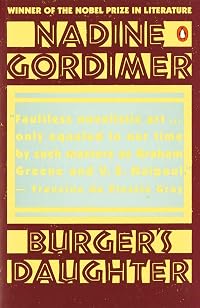
Burger's Daughter
by Nadine Gordimer
On This Page
Description
In South Africa, where Blacks and whites are caught in the winds of change, a young woman tries to uphold the radical heritage she received from her martyred parents while carving out a sense of self.Tags
Recommendations












Member Reviews
This is a wonderful book. I was expecting something overtly political, not realising that, as a writer living under the Apartheid regime in South Africa, Nadine Gordimer couldn't write anything overtly political. So she wrote something beautiful. And even so, it was banned.
The style has elements of Virginia Woolf's experiments with stream of conscious monologue, but the subject matter has far more weight than the things that concerned Woolf. The prose also has the coolness of Hemingway about it, a detached observational stance. The descriptions of place and season, and the way people move through life and among each other, are lyrical without being florid. There is a stillness running through the book that I found strangely comforting. show more There are no depictions of brutality or activism, nothing visceral or passionate, but the book feels more powerful for that. I felt like I had read something significant.
Rosa Burger is the daughter of a white South African Communist imprisoned for his political activity. We only ever meet him in the ways Rosa tries to distance herself from him, and his admirers eulogise him. He was a huge public figure. When he dies, Rosa realises she only really knew the public Lionel Burger. She did not know or really have a father, because Lionel belonged to everyone. The book explores the socio-political struggle of black South Africans without being about that struggle. From the people around her, we learn about the continued struggle. From Rosa, we learn what it is to be the child of a political hero and demon. We hear from Rosa in her one-sided conversations with an absent former lover, as she struggles to explain her life so far and the shadow her father casts over it. We hear about her in the third person, as though described in a newspaper report. We see her through the eyes of the surveillance service who follow her. Without having acted politically herself, she is automatically a named person following her father's death. She is white, she is an Afrikaner, but by the accident of her birth, and her father's political beliefs, she is denied freedom of movement and has expectations placed on her. She is the victim of oppression in different ways to someone black, but she shares their experience. She chooses not to become the person her father's friends and the state expect her to become. Her aim is to keep out of the limelight and obtain a passport. Only by leaving South Africa can she discover who she really is, and even then Lionel is still present.
The book made me think about racism and political oppression from the perspective of the oppressed, particularly in its rejection of a liberal white-led movement towards a 'free' South Africa. I found the passages where black characters spoke of their need to be in charge of bringing about change on their own terms very powerful. It also made me think about how we define ourselves, and how the experiences of our parents shape us just as much as our own experiences do. show less
The style has elements of Virginia Woolf's experiments with stream of conscious monologue, but the subject matter has far more weight than the things that concerned Woolf. The prose also has the coolness of Hemingway about it, a detached observational stance. The descriptions of place and season, and the way people move through life and among each other, are lyrical without being florid. There is a stillness running through the book that I found strangely comforting. show more There are no depictions of brutality or activism, nothing visceral or passionate, but the book feels more powerful for that. I felt like I had read something significant.
Rosa Burger is the daughter of a white South African Communist imprisoned for his political activity. We only ever meet him in the ways Rosa tries to distance herself from him, and his admirers eulogise him. He was a huge public figure. When he dies, Rosa realises she only really knew the public Lionel Burger. She did not know or really have a father, because Lionel belonged to everyone. The book explores the socio-political struggle of black South Africans without being about that struggle. From the people around her, we learn about the continued struggle. From Rosa, we learn what it is to be the child of a political hero and demon. We hear from Rosa in her one-sided conversations with an absent former lover, as she struggles to explain her life so far and the shadow her father casts over it. We hear about her in the third person, as though described in a newspaper report. We see her through the eyes of the surveillance service who follow her. Without having acted politically herself, she is automatically a named person following her father's death. She is white, she is an Afrikaner, but by the accident of her birth, and her father's political beliefs, she is denied freedom of movement and has expectations placed on her. She is the victim of oppression in different ways to someone black, but she shares their experience. She chooses not to become the person her father's friends and the state expect her to become. Her aim is to keep out of the limelight and obtain a passport. Only by leaving South Africa can she discover who she really is, and even then Lionel is still present.
The book made me think about racism and political oppression from the perspective of the oppressed, particularly in its rejection of a liberal white-led movement towards a 'free' South Africa. I found the passages where black characters spoke of their need to be in charge of bringing about change on their own terms very powerful. It also made me think about how we define ourselves, and how the experiences of our parents shape us just as much as our own experiences do. show less
What would you do if you were me? What is to be done?
Don't read this if you don't like politics, experimental writing, breaking down academic jargon to the bare necessities, candid displays of brutality and bodily functions of the female sort, and complete and utter lack of book-bound solutions for book-invoked problems. For those of you who require more holistic commitment and saviourless methodologies than the likes of [1984] and [Brave New World] can offer, read on.
...he won't scruple to invoke Kierkegaard's Either/Or against Hegel's dialectic to demonstrate the justice of segregated lavatories...
Don't say I didn't warn you.
The kind of education the children've rebelled against is evident enough; they can't spell and they can'tshow more
formulate their elation and anguish. But they know why they're dying.
That fact is that the majority of people who read this book on Goodreads will be white. There are variations of privilege in being white, but on the whole, should a white person's car stall while in the middle of a white neighborhood in Detroit, they upon asking for help at a nearby house will not be shot in the back of the head. I use this analogy grounded in the United States to explicate the contents of this book concerned with South Africa because while the United States is all I know, it was enough to teach me the difference between my words of understanding and others' lives of being a long time ago. It's a lesson that must be refreshed every time, all the time, for the ideological indoctrination comes in many forms and the books like this that survive them are few.
One of those eager souls who see no contradiction in their protest that they are not at all 'political' but would like to do something effective—something less self-defeating than charity, for what (euphemism being their natural means of expression) they call 'race relations'.
The term 'code-switching' focuses on the minority, whatever dialect or modicum of expression that is inherently less powerful due to pomp and circumstance. Those who attempt to refute their physical privilege and the need for 'switching' entirely make the mistake of believing they can prove their claim through living, as if their lives were their own to do with what they will. Death is not an equalizer so long as history chooses the heroes.
I know plenty blacks like Burger. It’s nothing, it’s us, we must be used to it, it’s not going to show on English television.
What this book is concerned with is a matter of existing with the least amount of blood on your hands. That's all. That's it. Now, there is plenty of social theory involved in that question, plenty of stories of those who have gone before, plenty of family and friends and peers and privileges to demarcate, explicate, perhaps even the boogeyBOSS of a Cthulhu government that will pull you into confrontation without the need for a single finger of effort on your part. There is the reality, there is the cause, and then there's you, and if you happen to be white in South Africa, not only could you flee through the favor of government that looks like you, your life would be the one applauded.
The old phrases crack and meaning shakes out wet and new.
Congratulations. You have been absolved of your guilt by resembling the powers that be. How does that feel?
There was no way of identifying one’s white face as one that was different from any other, one that should be spared.show less
Listed in 1001 Books You Must Read Before You Die, Nobel Laureate Nadine Gordimer's Burger's People (1979) is a superb novel about the collateral damage to family members of activists. But, from our vantage point as readers in the 21st century, knowing just how long it took for apartheid to be dismantled in South Africa, and knowing also that it is on the verge of being a failed state, it is also deeply sad.
The novel is the story of Rosa Burger, named by her idealistic, Marxist parents after the revolutionary socialist Rosa Luxemburg. The focus is on her struggle to find an identity after both her parents are dead, when she is emotionally adrift yet expected by all sides to continue her parents' efforts to subvert apartheid in South show more Africa.
The novel begins with a vivid image: a fourteen-year-old girl in her school uniform, standing in a queue of others waiting to visit their loved ones in prison. She is bringing blankets and a hot water bottle to her mother who has been detained in a brutal dawn swoop.
That passage, however, is in Italics, indicative of a feature of this novel: the different narrative voices. Sometimes it is Rosa's first person stream-of-consciousness voice, addressing other people in her life: her lovers, or her father, or her father's first wife. Sometimes it is a pseudo-objective sympathetic third person narrator, and sometimes that narrator reproduces the cynical, sarcastic voice of the authorities whose job it is to sabotage everything the activists try to do. Direct dialogue is rare: it is nearly always reproduced by someone else, often interrupted by what others said. Sometimes it takes a while to work who is who and where they are.
Rosa adapts without fuss to this shocking event — her mother in a notorious prison — because she has been raised in the expectation that both her parents might be in prison at the same time. She has grown up in a political atmosphere, where the house if full of banned people flouting the bans, people on bail, spouses suddenly single and not always just temporarily. They have ways of subverting the segregation laws; they have exits from the house that the surveillance teams don't know about; and Rosa, from a young age, has learned the art of not answering questions, deflecting topics she doesn't want to discuss, keeping her face blank and devoid of any expression that might reveal things that must be kept secret.
So it's not a normal childhood though she always knows that she has privilege because she's a white South African.
To read the rest of my review please visit https://anzlitlovers.com/2025/07/29/burgers-daughter-1979-by-nadine-gordimer/ show less
The novel is the story of Rosa Burger, named by her idealistic, Marxist parents after the revolutionary socialist Rosa Luxemburg. The focus is on her struggle to find an identity after both her parents are dead, when she is emotionally adrift yet expected by all sides to continue her parents' efforts to subvert apartheid in South show more Africa.
The novel begins with a vivid image: a fourteen-year-old girl in her school uniform, standing in a queue of others waiting to visit their loved ones in prison. She is bringing blankets and a hot water bottle to her mother who has been detained in a brutal dawn swoop.
The child was dry-eyed and composed, in fact she was an example to us all of the way a detainee's family ought to behave. Already she had taken on her mother's role in the household, giving loving support to her father, who was all too soon to be detained as well. On that day he had put others' plight before his own, and had been tirelessly busy ever since his own wife had been taken in the early hours of the morning, going from police station to police station trying to establish for helpless African families where their people were being held. But he knew that his schoolgirl daughter could be counted on in this family totally united and dedicated to the struggle. (p.12)
That passage, however, is in Italics, indicative of a feature of this novel: the different narrative voices. Sometimes it is Rosa's first person stream-of-consciousness voice, addressing other people in her life: her lovers, or her father, or her father's first wife. Sometimes it is a pseudo-objective sympathetic third person narrator, and sometimes that narrator reproduces the cynical, sarcastic voice of the authorities whose job it is to sabotage everything the activists try to do. Direct dialogue is rare: it is nearly always reproduced by someone else, often interrupted by what others said. Sometimes it takes a while to work who is who and where they are.
Rosa adapts without fuss to this shocking event — her mother in a notorious prison — because she has been raised in the expectation that both her parents might be in prison at the same time. She has grown up in a political atmosphere, where the house if full of banned people flouting the bans, people on bail, spouses suddenly single and not always just temporarily. They have ways of subverting the segregation laws; they have exits from the house that the surveillance teams don't know about; and Rosa, from a young age, has learned the art of not answering questions, deflecting topics she doesn't want to discuss, keeping her face blank and devoid of any expression that might reveal things that must be kept secret.
So it's not a normal childhood though she always knows that she has privilege because she's a white South African.
To read the rest of my review please visit https://anzlitlovers.com/2025/07/29/burgers-daughter-1979-by-nadine-gordimer/ show less
Written under Apartheid, Rosa is the daughter of 2 Afrikaner communists fighting against the regime. Gordimer uses Rosa to discuss the life of a young woman born into a family of dissenters and how this affects her own fate. On a government list from birth, Rosa spends her childhood, and later adulthood, visiting her parents in prison, passing messages and also living under suspicion. Part two takes the action overseas to Europe, where those against Apartheid lived in exile, before moving back to South Africa. Gordimer shows us how hard it is to maintain personal relationships under such circumstances. What sets the book apart from others is mixture of writing styles and changing perspectives. I found this enriched the novel as I felt show more you got a deeper understanding of Rosa. Highly recommended. show less
Burger's Daughter My first book finished for the year is for my personal Reading Nobel Women challenge. This was my choice for Nadine Gordimer who is a recipient for Literature, so I read one of her novels.
It has taken me a while to attempt to process how I feel about this book. It was difficult to get through because of the nature of the book. For starters, I know relatively little of what was going on in South Africa during apartheid and the anti-apartheid movements. I got the glossed over and sugar-coated versions in school. I knew of Nelson Mandela, even back in school, and what he was known for, but I couldn't grasp it. It was real in that I knew it to be nonfiction but it didn't really exist in my mind. As an American, so far show more away from South African, I just didn't get it.
While I will never understand the full impact of everything involved with apartheid, getting rid of it and getting past it, reading this book began to paint a picture I wasn't familiar with. I was lost for most of the beginning because the topic was so for it's time and place and they were still in the thick of it that I don't think it occurred to the author that it might be necessary one day. Still, I wish there was some sort of forward that was added for modern readers who aren't as familiar with the time that the story begins.
Another confusing thing in the beginning was the way it switched from the third person to the first person in some chapters, with the first person being Rosa's internal monologue talking to different people. It was mostly an old lover in the beginning but some others are added at the end.
The story itself isn't about apartheid or ending it, so much as this girl trying to live in that time and with her own heritage. Rosa is the daughter of a prominent white Communist who actively advocated for apartheid to end and for the Africans to be complete citizens in their own country. He is believed to be based on Bram Fischer. What makes the book magical in its own way isn't so much the story itself but all the little observations of Rosa when she is in the first person. She occupies a strange place in the history of South Africa where she sees things about the status of the places that other's within the story don't see.
More importantly, it's the way Gordimer says things, whether it is the way Rosa sees things or the arguments of people around her. Here is a piece of a conversation that I just don't really know what to do with:
It’s not peace at any price, it’s peace for each at his price. White liberalism will sacrifice the long odds on attaining social justice and settle for letting blacks into the exploiting class. The ‘enlightened’ government crowd will sacrifice the long odds on maintaining complete white supremacy and settle for propping up a black middle class whose class interests run counter to a black revolution.
It's just one piece of a larger conversation about whether or not the black who were invited to box with the whites at the Olympics and what it means for everyone. Is it progress that they are being invited? Is it a stall tactic for the whites who are in power to not have a full on revolution? And then what does it all mean when you take a second and look back on your own country's history? It sent me in circles for days thinking about how things work in the US and whether or not this person was on to something and what it would mean for everyone if it really worked this way. Passages like this happened several times in the book.
Rosa was a great character, not necessarily because she is likable but because she isn't always likable. A character shouldn't always have to be likable. Sometimes they are going to do disagreeable things, just as people do, if they are to be true to life characters. Her world and her problems were interesting and foreign to me and it was completely understandable to me for her to feel every way she felt, even when it resulted in her doing things I didn't think were a good idea.
The most relatable thing about the book, especially right now with the way so many people are feeling in the wake of the US's own recent political upheaval, was the way Rosa doesn't like her lot in life as one the "named" from birth. She has no chance for a normal life because of who her parents were but she also doesn't appear to want what a normal white girl there were have because of how her parents raised her. She spends most of the book in a place of hopelessness about how apartheid will never end. I can imagine that given the time it took, many people felt that way.
Altogether, it was a great book to read, it just wasn't fun or enjoyable. It was thought-provoking, it was difficult, it was heart-breaking, it rocked my world every few chapters, and it was a touch inspirational here and there. That said, it's not for everyone but anyone interested in world history should give it a try. Or anyone else interested in Reading all the Nobel Women, which I totally recommend because they are incredible women. show less
It has taken me a while to attempt to process how I feel about this book. It was difficult to get through because of the nature of the book. For starters, I know relatively little of what was going on in South Africa during apartheid and the anti-apartheid movements. I got the glossed over and sugar-coated versions in school. I knew of Nelson Mandela, even back in school, and what he was known for, but I couldn't grasp it. It was real in that I knew it to be nonfiction but it didn't really exist in my mind. As an American, so far show more away from South African, I just didn't get it.
While I will never understand the full impact of everything involved with apartheid, getting rid of it and getting past it, reading this book began to paint a picture I wasn't familiar with. I was lost for most of the beginning because the topic was so for it's time and place and they were still in the thick of it that I don't think it occurred to the author that it might be necessary one day. Still, I wish there was some sort of forward that was added for modern readers who aren't as familiar with the time that the story begins.
Another confusing thing in the beginning was the way it switched from the third person to the first person in some chapters, with the first person being Rosa's internal monologue talking to different people. It was mostly an old lover in the beginning but some others are added at the end.
The story itself isn't about apartheid or ending it, so much as this girl trying to live in that time and with her own heritage. Rosa is the daughter of a prominent white Communist who actively advocated for apartheid to end and for the Africans to be complete citizens in their own country. He is believed to be based on Bram Fischer. What makes the book magical in its own way isn't so much the story itself but all the little observations of Rosa when she is in the first person. She occupies a strange place in the history of South Africa where she sees things about the status of the places that other's within the story don't see.
More importantly, it's the way Gordimer says things, whether it is the way Rosa sees things or the arguments of people around her. Here is a piece of a conversation that I just don't really know what to do with:
It’s not peace at any price, it’s peace for each at his price. White liberalism will sacrifice the long odds on attaining social justice and settle for letting blacks into the exploiting class. The ‘enlightened’ government crowd will sacrifice the long odds on maintaining complete white supremacy and settle for propping up a black middle class whose class interests run counter to a black revolution.
It's just one piece of a larger conversation about whether or not the black who were invited to box with the whites at the Olympics and what it means for everyone. Is it progress that they are being invited? Is it a stall tactic for the whites who are in power to not have a full on revolution? And then what does it all mean when you take a second and look back on your own country's history? It sent me in circles for days thinking about how things work in the US and whether or not this person was on to something and what it would mean for everyone if it really worked this way. Passages like this happened several times in the book.
Rosa was a great character, not necessarily because she is likable but because she isn't always likable. A character shouldn't always have to be likable. Sometimes they are going to do disagreeable things, just as people do, if they are to be true to life characters. Her world and her problems were interesting and foreign to me and it was completely understandable to me for her to feel every way she felt, even when it resulted in her doing things I didn't think were a good idea.
The most relatable thing about the book, especially right now with the way so many people are feeling in the wake of the US's own recent political upheaval, was the way Rosa doesn't like her lot in life as one the "named" from birth. She has no chance for a normal life because of who her parents were but she also doesn't appear to want what a normal white girl there were have because of how her parents raised her. She spends most of the book in a place of hopelessness about how apartheid will never end. I can imagine that given the time it took, many people felt that way.
Altogether, it was a great book to read, it just wasn't fun or enjoyable. It was thought-provoking, it was difficult, it was heart-breaking, it rocked my world every few chapters, and it was a touch inspirational here and there. That said, it's not for everyone but anyone interested in world history should give it a try. Or anyone else interested in Reading all the Nobel Women, which I totally recommend because they are incredible women. show less
This was my first "go" at a novel by Nobel-Prize winning author Gordimer, and I really really wanted to like it. But - ooh, it was a slog, and rather a long haul to finish. South Africa is important, reading books about apartheid is necessary, but it seemed as if Gordimer was trying to make her character's story as inaccessible as possible. The "high modernist" style puts a great distance between the author and the reader. (I think book this was more difficult to read than late Henry James.)
The central character Rosa Burger is the daughter of a great anti-Apartheid activist and his equally committed anti-Apartheid wife. In the course of the book, she emerges from the shadow of her parents to become her own person. All this takes place show more in the backdrop of South Africa - specifically in and around Johannesburg - in the late 1960s and early 1970s, with most of the action taking place prior to the 1976 Soweto riots. Gordimer uses an interesting narrative style, not in itself an issue - there is both a first-person narrator, and a third person voice as well. The problem is that both used the same abstract, indirect, verbose, overly complex diction - so that they were both rather indistinguishable - as well as both being undistinguished. Too many compound complex sentences that don't go anywhere! And, finally, Gordimer does not use quotation marks for character speech - and I found it very annoying not always to be able to tell the difference between spoken words and inner thoughts. show less
The central character Rosa Burger is the daughter of a great anti-Apartheid activist and his equally committed anti-Apartheid wife. In the course of the book, she emerges from the shadow of her parents to become her own person. All this takes place show more in the backdrop of South Africa - specifically in and around Johannesburg - in the late 1960s and early 1970s, with most of the action taking place prior to the 1976 Soweto riots. Gordimer uses an interesting narrative style, not in itself an issue - there is both a first-person narrator, and a third person voice as well. The problem is that both used the same abstract, indirect, verbose, overly complex diction - so that they were both rather indistinguishable - as well as both being undistinguished. Too many compound complex sentences that don't go anywhere! And, finally, Gordimer does not use quotation marks for character speech - and I found it very annoying not always to be able to tell the difference between spoken words and inner thoughts. show less
This was the second novel by Nadine Gordimer that I have read; several years ago I read her short novel, July's People. I wish this novel had been a bit shorter, for I did not enjoy reading it. The story follows the life of Rosa, the title character, as she comes to terms with her father Lionel's legacy as an activist in the South African Communist Party over the course of 30 years. The perspective shifts between Rosa's internal monologue (often directed towards her father or her sometimes lover Conrad), and the omniscient narrator. The novel is rooted in the history of the anti-apartheid struggle in South Africa with references to actual events and people from that period.
Her somewhat cryptic style and the difficulty I had trying to show more focus on what was happening in the story made reading it more difficult than it was worth. There were moments of beautiful prose and my own travel to South Africa helped me picture some of the settings. However the history seemed to overwhelm the story of Rosa Burger. I asked myself whether this was a novel about Rosa Burger with historical context or if Burger's daughter was a cipher who inhabited a narrative about the history of twentieth century South Africa? There were moments in the narrative arc that seemed to exist for Rosa, but there were others that intruded creating a jagged edge. It was these moments where I had to force myself to keep reading from page to page. For a while I hoped the next chapter would bring some relief, but I gradually realized that this book was not going to succeed for this reader. show less
Her somewhat cryptic style and the difficulty I had trying to show more focus on what was happening in the story made reading it more difficult than it was worth. There were moments of beautiful prose and my own travel to South Africa helped me picture some of the settings. However the history seemed to overwhelm the story of Rosa Burger. I asked myself whether this was a novel about Rosa Burger with historical context or if Burger's daughter was a cipher who inhabited a narrative about the history of twentieth century South Africa? There were moments in the narrative arc that seemed to exist for Rosa, but there were others that intruded creating a jagged edge. It was these moments where I had to force myself to keep reading from page to page. For a while I hoped the next chapter would bring some relief, but I gradually realized that this book was not going to succeed for this reader. show less
Members
- Recently Added By
Lists

1001 Books You Must Read Before You Die
1,448 works; 1,134 members

Female Author
1,234 works; 64 members

1970s
657 works; 23 members

Nobel Price Winners
222 works; 20 members

"I'd Group-Read That"
20 works; 6 members

500 Great Books by Women
507 works; 60 members

1,001 BYMRBYD Concensus
723 works; 27 members
TML 200 Best Books 1950-1999
202 works; 10 members

Revolutions
72 works; 5 members

My TBR
371 works; 3 members

The Modern Library (The Two Hundred Best Novels....
202 works; 1 member
Author Information

118+ Works 12,491 Members
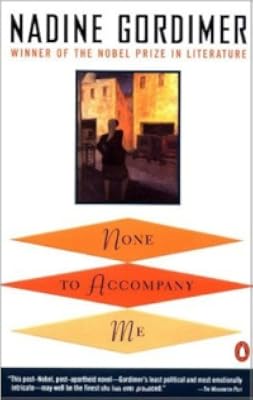
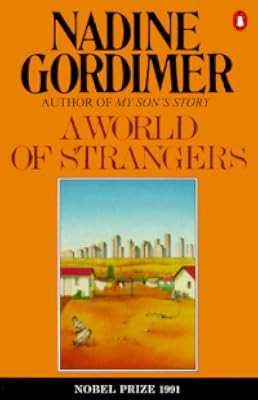
Nadine Gordimer was born in Gauteng, South Africa on November 20, 1923. She attended the University of Witwatersrand, Johannesburg, South Africa for one year. She is a novelist and short-story writer whose major theme is exile and alienation. Her first short story collection, The Soft Voice of the Serpent, was published in 1952 and her first show more novel, The Lying Days, was published in 1953. Her other short story collections include Jump, Why Haven't You Written: Selected Stories 1950-1972, and Loot. Her other novels include A World of Strangers, A Guest of Honour, Burger's Daughter, July's People, A Sport of Nature, My Son's Story, None to Accompany Me, The Pickup, and Get a Life. She has received numerous awards including the Booker Prize for The Conservationist in 1974, the Nobel Prize for Literature in 1991, and the French Legion of Honour in 2007. She died on July 13, 2014 at the age of 90. (Bowker Author Biography) Nadine Gordimer was awarded the Nobel Prize in Literature in 1991. (Publisher Provided) show less
Some Editions
Awards and Honors
Awards
Notable Lists
Series
Belongs to Publisher Series
Common Knowledge
- Canonical title*
- Burgers Tochter
- Original title
- Burger’s daughter
- Original publication date
- 1979
- People/Characters
- Rosemarie Burger "Rosa"
- Important places
- South Africa; Africa
- Epigraph
- I am the place in which something has occurred.
Claude Lévi-Strauss - First words
- Among the group of people waiting at the fortress was a schoolgirl in a brown and yellow uniform holding a green eiderdown quilt and, by the loop at its neck, a red hot-water bottle.
- Last words
- (Click to show. Warning: May contain spoilers.)Madame Bagnelli was never able to make it out.
- Original language
- English
- Canonical DDC/MDS
- 828.9936
*Some information comes from Common Knowledge in other languages. Click "Edit" for more information.
Classifications
- Genres
- General Fiction, Fiction and Literature
- DDC/MDS
- 828.9936 — Literature & rhetoric English & Old English literatures English miscellaneous writings English miscellaneous writings 1900- Non-American English language literature outside Britain (option) New Zealand, Australia, India, South Africa South Africa
- LCC
- PR9369.3 .G6 .B8 — Language and Literature English English Literature English literature: Provincial, local, etc.
- BISAC
Statistics
- Members
- 1,184
- Popularity
- 21,136
- Reviews
- 21
- Rating
- (3.59)
- Languages
- 12 — Catalan, Danish, Dutch, English, Finnish, French, German, Italian, Norwegian (Bokmål), Norwegian, Spanish, Swedish
- Media
- Paper, Audiobook, Ebook
- ISBNs
- 46
- ASINs
- 12