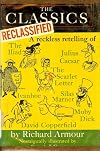
The classics reclassified
by Richard Armour
On This Page
Tags
Recommendations






















Member Recommendations

Member Reviews
The infamous comic writer of light verse, and my late good friend, Richard Armour, takes on The Classics. He summarizes ("digests") in memorable caricature, some of the Great Works, and provides biographical information. Fun "Questions" follow each literary selection. I provide a few selections of his observations:
Homer - Born in the 9th century BC, "Almost nothing is known about Homer, which explains why so much has been written about him". [1] He lived in poverty, was blind, and "wrote nothing down, perhaps not wishing to leave incriminating evidence". [3] "The marked difference in style between his two great epics has given rise to the theory that Homer was a man when he wrote the ILIAD and a woman when he wrote the ODYSSEY." show more [4]
Shakespeare - Baptized in 1564, Shakespear's mother was Mary Arden. "Little is known about her excerpt that she had eight children and was known for her good breeding". [24] Reviews "Julius Caesar", noting that the central character is Brutus, but "there is no movement afoot to change the name of the play".
Walter Scott. Born 1771, "his mother had ten bairns. An indefatigable woman, she also found time to have a child, Walter". Scott studied law, but wrote poetry and potboilers for money, struggling to pay off his debts. [46].
IVANHOE is set in the 12th century time of The Crusades, We have disguised crusaders returning home, feasting, and a tournament attended by Isaac the moneylender and his daughter Rebecca, whose beauty Scott devotes pages to describing--"the three uppermost clasps of her vest were left unfastened on account of the heat, which...enlarged the propsect to which we allude". [51] And of course, there is much "sounding of trumpets". In tourney, Ivanhoe is wounded. Brigands waylay Rowena and Rebecca and
Locksley (Robin Hood) and the Black Knight (King Richard) and Wamba (Wamba) surround the castle-dungeon of Front-de-Boeuf (Beef-head, and no I'm not making this up). Eventually, Ivanhoe is nursed to health by Rebecca who is then accused of witchcraft....eventually there is a chance of redemption by combat, and Armour provides no spoils alert.
Hawthorne - Born in Salem, 1804, descended from "sable-cloaked, steeple-crowned progenitors". [66] After a series of minor government jobs, Hawthorne took up writing stories about Puritans: "Two of his four novels deal with adultery, and some of his charactere go in for incest and fratricide". [69]
THE SCARLET LETTER. "The story is set in Boston, back in colonial times, when sin was really sinful." Armour keeps us in suspense about the identity of the father of the bastard child born of Hester. Her undisclosed husband, the fraudulent "Doctor" Chillingworth suspects "the sickening Mr. Dimmesdale, who is getting paler and thinner every day, in part because of his practice of fasting, 'to keep the grossness of his earthly state from clogging and obscuring his spiritual lamp'." [77]
Melville - Born 1819, son of a bankrupt, in New York City, and no formal education after the age of fifteen. He took to the sea as a cabin boy, and once said that his ship-years among the sailors and cannibals in Polynesia were "my Yale and Harvard", except "he received no degree and no letters from the Alumni Fund." [88]
MOBY DICK. Armour again provides a review that captures at once the feelings, ironies, and tone as well as the plot, and with humor! Noting that Ishmael is the first person narrator, and in Boston Ishmael shares a bed and becomes "buddies" with Queequeg, a heavily-tatooed harpooner from the South Seas, Armour notes the irony that his buddy's head reminded Ishmael of George Washington's bust.
In Chapter XXII, as Melville is about to introduce a "Captain Ahab", Melville "not wishing to rush things, elects at this point to give an account of the history and literature of whaling." [95] We learn that Alfred the Great wrote the first narrative of a whaling voyage, and Mary Folger, the grandmother of Benjamin Franklin, helped develop the New England whaling industry. We meet Ahab, "grim, troubled, mysterious", with a white facial scar and a "wooden leg made of ivory", which he steadies by sticking it into an especially prepared hole in the quarter-deck. [96] Armour then briefly adverts to the lesson in cetology Melville then presents, followed by a discussion of mastheads, from Egyptian times to the present.
Armour spares us the catalogue of famous pictures of whales, manufactures of rope lines, anatomy of whale eyes, ears, and tails, the particulars of skinning them, preparing blubber meals, and then at last, a great white whale with a crooked jaw and holes in its starboard flukes "has finally swum into his own book". Captain Ahab goes out of his mind -- "T'gallant sails!--stunsails! alow and aloft, and on both sides", and such gibberish. With only three chapters remaining, he also gets out "There she blows!".
Next, Armour surpasses himself by positing a theory and its basis, which appear to be irrefragable: That Moby Dick is not, "as so many scholars maintain, the Myuth of Indestructibility, the Christian Deity, Untrammeled Nature, the Puritan Conscience...--but Jupiter!" A pagan deity slipped into a cetacean to vex Ahab, just as Jupiter once disguised himself as a bull to carry off the voluptuous Europa. [99] Bril.
In the epic battle between whale-hunters and whale, Armour does not stand upon allegory and symbolism, but informs us of the outcome. Of course, it is no spoiler to note that Ishmael, the narrator, survives.
George Eliot - Born 1819 as Mary Ann Evans. How she came by her pen name "is not clear...she may have liked the By George on the title page of her books". [106] She and George Lewes became devoted to each other although he was married. When her books were successful and she could afford to do so, George Eliot supported him, his children and his wife until his death. When she was sixty, George Eliot married a man twenty years her junior.
SILAS MARNER. A moral tale, in which virtue is rewarded, though it took some forty years. Silas is a weaver, "grown pale, nearsighted, and so pathetic that the reader whose heart bleeds easily should keep a tourniquet handy." [110] Of course, we love him at the end.
Dickens - Born in Portsea, England, 1812, to a man eventually consigned Marshalsea ("a very damp prison") for failing to pay his debts. [124] Dickens "became wealthy writing about the poor." [125] He felt that the rich "should be forced to give up some of their ill-gotten gains" and he was a social reformer. He visited America twice--getting materials for MARTIN CHUZZLEWIT in which he describes Americans as "humbugs, braggarts, savages, and idiots" [127].
DAVID COPPERFIELD. Armour provides a moving rendition of this novel which ends in tears of happiness. show less
Homer - Born in the 9th century BC, "Almost nothing is known about Homer, which explains why so much has been written about him". [1] He lived in poverty, was blind, and "wrote nothing down, perhaps not wishing to leave incriminating evidence". [3] "The marked difference in style between his two great epics has given rise to the theory that Homer was a man when he wrote the ILIAD and a woman when he wrote the ODYSSEY." show more [4]
Shakespeare - Baptized in 1564, Shakespear's mother was Mary Arden. "Little is known about her excerpt that she had eight children and was known for her good breeding". [24] Reviews "Julius Caesar", noting that the central character is Brutus, but "there is no movement afoot to change the name of the play".
Walter Scott. Born 1771, "his mother had ten bairns. An indefatigable woman, she also found time to have a child, Walter". Scott studied law, but wrote poetry and potboilers for money, struggling to pay off his debts. [46].
IVANHOE is set in the 12th century time of The Crusades, We have disguised crusaders returning home, feasting, and a tournament attended by Isaac the moneylender and his daughter Rebecca, whose beauty Scott devotes pages to describing--"the three uppermost clasps of her vest were left unfastened on account of the heat, which...enlarged the propsect to which we allude". [51] And of course, there is much "sounding of trumpets". In tourney, Ivanhoe is wounded. Brigands waylay Rowena and Rebecca and
Locksley (Robin Hood) and the Black Knight (King Richard) and Wamba (Wamba) surround the castle-dungeon of Front-de-Boeuf (Beef-head, and no I'm not making this up). Eventually, Ivanhoe is nursed to health by Rebecca who is then accused of witchcraft....eventually there is a chance of redemption by combat, and Armour provides no spoils alert.
Hawthorne - Born in Salem, 1804, descended from "sable-cloaked, steeple-crowned progenitors". [66] After a series of minor government jobs, Hawthorne took up writing stories about Puritans: "Two of his four novels deal with adultery, and some of his charactere go in for incest and fratricide". [69]
THE SCARLET LETTER. "The story is set in Boston, back in colonial times, when sin was really sinful." Armour keeps us in suspense about the identity of the father of the bastard child born of Hester. Her undisclosed husband, the fraudulent "Doctor" Chillingworth suspects "the sickening Mr. Dimmesdale, who is getting paler and thinner every day, in part because of his practice of fasting, 'to keep the grossness of his earthly state from clogging and obscuring his spiritual lamp'." [77]
Melville - Born 1819, son of a bankrupt, in New York City, and no formal education after the age of fifteen. He took to the sea as a cabin boy, and once said that his ship-years among the sailors and cannibals in Polynesia were "my Yale and Harvard", except "he received no degree and no letters from the Alumni Fund." [88]
MOBY DICK. Armour again provides a review that captures at once the feelings, ironies, and tone as well as the plot, and with humor! Noting that Ishmael is the first person narrator, and in Boston Ishmael shares a bed and becomes "buddies" with Queequeg, a heavily-tatooed harpooner from the South Seas, Armour notes the irony that his buddy's head reminded Ishmael of George Washington's bust.
In Chapter XXII, as Melville is about to introduce a "Captain Ahab", Melville "not wishing to rush things, elects at this point to give an account of the history and literature of whaling." [95] We learn that Alfred the Great wrote the first narrative of a whaling voyage, and Mary Folger, the grandmother of Benjamin Franklin, helped develop the New England whaling industry. We meet Ahab, "grim, troubled, mysterious", with a white facial scar and a "wooden leg made of ivory", which he steadies by sticking it into an especially prepared hole in the quarter-deck. [96] Armour then briefly adverts to the lesson in cetology Melville then presents, followed by a discussion of mastheads, from Egyptian times to the present.
Armour spares us the catalogue of famous pictures of whales, manufactures of rope lines, anatomy of whale eyes, ears, and tails, the particulars of skinning them, preparing blubber meals, and then at last, a great white whale with a crooked jaw and holes in its starboard flukes "has finally swum into his own book". Captain Ahab goes out of his mind -- "T'gallant sails!--stunsails! alow and aloft, and on both sides", and such gibberish. With only three chapters remaining, he also gets out "There she blows!".
Next, Armour surpasses himself by positing a theory and its basis, which appear to be irrefragable: That Moby Dick is not, "as so many scholars maintain, the Myuth of Indestructibility, the Christian Deity, Untrammeled Nature, the Puritan Conscience...--but Jupiter!" A pagan deity slipped into a cetacean to vex Ahab, just as Jupiter once disguised himself as a bull to carry off the voluptuous Europa. [99] Bril.
In the epic battle between whale-hunters and whale, Armour does not stand upon allegory and symbolism, but informs us of the outcome. Of course, it is no spoiler to note that Ishmael, the narrator, survives.
George Eliot - Born 1819 as Mary Ann Evans. How she came by her pen name "is not clear...she may have liked the By George on the title page of her books". [106] She and George Lewes became devoted to each other although he was married. When her books were successful and she could afford to do so, George Eliot supported him, his children and his wife until his death. When she was sixty, George Eliot married a man twenty years her junior.
SILAS MARNER. A moral tale, in which virtue is rewarded, though it took some forty years. Silas is a weaver, "grown pale, nearsighted, and so pathetic that the reader whose heart bleeds easily should keep a tourniquet handy." [110] Of course, we love him at the end.
Dickens - Born in Portsea, England, 1812, to a man eventually consigned Marshalsea ("a very damp prison") for failing to pay his debts. [124] Dickens "became wealthy writing about the poor." [125] He felt that the rich "should be forced to give up some of their ill-gotten gains" and he was a social reformer. He visited America twice--getting materials for MARTIN CHUZZLEWIT in which he describes Americans as "humbugs, braggarts, savages, and idiots" [127].
DAVID COPPERFIELD. Armour provides a moving rendition of this novel which ends in tears of happiness. show less
Hilarious collection of parodies of the literary canon. I first discovered this book on the paperback rack at the drug store where I worked at age 15. My copy went missing. I loaned it to a school chum. 33 years later, she returned the book by mail. Armour's humor made me read the originals to fully appreciate the humor. I eventually earned an English degree and worked in publishing.
See youtube for Richard Armour delivering a hilarious 1971 address at UCLA (audio only):
Richard Armour speaking at UCLA 1/8/1971
See youtube for Richard Armour delivering a hilarious 1971 address at UCLA (audio only):
Richard Armour speaking at UCLA 1/8/1971
The Classics Reclassified was an old library favorite of mine, which I had not been able to reread in more years than I can remember. Now I have my own copy and have gladly reread it. The jokes are still funny and the illustrations still enjoyable. Although I have never read The Iliad, Julius Caesar, or Ivanhoe, I know how well Mr. Armour skewered The Scarlet Letter, Moby Dick, Silas Marner, and David Copperfield, , so I'm sure he was just as good with those other three.
I read this book before I read any of those classics, so if you haven't read the originals, go ahead. It'll still be fun.
I read this book before I read any of those classics, so if you haven't read the originals, go ahead. It'll still be fun.
Wonderfully insightful plays on words describe several of the books most required for reading: Scarlet Letter, Moby-Dick, David Copperfield, The Iliad (Achilles sulks all the way through), Ivanhoe, and Silas Marner (heart and cache of gold).
Thanks to this book, I now have conversational knowledge of The Iliad, Juliet Caesar, Ivanhoe, The Scarlet Letter, Moby Dick, Silas Marner and David Copperfield without having ever actually read those books. (Nor does it sound like I would want to read any of them.) And I got a few chuckles as well.
A word to the wise: some of these book summaries are repeated in Armour's later book, It All Started With Freshman English.
A word to the wise: some of these book summaries are repeated in Armour's later book, It All Started With Freshman English.
The Classics Reclassified by Richard Amour takes on Homer, Shakespeare, Sir Walter Scott, Hawthorne, Melville, George Eliot and Dickens. . . and wrestles them to the ground in 146 pages.
A sketch and a skewered biography of each of the authors prefaces a whirlwind retelling of their most famous book. Multiple choice questions follow, and Campbell Grant's illustrations enrich the text. (Yes, there ARE footnotes and a set of questions too.)
Even if you truly appreciate the originals you'll be amused (unless, unhappily, you have no sense of humor).
A sketch and a skewered biography of each of the authors prefaces a whirlwind retelling of their most famous book. Multiple choice questions follow, and Campbell Grant's illustrations enrich the text. (Yes, there ARE footnotes and a set of questions too.)
Even if you truly appreciate the originals you'll be amused (unless, unhappily, you have no sense of humor).
1
Members
- Recently Added By
Author Information

64+ Works 2,284 Members
All Editions
Common Knowledge
- Canonical title
- The classics reclassified
- Original title
- The classics reclassified ; in which certain famous books are not so much digested as indigested, together with mercifully brief biographies of their authors, a few unnecessary footnotes, and questions which it might be helpful not to answer
- Original publication date
- 1960-09
- People/Characters
- Homer; William Shakespeare; Sir Walter Scott; Nathaniel Hawthorne; Herman Melville; George Eliot (Mary Ann Evans Cross) (show all 101); Charles Dickens; Achilles; Agamemnon; Briseis; Zeus, Greek king of gods; Hera; Athene; Thetis; Paris of Troy; Helen of Troy; Menelaus, Greek mythology a king of Sparta, the husband of Helen of Troy; Pandarus; Hector; Andromache, wife of Hector; Skamandrios, son of Hector; Odysseus of Ithaca; Diomedes; Patroclus; Apollo; Haphaestus; Xanthos; King Priam of Troy; Julius Caesar; Calpurnia [in Julius Caesar]; Flavius; Marullus; Cassius; Brutus; Decius; Ligarius; Casca; Trebonius; Cinna; Publius; Mark Antony; Octavius; Lepidus; Pindarus; Strato; Richard Coeur de Lion|Richard Lionhearted; Prince John of England; Wilfred Ivanhoe; Cedric of Rotherwood (Ivanhoe's father); Lady Rowena (Cedric's ward); Reginald Front-de-Boeuf; Brian de Bois-Guilbert; Isaac the moneylender; Rebecca (Isaac's daughter); Locksley; Robin Hood; Athelstane; Urfried, daughter of Torquil Wolfganger; Prior Aylmer; Wamba the jester; Gurth the swineherd; Hester Prynne; Pearl Prynne (Hester's daughter); Roger Chillingworth (Hester's husband); Reverend Dimmesdale; Ishmael; Queequeg; Captain Ahab; Captain Bildad; Captain Peleg; Elijah (hints darkly about Captain Ahab); Moby-Dick; Moby Dick; Silas Marner; Squire Cass; Godfrey Cass (elder son); Dunstan Cass (younger son); Nancy Lammeter; Mrs. Winthrop (the wheelwright's wife); Molly Cass (Godfrey's secret wife); Hepzibah 'Eppie' (Godfrey's daughter | Silas' adopted daughter); Aaron Winthrop (the wheelwright's son); David Copperfield; Peggotty (David's nursemaid); Betsey Trotwood (David's aunt); Mr. Murdstone (David's stepfather); Miss Murdstone (Murdstone's sister); Barkis; J. Steerforth (cad); Tommy Traddles; Ham (Peggotty's nephew); Mrs. Gummidge; Em'ly (Peggotty's niece); Mr. Micawber; Mr. Wickfield (lawyer); Agnes Wickfield (daughter); Uriah Heep (Mr. Wickfield's assistant); Mr. Spenlow (David's employer); Dora Spenlow (daughter); Mrs. Crupp (David's housekeeper); Jip (Dora's dog)
- Important places
- Ancient Greece; Troy (modern Turkey); Stratford-upon-Avon, Warwickshire, England; London, England, UK; Rome, Italy; Edinburgh, Scotland (show all 13); Abbotsford, Borders, Scotland; England; Salem, Massachusetts, USA; Boston, Massachusetts Bay Colony; New York, New York, USA; Nantucket, Massachusetts, USA; Pacific Ocean
- Important events
- Trojan War (1260 - 1180 B.C. / B.C.E.)
- Dedication
- Dedicated to that amazing device, the Required Reading List, better even than artificial respiration for keeping dead authors alive.
- First words
- Almost nothing is known about Homer, which explains why so much has been written about him.
- Quotations
- 7. Mr. Micawber, the blowhard who served so much time in debtor's prison, is said to have been modeled on Dicken's father. Do you want your son to grow up to be a writer? (Questions on David Copperfield)
7. Do you realize how much information you have picked up about whales? Has this made you any happier and better adjusted? (Questions on Moby Dick)
One warrior is smitten with a javelin that goes in one temple and out another, but he is unharmed because he is not in either temple at the time. (The Iliad)
But back to David and Dora. They are wed and live idyllically, she calling him Doady (having given up trying to pronounce David) and he calling her Child Wife and Little Blossom (having given up his brains.) (David Coppe... (show all)rfield) - Last words
- (Click to show. Warning: May contain spoilers.)Full of the Dickens?
Classifications
Statistics
- Members
- 196
- Popularity
- 166,484
- Reviews
- 8
- Rating
- (4.15)
- Languages
- English
- Media
- Paper
- ISBNs
- 2
- ASINs
- 11