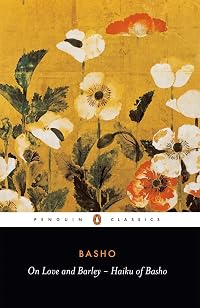
On Love and Barley: Haiku of Basho
by Matsuo Bashō
On This Page
Description
In a thoughtful and perceptive introduction, Stryk sets the stage for an appreciation of what Basho's poetry has to offer, sketching his life, his times, his spirit. For most of his life Basho was a recluse. He lived on the outskirts of Edo (Tokyo) in a hut shaded by an exotic banana tree (the Basho). When he traveled, he relied entirely on the hospitality of temples and fellow poets. His poems were strongly influenced by the Zen sect of Buddhism and its ideals of lightness, detachment, and show more appreciation of the commonplace. Basho aspired to and achieved unity of life and art, his poems become inseparable from nature. show lessTags
Recommendations


















Member Reviews
Me and my son did a thing with this book where whenever we'd set out on a walk or an adventure or a wagon ride or what have you we'd start with a haiku. It was the best and I am craving short nature poems to take Basho's place now (John Clare doesn't quite cut it, although I guess there's really no reason we couldn't start again with Basho from the start). It also gave us a lot of time to sit with the genre--he doesn't know most words and so I did a lot of explaining the meanings of the poems, and realized the really obvious thing that the highly constrained nature of the form makes them more, not less, open to different interpretations, as all the connecting information is left out and they are distilled to a series of vivid show more juxtapositions. Makes you notice the world around you. show less
I enjoyed this collection of haiku, though I had to keep reminding myself that the poems were translated and so the meter in English wasn't always what I expected for a haiku. Still, the images the poems evoked were lovely, and the introduction at the beginning was helpful to understand the backdrop for the collection.
Even in translation, where they inevitably must lose something, these poems are minatures of perfection, with a lightness and an unforced quality so different from the artifice and contrivance of many haiku produced since the art-form became famous. These are small gems that one can meditate over and dream upon.
If you like classic Haiku this is a nice collection from one of the early masters, Matsuo Kinsaku (1644-1694), better known as Basho, the name he took in honor of a banana tree that was given to him as a gift. It’s important not to “speed-read” through these 253 three-line poems - let the impact of the final decisive line sink in, it’s a simple but powerful form of poetry if you do that.
The ones I liked the most from this book are these seven:
“On the dead limb
squats a crow –
autumn night.”
“Faceless – bones
scattered in the field.
wind cuts my flesh.”
“Come, see real
flowers
of this painful world.”
“Loneliness –
caged cricket dangling
from the wall.”
“Friends part
forever – wild geese
lost in cloud.”
“Summer show more grasses,
all that remains
of soldiers’ dreams.”
Lastly this one, written as his “death poem”, a classic:
“Sick on a journey –
over parched fields
dreams wander on.” show less
The ones I liked the most from this book are these seven:
“On the dead limb
squats a crow –
autumn night.”
“Faceless – bones
scattered in the field.
wind cuts my flesh.”
“Come, see real
flowers
of this painful world.”
“Loneliness –
caged cricket dangling
from the wall.”
“Friends part
forever – wild geese
lost in cloud.”
“Summer show more grasses,
all that remains
of soldiers’ dreams.”
Lastly this one, written as his “death poem”, a classic:
“Sick on a journey –
over parched fields
dreams wander on.” show less
Review from
https://berniegourley.com/2016/11/04/book-review-on-love-and-barley-by-matsuo-ba...
This is a short collection of English translations of the haiku poetry of Matsuo Bashō. Bashō is one of the seminal figures in Japanese literature, and was a fascinating person. Living in 17th century Japan, his hometown was Iga-Ueno (a city whose other claim to fame was being one of two centers of medieval black-ops warriors known as ninja,) but he was also an ardent traveler and Zen Buddhist. One will note that many of his poems are about traveling.
The name of the collection is drawn from one of the poems (labeled “152” in this collection) that reads: “girl cat, so thin on love and barley”
Translating poetry is one of the hardest show more language tasks imaginable—and translating haiku to English is the hardest of the hard. This is because Japanese is grammatically sparse and the number of beats per syllable is limited, while English… not so much. Therefore, if one literally translates, not only would one likely get circa-2000 Babel Fish gibberish, the Zen simplicity vanishes. One has to appreciate any haiku to English translation that gets some of the feel of haiku right while still conveying meaning. This collection does a nice job in many cases, and maybe does it as well as can be expected.
The original poems [i.e. the Japanese] aren’t included. This may not seem like an issue to a reader who doesn’t know Japanese, but it can be nice to read the original poem phonetically (Japanese is a very phonetic language—unlike English.) The sound of a poem can be as evocative as its meaning. Some haiku translations offer three versions of the poem (i.e. the Japanese characters [useful only for Japanese readers], a Romanized spelling of the Japanese poem, and the translated poem), but—except for some of the poems referenced in the introduction—this one only gives the translation.
There is a substantial introduction that both gives one insight into Bashō as a person and poet, and puts his haiku into a broader context. There are also some end-notes for many of the poems to make sense of words and phrases that may not make sense to a contemporary English reader. There are some drawings that aren’t necessary, but they don’t hurt either, making a nice way to break up the collection. The book consists of about 50 pages of poems (with 5 haiku / page, or 250+ poems), and is less than 100 pages in total.
I would recommend this collection for poetry lovers. While poetry translations can be perilous, they can also offer new insight–even if one has read multiple translations of the same poem in the past.
>>>>>>>>>>>>>>>>>>>>>>>>>>>>>>
Review from Amazon:
Basho, one of the greatest of Japanese poets and the master of haiku, was also a Buddhist monk and a life-long traveller. His poems combine 'karumi', or lightness of touch, with the Zen ideal of oneness with creation. Each poem evokes the natural world - the cherry blossom, the leaping frog, the summer moon or the winter snow - suggesting the smallness of human life in comparison to the vastness and drama of nature. Basho himself enjoyed solitude and a life free from possessions, and his haiku are the work of an observant eye and a meditative mind, uncluttered by materialism and alive to the beauty of the world around him. show less
https://berniegourley.com/2016/11/04/book-review-on-love-and-barley-by-matsuo-ba...
This is a short collection of English translations of the haiku poetry of Matsuo Bashō. Bashō is one of the seminal figures in Japanese literature, and was a fascinating person. Living in 17th century Japan, his hometown was Iga-Ueno (a city whose other claim to fame was being one of two centers of medieval black-ops warriors known as ninja,) but he was also an ardent traveler and Zen Buddhist. One will note that many of his poems are about traveling.
The name of the collection is drawn from one of the poems (labeled “152” in this collection) that reads: “girl cat, so thin on love and barley”
Translating poetry is one of the hardest show more language tasks imaginable—and translating haiku to English is the hardest of the hard. This is because Japanese is grammatically sparse and the number of beats per syllable is limited, while English… not so much. Therefore, if one literally translates, not only would one likely get circa-2000 Babel Fish gibberish, the Zen simplicity vanishes. One has to appreciate any haiku to English translation that gets some of the feel of haiku right while still conveying meaning. This collection does a nice job in many cases, and maybe does it as well as can be expected.
The original poems [i.e. the Japanese] aren’t included. This may not seem like an issue to a reader who doesn’t know Japanese, but it can be nice to read the original poem phonetically (Japanese is a very phonetic language—unlike English.) The sound of a poem can be as evocative as its meaning. Some haiku translations offer three versions of the poem (i.e. the Japanese characters [useful only for Japanese readers], a Romanized spelling of the Japanese poem, and the translated poem), but—except for some of the poems referenced in the introduction—this one only gives the translation.
There is a substantial introduction that both gives one insight into Bashō as a person and poet, and puts his haiku into a broader context. There are also some end-notes for many of the poems to make sense of words and phrases that may not make sense to a contemporary English reader. There are some drawings that aren’t necessary, but they don’t hurt either, making a nice way to break up the collection. The book consists of about 50 pages of poems (with 5 haiku / page, or 250+ poems), and is less than 100 pages in total.
I would recommend this collection for poetry lovers. While poetry translations can be perilous, they can also offer new insight–even if one has read multiple translations of the same poem in the past.
>>>>>>>>>>>>>>>>>>>>>>>>>>>>>>
Review from Amazon:
Basho, one of the greatest of Japanese poets and the master of haiku, was also a Buddhist monk and a life-long traveller. His poems combine 'karumi', or lightness of touch, with the Zen ideal of oneness with creation. Each poem evokes the natural world - the cherry blossom, the leaping frog, the summer moon or the winter snow - suggesting the smallness of human life in comparison to the vastness and drama of nature. Basho himself enjoyed solitude and a life free from possessions, and his haiku are the work of an observant eye and a meditative mind, uncluttered by materialism and alive to the beauty of the world around him. show less
I never knew I could enjoy haiku so much.
Beautiful. The master of haiku.
Members
- Recently Added By
Lists

Japanese Literature
230 works; 40 members
Author Information

159+ Works 5,237 Members
The greatest of Japan's haiku poets and the greatest poet of his age, Basho raised the genre from a mediocre entertainment to serious verse and contributed greatly to its poetics. The work of his peak period is characterized by evocations of humankind's ultimate harmony with nature. He traveled widely, recording his journeys in his lyrical poetic show more diaries. He had numerous disciples, and haiku has remained a vigorous form of poetry to the present. (Bowker Author Biography) show less
All Editions
Some Editions
Series
Belongs to Publisher Series
Work Relationships
Is abridged in
Common Knowledge
- Canonical title
- On Love and Barley: Haiku of Basho
- Original publication date
- 1985 (English collection) (English collection)
- People/Characters
- Matsuo Bashō
- Important events
- Edo period or Tokugawa period; 17th century
- Dedication
- To Hiroshi Takaoka with affection
Classifications
- Genres
- Poetry, Fiction and Literature
- DDC/MDS
- 895 — Literature & rhetoric Literatures of other languages Literatures of East and Southeast Asia
- LCC
- PL794.4 .A6 — Language and Literature Languages and literatures of Eastern Asia, Africa, Oceania Languages of Eastern Asia, Africa, Oceania Japanese language and literature Japanese literature Individual authors and works
- BISAC
Statistics
- Members
- 461
- Popularity
- 66,318
- Reviews
- 8
- Rating
- (4.05)
- Languages
- English
- Media
- Paper, Ebook
- ISBNs
- 5
- ASINs
- 2