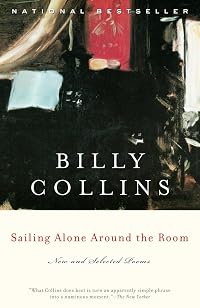
Sailing Alone Around the Room: New and Selected Poems
by Billy Collins
On This Page
Description
Offers a collection of witty, emotional, and direct poems by the popular and critically acclaimed poet, including selections from his four previous collections and new works such as "Man Listening to a Disc," about headphones.Tags
Recommendations






Member Reviews
I love that Collins is both accessible and interesting.
For example, in a poem called *Japan*, which is a sort of an ode to a haiku, there's a bit in the middle:
"I listen to myself saying it,
then I say it without listening,
then I hear it without saying it."
Haven't we all had that experience, perhaps while remembering an auntie's favorite saying, or a bit of doggerel from the playground, or even the Pledge of Allegiance?
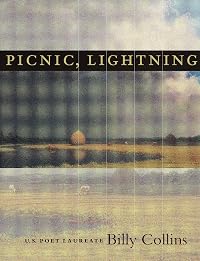
But then there's *Picnic, Lightning* which has clearly a lot going on under the surface, which we're reminded to examine by the end that wakes us up with:
"... all I hear is... the small plants singing
with lifted faces, and the click
of the sundial
as one hour sweeps into the next."
It's not enough to mention plants show more singing (flowers would have been cliché, but plants?) but Collins tells us that the sundial clicks! Since when do sundials click? Why does his?
There's also *Shoveling Snow with Buddha*
"All morning long we work side by side,
me with my commentary
and he inside the generous pocket of his silence..."
What? These are clearly poems to think about, to savor, even if they are easy to read as if narrative.
*Vade Mecum* made no sense to me until my son, recently graduated from a STEM college, offered his theory, which I really like. First, though, do look up the translation of the Latin title. Then tell me what you think.
Some of the poems are funny, or at least light, too. For example *The Rival Poet*. If you're not sure whether to read it seriously or humorously, you'll know to decide for the latter when you read the name of the rival's companion at a ceremony: "Contessa Maria Teresa Isabella Veronica Multaliere Eleganza de Bella Ferrari." And *Idiomatic* from which I learned that daydreaming, in France, is compared to "juggling balls of cotton." You'll have to read the poems*Forgetfulness* & *The Flight of the Reader* yourself.
Sometimes there's an allusion that some readers might not be able to catch. But I think most readers of any adult poetry would nod at the beginning of *The Night House* "Every day the body works in the fields of the world / mending a stone wall..."
And never forget to read poetry aloud! Even if inside your head, better if sotto voce, best if truly out loud. Poets work hard on the rhythms, assonances, etc., so respect that! Plus it makes it easier to understand, because you have to pay attention to the punctuation and thus you are given a chance to untangle the syntax which is often awkward given demands of the poet's chosen form. show less
For example, in a poem called *Japan*, which is a sort of an ode to a haiku, there's a bit in the middle:
"I listen to myself saying it,
then I say it without listening,
then I hear it without saying it."
Haven't we all had that experience, perhaps while remembering an auntie's favorite saying, or a bit of doggerel from the playground, or even the Pledge of Allegiance?
But then there's *Picnic, Lightning* which has clearly a lot going on under the surface, which we're reminded to examine by the end that wakes us up with:
"... all I hear is... the small plants singing
with lifted faces, and the click
of the sundial
as one hour sweeps into the next."
It's not enough to mention plants show more singing (flowers would have been cliché, but plants?) but Collins tells us that the sundial clicks! Since when do sundials click? Why does his?
There's also *Shoveling Snow with Buddha*
"All morning long we work side by side,
me with my commentary
and he inside the generous pocket of his silence..."
What? These are clearly poems to think about, to savor, even if they are easy to read as if narrative.
*Vade Mecum* made no sense to me until my son, recently graduated from a STEM college, offered his theory, which I really like. First, though, do look up the translation of the Latin title. Then tell me what you think.
Some of the poems are funny, or at least light, too. For example *The Rival Poet*. If you're not sure whether to read it seriously or humorously, you'll know to decide for the latter when you read the name of the rival's companion at a ceremony: "Contessa Maria Teresa Isabella Veronica Multaliere Eleganza de Bella Ferrari." And *Idiomatic* from which I learned that daydreaming, in France, is compared to "juggling balls of cotton." You'll have to read the poems*Forgetfulness* & *The Flight of the Reader* yourself.
Sometimes there's an allusion that some readers might not be able to catch. But I think most readers of any adult poetry would nod at the beginning of *The Night House* "Every day the body works in the fields of the world / mending a stone wall..."
And never forget to read poetry aloud! Even if inside your head, better if sotto voce, best if truly out loud. Poets work hard on the rhythms, assonances, etc., so respect that! Plus it makes it easier to understand, because you have to pay attention to the punctuation and thus you are given a chance to untangle the syntax which is often awkward given demands of the poet's chosen form. show less
We locate an adjective for the weather.
We announce that we are having a wonderful time.
We express the wish that you were here
and hide the wish that we were where you are,
walking back from the mailbox, your head lowered
as you read and turn the thin message in your hands.
A slice of this place, a length of white beach,
a piazza or carved spires of a cathedral
will pierce the familiar place where you remain,
and you will toss on the table this reversible display:
a few square inches of where we have strayed
and a compression of what we feel.
-from "American Sonnet"
In fairness, I should probably not have given Mr. Collins his second chance while I was taking a break from Marlon James' [b:Black Leopard, Red Wolf|40524312|Black Leopard, Red Wolf show more (The Dark Star Trilogy, #1)|Marlon James|https://images.gr-assets.com/books/1538656386s/40524312.jpg|48215793], giving that man's words the space and rest to hurt me really properly. Nor should I have picked up this small volume immediately after finishing Roz Chast's meditation on her parents' dying days in [b:Can't We Talk about Something More Pleasant?|18594409|Can't We Talk about Something More Pleasant?|Roz Chast|https://images.gr-assets.com/books/1421087235s/18594409.jpg|26340807]. But I have thirteen books out from the library and this seemed an easy one to get off the stack, and I really did need a break from Mr. James' wonderful-so-far book. So that is the state of your humble reviewer, a caveat in case any of you commit the folly of taking my not always humble opinion into account in what you read. Another caveat would be that when I find myself wishing a not so fond 'fuck you' to the poet in the midst of multiple poems, I think it best for all involved if I stop. Hence the DNF.
What has poor Mr. Collins done to earn such an impolite response? Perhaps not so much, besides waste my time and his. His poems are, after all, workmanlike examples of the craft, harmless meditations on teaching, chopping wood, the nature of reading and poetry, his parents deaths, all the waitpersons he's ever met and their someday deaths, and such. It's just that there's poetry for the sake of constructing a poem, issuing a musing (very like writing a postcard, I freely admit!), and then there's living a poem, tearing the words out of the desolation of life and death and bleeding them, sweating them into the shape of flame. To put it a different way, my very favorite poet right now is a stewardess who pours her struggles with identity, love, and her mother into beautiful burning meditations on her Tumblr, and her least trope would set Mr. Collins on fire. She won't ever be poet laureate. I doubt she'd even want to. She probably won't ever have a book of collected poems for me to set my five shining stars on. Maybe she wouldn't want that either. But I am the tiniest bit bitter about it.
Anyway, Mr. Collins and his poems are not horrible. He has his moments. (I see all of us reading ourselves away from ourselves,/straining in circles of light to find more light is brilliant! If only the rest of the poem were as good! A whole book of that, I would gladly crown with starlight!) But on the whole, if you want poetry, find you some real poetry. This is just postcards from where poetry is supposed to live. show less
I wish it hadn't taken me so long to get around to reading Billy Collins. His poems are accessible but profound, sung with a vernacular lyricism, ripe with humor and grief. He draws you in with an approachable, conversational opener like "The neighbors' dog will not stop barking" or "They say you can jinx a poem/if you talk about it before it is done." You don't realize as you continue reading that he is carrying you farther and farther away from the quotidian and into the realm of poetic meta-ness, turning your expectations upside-down. In fact, it's not until the end of a poem, when Collins drops some perfectly phrased closing observation into your lap, that you notice he has managed to bring you to the tip of a mountain while you show more still sit comfortably in your armchair with your tea. His poems describe heaven and home with the same affectionate wonder (and maybe they're really the same thing after all).
Poetry can take the most stalwart of readers and knock them into frustration with one swing. I recommend Billy Collins both for the beginner and for the weary consumer of literature who has forgotten how a great poem can exalt the reader. show less
Poetry can take the most stalwart of readers and knock them into frustration with one swing. I recommend Billy Collins both for the beginner and for the weary consumer of literature who has forgotten how a great poem can exalt the reader. show less
”I walk through the house reciting it and leave its letters falling through the air of every room.”
Whenever I read Billy Collins’ poems, I want to hand them out to people nearby, as if they are small gifts, from him to all of us. They so perfectly exist within their words that they seem almost self-formed, and Billy Collins is merely their handler who has unwrapped them or undressed them and showed us their essence.
No events are unnoticed, no detail is irrelevant, no thought is imponderable.
He is a master, training his apprentices:
And long after the classes, he sees the residues of his pupils in Schoolsville:
”Their grades are sewn into their clothes
Like references to Hawthorne.
The A’s stroll along with other A’s.
The D’s honk whenever they pass another D.
All the creative-writing students recline
On the courthouse lawn and play the lute.
Wherever they go, they form a big circle.”
Some poems are humorous, some poignant, many are deeply reflective, and all are precisely observant
I feel refreshed, grounded, included when reading his poems.
I like his world, and I like how he reminds us that this is our world too.
A couple of great reviews here, Spenk's and Steve's, capture the joy of it nicely. show less
Whenever I read Billy Collins’ poems, I want to hand them out to people nearby, as if they are small gifts, from him to all of us. They so perfectly exist within their words that they seem almost self-formed, and Billy Collins is merely their handler who has unwrapped them or undressed them and showed us their essence.
Forgetfulnessshow more
The name of the author is the first to go
followed obediently by the title, the plot,
the heartbreaking conclusion, the entire novel
which suddenly becomes one you have never read,
never even heard of,
as if, one by one, the memories you used to harbor
decided to retire to the southern hemisphere of the brain,
to
a little fishing village where there are no phones.
Long ago you kissed the names of the nine Muses goodbye
and watched the quadratic equation pack its bag,
and even now as you memorize the order of the planets,
something else is slipping away, a state flower perhaps,
the address of an uncle, the capital of Paraguay.
Whatever it is you are struggling to remember,
it is not poised on the tip of your tongue,
not even lurking in some obscure corner of your spleen.
It has floated away down a dark mythological river
whose name begins with an L as far as you can recall,
well on your own way to oblivion where you will join those
who have even forgotten how to swim and how to ride a bicycle.
No wonder you rise in the middle of the night
to look up the date of a famous battle in a book on war.
No wonder the moon in the window seems to have drifted
out of a love poem that you used to know by heart"
No events are unnoticed, no detail is irrelevant, no thought is imponderable.
He is a master, training his apprentices:
”Introduction To Poetry
I ask them to take a poem
and hold it up to the light like a color slide
or press an ear against its hive.
I say drop a mouse into a poem
and watch him probe his way out,
or walk inside the poem's room
and feel the walls for a light switch.
I want them to waterski
across the surface of a poem
waving at the author's name on the shore.
But all they want to do
is tie the poem to a chair with rope
and torture a confession out of it.
They begin beating it with a hose to find out what it really means.”
And long after the classes, he sees the residues of his pupils in Schoolsville:
”Their grades are sewn into their clothes
Like references to Hawthorne.
The A’s stroll along with other A’s.
The D’s honk whenever they pass another D.
All the creative-writing students recline
On the courthouse lawn and play the lute.
Wherever they go, they form a big circle.”
Some poems are humorous, some poignant, many are deeply reflective, and all are precisely observant
I feel refreshed, grounded, included when reading his poems.
I like his world, and I like how he reminds us that this is our world too.
A couple of great reviews here, Spenk's and Steve's, capture the joy of it nicely. show less
”I walk through the house reciting it and leave its letters falling through the air of every room.”
Whenever I read Billy Collins’ poems, I want to hand them out to people nearby, as if they are small gifts, from him to all of us. They so perfectly exist within their words that they seem almost self-formed, and Billy Collins is merely their handler who has unwrapped them or undressed them and showed us their essence.
No events are unnoticed, no detail is irrelevant, no thought is imponderable.
He is a master, training his apprentices:
And long after the classes, he sees the residues of his pupils in Schoolsville:
”Their grades are sewn into their clothes
Like references to Hawthorne.
The A’s stroll along with other A’s.
The D’s honk whenever they pass another D.
All the creative-writing students recline
On the courthouse lawn and play the lute.
Wherever they go, they form a big circle.”
Some poems are humorous, some poignant, many are deeply reflective, and all are precisely observant
I feel refreshed, grounded, included when reading his poems.
I like his world, and I like how he reminds us that this is our world too.
A couple of great reviews here, Spenk's and Steve's, capture the joy of it nicely. show less
Whenever I read Billy Collins’ poems, I want to hand them out to people nearby, as if they are small gifts, from him to all of us. They so perfectly exist within their words that they seem almost self-formed, and Billy Collins is merely their handler who has unwrapped them or undressed them and showed us their essence.
Forgetfulnessshow more
The name of the author is the first to go
followed obediently by the title, the plot,
the heartbreaking conclusion, the entire novel
which suddenly becomes one you have never read,
never even heard of,
as if, one by one, the memories you used to harbor
decided to retire to the southern hemisphere of the brain,
to
a little fishing village where there are no phones.
Long ago you kissed the names of the nine Muses goodbye
and watched the quadratic equation pack its bag,
and even now as you memorize the order of the planets,
something else is slipping away, a state flower perhaps,
the address of an uncle, the capital of Paraguay.
Whatever it is you are struggling to remember,
it is not poised on the tip of your tongue,
not even lurking in some obscure corner of your spleen.
It has floated away down a dark mythological river
whose name begins with an L as far as you can recall,
well on your own way to oblivion where you will join those
who have even forgotten how to swim and how to ride a bicycle.
No wonder you rise in the middle of the night
to look up the date of a famous battle in a book on war.
No wonder the moon in the window seems to have drifted
out of a love poem that you used to know by heart"
No events are unnoticed, no detail is irrelevant, no thought is imponderable.
He is a master, training his apprentices:
”Introduction To Poetry
I ask them to take a poem
and hold it up to the light like a color slide
or press an ear against its hive.
I say drop a mouse into a poem
and watch him probe his way out,
or walk inside the poem's room
and feel the walls for a light switch.
I want them to waterski
across the surface of a poem
waving at the author's name on the shore.
But all they want to do
is tie the poem to a chair with rope
and torture a confession out of it.
They begin beating it with a hose to find out what it really means.”
And long after the classes, he sees the residues of his pupils in Schoolsville:
”Their grades are sewn into their clothes
Like references to Hawthorne.
The A’s stroll along with other A’s.
The D’s honk whenever they pass another D.
All the creative-writing students recline
On the courthouse lawn and play the lute.
Wherever they go, they form a big circle.”
Some poems are humorous, some poignant, many are deeply reflective, and all are precisely observant
I feel refreshed, grounded, included when reading his poems.
I like his world, and I like how he reminds us that this is our world too.
A couple of great reviews here, Spenk's and Steve's, capture the joy of it nicely. show less
[[Billy Collins]] is the laureate of the everyday, capturing the lyrical nature of small moments. Some of the entries in this collection even cross into meta territory, poetry about poetry, or about a single poem. In any event, he is a one of a kind. There is no obfuscation, no riddles, no deeply inside jokes or references, as is so common of the poets of today who substitute the unknowable, untranslatable, or enigmatic for art. Each of the poems is clear in meaning without losing any lyrical mysticism. Why must modern poets purposely hide any meaning behind language or cute structure.
Highly Recommended!!!!!
5 bones!!!!!
Highly Recommended!!!!!
5 bones!!!!!
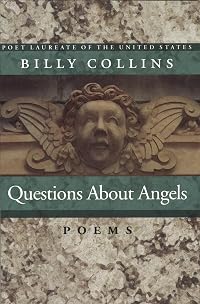
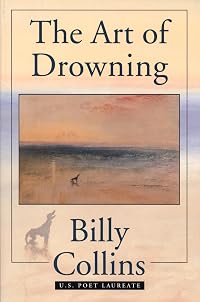
I'm not a natural to poetry; I really have to work at it and make a special effort to make time for it and pay attention, which is odd, because I have my quiet and unexpressed poetic way of looking at the world, but too often the language of individual poets is obscure to me, the imagery too specific or too filled with references I don't understand, rhythms I can't pick up on, moods I'm not in tune with. Billy Collins is new to me, and I decided to give this poetry collection a try after seeing a few of his best poems on Joe's threads. This collection gathers some "new" selections as of 2001, as well as older ones from collections from The Apple That Astonished Paris (1988), Questions About Angels (1991) The Art of Drowning (1995), and show more Picnic, Lightning (1998), from which comes one of my absolute favourites, which Joe transcribed in full on one of his threads, called Victoria's Secret. It's rather long, so here here are just the first three of nine verses:
Victoria's Secret
The one in the upper left-hand corner
is giving me a look
that says I know you are here
and I have nothing better to do
for the remainder of human time
than return your persistent but engaging stare.
She is wearing a deeply scalloped
flame-stitch halter top
with padded push-up styling
and easy side-zip tap pants.
The one on the facing page, however,
who looks at me over her bare shoulder,
cannot hide the shadow of annoyance in her brow.
You have interrupted me,
she seems to be saying,
with your coughing and your loud music.
Now please leave me alone;
Let me finish whatever it was I was doing
in my organza-trimmed
whisperweight camisole with
keyhole closure and a point d'esprit mesh back.
I wet my thumb and flip the page.
Here, the one who happens to be reclining
in a satin and lace merry widow
with an inset lace-up front,
decorated underwire cups and bodice with lace ruffles along the bottom
and hook-and-eye closure in the back,
is wearing a slightly contorted expression,
her head thrust back, mouth partially open,
a confusing mixture or pain and surprise
as if she had stepped on a tack
just as I was breaking down
her bedroom door with my shoulder.
What appealed tremendously to me about this particular poem I guess is I heard an inner voice, or was it the voice of my own mother maybe, who has a mean sense of humour and has always liked to put words in the mouths of the models on the glossy magazines we always had laying around the house, so there was something familiar about it, which took nothing away from the humour of it, and just made it all that more engaging in fact. Collins often writes poems about the process of writing poetry which are surprisingly appealing. There’s often a sense of playfulness in his work, though in his “new” work, there is more talk of death, since it seems he lost his mother around 2001 and was quite understandably more focused on themes of death and dying, but not always. My favourite poem from that particular collection is about a dog and like so much of his work, just seems so spot on:
Dharma
The way the dog trots out the front door
every morning
without a hat or an umbrella,
without any money
or the keys to her doghouse
never fais to fill the saucer of my heart
with milky admiration.
Who provides a finer example
of a life without encumbrance—
Thoreau in his curtainless hut
with a single plate, a single spoon?
Gandhi with his staff and his holy diapers?
Off she goes into the material world
with nothing but her brown coat
and her modest blue collar,
following only her wet nose,
the twin portals of her steady breathing,
followed only by the plume of her tail.
If only she did not shove the cat aside
every morning
and eat all his food
what a model of self-containment she would be,
what a paragon of earthly detachment.
If only she were not so eager
for a rub behind the ears,
so acrobatic in her welcomes,
if only I were not her god. show less
Victoria's Secret
The one in the upper left-hand corner
is giving me a look
that says I know you are here
and I have nothing better to do
for the remainder of human time
than return your persistent but engaging stare.
She is wearing a deeply scalloped
flame-stitch halter top
with padded push-up styling
and easy side-zip tap pants.
The one on the facing page, however,
who looks at me over her bare shoulder,
cannot hide the shadow of annoyance in her brow.
You have interrupted me,
she seems to be saying,
with your coughing and your loud music.
Now please leave me alone;
Let me finish whatever it was I was doing
in my organza-trimmed
whisperweight camisole with
keyhole closure and a point d'esprit mesh back.
I wet my thumb and flip the page.
Here, the one who happens to be reclining
in a satin and lace merry widow
with an inset lace-up front,
decorated underwire cups and bodice with lace ruffles along the bottom
and hook-and-eye closure in the back,
is wearing a slightly contorted expression,
her head thrust back, mouth partially open,
a confusing mixture or pain and surprise
as if she had stepped on a tack
just as I was breaking down
her bedroom door with my shoulder.
What appealed tremendously to me about this particular poem I guess is I heard an inner voice, or was it the voice of my own mother maybe, who has a mean sense of humour and has always liked to put words in the mouths of the models on the glossy magazines we always had laying around the house, so there was something familiar about it, which took nothing away from the humour of it, and just made it all that more engaging in fact. Collins often writes poems about the process of writing poetry which are surprisingly appealing. There’s often a sense of playfulness in his work, though in his “new” work, there is more talk of death, since it seems he lost his mother around 2001 and was quite understandably more focused on themes of death and dying, but not always. My favourite poem from that particular collection is about a dog and like so much of his work, just seems so spot on:
Dharma
The way the dog trots out the front door
every morning
without a hat or an umbrella,
without any money
or the keys to her doghouse
never fais to fill the saucer of my heart
with milky admiration.
Who provides a finer example
of a life without encumbrance—
Thoreau in his curtainless hut
with a single plate, a single spoon?
Gandhi with his staff and his holy diapers?
Off she goes into the material world
with nothing but her brown coat
and her modest blue collar,
following only her wet nose,
the twin portals of her steady breathing,
followed only by the plume of her tail.
If only she did not shove the cat aside
every morning
and eat all his food
what a model of self-containment she would be,
what a paragon of earthly detachment.
If only she were not so eager
for a rub behind the ears,
so acrobatic in her welcomes,
if only I were not her god. show less
Members
- Recently Added By
Lists

Favorite Recent Poetry: 1980-2022
178 works; 70 members

Books Read in 2022
5,226 works; 112 members

Mustich's 1000 Books to Read Before You Die: A Life Changing List
1,001 works; 20 members

The Complete Rory Gilmore Reading List
506 works; 5 members

Poetry volumes by single author
122 works; 8 members
Author Information

42+ Works 12,846 Members
Billy Collins has published six collections of poetry, including Questions About Angels and The Art of Drowning, Picnic, Lightning, his latest, sold more than 25,000 copies in its first year. He teaches at Lehman College of the City University of New York and at Sarah Lawrence College. He was named U.S. Poet Laureate in June 2000. (Bowker Author show more Biography) Billy Collins was born in New York City in 1941. He earned a BA from the College of the Holy Cross, and both an MA and PhD from the University of California-Riverside. Collins conducted summer poetry workshops at University College Galway and is the Poet in Residence at Burren College of Art in Ireland. He is also a professor of English at Lehman College (CUNY). In 1992, Collins was chosen to be the Literary Lion of the New York Public Library. He was named U.S. Poet Laureate in 2001 and held the title until 2003. Collins then served as Poet Laureate for the State of New York from 2004 until 2006. His poetry has appeared in anthologies, textbooks and periodicals including Poetry, The American Poetry Review, The American scholar, Harper's, The Paris Review and The New Yorker. He is the author of six books of poetry including "The Art of Drowning." His poems have also been selected to appear in The Best American Poetry of 1992, 1993 and 1997. His works have won various awards including the Bess Hokin Prize, the Frederick Bock Prize, the Oscar Blumenthal Prize and the Levinson Prize, all awarded by Poetry. He has received fellowships from the New York Foundation for the Arts, the National Endowment for the Arts and the Guggenheim Foundation. His collection of poems entitled Aimless Love made numerous best-seller lists in 2013. (Bowker Author Biography) show less
Awards and Honors
Distinctions
Notable Lists
Common Knowledge
- Canonical title
- Sailing Alone Around the Room: New and Selected Poems
- Original publication date
- 2001
- Dedication
- In Memoriam/ Katherine Collins (1901 - 1997) / William S. Collins (1901 - 1994 )
- Blurbers
- Updike, John
Classifications
Statistics
- Members
- 2,589
- Popularity
- 7,345
- Reviews
- 31
- Rating
- (4.21)
- Languages
- English, Italian, Spanish
- Media
- Paper, Ebook
- ISBNs
- 8
- ASINs
- 8