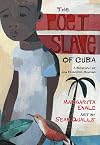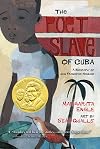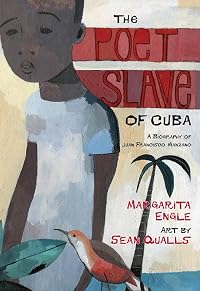
The Poet Slave of Cuba: A Biography of Juan Francisco Manzano
by Margarita Engle
On This Page
Description
Juan Francisco Manzano was born in 1797 into the household of wealthy slaveowners in Cuba. He spent his early years at the side of his owner's wife, entertaining her friends. His poetry was his outlet, reflecting the beauty and cruelty of his world. Written in verse.Tags
Recommendations

Member Reviews
Subtitle: A Biography of Juan Francisco Manzano. Manzano was born into the household of a wealthy slaveowner in Cuba in 1797. The young Juan showed a talent for poetry, and he was used by his owner as entertainment for her friends; he recited poetry, sang opera and performed for them. Dona Beatriz gave Juan’s mother and father their freedom, but kept the “child of my old age” with her. Her promise that Juan, too, would be freed on her death was not kept; he was sent to the Marquesa de Prado Ameno, whose cruelty apparently knew no bounds. He eventually escaped her estate and made his way to Havana. His poetry was censored by the colonial Spanish government because his depictions of slavery were considered to incite revolution. We show more know of his life today only because his autobiographical notes were smuggled to England where they were published, though half his manuscript was lost, so only his earlier life is recorded in his own hand.
Engle studied Manzano’s poetry and life and was determined to write about him. She decided that to do justice to the power of his words, the biography should also be written in verse. Her poems are powerful, evoking a visceral response to the cruelty, sadness, dashed hopes and lost opportunities the young Juan experienced. But there is also the triumph of his indomitable spirit and a voice that would not be silenced.
I’m so glad I came across this little gem. show less
Engle studied Manzano’s poetry and life and was determined to write about him. She decided that to do justice to the power of his words, the biography should also be written in verse. Her poems are powerful, evoking a visceral response to the cruelty, sadness, dashed hopes and lost opportunities the young Juan experienced. But there is also the triumph of his indomitable spirit and a voice that would not be silenced.
I’m so glad I came across this little gem. show less
This novel in verse about the real-life poet Juan Francisco Manzano, who started life as a slave on the sugar plantations of Cuba, hauntingly and devastatingly captures the essence of the time (late 18th/early 19th century) and place (Cuba under the decadent Spanish Empire). Told from various points of view—Juan, his natural mother, the horrible, sadistic mistress whose resentment of him grows the crueler she is to him, her son who tries to show Juan kindness, an overseer who agonizes over the pain he causes. Stark yet gorgeous, angry yet graceful, this work challenges and exhilarates.
I initially was intrigued with the form author Margarita Engle used to tell Manzano's story. Juan Francisco Manzano was born into slavery, where he lived two very different lives at the hands of his masters. One relationship shows a woman who treats him as if young Juan is her "toy" to parade around as a prized object; while his next master abuses him, partly because of her jealousy at Juan's knowledge. The Poet Slave of Cuba, while written beautifully and from various characters' perspectives, makes this a very realistic, gut-wrenching, and inspirational biography.
We have seen an explosion of verse novels every since Karen Hesse won the Newbery with the magnificent Out of the Dust. Many of the novels I read do not strike me as especially poetic. I read them and wonder why the author chose a verse form. Here is a verse novel in which the poetry is absolutely essential. The fact that this book is also a biography is icing on the cake. Juan Francisco Manzano is a slave yet he writes in free verse, a great example of using form to enhance function. In this book we have themes of racism (and I do love the way in which the white child attempts to help). The black and white sketches add to the book's value and give readers other access options. That fairness aspect, the promises broken, getting punished show more for things you do not do--make this book accessible for a younger audience, but there is enough sophistication in the poetry and the character development to sustain older readers. There is violence and brutal situations discussed. This book also gives voice to even those near villain characters. Juan moves from a preteen 11 year old to a 16 year old, which is reflected in the language of the poems. Highly and universally recommended! show less
This book is at once heartbreaking, beautiful, and inspiring. Juan is a slave in Cuba, and the woman treats him as her son, yet her slave son, who must call her momma, entertain her by reciting poetry and verse, yet is denied an education or even access to his own mother. Yet through all of his hardships, including promises of freedom that never come, Juan never looses his sense of hope or optimism. This book would serve not only to launch a poetry unit in the classroom, but more importantly to discuss hardship, empathy, optimism, and the true cost of slavery.
The Poet Slave of Cuba is a very dynamic biography. It is written in poetry, in the different perspectives of Juan, Juan's mother (Maria Del Pilar), Juan's father (Toribo), Juan's first owner (Dona Beatriz), Juan's second owner (La Marquesa De Prado Ameno), La Marquesa's son (Don Nicolas), and the Overseer. Because there were no table of contents or list of characters it was a little difficult remembering the names of the characters for each poem, I found myself flipping back to make sure I knew which person's perspective I was reading. That being said, I throughly enjoyed the format and the way the author was able to connect each person to the flow of the story. It takes place in Cuba in the eighteenth century. The main antagonist is show more clearly La Marquesa De Prado Ameno for her merciless actions. Don Nicolas provides perfect contrast to the antagonists because he does not wish to hurt Juan and only wishes his mother would not punish Juan so that they could play together. The Overseer seems to be an antagonist in his actions but also helpful at times. There are illustrations sporadically throughout this book which helps the reader better visualize each character.
With the first owner, Dona Beatriz, Juan was subject to becoming her parrot at parties, reciting poems and quotes that he had memorized. She literally compared him to a poodle that doesn't shed. With the second owner, La Marquesa, Juan was repeatedly tortured. She would have him whipped and leave him in the cellar with no food or water for days, luckily her son Don and Juan's mother Maria would sneak food to Juan and sips of water when they could. Don and Juan's friendship throughout the book was strong. His mother, Maria, was a big part of his life despite the fact that she was free and he was not. A shift in Juan's outlook seems to appear shortly after the second owner starts her abuse. With the first owner he seems to have a pleasant view on learning and life; viewing his mind as, "a brush made of feathers [...] I love words written with my feathery mind." With the second owner she seemed to look for reasons to torture him, each punishment increasingly worse than the one before. An interesting quote coming from Juan's perspective is, " or are crushed between the stones that grind the cane and separate it from the bagasse a fancy word that means dry, fibrous trash like my heart." Throughout the story though, Juan kept his faith in God even though he repeatedly got the short end of the stick. I believe there are good examples of sacrifice, injustice, friendship, imagination, and faith that would be good for mature children to read. There are graphic moments so I would be cautious when recommending this to a child. show less
With the first owner, Dona Beatriz, Juan was subject to becoming her parrot at parties, reciting poems and quotes that he had memorized. She literally compared him to a poodle that doesn't shed. With the second owner, La Marquesa, Juan was repeatedly tortured. She would have him whipped and leave him in the cellar with no food or water for days, luckily her son Don and Juan's mother Maria would sneak food to Juan and sips of water when they could. Don and Juan's friendship throughout the book was strong. His mother, Maria, was a big part of his life despite the fact that she was free and he was not. A shift in Juan's outlook seems to appear shortly after the second owner starts her abuse. With the first owner he seems to have a pleasant view on learning and life; viewing his mind as, "a brush made of feathers [...] I love words written with my feathery mind." With the second owner she seemed to look for reasons to torture him, each punishment increasingly worse than the one before. An interesting quote coming from Juan's perspective is, " or are crushed between the stones that grind the cane and separate it from the bagasse a fancy word that means dry, fibrous trash like my heart." Throughout the story though, Juan kept his faith in God even though he repeatedly got the short end of the stick. I believe there are good examples of sacrifice, injustice, friendship, imagination, and faith that would be good for mature children to read. There are graphic moments so I would be cautious when recommending this to a child. show less
A beautifully written book in verse, it tells of the life of Juan Fransisco Manzano, a Cuban poet who was born a slave. His story is told from not only his point of view, but from the point of view of his mother, father, and two "owners." His first mistress treated as some sort of pet, dressing him up and showing him off, appearing, for all intensive purposes, to care for him. She promised his mother freedom upon her death, but rather than being free himself, Juan was passed on to another woman who felt that his gift was something to be squashed, unfitting of a slave. The reader suffers with him as his punishments are described, terrible even in verse. Even if the verse may put off some readers, it should be pushed anyway because it is show more not dense, and almost easier to read, as well as adding to the ambiance and tone of the book, reading the world as Manzano himself may have. Recommended to middle school and high school readers. show less
Members
- Recently Added By
Author Information

57+ Works 7,209 Members
Margarita Engle is a Cuban-American poet and novelist. Her books include The Wild Book, Tropical Secrets, The Firefly Letters, The Lightning Dreamer, When You Wander, Mountain Dog, and Silver People. She has received several awards including the Jane Addams Children's Book Award, the Pura Belpré Award, the Américas Award, and the Claudia Lewis show more Poetry Award for The Surrender Tree and the Pura Belpré Award and the Américas Award for The Poet Slave of Cuba. (Bowker Author Biography) show less
All Editions
Awards and Honors
Awards
Distinctions
Notable Lists
Common Knowledge
- Canonical title
- The Poet Slave of Cuba: A Biography of Juan Francisco Manzano
- Important places
- Cuba
Classifications
Statistics
- Members
- 333
- Popularity
- 95,564
- Reviews
- 37
- Rating
- (3.92)
- Languages
- English
- Media
- Paper, Audiobook, Ebook
- ISBNs
- 8
- ASINs
- 6