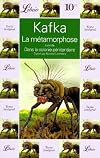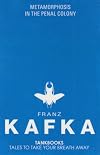
Metamorphosis and In the Penal Colony
by Franz Kafka 
On This Page
Tags
Recommendations

























Member Reviews
There is often menace and even horror in Kafka's works, but not usually blood and gore, as this has. Nevertheless, in many ways, it is quintessential Kafka, featuring abuse of the law, the mental horror of a helpless and uniformed protagonist, an outsider, a degree of surrealism, and some dry asides.
The Harrowing Harrow
The plot is grim but simple. A traveller to a tropical penal colony is invited to watch their unique method of execution: a complex machine (the Harrow) engraves the words of the offence in an illegible script. The condemned man usually dies about 12 hours later, but as the words are drilled into him, he is supposed to experience a moment of revelation and regret.
The machine is explained in graphic detail by the officer show more who has devoted years to its upkeep and worships it almost as much as he worships the previous commander who invented it. The officer is despairing that the new commander is not enlightened enough to give full support to the method and fears the commander wants to abolish it.
I expect Orwell had this in mind in 1984: “In the old days the heretic walked to the stake still a heretic… But we make the brain perfect before we blow it out.”
Although proud of the moment of enlightenment bestowed just before death, the officer's concern is mechanics, not morality. Was it madness that made him so obsessed, or his obsession that drove him to madness?
Does Inaction Make one Morally Culpable for Events?
The traveller is horrified, but is unsure whether or how he should intervene. He is an honoured guest, and from a country that is not the colonial power.
In this short story, there are three times when he considers acting. But he does not. "He knew what was going to happen but he had no right to hinder" because the officer was acting logically according to his own principles.
He does not even say farewell to the commandant. He just sails away. I'm reminded of Le Guin's chilling short story, The Ones Who Walked Away from Omelas, which I reviewed HERE.
Sacrifice
In a twist, the one who is sacrificed to the machine is the one who worships it. But even that is futile: the face of the dead officer showed "no sign of the promised deliverance... What all the others had found in the machine, the officer had not found."
Quintessentiallity
The particularly Kafkaesque elements are that the condemned man never knows his crime. It is a trumped up charge of "insubordination and insulting a senior officer", which arises from a pointless job at which success is almost impossible: he fell asleep, so failed to salute the (sleeping) captain's door on the hour, every hour, through the night.
Furthermore, the accused has had no opportunity to defend himself, does not initially know he is due to be executed, or how, and does not speak the language of the officer, traveller or guard. The officer is judge, jury and executioner, something he is proud of - after all, "guilt is always beyond question".
Resurgam
The more surprising and sinister aspect is the fact that the few remaining followers of the previous commander believe that one day he "will rise again" from his grave...
See also
• See my Kafka-related bookshelf for other works by and about Kafka: HERE.
• Another outsider viewing a strange tradition is the narrator of Shirley Jackson's equally disturbing short story, The Lottery, which I reviewed HERE.
• There's a story in Daisy Johnson's Fen about someone's speech causing physical pain, but it's mystical, rather than gory. See my review HERE.
• For a dystopian take on one person's language inflicting extreme physical pain on others, see Ben Marcus' The Flame Alphabet. See my review HERE.
• For a brutal and beautiful alternative to the Harrow, see Yevgeny Zamyatin’s WE. See my review HERE.
• See Bruce's excellent review for an interesting angle, seeing this as a metaphor for language and communication: HERE.
• There is/was an operatic adaptation, which is worth seeing if you have the chance.
Short story club
I read this again in Black Water: The Anthology of Fantastic Literature, by Alberto Manguel, from which I’m reading one story a week with The Short Story Club, starting 4 September 2023.
You can read this story HERE.
You can join the group here. show less
The Harrowing Harrow
The plot is grim but simple. A traveller to a tropical penal colony is invited to watch their unique method of execution: a complex machine (the Harrow) engraves the words of the offence in an illegible script. The condemned man usually dies about 12 hours later, but as the words are drilled into him, he is supposed to experience a moment of revelation and regret.
The machine is explained in graphic detail by the officer show more who has devoted years to its upkeep and worships it almost as much as he worships the previous commander who invented it. The officer is despairing that the new commander is not enlightened enough to give full support to the method and fears the commander wants to abolish it.
I expect Orwell had this in mind in 1984: “In the old days the heretic walked to the stake still a heretic… But we make the brain perfect before we blow it out.”
Although proud of the moment of enlightenment bestowed just before death, the officer's concern is mechanics, not morality. Was it madness that made him so obsessed, or his obsession that drove him to madness?
Does Inaction Make one Morally Culpable for Events?
The traveller is horrified, but is unsure whether or how he should intervene. He is an honoured guest, and from a country that is not the colonial power.
In this short story, there are three times when he considers acting. But he does not. "He knew what was going to happen but he had no right to hinder" because the officer was acting logically according to his own principles.
He does not even say farewell to the commandant. He just sails away. I'm reminded of Le Guin's chilling short story, The Ones Who Walked Away from Omelas, which I reviewed HERE.
Sacrifice
In a twist, the one who is sacrificed to the machine is the one who worships it. But even that is futile: the face of the dead officer showed "no sign of the promised deliverance... What all the others had found in the machine, the officer had not found."
Quintessentiallity
The particularly Kafkaesque elements are that the condemned man never knows his crime. It is a trumped up charge of "insubordination and insulting a senior officer", which arises from a pointless job at which success is almost impossible: he fell asleep, so failed to salute the (sleeping) captain's door on the hour, every hour, through the night.
Furthermore, the accused has had no opportunity to defend himself, does not initially know he is due to be executed, or how, and does not speak the language of the officer, traveller or guard. The officer is judge, jury and executioner, something he is proud of - after all, "guilt is always beyond question".
Resurgam
The more surprising and sinister aspect is the fact that the few remaining followers of the previous commander believe that one day he "will rise again" from his grave...
See also
• See my Kafka-related bookshelf for other works by and about Kafka: HERE.
• Another outsider viewing a strange tradition is the narrator of Shirley Jackson's equally disturbing short story, The Lottery, which I reviewed HERE.
• There's a story in Daisy Johnson's Fen about someone's speech causing physical pain, but it's mystical, rather than gory. See my review HERE.
• For a dystopian take on one person's language inflicting extreme physical pain on others, see Ben Marcus' The Flame Alphabet. See my review HERE.
• For a brutal and beautiful alternative to the Harrow, see Yevgeny Zamyatin’s WE. See my review HERE.
• See Bruce's excellent review for an interesting angle, seeing this as a metaphor for language and communication: HERE.
• There is/was an operatic adaptation, which is worth seeing if you have the chance.
Short story club
I read this again in Black Water: The Anthology of Fantastic Literature, by Alberto Manguel, from which I’m reading one story a week with The Short Story Club, starting 4 September 2023.
You can read this story HERE.
You can join the group here. show less
Il en est des Récits de Franz Kafka comme de toutes les oeuvres étrangères d’une portée universelle : en proposer une "nouvelle" traduction (dans le cas présent, celle de Catherine Billmann et Jacques Cellard) paraîtra présomptueux car cette nouveauté ne peut porter que sur le mouvement et le détail d’un texte qui s’impose également, par définition, à tous ses traducteurs. Nouvelle ou renouvelée, cette traduction, avec un premier volume intitulé La Métamorphose, La Sentence, Le Soutier et autres récits I et avec le présent recueil, réunit la totalité des récits publiés de 1912 à 1924. Nous reprenons ainsi le projet mené à bien en 1969-1970 pour les textes d’origine, par Paul Raabe et les éditions show more Fischer, et qui a abouti aux Sämtliche Erzählungen ("Tous les récits"), publiés en livre de poche Fischer (1970, 406 p.). L’ordre dans lequel se succèdent ces Récits est celui de leur première parution, de sorte que le lecteur pourra suivre, pour autant qu’une traduction le permette, le cheminement conceptuel et narratif qui a fait de Franz Kafka l’un des plus grands auteurs de ce siècle. show less
Jun 7, 2011French
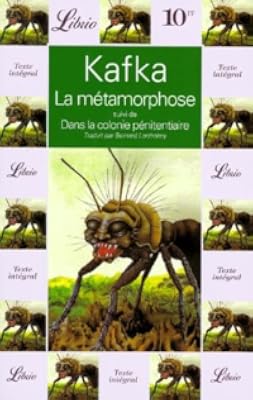
Le personnage principal de la Métamorphose, Gregor Samsa, représentant de commerce faisant vivre son père, sa mère et sa sœur, employé, fils et frère modèle, se transforme un beau matin en gros insecte. Enfermé dans sa chambre par sa famille pour qui il est un objet de dégoût et de honte, il se fait nourir par sa sœur. Gregor se trouve peu à peu abandonné : sa chambre vidée de ses meubles devient un débarras, on le nourrit irrégulièrement. Parallèlement à cette déchéance, le père recouvre la force physique et morale qu’il avait perdue et la sœur auparavant timide et douce, s’affirme avec force. Après avoir provoqué le départ des locataires que sa famille hébergeait pour gagner un peu d’argent, Gregor show more blessé par son p ère plusieurs mois auparavant- celui-ci lui tire une pomme qui, restant encastrée dans sa carapace, pourrit lentement- sent qu’il nuit aux siens et se laisse mourir. La nouvelle se termine sur la journée de congé et de promenade au soleil que s’accorde la famille, délivrée par cette mort. show less
Nov 21, 2010French
ebook
Mar 21, 2015French
Ratings
Members
- Recently Added By
Author Information

Franz Kafka -- July 3, 1883 - June 3, 1924 Franz Kafka was born to middle-class Jewish parents in Prague, Czechoslovakia on July 3, 1883. He received a law degree at the University of Prague. After performing an obligatory year of unpaid service as law clerk for the civil and criminal courts, he obtained a position in the workman's compensation show more division of the Austrian government. Always neurotic, insecure, and filled with a sense of inadequacy, his writing is a search for personal fulfillment and understanding. He wrote very slowly and deliberately, publishing very little in his lifetime. At his death he asked a close friend to burn his remaining manuscripts, but the friend refused the request. Instead the friend arranged for publication Kafka's longer stories, which have since brought him worldwide fame and have influenced many contemporary writers. His works include The Metamorphosis, The Castle, The Trial, and Amerika. Kafka was diagnosed with tuberculosis (TB) in August 1917. As his disease progressed, his throat became affected by the TB and he could not eat regularly because it was painful. He died from starvation in a sanatorium in Kierling, near Vienna, after admitting himself for treatment there on April 10, 1924. He died on June 3 at the age of 40. (Bowker Author Biography) show less
Franz Kafka has a Legacy Library. Legacy libraries are the personal libraries of famous readers, entered by LibraryThing members from the Legacy Libraries group.
Series
Belongs to Publisher Series
Work Relationships
Common Knowledge
- Canonical title
- The Metamorphosis AND In the Penal Colony; Metamorphosis and In the Penal Colony
- Original publication date
- 1919
- People/Characters
- Gregor Samsa; Traveller
- Original language
- German
- Disambiguation notice
- This contains only "The Metamorphosis" and "In the Penal Colony", do not combine with collections that also include other stories.
Classifications
Statistics
- Members
- 210
- Popularity
- 155,546
- Reviews
- 4
- Rating
- (3.77)
- Languages
- 5 — English, Finnish, French, German, Italian
- Media
- Paper, Ebook
- ISBNs
- 7
- ASINs
- 4