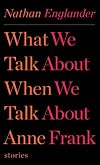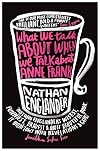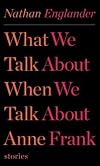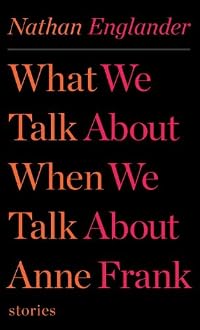
What We Talk About When We Talk About Anne Frank: Stories
by Nathan Englander
On This Page
Description
Fiction. Literature. Short Stories. HTML:These eight new stories from the celebrated novelist and short-story writer Nathan Englander display a gifted young author grappling with the great questions of modern life, with a command of language and the imagination that place Englander at the very forefront of contemporary American fiction.The title story, inspired by Raymond Carver’s masterpiece, is a provocative portrait of two marriages in which the Holocaust is played out as a show more devastating parlor game. In the outlandishly dark “Camp Sundown” vigilante justice is undertaken by a group of geriatric campers in a bucolic summer enclave. “Free Fruit for Young Widows” is a small, sharp study in evil, lovingly told by a father to a son. “Sister Hills” chronicles the history of Israel’s settlements from the eve of the Yom Kippur War through the present, a political fable constructed around the tale of two mothers who strike a terrible bargain to save a child. Marking a return to two of Englander’s classic themes, “Peep Show” and “How We Avenged the Blums” wrestle with sexual longing and ingenuity in the face of adversity and peril. And “Everything I Know About My Family on My Mother’s Side” is suffused with an intimacy and tenderness that break new ground for a writer who seems constantly to be expanding the parameters of what he can achieve in the short form.
Beautiful and courageous, funny and achingly sad, Englander’s work is a revelation. show less
Tags
Recommendations



Member Reviews
We are all Jews. Englander's stories are set in a Jewish world, with protagonists as diverse as settlers on the West Bank, secular couples in Florida or old World survivors in Israel. Yet, as rooted as they are in this particular world with its own customs and language, their ethical dilemmas are clearly universal, and the reader cannot help but be drawn in. The story about the Author's readings provides a little dip in the momentum, but otherwise all stories in this book are gems. The author dissects these quandaries with Talmudic precision: when and how to forgive? What is a life worth living? By what standards should you pick your friends? The author has chosen Jewish settings from past and present in which these questions show more crystallise, and people need to make life-and-death decisions based on what othermise might be academic niceties. The author's kindness, humour and intelligence shine through throughout in a beautifully written and memorable book that I will want to re-read soon. show less
A very recommendable book whose stories take the Jewish experience as their main theme. The author writes fluidly and with a light touch, even dealing with enormously sad subjects, and there's a touch of sensuality to his writing, too, whether he's discussing women, as in "Peep Show" or produce, as in "Fresh Fruit for Young Widows." I suspect that Englander is on the dovish, leftish side of Israeli politics, but he's a good enough writer not to let on: the best stories here -- story that gives the book its title, "Sister Hills," "Camp Sundown" and "How We Avenged the Blums" -- really get at the basic issues and contradictions facing Jews, either in Israel or elsewhere, right now. Englander has a talent for compressing the Jewish show more experience into brief, often surreally humorous incidents, and, more importantly, seems to really sense the dangers and possibilities that the community he belongs to contains. The only one of these stories I found lacking was "The Reader" -- though I'm amused to think that the title might be a nod to the much-derided novel of the same name, just as the book's title references Raymond Carver. It's a complaint about the supposed death of print and the difficulties of writing, but as an e-book enthusiast I didn't buy it. Bookstore owners -- who are certainly feeling the squeeze these days -- may sympathize, but I tend to think that digital books let more people read more books than ever before. That rather bitter story excepted, "What We Talk About When We Talk About Anne Frank" is recommended to anyone interested in well-written short stories. Englander once again proves that small can indeed be beautiful that the biggest issues can sometimes be dealt with in small spaces. show less
Until I heard a radio interview with Nathan Englander, I'd not read any of his work. What We Talk About When We Talk About Anne Frank, was my introduction to this acclaimed short-story writer.
As others have mentioned, this book provided more insight into the nuances of growing up/grown-up life as a Jew than I expected . . I appreciated the opportunity to learn! Funny, disturbing, heartbreaking, discomfiting, heartwarming, lighthearted and, often, violent to the point of (personally) feeling battered and bruised - it was not (for me) a comfortable reading experience nor was it an easy book get through!
There were times when I put the book aside - jumpy, ill-at-ease, truly distressed and determined to "let it go at that" - but I didn't. show more The fact that I didn't leave it unfinished tells a story. Nathan Englander has been gifted with the ability to paint stark, sensual and smile-worthy pictures with words - the book, repeatedly, drew me back in and I was hooked. Once finished, I feel it was, definitely, a worthwhile read. I recommend this book . . (I think)! show less
As others have mentioned, this book provided more insight into the nuances of growing up/grown-up life as a Jew than I expected . . I appreciated the opportunity to learn! Funny, disturbing, heartbreaking, discomfiting, heartwarming, lighthearted and, often, violent to the point of (personally) feeling battered and bruised - it was not (for me) a comfortable reading experience nor was it an easy book get through!
There were times when I put the book aside - jumpy, ill-at-ease, truly distressed and determined to "let it go at that" - but I didn't. show more The fact that I didn't leave it unfinished tells a story. Nathan Englander has been gifted with the ability to paint stark, sensual and smile-worthy pictures with words - the book, repeatedly, drew me back in and I was hooked. Once finished, I feel it was, definitely, a worthwhile read. I recommend this book . . (I think)! show less
Overall, I liked the writing better than the content of most of the stories. I did find the basic ideas of some of the short stories thought provoking, but I was sometimes offended by the direction Englander pursued. For me, the title story was by far the best; however, I did learn from some of the other stories.
The author's talent and humor shine so brightly that I liked these stories in spite of the grimness in many of them. The title story was fantastic-perceptive and shocking. The Reader was probably my second favorite story-the one I'd tell people to read, even if they didn't read the entire collection. I will be checking out more of this author's work.
Though the styles of the stories jumped around - some realism, some surrealism, some allegory - they all dealt with cultural, spiritual and political aspects of Judaism. As someone who is Jewish and has traveled in Israel, I found the stories very interesting and relatable. I would be curious to hear the reaction of someone with no connection to Judaism, though.
The title story, the best in the book, is about two middle aged Jewish couples, one American-secular and one Israeli-Orthodox, getting together after many years apart. Tensions build around their differing attitudes towards relationships, parenting, religion and politics. Their positions are put to the test, and some are found wanting, when they play a "game" in which they have show more to decide who would hide them and who would turn them in if there was ever a second Holocaust. show less
The title story, the best in the book, is about two middle aged Jewish couples, one American-secular and one Israeli-Orthodox, getting together after many years apart. Tensions build around their differing attitudes towards relationships, parenting, religion and politics. Their positions are put to the test, and some are found wanting, when they play a "game" in which they have show more to decide who would hide them and who would turn them in if there was ever a second Holocaust. show less
There’s a blurb on the back of this book from the great Richard Russo that really captures what makes this collection so special: “Nathan Englander is one of the rare writers, who like Faulkner, manages to make his seemingly obsessive, insular concerns all the more universal for their specificity.” Englander’s characters are all Jewish, struggling with antisemitism, memories of the Holocaust and the pull between religion and the secular world. As someone raised Catholic, I may not get all the Hebrew and Yiddish words that pepper some of these stories, but I found every one of the stories riveting. Englander is one of those amazing writers that you just sit back comfortably to read, knowing that with every turned page he’s show more going to delight and amaze you. The other startling things about this collection is the range – he takes you from the silly revenge fantasies of a pack of teenage boys to the gripping reality of a violent, soul-deadened man whose ability to empathize was killed off by the horrors he lived through in a concentration camp. I highly recommend this collection to anyone.
The eight stories in the collection are:
1. What We Talk About When We Talk About Anne Frank -- 30 pp – An Orthodox couple living in Israel visits another secular couple living in Florida so the two wives, who were childhood friends in Brooklyn, can reunite. The story, told from the secular husband’s perspective, starts off with a very funny take on the man’s annoyance at his Israeli’s counterpart’s constant attempts to prove he and his wife are living a more Jewish life than their American friends. But when the couples play the “Anne Frank game” to determine who they could depend on to save them if they needed to be hidden in a secret place, the Orthodox wife comes to a startling realization about her husband.
2. Sister Hills – 39 pp – A great story about two women from families who founded a small Jewish settlement near the Palestinian border that grew to a bustling city. One woman loses her husband and three sons to various wars and accidents, and when she is left without family, she expects her neighbor to honor a contract they made when the other woman’s daughter was an infant and feverish. Hoping she could trick the angel of death, the other woman “sold” her daughter to her neighbor, for a minimal amount and then continued to raise her, never thinking the other woman would ever really consider the daughter hers.
3. How We Avenged the Blums -- 21 pp – A very funny tale about a pack of boys plotting their revenge against a bully who likes to pick on Jewish kids. Part of their plan includes getting very unorthodox martial arts training from a Russian refusenik who works as a janitor at their school. This story was in the 2006 Best American Short Stories collection.
4. Peep Show -- 15 pp – Another funny, but this time surreal, story about a young, married lawyer who steps into a Times Square peep show, but gets very excited by one of the girls who works there. When he deposits more coins in the machine, to open his window and view her again, the stage has been taken over the rabbis, now naked, who taught him as a boy and want to know why he has abandoned his religion.
5. “Everything I Know About My Family on My Mother’s Side” - 21 pp – A story written in short numbered sections about a writer with a Bosnian girlfriend who worries that he doesn’t have as interesting a family life as she does – and therefore may not have enough material to create interesting fiction. When he starts to piece together his family history, he discovers there are more interesting stories than he realized – all the while mourning the loss of his girlfriend after she leaves him.
6. Camp Sundown – 25 pp – One of my favorite stories in the collection. Starts off as a very funny tale about the frustrations of a counselor at a Jewish camp for the elderly, but takes a movingly darker turn when some of the older folks plot revenge against a fellow camper they are convinced was a guard at a concentration camp they managed to survive.
7. The Reader -- 18 pp – A writer was once the toast of the town, but 12 years elapsed before he published his next book, and now he’s forgotten. He goes on a book tour and faces empty seats at bookstores for his readings – except for one loyal fan who shows up at every reading, in cities across the country, forcing the author to put on the standard show, even though there’s no one else in the audience. The slightly surreal piece becomes a great contemplation of the relationship between writers and their readers.
8. Free Fruit for Young Widows – 17 pp – Englander saves the hardest hitting story for last. The story begins with a description about a heartless Israeli soldier who kills four spies in the Israeli army and then savagely beats the man who questions why he did it, when he could have just as easily taken them as prisoners. Years later, the victim of that beating treats that man to fruit from his stand whenever he encounters his former adversary, who has become a professor. The fruit seller’s son, knowing the story, wonders how his father could be so kind to a man who was so brutal to him, but then he learns about the soul-deadening atrocities the man experienced in a concentration camp, and the further heartlessness he experienced after the war when he tried to reunite with the non-Jewish family who worked the farm his family owned before they were shipped off to the camps. A grabs-you-by-the-throat powerful story that selected for the 2011 Best American Short Stories collection. show less
The eight stories in the collection are:
1. What We Talk About When We Talk About Anne Frank -- 30 pp – An Orthodox couple living in Israel visits another secular couple living in Florida so the two wives, who were childhood friends in Brooklyn, can reunite. The story, told from the secular husband’s perspective, starts off with a very funny take on the man’s annoyance at his Israeli’s counterpart’s constant attempts to prove he and his wife are living a more Jewish life than their American friends. But when the couples play the “Anne Frank game” to determine who they could depend on to save them if they needed to be hidden in a secret place, the Orthodox wife comes to a startling realization about her husband.
2. Sister Hills – 39 pp – A great story about two women from families who founded a small Jewish settlement near the Palestinian border that grew to a bustling city. One woman loses her husband and three sons to various wars and accidents, and when she is left without family, she expects her neighbor to honor a contract they made when the other woman’s daughter was an infant and feverish. Hoping she could trick the angel of death, the other woman “sold” her daughter to her neighbor, for a minimal amount and then continued to raise her, never thinking the other woman would ever really consider the daughter hers.
3. How We Avenged the Blums -- 21 pp – A very funny tale about a pack of boys plotting their revenge against a bully who likes to pick on Jewish kids. Part of their plan includes getting very unorthodox martial arts training from a Russian refusenik who works as a janitor at their school. This story was in the 2006 Best American Short Stories collection.
4. Peep Show -- 15 pp – Another funny, but this time surreal, story about a young, married lawyer who steps into a Times Square peep show, but gets very excited by one of the girls who works there. When he deposits more coins in the machine, to open his window and view her again, the stage has been taken over the rabbis, now naked, who taught him as a boy and want to know why he has abandoned his religion.
5. “Everything I Know About My Family on My Mother’s Side” - 21 pp – A story written in short numbered sections about a writer with a Bosnian girlfriend who worries that he doesn’t have as interesting a family life as she does – and therefore may not have enough material to create interesting fiction. When he starts to piece together his family history, he discovers there are more interesting stories than he realized – all the while mourning the loss of his girlfriend after she leaves him.
6. Camp Sundown – 25 pp – One of my favorite stories in the collection. Starts off as a very funny tale about the frustrations of a counselor at a Jewish camp for the elderly, but takes a movingly darker turn when some of the older folks plot revenge against a fellow camper they are convinced was a guard at a concentration camp they managed to survive.
7. The Reader -- 18 pp – A writer was once the toast of the town, but 12 years elapsed before he published his next book, and now he’s forgotten. He goes on a book tour and faces empty seats at bookstores for his readings – except for one loyal fan who shows up at every reading, in cities across the country, forcing the author to put on the standard show, even though there’s no one else in the audience. The slightly surreal piece becomes a great contemplation of the relationship between writers and their readers.
8. Free Fruit for Young Widows – 17 pp – Englander saves the hardest hitting story for last. The story begins with a description about a heartless Israeli soldier who kills four spies in the Israeli army and then savagely beats the man who questions why he did it, when he could have just as easily taken them as prisoners. Years later, the victim of that beating treats that man to fruit from his stand whenever he encounters his former adversary, who has become a professor. The fruit seller’s son, knowing the story, wonders how his father could be so kind to a man who was so brutal to him, but then he learns about the soul-deadening atrocities the man experienced in a concentration camp, and the further heartlessness he experienced after the war when he tried to reunite with the non-Jewish family who worked the farm his family owned before they were shipped off to the camps. A grabs-you-by-the-throat powerful story that selected for the 2011 Best American Short Stories collection. show less
Members
- Recently Added By
Published Reviews
It’s the title story and “Everything I Know About My Family” that point to Mr. Englander’s evolution as a writer, his ability to fuse humor and moral seriousness into a seamless narrative, to incorporate elliptical — yes, Carver-esque — techniques into his arsenal of talents to explore how faith and family (and the stories characters tell about faith and family) ineluctably shape show more an individual’s identity. show less
added by 1morechapter
Light on technical and formal fireworks, heavy on savoury comedy and possessed of a somehow uncontemporary moral gravity, What We Talk About When We Talk About Anne Frank is instead a short story collection of atypical seriousness and grip.
added by 1morechapter
Lists

Recommend the 20 best books you've read in the last five years
2,168 works; 606 members

New Books I Can't Wait to read...
55 works; 14 members

Favorite Books Published in 2012
57 works; 17 members

Short Story and Novella Collections
47 works; 6 members

Pulitzer Prize for Fiction - Finalists
88 works; 9 members

Books With the Most Memorable Titles
478 works; 158 members
Author Information

20+ Works 3,881 Members
Some Editions
Awards and Honors
Awards
Distinctions
Series
Belongs to Publisher Series
Work Relationships
Contains
Common Knowledge
- Original publication date
- 2012
- First words
- They're in our house maybe ten minutes and already Mark's lecturing us on the Israeli occupation.
- Quotations
- “Ten kids,” I say. “We could get you a reality show with that here in the States. (What We Talk About...)
... they went off to the Holy Land and went from Orthodox to ultra-orthodox, which to me sounds like a repackaged detergent - ORTHODOX ULTRA, now with more deep-healing power. (When We Talk About...) - Last words
- (Click to show. Warning: May contain spoilers.)This, even after his father had died.
- Blurbers
- Franzen, Jonathan; Obreht, Téa; Egan, Jennifer; Eggers, Dave; McCann, Colum; Foer, Jonathan Safran
Classifications
Statistics
- Members
- 854
- Popularity
- 31,795
- Reviews
- 38
- Rating
- (3.80)
- Languages
- 7 — Dutch, English, French, German, Italian, Portuguese, Swedish
- Media
- Paper, Audiobook, Ebook
- ISBNs
- 25
- ASINs
- 10