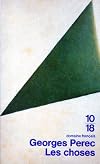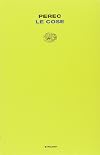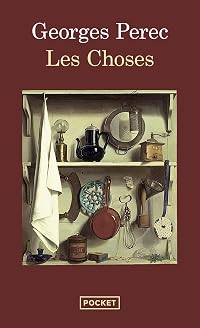
Things: A Story of the Sixties
by Georges Perec
On This Page
Description
Story of a young French couple and their quest for material happiness. A portrayal of French social conditions in the 1960s.Tags
Recommendations












Member Recommendations

Member Reviews
Perec‘s first short novel, written before he met Raymond Queneau and joined Oulipo, is almost a straight piece of narrative fiction, not really experimental at all apart from a bit of fancy footwork involving tenses. And the unusual way in which the main character is not an individual but a couple, Sylvie and Jérôme, who are differentiated only during the Tunisian chapters, where (as happened to Perec and his wife during their time in Sfax) it is Sylvie who teaches and Jérôme who can‘t find a job.
Perec is exploring the way modern life drags us into the quest for material possessions. Sylvie and Jérôme are young Parisians who have every reason to be suspicious of consumer society: they work as part-time market researchers, so show more they know a lot about the inner workings of the advertising industry. They have deliberately opted out of the bourgeois rat-race of career, mortgage, pension, kids, and they love being able to work when it suits them, but they are still sufficiently exposed to the dominant ideology that they believe — as most of us do — that being surrounded by the right furniture, light-fittings, books and records will make them happier and more fulfilled as human beings. Oddly enough, it doesn’t.
A far gentler, less bitterly satirical book than I imagined this was going to be: Perec clearly has a lot of sympathy with his characters, despite his advantage of hindsight. show less
Perec is exploring the way modern life drags us into the quest for material possessions. Sylvie and Jérôme are young Parisians who have every reason to be suspicious of consumer society: they work as part-time market researchers, so show more they know a lot about the inner workings of the advertising industry. They have deliberately opted out of the bourgeois rat-race of career, mortgage, pension, kids, and they love being able to work when it suits them, but they are still sufficiently exposed to the dominant ideology that they believe — as most of us do — that being surrounded by the right furniture, light-fittings, books and records will make them happier and more fulfilled as human beings. Oddly enough, it doesn’t.
A far gentler, less bitterly satirical book than I imagined this was going to be: Perec clearly has a lot of sympathy with his characters, despite his advantage of hindsight. show less
Things made me melancholic of the inner life of my early 20s when I stared at shop windows, in love, wanting what I didn't have, imagining the lifestyle posed in magazines and movies and shop fronts. Its a time of desire, longing, wanting, when objects easily influence one's reason. You know why lifestyle marketing works, Perec didn't write sociology and advertising copy, but he got to the heart of this moment in life and our relationship to capitalism and consumption. Even thinking about the book makes me melancholic for that moment in time, before you had things, before you had the money for things, but things conjured so many dreams.
Una storia di speranza e rinuncia, di un sogno bohemienne che viene avvelenato dal desiderio delle cose, considerate come fine a loro stesse e non ammantate di fascino à la Huysmans, soccombendo nella spirale della normalità capitalistica. Una storia amara e spietata, perché raccontata con oggettività e senza ironia. Prova provata che Perec, qui al primo libro nel 1965, poteva scrivere di tutto.
“Sarebbe piaciuto loro essere ricchi. Credevano che avrebbero saputo esserlo. Avrebbero saputo vestirsi, guardare, sorridere come persone ricche. Avrebbero avuto il tatto, la discrezione necessari. Avrebbero dimenticato la loro ricchezza, avrebbero saputo non ostentarla. Non se ne sarebbero vantati. L'avrebbero respirata. I loro piaceri show more sarebbero stati intensi. Avrebbero conosciuto il piacere di camminare, bighellonare, scegliere, gustare. Avrebbero conosciuto la gioia di vivere. La loro vita sarebbe stata un'arte del vivere. show less
“Sarebbe piaciuto loro essere ricchi. Credevano che avrebbero saputo esserlo. Avrebbero saputo vestirsi, guardare, sorridere come persone ricche. Avrebbero avuto il tatto, la discrezione necessari. Avrebbero dimenticato la loro ricchezza, avrebbero saputo non ostentarla. Non se ne sarebbero vantati. L'avrebbero respirata. I loro piaceri show more sarebbero stati intensi. Avrebbero conosciuto il piacere di camminare, bighellonare, scegliere, gustare. Avrebbero conosciuto la gioia di vivere. La loro vita sarebbe stata un'arte del vivere. show less
[Review on Things only - for now:]
Things puts a new spin on the whole "The things you own end up owning you" principle. The couple at the outskirts of this story (I was going to say 'center of this story' but really they are both central and peripheral) at times knowingly buy in to the belief that they are deliberately purchasing things or conducting market research on things knowing they themselves do so with an end to fill a void to provide pleasure and/or status. But at other times, they seem to find themselves lost, unable to find this joy from the objects around them, or to find the right kind of objects to fill their emptiness.
Perec doesn't present his story with any kind of dialogue (unless you count the epilogue). Instead he show more presents his story as a kind of catalog of description, accounts and inventories of things, people, and activities. It is sometimes tiresome but more often than not a bit absorbing in a social commentary/voyeurism sort of way, and often beautiful and very visual. Probably the only problem I had with his 'message' is that the trip to Sfax is almost a cop-out: Why are we required to leave our country in order to find change or to seek out an answer? He salvages this by suggesting that leaving is just another form of loss that the characters experience.
The book has a taste of optimism but is mostly dreary and heartbreaking. There is beauty to be found, but Jerome and Sylvie seem to discover it only as it is leaving them (or they are leaving it).
There is a lot to discover in this book that make it a worthwhile read, a lot of moments that, even though this was written about the sixties, resonate in our consumerist culture and in our desire to find ourselves through the things we buy and with which we surround ourselves.
Note: I read Things for a class in conjunction with Lipovetsky's Hypermodern Times. Even though neither were written for the other, there is great value to reading them together. show less
Things puts a new spin on the whole "The things you own end up owning you" principle. The couple at the outskirts of this story (I was going to say 'center of this story' but really they are both central and peripheral) at times knowingly buy in to the belief that they are deliberately purchasing things or conducting market research on things knowing they themselves do so with an end to fill a void to provide pleasure and/or status. But at other times, they seem to find themselves lost, unable to find this joy from the objects around them, or to find the right kind of objects to fill their emptiness.
Perec doesn't present his story with any kind of dialogue (unless you count the epilogue). Instead he show more presents his story as a kind of catalog of description, accounts and inventories of things, people, and activities. It is sometimes tiresome but more often than not a bit absorbing in a social commentary/voyeurism sort of way, and often beautiful and very visual. Probably the only problem I had with his 'message' is that the trip to Sfax is almost a cop-out: Why are we required to leave our country in order to find change or to seek out an answer? He salvages this by suggesting that leaving is just another form of loss that the characters experience.
The book has a taste of optimism but is mostly dreary and heartbreaking. There is beauty to be found, but Jerome and Sylvie seem to discover it only as it is leaving them (or they are leaving it).
There is a lot to discover in this book that make it a worthwhile read, a lot of moments that, even though this was written about the sixties, resonate in our consumerist culture and in our desire to find ourselves through the things we buy and with which we surround ourselves.
Note: I read Things for a class in conjunction with Lipovetsky's Hypermodern Times. Even though neither were written for the other, there is great value to reading them together. show less
2 early pre-OuLiPo novels of Perec. Given that Perec is in my top 10 favorite writers, I read everything that I come across by him & he can, basically, 'do no wrong'. As is usually the case, I like creative people who continue to be creative: ie: who manage to make new work that's significantly different from their older work. Perec exemplifies this. Each thing I've read by him has been significantly different from each other, each has been strong.
I'd call both novels vaguely (or, perhaps, not so vaguely) Existentialist. Wch is weird for me b/c I don't think I've ever called the writings of anyone other than the obvious Camus & Sartre that. They're not so vaguely sad & make me think of writing in general as a form of 'insanity'. I show more mean, what type of person chooses to spend their time in what's usually a highly isolated & isolating activity - probably in the hopes that other (often also isolated) people, the readers, will experience the product? THEN, who chooses to have that product be about, 1st, in "Things", a subtle (or not so subtle?) sense of perpetual dissatisfaction typically critiqued as "consumerism" but, perhaps, more indicative of an even broader human condition: a striving for the 'impossible' (or unlikely); & 2nd, in "A Man Asleep", about a person whose depression practically reduces them to a zombie? (Did you forget that that long-winded sentence was working toward being a question?)
According to David Bellos' introduction, Perec, himself, went thru a similar period to that of the main character (essentially the 'only' character) in "A Man Asleep". I'd've pretty much taken that for granted even if Bellos hadn't so informed me. The character, who mostly drops out of social society, reminds me of a guy I know who's reputed to've been a law student at a local university. Now he's a street person who claims he doesn't know what happened to himself - except that he developed a problem of feeling "paralyzed" & incapable of doing things. He says he tried to hang in there but cdn't. Now he's widely known as being the filthiest street person w/ the most tattered clothes. Perec's character fares much better. For one thing he has money that he budgets carefully, he has a place to live, he can afford to eat & go to the movies, he stays clean. But, otherwise, he's somewhat mind-numbing to read about.
&, of course, there's Perec's writing itself. His descriptions are marvelous & sensitive - no doubt in large part, here, thanks to David Bellos' & Andrew Leaks' equally marvelous & sensitive translations. show less
I'd call both novels vaguely (or, perhaps, not so vaguely) Existentialist. Wch is weird for me b/c I don't think I've ever called the writings of anyone other than the obvious Camus & Sartre that. They're not so vaguely sad & make me think of writing in general as a form of 'insanity'. I show more mean, what type of person chooses to spend their time in what's usually a highly isolated & isolating activity - probably in the hopes that other (often also isolated) people, the readers, will experience the product? THEN, who chooses to have that product be about, 1st, in "Things", a subtle (or not so subtle?) sense of perpetual dissatisfaction typically critiqued as "consumerism" but, perhaps, more indicative of an even broader human condition: a striving for the 'impossible' (or unlikely); & 2nd, in "A Man Asleep", about a person whose depression practically reduces them to a zombie? (Did you forget that that long-winded sentence was working toward being a question?)
According to David Bellos' introduction, Perec, himself, went thru a similar period to that of the main character (essentially the 'only' character) in "A Man Asleep". I'd've pretty much taken that for granted even if Bellos hadn't so informed me. The character, who mostly drops out of social society, reminds me of a guy I know who's reputed to've been a law student at a local university. Now he's a street person who claims he doesn't know what happened to himself - except that he developed a problem of feeling "paralyzed" & incapable of doing things. He says he tried to hang in there but cdn't. Now he's widely known as being the filthiest street person w/ the most tattered clothes. Perec's character fares much better. For one thing he has money that he budgets carefully, he has a place to live, he can afford to eat & go to the movies, he stays clean. But, otherwise, he's somewhat mind-numbing to read about.
&, of course, there's Perec's writing itself. His descriptions are marvelous & sensitive - no doubt in large part, here, thanks to David Bellos' & Andrew Leaks' equally marvelous & sensitive translations. show less
I enjoyed Things much more than A Man Asleep. Being about the same age/at the same point in my life as the main characters, I found myself really identifying with the way the world appears to the Perec's characters. It doesn't do much to inspire hope for those who haven't "settled in" as far as life is concerned, but it's reassuring to remember we're all in the same boat.
I enjoyed Things much more than A Man Asleep. Being about the same age/at the same point in my life as the main characters, I found myself really identifying with the way the world appears to the Perec's characters. It doesn't do much to inspire hope for those who haven't "settled in" as far as life is concerned, but it's reassuring to remember we're all in the same boat.
Members
- Recently Added By
Lists

1,001 BYMRBYD Concensus
723 works; 27 members

hopes
34 works; 1 member
Author Information

150+ Works 13,570 Members
Georges Perec was born in Paris on March 7, 1936 and was educated in Claude-Bernard and Geoffroy-Saint-Hilaire. Perec was a parachutist in the French Military before he began publishing his writing in magazines like Partisans. Perec also wrote the book, Life: A Users Manual. Perec is noted for his constrained writing: his 300-page novel La show more disparition (1969) is a lipogram, written without ever using the letter "e". Perec won the Prix Renaudot in 1965, the Prix Jean Vigo in 1974, the Prix Médicis in 1978. Georges Perec died on March 3, 1982. (Bowker Author Biography) show less
Some Editions
Awards and Honors
Series
Belongs to Publisher Series
Work Relationships
Is contained in
Has as a student's study guide
Common Knowledge
- Canonical title
- Things: A Story of the Sixties
- Original title
- Les choses. Une histoire des années soixante
- Original publication date
- 1965
- People/Characters
- Jerome; Sylvie
- Important places
- Paris, France
- Dedication
- To Denis Buffard
- Original language
- French
- Disambiguation notice
- This entry is for the single work Things: A Story of the Sixties and should not be combined with works containing both Things: A Story of the Sixties *and* A Man Asleep.
Classifications
Statistics
- Members
- 924
- Popularity
- 28,901
- Reviews
- 21
- Rating
- (3.69)
- Languages
- 17 — Catalan, Danish, Dutch, English, Estonian, Finnish, French, German, Icelandic, Italian, Norwegian (Bokmål), Polish, Portuguese, Russian, Spanish, Swedish, Turkish
- Media
- Paper, Audiobook, Ebook
- ISBNs
- 46
- ASINs
- 24