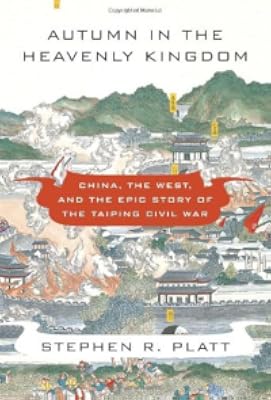
Autumn in the Heavenly Kingdom: China, the West, and the Epic Story of the Taiping Civil War
by Stephen R. Platt
On This Page
Description
This narrative history of China's nineteenth-century Taiping Rebellion (which cost some twenty million lives) brims with unforgettable characters and vivid re-creations of massive and sometimes gruesome battles--a riveting, both sweeping and intimate portrait of the largest civil war in history.Tags
Recommendations



Member Reviews
This is an excellent narrative history of a war which has the contradiction of being the second-bloodiest war in history (some 20 MILLION dead), and yet being almost wholly forgotten to Western audiences. The Chinese remember it, though. THeir history tells stories of the Yangtse overflowing and choked with the swollen corpses of the dead.
In narrative history style, Platt focuses on several of the major characters - a Confucian scholar-general who is the Qing Empire's last hope, British diplomats and mercenaries, American observers and missionaries, and the Shield-King, cousin to the Taiping ruler himself, who had visions of Christianity and modernizing China, at the point of a sword and God's blessing.
Although the Western nomenclature show more has this as a 'Rebellion', Platt characterizes this conflict as a Civil War - contemporary with the American one about to boil over. He posits that the two sides were so evenly matched that it was foreign intervention which tipped the balance to the Qing. They did so primarily for trade reasons, despite the fevered diplomacy of the Taiping, and the appeal to 'their fellow Christians'.
It is unknown what might have happened of the 'Younger Brother of Jesus Christ' took over China, and the Qing fell then instead of hanging on until 1911. If his plans of forced modernization had gone through some years earlier than planned, who knows what the course of Asian history would be instead. China is a colossus with feet of clay, and even now, her destiny is uncertain. show less
In narrative history style, Platt focuses on several of the major characters - a Confucian scholar-general who is the Qing Empire's last hope, British diplomats and mercenaries, American observers and missionaries, and the Shield-King, cousin to the Taiping ruler himself, who had visions of Christianity and modernizing China, at the point of a sword and God's blessing.
Although the Western nomenclature show more has this as a 'Rebellion', Platt characterizes this conflict as a Civil War - contemporary with the American one about to boil over. He posits that the two sides were so evenly matched that it was foreign intervention which tipped the balance to the Qing. They did so primarily for trade reasons, despite the fevered diplomacy of the Taiping, and the appeal to 'their fellow Christians'.
It is unknown what might have happened of the 'Younger Brother of Jesus Christ' took over China, and the Qing fell then instead of hanging on until 1911. If his plans of forced modernization had gone through some years earlier than planned, who knows what the course of Asian history would be instead. China is a colossus with feet of clay, and even now, her destiny is uncertain. show less
The 'Taiping Rebellion' (1850-64) was the largest Civil War in human history and the deadliest conflict of the 19th century. Autumn in the Heavenly Kingdom focuses on events through the eyes of individual characters in an attempt at narrative history of this massive conflict. The first third is fantastic, I was totally hooked and drawn into an exotic world. Later parts become a long Gibbon-style series of contingent battles and people with hard to remember names that blend together and bog the narrative. But it gives a good sense of the course of the war, it was complicated and brutal, political machinations and atrocities happen frequently, there were many epic events. Platt makes the case that British intervention backed the wrong show more side - thus messing up the natural order of Chinese rebellion that frequently replaced aging dynasties - resulting in even worse bloodshed in the 20th century. I think this is a great introduction to the Taiping Rebellion with a global perspective showing it was more than just an internal civil war but part of a global series of events. It received an unfair negative review in the NYT, the complaints are somewhat true but overblown, and the reviewer totally missed the main thesis of western power intervention, it is the first book to integrate this view. show less
Lacks Exposition and Introduction to Main Historical Figures
"Autumn in the Heavenly Kingdom" by Jonathan Spence is a well-researched book that covers isolated parts of the Taiping Rebellion. It is not a comprehensive history.
The focus of Spence's book is Hong Rengan, a Christian convert who was a distant relative of the Taiping leader. Hong Rengan was absent from the start of the rebellion, and thus the author's narrative begins "en medias res" with only a passing backstory about the rebellion's origins. As Spence writes throughout the book, Hong Rengan was immensely popular among the Western diplomats and missionaries. Thus, much of the book also spends time discussing the missionaries and their lives. "Autumn in the Heavenly Kingdom" show more has a focus on the West's view of events in China - particularly a distrust of the ruling Qing dynasty.
As a biography of Hong Rengan and his role as a minister in the rebellion, this is an excellent book. I was looking for a definitive history of the Taiping Rebellion, which this is not. show less
"Autumn in the Heavenly Kingdom" by Jonathan Spence is a well-researched book that covers isolated parts of the Taiping Rebellion. It is not a comprehensive history.
The focus of Spence's book is Hong Rengan, a Christian convert who was a distant relative of the Taiping leader. Hong Rengan was absent from the start of the rebellion, and thus the author's narrative begins "en medias res" with only a passing backstory about the rebellion's origins. As Spence writes throughout the book, Hong Rengan was immensely popular among the Western diplomats and missionaries. Thus, much of the book also spends time discussing the missionaries and their lives. "Autumn in the Heavenly Kingdom" show more has a focus on the West's view of events in China - particularly a distrust of the ruling Qing dynasty.
As a biography of Hong Rengan and his role as a minister in the rebellion, this is an excellent book. I was looking for a definitive history of the Taiping Rebellion, which this is not. show less
While this book does an excellent job narrating the political events of the Taiping Rebellion, it treats the Taiping movement itself as an "other" around which swirl the machinations of Qing Mandarins and British imperialists. Far too often, I found myself impatient reading about European and American hypocrisy, wishing I could get a sense of what motivated the rebels and how they became such a powerful force.
Recent superlative Chinese history, compulsively readable.
A well written history of the Chinese Civil War/Taiping Rebellion. An interesting read with a concentration on the foreign powers (Britian primarily) and the impact of their actions on the war.
The Taiping Rebellion (or war as Platt describes it, with good reason) was one of the most destructive conflicts in China and indeed the world. The Qing government faced a popular heterodox Christian revolt that spread across several provinces, and was only substantially solved after foreign involvement.
Platt's book details the history of the war, its principle figures, and the differing responses the world had to it, ranging from initial support to condemnation as crossed wires and miscommunication shifted global opinion against the Taiping.
Extremely well-researched and well written, this book is a fascinating insight into a key part of China's early modern history, the impact of which is still present in Chinese society today.
Platt's book details the history of the war, its principle figures, and the differing responses the world had to it, ranging from initial support to condemnation as crossed wires and miscommunication shifted global opinion against the Taiping.
Extremely well-researched and well written, this book is a fascinating insight into a key part of China's early modern history, the impact of which is still present in Chinese society today.
Members
- Recently Added By
Published Reviews
ThingScore 63
There should be a term in German that describes the sinking feeling you have when reading a serious book of scholarship, one whose determined author deserves praise and tenure, that no civilian reader should pick up, that will not warm in your hands, that will make you regret the 10 hours of your life lost to it, and that, once put down, will not cry out to be picked back up.
added by Shortride
“Stephen Platt brings to vivid life a pivotal chapter in China’s history that has been all but forgotten: the Taiping Rebellion in the mid-nineteenth century, which cost one of the greatest losses of life of any war in history. It had far-reaching consequences that still reverberate in contemporary China. Autumn in the Heavenly Kingdom is a fascinating work by a first-class historian and show more superb writer.” show less
added by Stbalbach
Lists

r/History Recommended Reading List
603 works; 12 members

Paul French's Ultimate China Bookshelf
31 works; 1 member

The China Project Book List
100 works; 2 members

China / Hong Kong / Taiwan
25 works; 1 member
Author Information

4 Works 869 Members
Stephen R. Platt recounts these events in spellbinding detail, building his story on two fascinating characters with opposing visions for China's future: the conservative Confucian scholar Zeng Guofan, an accidental general who emerged as the most influential military strategist in China's modern history; and Hong Rengan, a brilliant Taiping show more leader whose grand vision of building a modern, industrial, and pro-Western Chinese state ended in tragic failure. show less
Awards and Honors
Awards
Distinctions
Notable Lists
Common Knowledge
- Canonical title
- Autumn in the Heavenly Kingdom: China, the West, and the Epic Story of the Taiping Civil War
- Original publication date
- 2012
- People/Characters
- Charles George Gordon
- Important events
- Taiping Rebellion
Classifications
Statistics
- Members
- 429
- Popularity
- 72,015
- Reviews
- 11
- Rating
- (3.98)
- Languages
- Chinese, English
- Media
- Paper, Audiobook, Ebook
- ISBNs
- 13
- ASINs
- 9