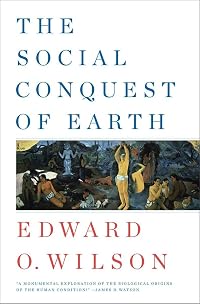
The Social Conquest of Earth
by Edward O. Wilson
On This Page
Description
Based on a lifetime of pioneering research, preeminent naturalist Edward O. Wilson gives us a new history of human evolution, presented in an elegant and provocative narrative that promises to have reverberations in fields as diverse as anthropology and social psychology, neuroscience and 21st-century intellectual and religious history. Wilson begins by addressing three "fundamental questions" of religion and philosophy that have fascinated thinkers for centuries: Where did we come from? show more What are we? Where are we going? Writing that "the origin of modern humanity was a stroke of luck, good for our species for a while, bad for most of the rest of life forever," Wilson traces the rise of Homo sapiens from its infancy, drawing on his remarkable knowledge of biology and social behavior to present us with the clearest explanation ever produced as to the origin of the human condition. Wilson also reveals how "group selection" can be the only model for explaining man's origins and domination, and warns that it has now accelerated--through unregulated and untrammeled growth--to such a point that the planet as we know it is being threatened.--From publisher description. From the most celebrated heir to Darwin comes a groundbreaking book on evolution, the summa work of Edward O. Wilson's legendary career. show lessTags
Recommendations










Member Reviews
I've been a fan of E.O. Wilson's books for quite a few years now, so when I read in last November's Atlantic ("E.O. Wilson's Theory of Everything," by Howard French) about the book Wilson has said might just be his last, I could hardly wait for it. The Social Conquest of Earth (W.W. Norton, 2012) hits shelves in early April, and like many of Wilson's books, it's sure to provoke argument, controversy, and debate. Wilson pulls no punches and leaves no sacred cows grazing; this is a man sure of his conclusions.
Howard French's Atlantic article does a good job summarizing Wilson's main theory as laid out in The Social Conquest of Earth: that sociality among animal species evolved not because of the theory generally accepted for the last show more half-century or so, known as "kin-selection theory" (that is, that cooperation between species members arises because of close genetic connection between group members) but rather that eusocial behaviors have (only very rarely) emerged in animal species as a result of an evolutionary process.
Wilson also examines the development of kin selection theory and how his views on it have evolved over the years as new evidence has come to light. With the arrival of the theory of multilevel natural selection as a more general theory, and with the breakdown of kin selection theory's basic principles, he argues that it is time for evolutionary biology to leave the idea of kin selection behind entirely. I'm sure that it won't go without a fight, as it still has a wide variety of proponents in the field, but it will sure be a fascinating process to watch (and just speaking intuitively, since I don't know the technical literature very well at all, it seems to me that Wilson probably has the better of the argument).
The process toward sociality as laid out by Wilson consists of five distinct stages, the final two of which have been reached only in certain insects like honeybees and army ants (group formation; "occurrence of a minimum and necessary combination of preadaptive traits in the groups, causing the groups to be tightly formed"; "appearance of mutations that prescribe the persistence of the group"; group-level selection by environmental forces; and changes in the life cycle based on group-level selection, sometimes leading to the development of a superorganism). A key step along the path to sociality, Wilson argues, was the creation of a defensible nest.
Much of The Social Conquest of Earth is given over to fascinating and sometimes quite technical accounts of how these processes developed in animal species, from certain types of shrimp to termites to leafcutter ants and aphids, and then how human societal development can be traced back to those same processes. "The key to the origin of the human condition is not to be found in our species exclusively, because the story did not start and end with humanity. The key,"Wilson argues, "is to be found in the evolution of social life in animals as a whole" (p. 109). As to why humans have emerged to be the dominant species they have, Wilson suggests it's simply because Homo sapiens is the only species to have made "every one of the required lucky turns": land-based existence, large body size, grasping hands, bipedal movement, meat-based diet, organized groups, control of fire, development of central campsite "nests," division of labor, &c.
The human brain, Wilson writes, "had to become highly intelligent and intensely social ... selfish at one time, selfless at another" (p. 17). He argues that humanity is faced with an unsolvable dilemma, rooted deeply in our evolutionary history: that because human beings are subject to both individual- and group-level impulses and urges at all times, we are literally at war with our selves. Altruism and group welfare are a part of us, but at the same time, so are selfish desires. The human species is, Wilson writes, "an evolutionary chimera, living on intelligence steered by the demands of animal instinct. This is the reason we are mindlessly destroying the biosphere and, with it, our own prospects for permanent existence" (p. 13).
Some of the consequences Wilson sees in the ever-present human struggle between individual- and group-level selection include intense inter-group competition; unstable group composition; "an unavoidable and perpetual war ... between honor, virtue, and duty ... and selfishness, cowardice, and hypocrisy"; "quick and expert reading of intention"; and, in fact, much of culture itself (p. 56). What humans create as art, religion and social behavior, Wilson maintains, springs from this tension between individual and group selection.
In the last hundred pages or so of The Social Conquest of Earth, Wilson turns to human culture. Drawing on his immensely broad knowledge of scholarship across an impressive variety of fields (from linguistics to history to religion to art and beyond), Wilson lays out the processes by which human beings came to develop what we know today as culture (from language to religion and beyond). He begins by bursting a bubble or two: "The explosion of innovations that lifted humanity to world dominance surely did not result from a single empowering mutation. Even less likely did it come as some mystic afflatus that descended upon our struggling forebears" (p. 225). Wilson uses the term "gene-culture coevolution" to describe the process by which cultural practices developed and were passed down through the "genetic predisposition of individuals to select and transmit through culture one out of multiple options possible" (p. 203). This idea, he writes, offers a way to connect the natural sciences, social sciences and the humanities; understanding how both genes and group selection dynamics have influenced and continue to influence cultural practices can help us as a species explain why we do some of the things we do. "The naturalistic understanding of morality does not lead to absolute precepts and sure judgments, but instead warns against basing them blindly on religious and ideological dogmas," Wilson writes (p. 252).
Indeed, Wilson's harshest criticism in the book is reserved not for those who continue to embrace kin selection theory, but for what he sees as "dogmatic ethics gone wrong for lack of knowledge" (p. 253). Two particular examples are bans on contraception and homphobia. The first, promulgated by Paul VI in 1968, fails to account for all the evidence that non-reproductive sexual activity plays key roles in human biology. And homophobia, Wilson writes, is just as wrong: homosexuality, a trait influenced by heredity, occurs too frequently to be due to genetic mutation, and it is widely accepted that "if a trait cannot be due solely to random mutations, and yet it lowers or eliminates reproduction in those who have it, then the trait must be favored by natural selection working on a target of some other kind. For example, a low dose of homosexual-tending genes may give competitive advantages to a practising heterosexual. Or, homosexuality may give advantages to the group by special talents, unusual qualities of personality, and the specialized roles and professions it generates. There is abundant evidence that such is the case in both preliterate and modern societies. Either way, societies are mistaken to disapprove of homosexuality because gays have different sexual preferences and reproduce less. Their presence instead should be valued for what they contribute constructively to human diversity. A society that condemns homosexuality harms itself" (p. 253-4).
Organized religion, Wilson argues here, is a simple expression of tribalism, with the "illogic" of religious belief not a weakness, but a strength, in that it serves to bind the group's members together to the exclusion of outsiders (unless they can be persuaded to join). Creation stories, genesis myths and even the "phantasmagoric elements" shared between the world's religions are all explainable as cultural relics (and/or as the result of hallucinogenic drugs; this, he suggests, is a much more plausible explanation for John's visions as recorded in the Book of Revelation than that any such thing actually happened).
By understanding that the struggle inherent in multilevel selection "is the fountainhead of the humanities," Wilson writes, we can better explain our cultural artifacts, and perhaps even rise above what they have wrought in today's society. In the final chapter, "A New Enlightenment," Wilson calls for humanity to overcome the cultural shackles that bind us into tribes and come together as a species, before it is too late, to preserve the planet, the only one we're ever going to be able to live on. The processes of human-wrought climate change and the "obliteration" of Earth's biodiversity must be arrested, Wilson urges, and in order to make that possible:
"It will be useful in taking a second look at science and religion to understand the true nature of the search for objective truth. Science is not just another enterprise like medicine or enginerering or theology. It is the wellspring of all the knowledge we have of the real world that can be tested and fitted to preexisting knowledge. It is the arsenal of technologies and inferential mathematics needed to distinguish the true from the false. It formulates the principles and formulas that tie all this knowledge together. Science belongs to everybody. Its constituent parts can be challenged by anybody in the world who has sufficient information to do so. It is not just 'another way of knowing' as often claimed, making it coequal with religious faith. The conflict between scientific knowledge and the teachings of organized religions is irreconciable. The chasm will continue to widen and cause no end of trouble as long as religious leaders go on making unsupportable claims about supernatural causes of reality" (p. 295).
It's not too late for humanity, Wilson concludes, ever optimistic, but to save our planet, and ourselves, will require a tremendous amount of effort and a recalibration of humanity's priorities on a grand scale. We must, he argues, rely on "an ethic of simple decency to one another, the unrelenting application of reason, and acceptance of what we truly are" (p. 297).
I can't say that I entirely share Wilson's faith in humanity. While I certainly find his theory as outlined here quite compelling, I also happen to share his belief in rational, science-based thinking, and too many people out in the world don't (witness the state of American politics today, where denial of science-based realism is worn as a badge of honor by the leading members of a major political party). I fear that it will take a catastrophic event of, dare I say, Biblical proportions, to bring many people around to the view that comes so naturally to Wilson and, likely, to many of those who read his works.
Wilson's writing draws the reader in quickly: here's a representative quotation from near the beginning of the book: "Humanity today is like a walking dreamer, caught between the fantasies of sleep and the chaos of the real world. The mind seeks but cannot find the precise place and hour. We have created a Star Wars civilization, with Stone Age emotions, medieval institutions, and godlike technology. We thrash about. We are terribly confused by the mere fact of our existence, and a danger to ourselves and to the rest of life" (p. 7). He's able to summarize very technical scientific processes and make them understandable to those of us not so well-versed in such things, and while sometimes it's handy to have a dictionary about (a few of the new words I jotted down as I read: vicariant, anastomosed), that makes reading books like this all the more enjoyable.
A challenging, deeply meaningful and extremely important book, sure to provoke much argument from many different corners, The Social Conquest of Earth is the sort of book that doesn't come around very often at all. Anyone with an interest in the consilience between intellectual disciplines and/or in the roots of human culture generally should read it, and I hope the conversations it sparks will be sustained and fruitful.
http://philobiblos.blogspot.com/2012/03/book-review-social-conquest-of-earth.htm... show less
Howard French's Atlantic article does a good job summarizing Wilson's main theory as laid out in The Social Conquest of Earth: that sociality among animal species evolved not because of the theory generally accepted for the last show more half-century or so, known as "kin-selection theory" (that is, that cooperation between species members arises because of close genetic connection between group members) but rather that eusocial behaviors have (only very rarely) emerged in animal species as a result of an evolutionary process.
Wilson also examines the development of kin selection theory and how his views on it have evolved over the years as new evidence has come to light. With the arrival of the theory of multilevel natural selection as a more general theory, and with the breakdown of kin selection theory's basic principles, he argues that it is time for evolutionary biology to leave the idea of kin selection behind entirely. I'm sure that it won't go without a fight, as it still has a wide variety of proponents in the field, but it will sure be a fascinating process to watch (and just speaking intuitively, since I don't know the technical literature very well at all, it seems to me that Wilson probably has the better of the argument).
The process toward sociality as laid out by Wilson consists of five distinct stages, the final two of which have been reached only in certain insects like honeybees and army ants (group formation; "occurrence of a minimum and necessary combination of preadaptive traits in the groups, causing the groups to be tightly formed"; "appearance of mutations that prescribe the persistence of the group"; group-level selection by environmental forces; and changes in the life cycle based on group-level selection, sometimes leading to the development of a superorganism). A key step along the path to sociality, Wilson argues, was the creation of a defensible nest.
Much of The Social Conquest of Earth is given over to fascinating and sometimes quite technical accounts of how these processes developed in animal species, from certain types of shrimp to termites to leafcutter ants and aphids, and then how human societal development can be traced back to those same processes. "The key to the origin of the human condition is not to be found in our species exclusively, because the story did not start and end with humanity. The key,"Wilson argues, "is to be found in the evolution of social life in animals as a whole" (p. 109). As to why humans have emerged to be the dominant species they have, Wilson suggests it's simply because Homo sapiens is the only species to have made "every one of the required lucky turns": land-based existence, large body size, grasping hands, bipedal movement, meat-based diet, organized groups, control of fire, development of central campsite "nests," division of labor, &c.
The human brain, Wilson writes, "had to become highly intelligent and intensely social ... selfish at one time, selfless at another" (p. 17). He argues that humanity is faced with an unsolvable dilemma, rooted deeply in our evolutionary history: that because human beings are subject to both individual- and group-level impulses and urges at all times, we are literally at war with our selves. Altruism and group welfare are a part of us, but at the same time, so are selfish desires. The human species is, Wilson writes, "an evolutionary chimera, living on intelligence steered by the demands of animal instinct. This is the reason we are mindlessly destroying the biosphere and, with it, our own prospects for permanent existence" (p. 13).
Some of the consequences Wilson sees in the ever-present human struggle between individual- and group-level selection include intense inter-group competition; unstable group composition; "an unavoidable and perpetual war ... between honor, virtue, and duty ... and selfishness, cowardice, and hypocrisy"; "quick and expert reading of intention"; and, in fact, much of culture itself (p. 56). What humans create as art, religion and social behavior, Wilson maintains, springs from this tension between individual and group selection.
In the last hundred pages or so of The Social Conquest of Earth, Wilson turns to human culture. Drawing on his immensely broad knowledge of scholarship across an impressive variety of fields (from linguistics to history to religion to art and beyond), Wilson lays out the processes by which human beings came to develop what we know today as culture (from language to religion and beyond). He begins by bursting a bubble or two: "The explosion of innovations that lifted humanity to world dominance surely did not result from a single empowering mutation. Even less likely did it come as some mystic afflatus that descended upon our struggling forebears" (p. 225). Wilson uses the term "gene-culture coevolution" to describe the process by which cultural practices developed and were passed down through the "genetic predisposition of individuals to select and transmit through culture one out of multiple options possible" (p. 203). This idea, he writes, offers a way to connect the natural sciences, social sciences and the humanities; understanding how both genes and group selection dynamics have influenced and continue to influence cultural practices can help us as a species explain why we do some of the things we do. "The naturalistic understanding of morality does not lead to absolute precepts and sure judgments, but instead warns against basing them blindly on religious and ideological dogmas," Wilson writes (p. 252).
Indeed, Wilson's harshest criticism in the book is reserved not for those who continue to embrace kin selection theory, but for what he sees as "dogmatic ethics gone wrong for lack of knowledge" (p. 253). Two particular examples are bans on contraception and homphobia. The first, promulgated by Paul VI in 1968, fails to account for all the evidence that non-reproductive sexual activity plays key roles in human biology. And homophobia, Wilson writes, is just as wrong: homosexuality, a trait influenced by heredity, occurs too frequently to be due to genetic mutation, and it is widely accepted that "if a trait cannot be due solely to random mutations, and yet it lowers or eliminates reproduction in those who have it, then the trait must be favored by natural selection working on a target of some other kind. For example, a low dose of homosexual-tending genes may give competitive advantages to a practising heterosexual. Or, homosexuality may give advantages to the group by special talents, unusual qualities of personality, and the specialized roles and professions it generates. There is abundant evidence that such is the case in both preliterate and modern societies. Either way, societies are mistaken to disapprove of homosexuality because gays have different sexual preferences and reproduce less. Their presence instead should be valued for what they contribute constructively to human diversity. A society that condemns homosexuality harms itself" (p. 253-4).
Organized religion, Wilson argues here, is a simple expression of tribalism, with the "illogic" of religious belief not a weakness, but a strength, in that it serves to bind the group's members together to the exclusion of outsiders (unless they can be persuaded to join). Creation stories, genesis myths and even the "phantasmagoric elements" shared between the world's religions are all explainable as cultural relics (and/or as the result of hallucinogenic drugs; this, he suggests, is a much more plausible explanation for John's visions as recorded in the Book of Revelation than that any such thing actually happened).
By understanding that the struggle inherent in multilevel selection "is the fountainhead of the humanities," Wilson writes, we can better explain our cultural artifacts, and perhaps even rise above what they have wrought in today's society. In the final chapter, "A New Enlightenment," Wilson calls for humanity to overcome the cultural shackles that bind us into tribes and come together as a species, before it is too late, to preserve the planet, the only one we're ever going to be able to live on. The processes of human-wrought climate change and the "obliteration" of Earth's biodiversity must be arrested, Wilson urges, and in order to make that possible:
"It will be useful in taking a second look at science and religion to understand the true nature of the search for objective truth. Science is not just another enterprise like medicine or enginerering or theology. It is the wellspring of all the knowledge we have of the real world that can be tested and fitted to preexisting knowledge. It is the arsenal of technologies and inferential mathematics needed to distinguish the true from the false. It formulates the principles and formulas that tie all this knowledge together. Science belongs to everybody. Its constituent parts can be challenged by anybody in the world who has sufficient information to do so. It is not just 'another way of knowing' as often claimed, making it coequal with religious faith. The conflict between scientific knowledge and the teachings of organized religions is irreconciable. The chasm will continue to widen and cause no end of trouble as long as religious leaders go on making unsupportable claims about supernatural causes of reality" (p. 295).
It's not too late for humanity, Wilson concludes, ever optimistic, but to save our planet, and ourselves, will require a tremendous amount of effort and a recalibration of humanity's priorities on a grand scale. We must, he argues, rely on "an ethic of simple decency to one another, the unrelenting application of reason, and acceptance of what we truly are" (p. 297).
I can't say that I entirely share Wilson's faith in humanity. While I certainly find his theory as outlined here quite compelling, I also happen to share his belief in rational, science-based thinking, and too many people out in the world don't (witness the state of American politics today, where denial of science-based realism is worn as a badge of honor by the leading members of a major political party). I fear that it will take a catastrophic event of, dare I say, Biblical proportions, to bring many people around to the view that comes so naturally to Wilson and, likely, to many of those who read his works.
Wilson's writing draws the reader in quickly: here's a representative quotation from near the beginning of the book: "Humanity today is like a walking dreamer, caught between the fantasies of sleep and the chaos of the real world. The mind seeks but cannot find the precise place and hour. We have created a Star Wars civilization, with Stone Age emotions, medieval institutions, and godlike technology. We thrash about. We are terribly confused by the mere fact of our existence, and a danger to ourselves and to the rest of life" (p. 7). He's able to summarize very technical scientific processes and make them understandable to those of us not so well-versed in such things, and while sometimes it's handy to have a dictionary about (a few of the new words I jotted down as I read: vicariant, anastomosed), that makes reading books like this all the more enjoyable.
A challenging, deeply meaningful and extremely important book, sure to provoke much argument from many different corners, The Social Conquest of Earth is the sort of book that doesn't come around very often at all. Anyone with an interest in the consilience between intellectual disciplines and/or in the roots of human culture generally should read it, and I hope the conversations it sparks will be sustained and fruitful.
http://philobiblos.blogspot.com/2012/03/book-review-social-conquest-of-earth.htm... show less
Wilson is such a poetic guy that you almost hate to disagree with him based on prose style alone. Seriously, his sentences have the sorts of graceful rhythms that you associate with British authors that have had an expensive classical education, which makes reading him enjoyable even if, as many seem to feel, he's completely wrong. This book is a typically Wilsonian exploration of the human need to find meaning in our lives that's based on biology but aims at culture. He's never liked C. P. Snow's famous division between hard science and "soft studies", so in his introduction, he used Paul Gaugin's famous painting "D'où Venons Nous / Que Sommes Nous / Où Allons Nous" ("Where Do We Come From? What Are We? Where Are We Going?") as an show more example of the type of questioning that occupies most philosophy, art, and culture, and, while acknowledging the power of the fruits of these artistic labors, dismissed them as being unable, on their own, to answer those questions. As he's famously said in the past, in one of those imperious statements that tend to polarize readers, most historical philosophy is essentially worthless, being based on "failed models of the brain", and in his view only the techniques of modern science, with their tradition of rigor, empiricism, and dismantling dogma, can deliver even partially true answers to the Big Questions.
The most controversial aspect of the book, from a scientific standpoint, is that after a lifetime of championing kin selection, the current mainstream view of how evolution operates, Wilson has now decided that group selection is the way to go. Essentially he's arguing that eusociality, the collective, collaborative interactions characteristic of humans and ants among very few other species, is the key to understanding ourselves, and that requires understanding where it came from along with a new understanding of evolution. So there are very thought-provoking discussions of humans and ants wrapped in a troubling heresy. In humans, he traced our current dominance to the lucky confluence of a few necessary preadaptations that separate us from our protohuman ancestors and relatives. These are: dwelling on land (even brilliant cetaceans can't develop fire); large body size (tiny creatures just can't get brains large enough for general-purpose intelligence); grasping hands (far superior to claws and fangs for manipulating tools); bipedalism (freeing up our hands to interact with the world more); diet (meat, though hard to hunt, is rich in energy); fire (duh); and division of labor (this is a fascinating link that deserves a book of its own - is Adam Smith-style division of labor itself a source of intelligence, or merely a product of it?).
You may have noticed that very few of those attributes are true of ants; hold that thought. He immediately pivoted towards declaring kin selection a failure and declaring that group selection was a necessary component of a multi-level theory of evolution. I confess that at first I simply didn't understand how he was able to reach that conclusion. As discussed by writers like Richard Dawkins in his excellent The Extended Phenotype, a huge amount of incredibly complicated behavior that reaches all the way up to the level of an organism's interaction with its peers can be explained by the interactions of genes and only genes; there simply is no group-level counterpart of a gene that can be inherited or replicated, and though epigenetic artifacts like memes seem to behave in analogous ways on a "higher" level, they are merely the products of combinations of genes and don't necessarily have a "real" existence independent of the individuals that create them. Cultural markers like religious affiliation, language, sexual practices, sporting traditions, economic arrangements, or conventions on which side of the road to drive on may look like they are the group-level equivalent to genes because they get passed on to succeeding generations, seem to have an effect on the fitness of the groups that practice them, and undergo gene-like mutations and alterations, but they are at base mere phenotypes, and no appeal to "top-down" processes like group selection or "superior culture" are needed to explain them.
The "centrifugal force" of between-group conflict and "centripetal force" of in-group altruism that Wilson devotes much of the book to discussing are, in the mainstream view, no different, and so I had some trouble enjoying the (very interesting and well-written) Out-of-Africa chapters thereof because I was constantly wondering when Wilson was going to circle back around and fully explain his bombshell. There were many points where he brings up evidence that seems like trouble for his group-selection theory, such as when he uses the example of the full competence of Australian aboriginal children brought up by white families - if the 45,000 genetic divergence of native Australians and modern white Australians is able to be so easily overcome by upbringing in a particular culture, how does that disprove the theory that cultural differences are essentially interchangeable epiphenomena of our overwhelmingly similar genes? He cited an insight from the great cybernetician Herbert Simon about the fact that human societies are decomposable into nearly discrete sub-systems shows the advantages of division of labor to a hierarchical society, but mere complexity is not in itself a sign of a qualitatively different type of evolution; Simon himself had a bit in his pioneering The Sciences of the Artificial where he discussed how complex behavior can be merely the result of complexities in the environment, and not in the system directly. For example, Modern France is much more complex than the France of 1500 AD, but any kind of group evolution would have to work on what seems to be implausibly fast levels to have any role in this, and the fact that groups can descend to much lower levels of complexity (e.g. post-Fall Romans, Easter Islanders, the Mayans) without any noticeable changes in the genetic makeup of the populations made me skeptical that group selection is anything other than the interface of genetic epiphenomena with the outside world.
It took until the ant chapters for me to really come to terms with his thesis, maybe because I had fewer preconceived notions and was more open to his theory when it was put in terms of ants rather than people. He explained two criteria for eusociality: first, every eusocial species typically has large investments in nests, with the corollary that some percentage of individuals never leave the nest; second, each eusocial species also has a division of labor, with the corollary that some individuals labor for the good of the collective instead of for direct personal gain. Thus bees have their hives with attendant workers and soldiers, while humans have cities with the same, and this kind of multi-generational investment and specialization ("capital accumulation" and "career paths", in human terms) give individual members of the collective/polity more advantages than if they were simply fending for themselves and had to begin each generation from scratch. This reframing of traditional Adam Smith-style economics is both banal and pretty clever, and it reminded me of Paul Krugman's short essay "What Economists Can Learn from Evolutionary Theorists" on the similarities between neoclassical economic models and their biological counterparts in population simulations and so forth, in that it showed the interesting conclusions you can get by broadening your scope to include other disciplines.
The ant sections are also where Wilson made the clearest preparatory arguments for his group selection thesis by going over the analogous preadaptations that insect species went through in order to develop eusociality: fortified nest sites, protection against predators, and the presence of some incremental advantage to being in a hive versus being solitary. The one bright line appears to be the emergence of a distinct worker caste. With that discussion of the nature of eusociality, Wilson then turned to why individual selection seemed unable to explain it. The distinction between the gene as a unit of heredity and the gene or individual as the unit of selection, phenotype plasticity (the tendency for identical genes to have different phenotypes depending on environmental circumstances, such as humans having distinct fingerprints even though we all have the same finger genes), and the puzzle of why some eusocial species are diploid versus haplodiploid formed the main platform for the discussion of Hamilton's inequality, which is at the heart of kin selection theory. Stated briefly, "rb > c, meaning that an allele prescribing altruism will increase in frequency in a population if the benefit, b, to the recipient of the altruism, times r, the degree of kinship to the altruist, is greater than the cost to the altruist." This had always seemed very reasonable to me, and it still does, though Wilson spent a great deal of time going over its theoretical and empirical shortcomings.
As a layman I'm obviously not qualified enough to fully judge his conclusions, but I did not see a real falsifiable prediction in the book: is it actually impossible for something like a sterile worker caste to evolve using the principle of kin selection? There was a lot of talk about the failings of kin selection in simulations, yet it seemed like the actual proof was left to an appendix that never arrived. Furthermore, it seemed like he was only interested in the question of which type of selection was correct as a way to talk about eusociality, which seemed like putting the cart before the horse. The way he discussed it, eusociality is to individualism roughly as multicellularism is to unicellularism, which makes sense on an analogical level, yet the book just plain needed more about group selection to back that up. However, his discussion of eusociality was awesome, and seemed full of good insights. Much much more could be written about group and individual forces, and the sections that talked about how they interacted in terms of culture were really good, especially when he mentioned art or religion. His insights on how much of art is merely patterns that excite the pattern-recognition systems of the human brain are not new, but the argument gains new meaning in the context of the social purposes of art and what artistic endeavors do for group solidarity.
His closing contention that space travel is a harmful, expensive mirage annoyed me as a science fiction fan and as someone who thinks that space travel is a logical next step in the long-term evolution of Earth life, but that ending aberrance shouldn't detract from the fascinating meditation on the true nature of our species and its ultimate destination. These sentences in particular touch on a very important theme in all politics: "[A]n iron rule exists in genetic social evolution. It is that selfish individuals beat altruistic individuals, while groups of altruists beat groups of selfish individuals. The victory can never be complete; the balance of selection pressures cannot move to either extreme. If individual selection were to dominate, societies would dissolve. If group selection were to dominate, human groups would come to resemble ant colonies." Wilson may not have definitively answered the question of Where Are We Going?, but I would love for some further discussion from him, and from the other geneticists who oppose group selection, yet have not given eusociality the kind of treatment it gets here. show less
The most controversial aspect of the book, from a scientific standpoint, is that after a lifetime of championing kin selection, the current mainstream view of how evolution operates, Wilson has now decided that group selection is the way to go. Essentially he's arguing that eusociality, the collective, collaborative interactions characteristic of humans and ants among very few other species, is the key to understanding ourselves, and that requires understanding where it came from along with a new understanding of evolution. So there are very thought-provoking discussions of humans and ants wrapped in a troubling heresy. In humans, he traced our current dominance to the lucky confluence of a few necessary preadaptations that separate us from our protohuman ancestors and relatives. These are: dwelling on land (even brilliant cetaceans can't develop fire); large body size (tiny creatures just can't get brains large enough for general-purpose intelligence); grasping hands (far superior to claws and fangs for manipulating tools); bipedalism (freeing up our hands to interact with the world more); diet (meat, though hard to hunt, is rich in energy); fire (duh); and division of labor (this is a fascinating link that deserves a book of its own - is Adam Smith-style division of labor itself a source of intelligence, or merely a product of it?).
You may have noticed that very few of those attributes are true of ants; hold that thought. He immediately pivoted towards declaring kin selection a failure and declaring that group selection was a necessary component of a multi-level theory of evolution. I confess that at first I simply didn't understand how he was able to reach that conclusion. As discussed by writers like Richard Dawkins in his excellent The Extended Phenotype, a huge amount of incredibly complicated behavior that reaches all the way up to the level of an organism's interaction with its peers can be explained by the interactions of genes and only genes; there simply is no group-level counterpart of a gene that can be inherited or replicated, and though epigenetic artifacts like memes seem to behave in analogous ways on a "higher" level, they are merely the products of combinations of genes and don't necessarily have a "real" existence independent of the individuals that create them. Cultural markers like religious affiliation, language, sexual practices, sporting traditions, economic arrangements, or conventions on which side of the road to drive on may look like they are the group-level equivalent to genes because they get passed on to succeeding generations, seem to have an effect on the fitness of the groups that practice them, and undergo gene-like mutations and alterations, but they are at base mere phenotypes, and no appeal to "top-down" processes like group selection or "superior culture" are needed to explain them.
The "centrifugal force" of between-group conflict and "centripetal force" of in-group altruism that Wilson devotes much of the book to discussing are, in the mainstream view, no different, and so I had some trouble enjoying the (very interesting and well-written) Out-of-Africa chapters thereof because I was constantly wondering when Wilson was going to circle back around and fully explain his bombshell. There were many points where he brings up evidence that seems like trouble for his group-selection theory, such as when he uses the example of the full competence of Australian aboriginal children brought up by white families - if the 45,000 genetic divergence of native Australians and modern white Australians is able to be so easily overcome by upbringing in a particular culture, how does that disprove the theory that cultural differences are essentially interchangeable epiphenomena of our overwhelmingly similar genes? He cited an insight from the great cybernetician Herbert Simon about the fact that human societies are decomposable into nearly discrete sub-systems shows the advantages of division of labor to a hierarchical society, but mere complexity is not in itself a sign of a qualitatively different type of evolution; Simon himself had a bit in his pioneering The Sciences of the Artificial where he discussed how complex behavior can be merely the result of complexities in the environment, and not in the system directly. For example, Modern France is much more complex than the France of 1500 AD, but any kind of group evolution would have to work on what seems to be implausibly fast levels to have any role in this, and the fact that groups can descend to much lower levels of complexity (e.g. post-Fall Romans, Easter Islanders, the Mayans) without any noticeable changes in the genetic makeup of the populations made me skeptical that group selection is anything other than the interface of genetic epiphenomena with the outside world.
It took until the ant chapters for me to really come to terms with his thesis, maybe because I had fewer preconceived notions and was more open to his theory when it was put in terms of ants rather than people. He explained two criteria for eusociality: first, every eusocial species typically has large investments in nests, with the corollary that some percentage of individuals never leave the nest; second, each eusocial species also has a division of labor, with the corollary that some individuals labor for the good of the collective instead of for direct personal gain. Thus bees have their hives with attendant workers and soldiers, while humans have cities with the same, and this kind of multi-generational investment and specialization ("capital accumulation" and "career paths", in human terms) give individual members of the collective/polity more advantages than if they were simply fending for themselves and had to begin each generation from scratch. This reframing of traditional Adam Smith-style economics is both banal and pretty clever, and it reminded me of Paul Krugman's short essay "What Economists Can Learn from Evolutionary Theorists" on the similarities between neoclassical economic models and their biological counterparts in population simulations and so forth, in that it showed the interesting conclusions you can get by broadening your scope to include other disciplines.
The ant sections are also where Wilson made the clearest preparatory arguments for his group selection thesis by going over the analogous preadaptations that insect species went through in order to develop eusociality: fortified nest sites, protection against predators, and the presence of some incremental advantage to being in a hive versus being solitary. The one bright line appears to be the emergence of a distinct worker caste. With that discussion of the nature of eusociality, Wilson then turned to why individual selection seemed unable to explain it. The distinction between the gene as a unit of heredity and the gene or individual as the unit of selection, phenotype plasticity (the tendency for identical genes to have different phenotypes depending on environmental circumstances, such as humans having distinct fingerprints even though we all have the same finger genes), and the puzzle of why some eusocial species are diploid versus haplodiploid formed the main platform for the discussion of Hamilton's inequality, which is at the heart of kin selection theory. Stated briefly, "rb > c, meaning that an allele prescribing altruism will increase in frequency in a population if the benefit, b, to the recipient of the altruism, times r, the degree of kinship to the altruist, is greater than the cost to the altruist." This had always seemed very reasonable to me, and it still does, though Wilson spent a great deal of time going over its theoretical and empirical shortcomings.
As a layman I'm obviously not qualified enough to fully judge his conclusions, but I did not see a real falsifiable prediction in the book: is it actually impossible for something like a sterile worker caste to evolve using the principle of kin selection? There was a lot of talk about the failings of kin selection in simulations, yet it seemed like the actual proof was left to an appendix that never arrived. Furthermore, it seemed like he was only interested in the question of which type of selection was correct as a way to talk about eusociality, which seemed like putting the cart before the horse. The way he discussed it, eusociality is to individualism roughly as multicellularism is to unicellularism, which makes sense on an analogical level, yet the book just plain needed more about group selection to back that up. However, his discussion of eusociality was awesome, and seemed full of good insights. Much much more could be written about group and individual forces, and the sections that talked about how they interacted in terms of culture were really good, especially when he mentioned art or religion. His insights on how much of art is merely patterns that excite the pattern-recognition systems of the human brain are not new, but the argument gains new meaning in the context of the social purposes of art and what artistic endeavors do for group solidarity.
His closing contention that space travel is a harmful, expensive mirage annoyed me as a science fiction fan and as someone who thinks that space travel is a logical next step in the long-term evolution of Earth life, but that ending aberrance shouldn't detract from the fascinating meditation on the true nature of our species and its ultimate destination. These sentences in particular touch on a very important theme in all politics: "[A]n iron rule exists in genetic social evolution. It is that selfish individuals beat altruistic individuals, while groups of altruists beat groups of selfish individuals. The victory can never be complete; the balance of selection pressures cannot move to either extreme. If individual selection were to dominate, societies would dissolve. If group selection were to dominate, human groups would come to resemble ant colonies." Wilson may not have definitively answered the question of Where Are We Going?, but I would love for some further discussion from him, and from the other geneticists who oppose group selection, yet have not given eusociality the kind of treatment it gets here. show less
In this book Dr. Wilson has created an incredibly positive portrait of the human family: we have prospered because we have learned to work together.
E. O. Wilson is an expert on ants, and in the 1970s popularized the theory of kin selection in his book Sociobiology. This theory was an attempt to explain why certain organisms form social groups at the cost to an individual’s survival. Why do worker bees give up the ability to reproduce, for example? This seems to fly in the face of Darwin’s theory of evolution.
The kinship theory stated that if, by not having offspring yourself, you could help more of your sister’s offspring survive, that would still be a survival strategy because your sister shares many of your genes.
Dr. Wilson show more shows in The Social Conquest of Earth that, in fact, this is an incredibly effective survival strategy. The creatures who have learned to form cooperative societies are the masters of their ecological niche: “The twenty thousand known species of eusocial insects, mostly ants, bees, wasps, and termites, account for only 2 percent of the approximately one million known species of insects. Yet this tiny minority of species dominates the rest of the insects in their numbers, their weight, and their impact on the environment.”
Kinship theory seemed to explain insect cooperative societies very well, but over time it became clear that it was unsatisfactory to explain human society. Humans will help non-relatives to survive; we will even risk our lives to save a stranger. This required a different explanation, and this book is Wilson’s popular exposition of his new theory of group selection.
Most of the book is about establishing the evidence for this new theory, including that this is the best way to explain the evolution of social groups among humans.
What really sets humans apart is that our cooperation makes us more successful as individuals. Unlike insects that diminish their individual survival through cooperation (unless you happen to be the queen), humans maximize their individual survival.
In fact, this is what makes humans so dynamic: we are a delicate balance of selfishness and cooperation. That is our strength, but also the source of conflict. Unlike the insects, in the midst of our cooperative societies we also compete with each other for mates and resources.
Studies show young children will help a stranger without second thought, unlike chimpanzees who show no interest in helping. Humans don’t have to be trained to be kind and helpful.
Tens of thousands of years of evolution has give us as many cooperative instincts as selfish ones, yet modern American society acts as if the only true instincts are the selfish ones, and that altruism is some aberrant behavior. When reporting on a natural disaster like Hurricane Sandy in the Northeast, reporters love to pull out the stories of sacrifice and selfless aid to strangers, and speak with wonder as if this is uncommon. It’s not uncommon; it’s part of our nature. Being helpful to our neighbor is part of who we are.
In terms of the political, you could say conservatives act as if we were all selfishness, and liberals act as if we are only cooperators. The truth is we’re both. But in this country the conservative worldview has mostly prevailed. We’re taught that cooperation is unnatural; that our biological nature is purely and solely selfish. My hope is that this new theory will eventually bring a balance to our understanding of society—cooperation is as natural a part of us as competition.
Dr. Wilson asserts that the first step in the progression to sociality in a species is the creation of a communal nest. I loved his image of early humans learning to control fire: fire became our nest, our gathering place. This in turn could have been the spur to develop language—when it’s dark and there’s nothing else to do, early peoples could talk about the day.
Does this explain why we still love to sit around campfires and tell stories and sing songs together? Why the fireplace is the heart (hearth) of the home? show less
E. O. Wilson is an expert on ants, and in the 1970s popularized the theory of kin selection in his book Sociobiology. This theory was an attempt to explain why certain organisms form social groups at the cost to an individual’s survival. Why do worker bees give up the ability to reproduce, for example? This seems to fly in the face of Darwin’s theory of evolution.
The kinship theory stated that if, by not having offspring yourself, you could help more of your sister’s offspring survive, that would still be a survival strategy because your sister shares many of your genes.
Dr. Wilson show more shows in The Social Conquest of Earth that, in fact, this is an incredibly effective survival strategy. The creatures who have learned to form cooperative societies are the masters of their ecological niche: “The twenty thousand known species of eusocial insects, mostly ants, bees, wasps, and termites, account for only 2 percent of the approximately one million known species of insects. Yet this tiny minority of species dominates the rest of the insects in their numbers, their weight, and their impact on the environment.”
Kinship theory seemed to explain insect cooperative societies very well, but over time it became clear that it was unsatisfactory to explain human society. Humans will help non-relatives to survive; we will even risk our lives to save a stranger. This required a different explanation, and this book is Wilson’s popular exposition of his new theory of group selection.
Most of the book is about establishing the evidence for this new theory, including that this is the best way to explain the evolution of social groups among humans.
What really sets humans apart is that our cooperation makes us more successful as individuals. Unlike insects that diminish their individual survival through cooperation (unless you happen to be the queen), humans maximize their individual survival.
In fact, this is what makes humans so dynamic: we are a delicate balance of selfishness and cooperation. That is our strength, but also the source of conflict. Unlike the insects, in the midst of our cooperative societies we also compete with each other for mates and resources.
Studies show young children will help a stranger without second thought, unlike chimpanzees who show no interest in helping. Humans don’t have to be trained to be kind and helpful.
Tens of thousands of years of evolution has give us as many cooperative instincts as selfish ones, yet modern American society acts as if the only true instincts are the selfish ones, and that altruism is some aberrant behavior. When reporting on a natural disaster like Hurricane Sandy in the Northeast, reporters love to pull out the stories of sacrifice and selfless aid to strangers, and speak with wonder as if this is uncommon. It’s not uncommon; it’s part of our nature. Being helpful to our neighbor is part of who we are.
In terms of the political, you could say conservatives act as if we were all selfishness, and liberals act as if we are only cooperators. The truth is we’re both. But in this country the conservative worldview has mostly prevailed. We’re taught that cooperation is unnatural; that our biological nature is purely and solely selfish. My hope is that this new theory will eventually bring a balance to our understanding of society—cooperation is as natural a part of us as competition.
Dr. Wilson asserts that the first step in the progression to sociality in a species is the creation of a communal nest. I loved his image of early humans learning to control fire: fire became our nest, our gathering place. This in turn could have been the spur to develop language—when it’s dark and there’s nothing else to do, early peoples could talk about the day.
Does this explain why we still love to sit around campfires and tell stories and sing songs together? Why the fireplace is the heart (hearth) of the home? show less
The key term is “eusociality” (“true social condition”), defined as groups with multiple generations and a cooperative division of labor that appears altruistic, with some members taking on roles that reduce lifespan or offspring so that other members can increase lifespan or offspring. Both ant and human societies can be so described. This book is about the similarities and differences, the evolution of ants, the evolution of humans in corresponding steps, the controversy of kin selection versus group selection, and human nature as the inevitable consequence of a tension between individual and group selection.
It reads less cohesively than one might hope, with repetition not as reminder or emphasis but more as if the parts were show more not carefully stitched into a whole, and vague speculation patched onto specifics. Terms such as “altruism” and “cooperation” are left somewhat open to interpretation. It is not intended to be a scholarly treatment. (Though at the end is a list of references for each chapter.) I wanted more comprehensive and detailed evidence in the sections about ants, because this is Wilson’s area of expertise, and tentatively accepted the sections about humans as sketched hypothesis rather than formal theory. Reservations aside, it is quintessential Wilson, with biophilia throughout, and an insistence that we can and should see ourselves in other creatures. “History makes no sense without prehistory, and prehistory makes no sense without biology.”
The summary below is vastly simplified, prone to corruption by misunderstanding, and mostly for my own benefit (because my memory is poor and I’ll be pursuing some of those references), presented for anyone else who may find it useful, as either a preview or an excuse not to read the entire book. Note that I don’t necessarily agree with it all.
Ant Evolution
Ants evolved from solitary winged wasps, about 150 million years ago. (The discovery of Sphecomyrma freyi “ranked in scientific importance with Archaeopteryx ... and Australopithecus“.) Eventually the queens continued to fly briefly, and the workers ceased to fly. About 130 million years ago, a radical change occurred: gymnosperms (conifers, cycads, ginkgos) gave way to angiosperms (flowering plants). Ants were “lifted in the tide” of this more complex environment, and by 65 million years ago most of the two dozen subfamilies had appeared. Two evolutionary advances were partnership with aphids and other insects that thrive on plant sap, and the addition of seeds to prey and carrion as a food source. Now, ants dominate the insects. All ants on earth weigh roughly the same as all humans.
The crucial evolutionary step is a persistent nest within foraging range of food, exploring and returning to the same spot rather than roaming through a region. Among solitary animals, young typically disperse from the nest to breed. Many species of sawfly form coordinated aggregations, but females travel from prey to prey to lay eggs, and none has crossed over to eusociality. The threshold of eusociality is reached when some of the young remain in the nest. As soon as a cohesive group exists, natural selection acts upon it. A cooperating group fares better than independent individuals in constructing and defending a nest, and locating and transporting food. Eusociality may occur in response to environmental pressures, for example if predators steal eggs when the mother leaves the nest to forage for food. With a wider variety of food, the harvest season is extended, and the potential for overlap of generations is increased.
The more elaborate and extensive the nest, the more ferocious ants are in defending it. In two strains of fire ant, one with few queens and odor-based territorial behavior, the other with many queens and no territorial behavior, the difference is in a single gene that is key to odor recognition and identification of nestmates.
How might division of labor emerge? It is preexisting behavior of solitary insects. When two normally solitary bees are placed together so that only one nest can be built, they form a hierarchy and divide labor. The dominant female stays in the nest to guard and lay eggs, while the subordinate female forages for food. Individuals tend to move from one task to another in sequence, avoiding a task that is already done or in progress, and vary in the level of stimulation that triggers activity. So when two individuals are placed together, the one with the lower threshold begins a task, and the other takes on a different task. A division of labor does not require genetic change in behavior. All that is necessary is for the dispersal mechanism to be suppressed so that offspring remain in the nest.
Only the queen reproduces. While natural selection is acting on the colony as a superorganism, it is actually acting on the individual queen’s genes. The queen and workers share a low variety of the genes prescribing caste, and a higher variety of genes for other traits such disease resistance. Initially, workers had a different role from but similar appearance to the queen. Once the workers were anatomically distinct, the eusocial colony could not revert. How could anatomical differences occur? Wing development, for example, is regulated by a gene network. By 150 million years ago, the network had been altered in some species so that genes were not expressed under some circumstances. Any fertilized egg can become a queen or a worker, depending on environmental conditions, e.g. season and food and pheromones.
Group Selection vs Kin Selection
A classic explanation for altruism has been the theory of kin selection, proposed by William D. Hamilton in 1964, and summarized in the inequality rb > c (r = relatedness, b = benefit, c = cost). The inclusive fitness of an individual is its own fitness (number of offspring) plus the effect of its actions on the fitness of collateral relatives. An altruistic individual may fail to reproduce, but genes shared with relatives survive, and altruism increases with closeness of relationship. Wilson was an early proponent of this theory, hooked by the association of haplodiploid reproduction in wasps and bees and ants with eusocial behavior. The problem, though, is that this association doesn’t apply to termites, or shrimp, or mole rats. And not all haplodiploid species are eusocial. And clonal species, with an even closer genetic relationship, aren’t eusocial. In some bird and mammal species, offspring may remain at home to help raise younger siblings, delaying their own reproduction in favor of their parents’. This has been attributed to kin selection, but studying a wider range of species suggests that correlation with the degree of relationship isn’t so clear, and the driving factor may be expectation of inheritance when resources are scarce. Measures of relationship in two systems may be identical, but yield different levels of cooperation. Measures of relationship may be on opposite ends of the spectrum, but yield equal levels of cooperation. In essence, none of the terms in the equation could be unambiguously defined, and became “whatever it takes to make Hamilton’s inequality work”.
In a 2010 Nature article, Martin Nowak, Corina Tarnita, and Wilson presented a game theory model demonstrating that kin selection as an explanation for ant eusociality is incorrect. To Wilson’s satisfaction. This is a highly controversial conclusion. In this book, he does not give technical specifics, and he does not present the array of arguments pro and con. He believes that the case is closed: game theory models show that selection “reverberates” up and down multiple levels, and can be applied universally, with degree of relationship irrelevant, whereas kin theory models have limited scope and can always be restated in terms of group selection.
Human Evolution and Human Nature
The prerequisite of a protected and persistent nest applies to other animals that have achieved a eusocial level of organization: shrimp that build nests in marine sponges, mole rats with a queen and workers and soldiers. How does it apply to humans? A campsite with fire. The split of humans and chimpanzees occurred about 6 million years ago. Both have grasping hands suitable for tools. Both have cultural transmission of tool use. Both form organized packs for hunting. Both occupy and defend territory. Chimpanzees, however, roam through an area of many square miles in search of food. Homo erectus controlled fire a million years ago.
Unlike ants, individual humans reproduce. As groups become cohesive entities, natural selection operates on two levels simultaneously: individual selection (within groups) and group selection (between groups). Although group selection happens with other animals, it does not rise to the same level. In humans, individual and group selection are in chronic tension, and this is the core of human nature. Individual selection is responsible for much of “sin”; in competition within the group, the more selfish individual prevails. Group selection is responsible for much of “virtue”; in competition between groups, the more internally cooperative group prevails. Neither extreme will do. Too far in the direction of individuals, and society would dissolve. Too far in the direction of groups, and society would resemble an ant colony of robots.
“I believe that ample evidence, arising from multiple branches of learning in the sciences and humanities, allows a clear definition of human nature.” Human nature is neither genetic code, nor cultural universals. “Human nature is the inherited regularities of mental development common to our species. They are the ‘epigenetic rules,’ which evolved by the interaction of genetic and cultural evolution.” Examples: incest avoidance, and color vocabulary (which is based on the way brains are wired to perceive color). Cultural variation is determined by two properties, both subject to natural selection: the degree of flexibility in epigenetic rules, and the inclination to imitate. Wide variation in a dimension (e.g. marriage) doesn’t mean that genes are not involved. The expression of genes may be plastic, and plasticity itself is adaptive. Genetic evolution has not ceased, but continues in conjunction with culture. A “textbook example” is lactose tolerance. With global interaction, variation within populations increases, and variation between populations decreases.
The creative arts are “filtered through the narrow biological channels of human cognition”, e.g. what is visually appealing, complex enough to be interesting, simple enough to be comprehensible. The conflict between individual and group is the foundation of the humanities. The study of interacting genetic and cultural evolution should “make the pathways to harmony among the three great branches”: natural science, social science, humanities.
Because of group selection, tribalism is fundamental. Social organization has progressed through egalitarian bands and hierarchical chiefdoms and centralized states, but this is cultural evolution, not genetic evolution. We retain tribal psychology in an interlocking system of groups, instinctively favoring in-group members. War is the inevitable curse. Organized religion is an expression of tribalism; illogic is not a weakness, but a strength that binds members together. The myths and gods of organized religion are “stultifying and divisive”, encourage ignorance, and distract from problems of the real world. (Ahem. Please don’t kill the messenger.) The Neolithic significantly increased food supply, but did not change human nature. “Humanity failed to seize the great opportunity given it at the dawn of the Neolithic era. It might then have halted population growth below the constraining minimum limit.” But it didn’t, and we are now facing the consequences. One instinct that might redeem us: the golden rule.
(read 10 Jan 2013) show less
It reads less cohesively than one might hope, with repetition not as reminder or emphasis but more as if the parts were show more not carefully stitched into a whole, and vague speculation patched onto specifics. Terms such as “altruism” and “cooperation” are left somewhat open to interpretation. It is not intended to be a scholarly treatment. (Though at the end is a list of references for each chapter.) I wanted more comprehensive and detailed evidence in the sections about ants, because this is Wilson’s area of expertise, and tentatively accepted the sections about humans as sketched hypothesis rather than formal theory. Reservations aside, it is quintessential Wilson, with biophilia throughout, and an insistence that we can and should see ourselves in other creatures. “History makes no sense without prehistory, and prehistory makes no sense without biology.”
The summary below is vastly simplified, prone to corruption by misunderstanding, and mostly for my own benefit (because my memory is poor and I’ll be pursuing some of those references), presented for anyone else who may find it useful, as either a preview or an excuse not to read the entire book. Note that I don’t necessarily agree with it all.
Ant Evolution
Ants evolved from solitary winged wasps, about 150 million years ago. (The discovery of Sphecomyrma freyi “ranked in scientific importance with Archaeopteryx ... and Australopithecus“.) Eventually the queens continued to fly briefly, and the workers ceased to fly. About 130 million years ago, a radical change occurred: gymnosperms (conifers, cycads, ginkgos) gave way to angiosperms (flowering plants). Ants were “lifted in the tide” of this more complex environment, and by 65 million years ago most of the two dozen subfamilies had appeared. Two evolutionary advances were partnership with aphids and other insects that thrive on plant sap, and the addition of seeds to prey and carrion as a food source. Now, ants dominate the insects. All ants on earth weigh roughly the same as all humans.
The crucial evolutionary step is a persistent nest within foraging range of food, exploring and returning to the same spot rather than roaming through a region. Among solitary animals, young typically disperse from the nest to breed. Many species of sawfly form coordinated aggregations, but females travel from prey to prey to lay eggs, and none has crossed over to eusociality. The threshold of eusociality is reached when some of the young remain in the nest. As soon as a cohesive group exists, natural selection acts upon it. A cooperating group fares better than independent individuals in constructing and defending a nest, and locating and transporting food. Eusociality may occur in response to environmental pressures, for example if predators steal eggs when the mother leaves the nest to forage for food. With a wider variety of food, the harvest season is extended, and the potential for overlap of generations is increased.
The more elaborate and extensive the nest, the more ferocious ants are in defending it. In two strains of fire ant, one with few queens and odor-based territorial behavior, the other with many queens and no territorial behavior, the difference is in a single gene that is key to odor recognition and identification of nestmates.
How might division of labor emerge? It is preexisting behavior of solitary insects. When two normally solitary bees are placed together so that only one nest can be built, they form a hierarchy and divide labor. The dominant female stays in the nest to guard and lay eggs, while the subordinate female forages for food. Individuals tend to move from one task to another in sequence, avoiding a task that is already done or in progress, and vary in the level of stimulation that triggers activity. So when two individuals are placed together, the one with the lower threshold begins a task, and the other takes on a different task. A division of labor does not require genetic change in behavior. All that is necessary is for the dispersal mechanism to be suppressed so that offspring remain in the nest.
Only the queen reproduces. While natural selection is acting on the colony as a superorganism, it is actually acting on the individual queen’s genes. The queen and workers share a low variety of the genes prescribing caste, and a higher variety of genes for other traits such disease resistance. Initially, workers had a different role from but similar appearance to the queen. Once the workers were anatomically distinct, the eusocial colony could not revert. How could anatomical differences occur? Wing development, for example, is regulated by a gene network. By 150 million years ago, the network had been altered in some species so that genes were not expressed under some circumstances. Any fertilized egg can become a queen or a worker, depending on environmental conditions, e.g. season and food and pheromones.
Group Selection vs Kin Selection
A classic explanation for altruism has been the theory of kin selection, proposed by William D. Hamilton in 1964, and summarized in the inequality rb > c (r = relatedness, b = benefit, c = cost). The inclusive fitness of an individual is its own fitness (number of offspring) plus the effect of its actions on the fitness of collateral relatives. An altruistic individual may fail to reproduce, but genes shared with relatives survive, and altruism increases with closeness of relationship. Wilson was an early proponent of this theory, hooked by the association of haplodiploid reproduction in wasps and bees and ants with eusocial behavior. The problem, though, is that this association doesn’t apply to termites, or shrimp, or mole rats. And not all haplodiploid species are eusocial. And clonal species, with an even closer genetic relationship, aren’t eusocial. In some bird and mammal species, offspring may remain at home to help raise younger siblings, delaying their own reproduction in favor of their parents’. This has been attributed to kin selection, but studying a wider range of species suggests that correlation with the degree of relationship isn’t so clear, and the driving factor may be expectation of inheritance when resources are scarce. Measures of relationship in two systems may be identical, but yield different levels of cooperation. Measures of relationship may be on opposite ends of the spectrum, but yield equal levels of cooperation. In essence, none of the terms in the equation could be unambiguously defined, and became “whatever it takes to make Hamilton’s inequality work”.
In a 2010 Nature article, Martin Nowak, Corina Tarnita, and Wilson presented a game theory model demonstrating that kin selection as an explanation for ant eusociality is incorrect. To Wilson’s satisfaction. This is a highly controversial conclusion. In this book, he does not give technical specifics, and he does not present the array of arguments pro and con. He believes that the case is closed: game theory models show that selection “reverberates” up and down multiple levels, and can be applied universally, with degree of relationship irrelevant, whereas kin theory models have limited scope and can always be restated in terms of group selection.
Human Evolution and Human Nature
The prerequisite of a protected and persistent nest applies to other animals that have achieved a eusocial level of organization: shrimp that build nests in marine sponges, mole rats with a queen and workers and soldiers. How does it apply to humans? A campsite with fire. The split of humans and chimpanzees occurred about 6 million years ago. Both have grasping hands suitable for tools. Both have cultural transmission of tool use. Both form organized packs for hunting. Both occupy and defend territory. Chimpanzees, however, roam through an area of many square miles in search of food. Homo erectus controlled fire a million years ago.
Unlike ants, individual humans reproduce. As groups become cohesive entities, natural selection operates on two levels simultaneously: individual selection (within groups) and group selection (between groups). Although group selection happens with other animals, it does not rise to the same level. In humans, individual and group selection are in chronic tension, and this is the core of human nature. Individual selection is responsible for much of “sin”; in competition within the group, the more selfish individual prevails. Group selection is responsible for much of “virtue”; in competition between groups, the more internally cooperative group prevails. Neither extreme will do. Too far in the direction of individuals, and society would dissolve. Too far in the direction of groups, and society would resemble an ant colony of robots.
“I believe that ample evidence, arising from multiple branches of learning in the sciences and humanities, allows a clear definition of human nature.” Human nature is neither genetic code, nor cultural universals. “Human nature is the inherited regularities of mental development common to our species. They are the ‘epigenetic rules,’ which evolved by the interaction of genetic and cultural evolution.” Examples: incest avoidance, and color vocabulary (which is based on the way brains are wired to perceive color). Cultural variation is determined by two properties, both subject to natural selection: the degree of flexibility in epigenetic rules, and the inclination to imitate. Wide variation in a dimension (e.g. marriage) doesn’t mean that genes are not involved. The expression of genes may be plastic, and plasticity itself is adaptive. Genetic evolution has not ceased, but continues in conjunction with culture. A “textbook example” is lactose tolerance. With global interaction, variation within populations increases, and variation between populations decreases.
The creative arts are “filtered through the narrow biological channels of human cognition”, e.g. what is visually appealing, complex enough to be interesting, simple enough to be comprehensible. The conflict between individual and group is the foundation of the humanities. The study of interacting genetic and cultural evolution should “make the pathways to harmony among the three great branches”: natural science, social science, humanities.
Because of group selection, tribalism is fundamental. Social organization has progressed through egalitarian bands and hierarchical chiefdoms and centralized states, but this is cultural evolution, not genetic evolution. We retain tribal psychology in an interlocking system of groups, instinctively favoring in-group members. War is the inevitable curse. Organized religion is an expression of tribalism; illogic is not a weakness, but a strength that binds members together. The myths and gods of organized religion are “stultifying and divisive”, encourage ignorance, and distract from problems of the real world. (Ahem. Please don’t kill the messenger.) The Neolithic significantly increased food supply, but did not change human nature. “Humanity failed to seize the great opportunity given it at the dawn of the Neolithic era. It might then have halted population growth below the constraining minimum limit.” But it didn’t, and we are now facing the consequences. One instinct that might redeem us: the golden rule.
(read 10 Jan 2013) show less
I wanted to like this book however its premise is not one that I can agree - which is that human beings are innately destructive. Initially I agreed with the author, then later based on how he aligned human behavior with certain phrases I became hyper alert....it almost sounds like a replica of the ultra-religious "innate sin" that humans carry....and (separate to the book) I am increasingly sensitive to the partnership between green-economy & religious fundamentalism.
I enjoyed reading/learning of the author Wilson's outlining human evolution...especially the deep memory of fields of grass behind a primordial memory of safety/security.
I enjoyed parts of this book very much. I recommend this book to read however if it is too dry for show more you, then recommend skipping around. It is worth seeing almost like a reference book rather than a cover-to-cover read. show less
I enjoyed reading/learning of the author Wilson's outlining human evolution...especially the deep memory of fields of grass behind a primordial memory of safety/security.
I enjoyed parts of this book very much. I recommend this book to read however if it is too dry for show more you, then recommend skipping around. It is worth seeing almost like a reference book rather than a cover-to-cover read. show less
Wilson, authoritatively as one would expect, tackles the questions "Where do we come from?", "What are we?", and "Where are we going?". Some of the salient points: Whereas some insects attained eusociality through evolution of instinct, prehumans did it through evolution of intelligence. Human nature, which includes innate tribalism and bellicosity, is best explained epigenetically. Natural selection at the individual level has promoted intra-group selfishness, while selection at the group level has promoted intra-group altruism and inter-group enmity. "We, all of us, live out our lives in conflict and contention." (p 290) For our environmental crimes (global warming, etc), "we will be despised by our descendants." (p294) "The conflict show more between scientific knowledge and organized religions is irreconcilable." (p 295) show less
Ambitious.
Thorough.
I've read a lot of science books (biology, evolution, neuroscience, psychology...) over the last several years. ?áTurns out that they probably only served to help me to be savvy enough to understand this, which turns much of what I learned from them upside down. ?áWell, ok, maybe that's an exaggeration. ?áBut Wilson covers an awful lot of ground here, summarizing all sorts of recent investigations, and very convincingly disputing a bunch of the conclusions drawn from them. ?á
The theory he rejects most heartily is inclusive fitness" (aka kin selection). ?áHe's all about group selection, which is not the same thing, even though some scientists would (apparently) weasel their words to make their disproved show more versions of the theories fit Wilson's version. ?áHe explains how mathematical models of kinship make it impossible for kin selection to be a force. ?á
I'm not at all sure I understood everything he was saying, but in context with the rest of his ideas, I'm convinced he's got a good enough handle on the current state of our knowledge that I don't want to read anything in these fields of science that was published before this - it'd be like I'd just be trying to master alchemy or potions before learning modern chemistry. ?áI do recommend you read this, too, and skip anything else, especially about human evolution, that is older than this. ?áIn fact, maybe skip ahead to brand-new books, as Wilson himself admits that there are still a lot of avenues of research that need to be investigated, still a lot of aspects of his theories that are not quite sufficiently supported by "current" data.
Some bookdarts - though I don't know if they mean anything sans context:
"It has long been known that Africans south of the Sahara are far more diverse genetically than native peoples in other parts of the world. ... Four San (Bushman hunter-gatherers) proved [from the protein-coding sequences of their genomes] to differ more from one another than an average European does from an average Asian."
"Colonies of cheaters lose to colonies of cooperators." ?á(The best summation of the paradox of the conflicting drives of human nature that I've ever seen.)
"The behaviors created by epigenetic rules are not hardwired like reflexes. ?áIt is the epigenetic rules instead that are hardwired, and hence compose the true core of human nature. ?áThese behaviors are learned, but the process is what psychologists call 'prepared.' ?áIn prepared learning, we are innately disposed... to learn a fear of snakes very quickly..." but not be fearful of other reptiles like turtles.
Children age 2.5 were compared to chimps, and the human tots "learned more while watching a demonstration, better understood cues that?áaid to locating?áa reward, followed the gaze of others to a target.... ?á Humans, it appears, are successful not because of an elevated general intelligence that addresses all challenges but because they are born to be specialists in social skills."
(I do wish the illustrations were in color, at least the ones with the captions indicating that Wilson thought that they would be.)
I'm certainly not convinced by everything that Wilson presented. ?áBut I found it all interesting, and believe that any of you armchair scientists will too.
" show less
Thorough.
I've read a lot of science books (biology, evolution, neuroscience, psychology...) over the last several years. ?áTurns out that they probably only served to help me to be savvy enough to understand this, which turns much of what I learned from them upside down. ?áWell, ok, maybe that's an exaggeration. ?áBut Wilson covers an awful lot of ground here, summarizing all sorts of recent investigations, and very convincingly disputing a bunch of the conclusions drawn from them. ?á
The theory he rejects most heartily is inclusive fitness" (aka kin selection). ?áHe's all about group selection, which is not the same thing, even though some scientists would (apparently) weasel their words to make their disproved show more versions of the theories fit Wilson's version. ?áHe explains how mathematical models of kinship make it impossible for kin selection to be a force. ?á
I'm not at all sure I understood everything he was saying, but in context with the rest of his ideas, I'm convinced he's got a good enough handle on the current state of our knowledge that I don't want to read anything in these fields of science that was published before this - it'd be like I'd just be trying to master alchemy or potions before learning modern chemistry. ?áI do recommend you read this, too, and skip anything else, especially about human evolution, that is older than this. ?áIn fact, maybe skip ahead to brand-new books, as Wilson himself admits that there are still a lot of avenues of research that need to be investigated, still a lot of aspects of his theories that are not quite sufficiently supported by "current" data.
Some bookdarts - though I don't know if they mean anything sans context:
"It has long been known that Africans south of the Sahara are far more diverse genetically than native peoples in other parts of the world. ... Four San (Bushman hunter-gatherers) proved [from the protein-coding sequences of their genomes] to differ more from one another than an average European does from an average Asian."
"Colonies of cheaters lose to colonies of cooperators." ?á(The best summation of the paradox of the conflicting drives of human nature that I've ever seen.)
"The behaviors created by epigenetic rules are not hardwired like reflexes. ?áIt is the epigenetic rules instead that are hardwired, and hence compose the true core of human nature. ?áThese behaviors are learned, but the process is what psychologists call 'prepared.' ?áIn prepared learning, we are innately disposed... to learn a fear of snakes very quickly..." but not be fearful of other reptiles like turtles.
Children age 2.5 were compared to chimps, and the human tots "learned more while watching a demonstration, better understood cues that?áaid to locating?áa reward, followed the gaze of others to a target.... ?á Humans, it appears, are successful not because of an elevated general intelligence that addresses all challenges but because they are born to be specialists in social skills."
(I do wish the illustrations were in color, at least the ones with the captions indicating that Wilson thought that they would be.)
I'm certainly not convinced by everything that Wilson presented. ?áBut I found it all interesting, and believe that any of you armchair scientists will too.
" show less
Members
- Recently Added By
Published Reviews
ThingScore 17
Wilson’s book, however, is not devoid of merit. There are interesting titbits about biology and anthropology, including fascinating descriptions of how diverse cultures divide up the colour spectrum in similar ways, and how incest taboos, which avert genetically based birth defects, are enforced even by cultures that don’t understand the genetic consequences. Yet the good bits are show more ultimately scuppered by Wilson’s attempt to feed questionable biological ideas to the public while ignoring the criticisms of his peers. The result is that readers will be seriously misled about human evolution and the evolution of social behaviour as a whole.
It is puzzling that, at the end of a distinguished career, Edward Wilson has chosen to repudiate fertile and long-standing ideas about evolution in favour of alternatives that are deeply flawed. His immense achievements have made his legacy secure, but it will be tarnished by this misguided attempt to explain social behaviour in insects and humans. show less
It is puzzling that, at the end of a distinguished career, Edward Wilson has chosen to repudiate fertile and long-standing ideas about evolution in favour of alternatives that are deeply flawed. His immense achievements have made his legacy secure, but it will be tarnished by this misguided attempt to explain social behaviour in insects and humans. show less
added by jimroberts
Edward Wilson has made important discoveries of his own. His place in history is assured, and so is Hamilton’s. Please do read Wilson’s earlier books, including the monumental The Ants, written jointly with Bert Hölldobler (yet another world expert who will have no truck with group selection). As for the book under review, the theoretical errors I have explained are important, pervasive, show more and integral to its thesis in a way that renders it impossible to recommend. To borrow from Dorothy Parker, this is not a book to be tossed lightly aside. It should be thrown with great force. And sincere regret. show less
added by jimroberts
Sandwiched between his discussion of evolution and a concluding statement called “A New Enlightenment” is a series of chapters on language, culture, morality, religion and art. This section is intended to answer the “What are we?” question, but it is disappointing. Each chapter is only about a dozen pages and mainly summarizes the proposals of other scholars. While Wilson is never show more boring, there are few new insights here. The feeling you get recalls a remark once made by Roger Ebert about an artsy horror movie: there is foreboding and there is afterboding, but no actual boding. show less
added by rybie2
Lists

Ideas for "Science, Religion, and History" group reads
29 works; 9 members

Environmental History
46 works; 8 members

Books Do Furnish a Life
43 works; 1 member

Books Cited in Blueprint by Nicholas Christakis
261 works; 1 member
Talk Discussions
Past Discussions
GROUP READ: The Social Conquest of Earth (main thread) in 75 Books Challenge for 2012 (January 2013)
Author Information

72+ Works 18,027 Members
He was born in Birmingham, Alabama, in 1929. He is currently Pellegrino University Research Professor & Honorary Curator in Entomology of the Museum of Comparative Zoology at Harvard. He is on the Board of Directors of the Nature Conservancy, Conservation International & the American Museum of Natural History. He lives in Lexington, Massachusetts. show more (Bowker Author Biography) show less
Some Editions
Awards and Honors
Awards
Distinctions
Notable Lists
Common Knowledge
- Canonical title
- The Social Conquest of Earth
- People/Characters
- Humanity
- Important places
- Earth
- Important events
- Life
- First words
- There is no grail more elusive or precious in the life of the mind than the key to understanding the human condition.
- Last words
- (Click to show. Warning: May contain spoilers.)So, now I will confess my own blind faith. Earth, by the twenty-second century, can be turned, if we so wish, into a permanent paradise for human beings, or at least the strong beginnings of one. We will do a lot more damage to ourselves and the rest of life along the way, but out of an ethic of simple decency to one another, the unrelenting application of reason, and acceptance of what we truly are, our dreams will finally come home to stay.
- Blurbers
- Sacks, Oliver; Greenblatt, Stephen; Diamond, Jared; French, Howard W.; Varmus, Harold; Watson, James D.
Classifications
- Genres
- Science & Nature, Nonfiction, Anthropology, General Nonfiction, Philosophy
- DDC/MDS
- 599.93 — Natural sciences & mathematics Animals Mammals Homo sapiens Genetics, sex and age characteristics, evolution
- LCC
- GN360 .W53 — Geography, Anthropology and Recreation Anthropology Anthropology Ethnology. Social and cultural anthropology Culture and cultural processes
- BISAC
Statistics
- Members
- 989
- Popularity
- 26,550
- Reviews
- 19
- Rating
- (3.74)
- Languages
- 9 — Chinese, English, French, German, Italian, Portuguese, Romanian, Russian, Spanish
- Media
- Paper, Audiobook, Ebook
- ISBNs
- 21
- ASINs
- 12